The Ultimate Guide to Keeping Your Dry Peptides Fresh and Potent
Disclaimer: The information provided in this article is for educational and informational purposes only. It is not intended as medical advice, diagnosis, or treatment. Products and compounds referenced are for research use only and are not approved for human or veterinary consumption. Always consult a qualified professional regarding health or medical decisions.
Introduction
Whether dry peptides need to be refrigerated depends on your project timeline: while solid lyophilized peptides tolerate ambient room temperature for short-term transit of days to weeks, standard refrigeration at 2–8°C is recommended for active research lasting 1 month to 2 years, and freezing at -20°C is preferred for multi-year archival storage. Storing research compounds properly is essential for generating reproducible, valid experimental results.
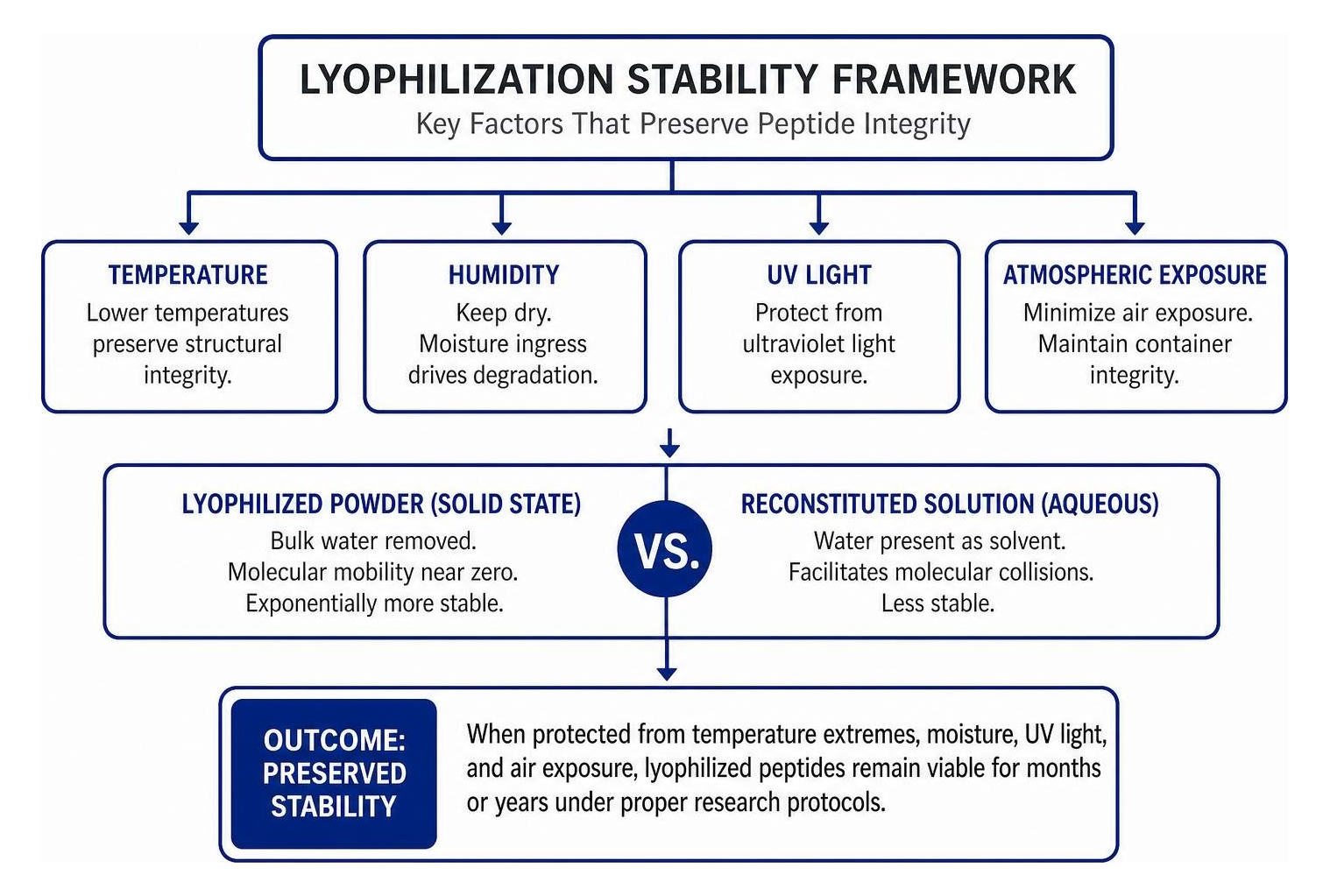
Freeze-dried stability relies on controlling temperature, humidity, ultraviolet light, and atmospheric exposure. When solid peptides are kept under proper research protocols, they remain viable for months or years. However, improper laboratory storage conditions can accelerate chemical degradation pathways, rendering an assay unreliable before testing even begins.
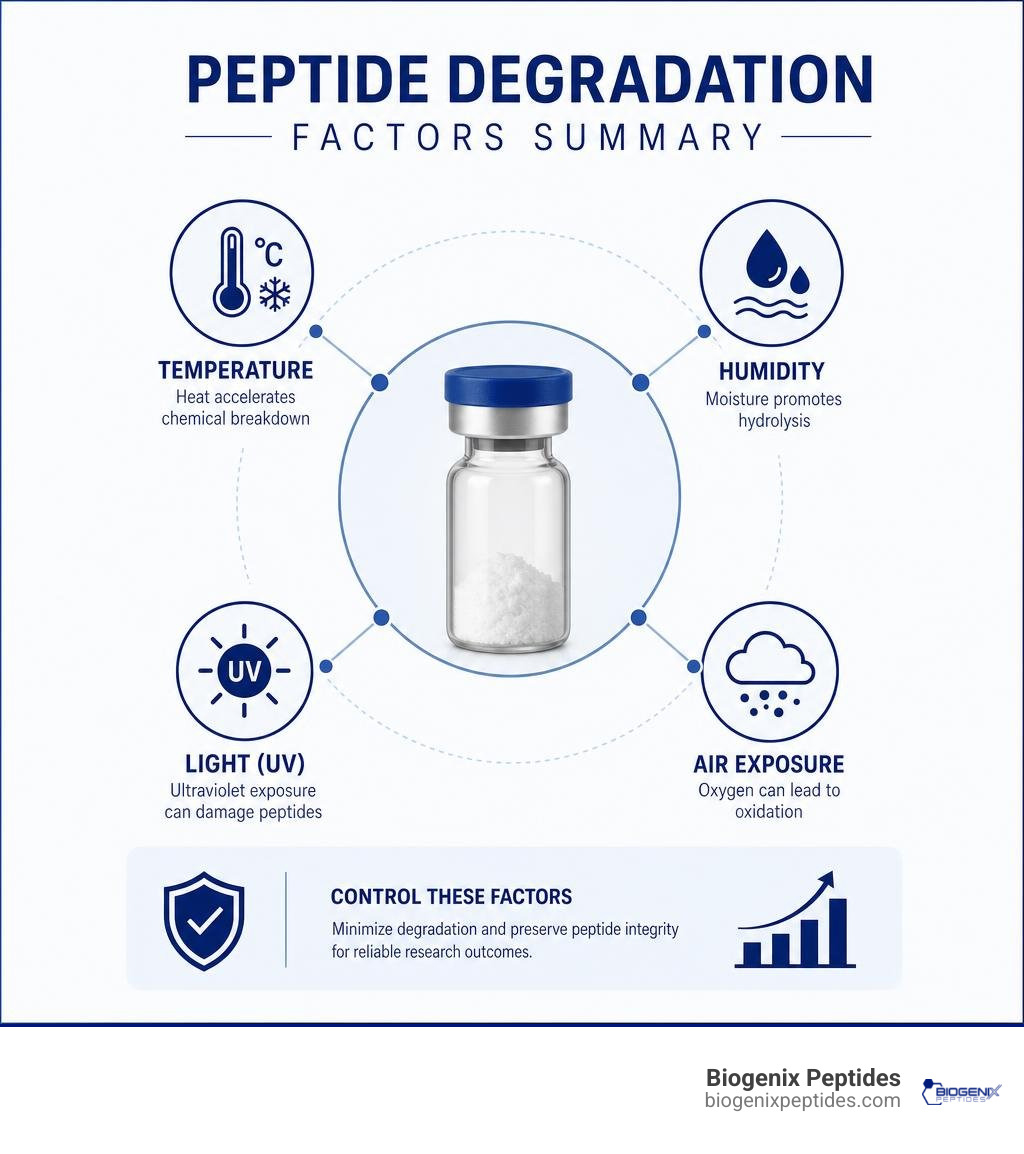
Understanding the physical chemistry of peptide preservation allows researchers to make informed decisions regarding cold-chain allocation, freezer space, and workflow logistics.
Understanding Lyophilization: Powder vs. Solution Stability
Lyophilization, or freeze-drying, is a dehydration process that removes water from a frozen peptide solution via sublimation under high vacuum. This process transforms an aqueous liquid into a solid, porous cake or powder. For a deeper look into the manufacturing advantages, explore why research peptides are typically lyophilized and how this benefits research as well as our guide covering everything you need to know about lyophilized peptides.
From a chemical kinetics standpoint, solid-state peptides are exponentially more stable than peptides in aqueous solution. Water acts as both a reactive solvent and a physical medium that facilitates molecular collisions. Removing bulk water drops the system’s thermodynamic molecular mobility near zero, keeping the peptide’s primary backbone intact.
Hydrolysis and the Primary Risk of Moisture Ingress
Water is the primary driver of chemical degradation in research peptides. The fundamental reaction breaking down the peptide backbone is hydrolysis, where a water molecule cleaves the amide (peptide) bond linking two amino acid residues. This reaction splits the peptide chain into two shorter fragments, with a carboxylic acid group forming on one end and an amine group on the other.
Because lyophilized cakes are highly hygroscopic (they readily absorb moisture from surrounding air), atmospheric humidity is a constant threat. When ambient water vapor penetrates an imperfect seal, it creates micro-aqueous environments on the powder surface. This localized moisture initiates hydrolysis even if the vial remains ostensibly solid, decreasing sample purity. Solid-state preservation requires maintaining a completely dry microenvironment, which is why researchers follow strict peptide storage stability guidelines to mitigate atmospheric exposure.
Do Dry Peptides Need to Be Refrigerated? The Science of Lyophilized Stability
To answer whether do dry peptides need to be refrigerated, we must examine chemical kinetics. All chemical reactions—including peptide degradation pathways like deamidation, hydrolysis, and oxidation—depend directly on thermal energy.
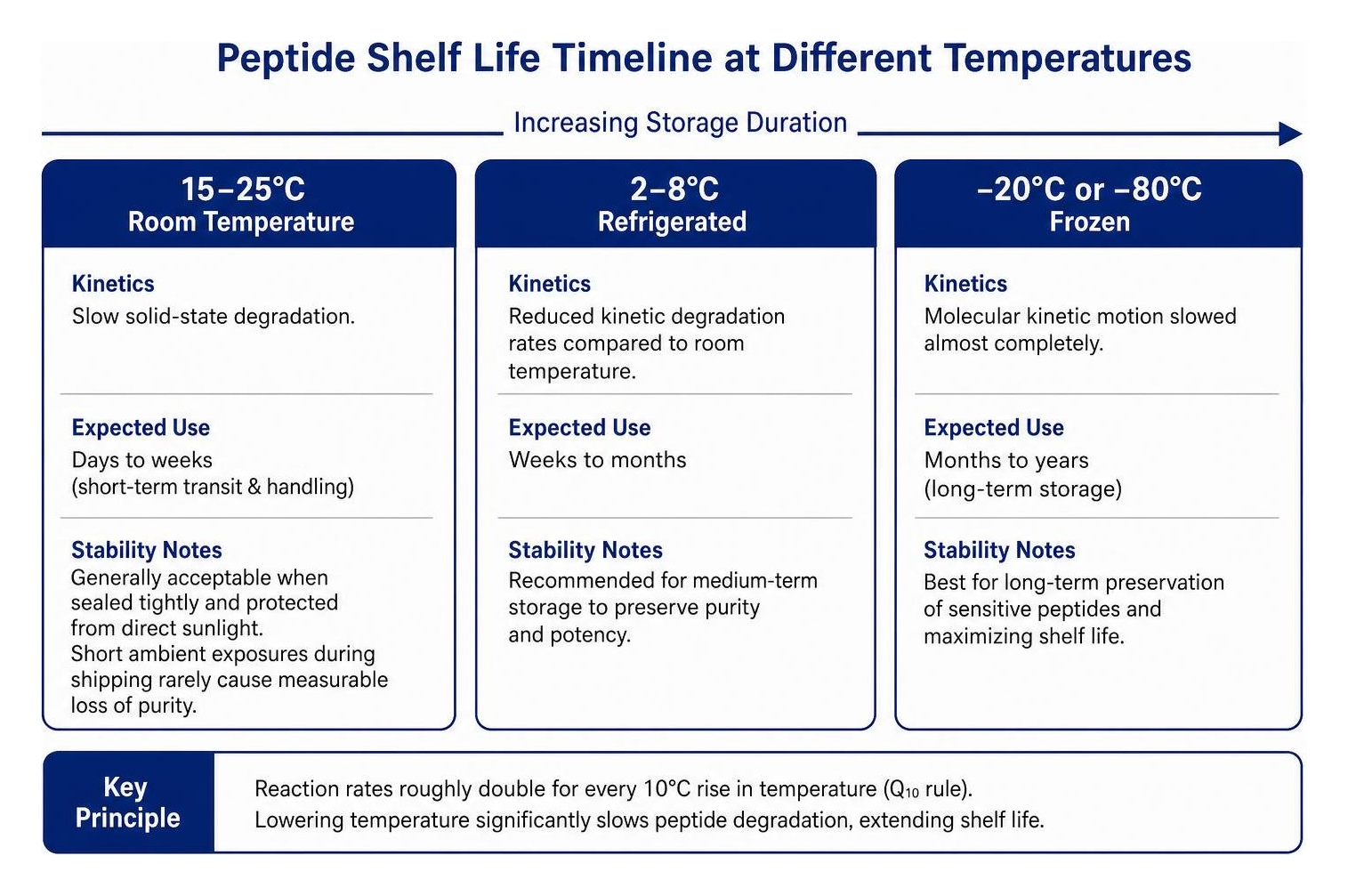
According to the Arrhenius equation and empirical biochemical kinetics, reaction rates roughly double for every 10°C rise in temperature. This relationship is known as the Q10 rule, where Q10 represents the factor by which a reaction rate increases when the temperature is raised by 10 degrees Celsius.
Lyophilized peptides maintained at ambient room temperature (15–25°C) experience low reaction rates because the absence of bulk water prevents most degradation pathways. However, ambient thermal energy still drives slow solid-state degradation.
Lowering the storage temperature to a refrigerated range of 2–8°C reduces kinetic degradation rates significantly. Transitioning to a sub-zero freezer environment (-20°C or -80°C) slows molecular kinetic motion almost completely, preserving sensitive bonds over multi-year timeframes.
Under What Lab Conditions Do Dry Peptides Need to Be Refrigerated?
Choosing between ambient, refrigerated, or frozen storage depends on the expected timeframe before experimental reconstitution:
- Days to Weeks (Short-Term Transit & Handling): Ambient room temperature (15–25°C) is generally acceptable for solid lyophilized peptides, provided they are sealed tightly and protected from direct sunlight. Short ambient exposures during shipping rarely cause measurable loss of purity.
- 1 Month to 2 Years (Active Laboratory Projects): Standard refrigeration at 2–8°C is recommended. This range preserves structural stability, retards oxidative reactions, and prevents thermal degradation without the physical stress of ice crystal reorganization. If you are debating between shelf space and cold units, review our breakdown on to fridge or not to fridge: your peptide storage questions answered and our handbook don’t let your peptides lose their cool.
- 2 Years or Longer (Long-Term Archiving): Solid powders should be stored in a laboratory freezer at -20°C (or -80°C for exceptionally unstable or valuable sequences). Freezing solid powders keeps baseline purity intact across several years. For guidance on long-term powder preservation, consult keep your powder dry and your freezer cold alongside don’t let your peptides perish: the powder storage handbook.
Sequence Vulnerabilities and Residue-Specific Oxidation
Not all peptides respond to storage conditions in the same way. The primary amino acid sequence dictates the molecule’s chemical vulnerabilities, as explored in the science of making peptides heatproof and analytical biochemical stability literature.
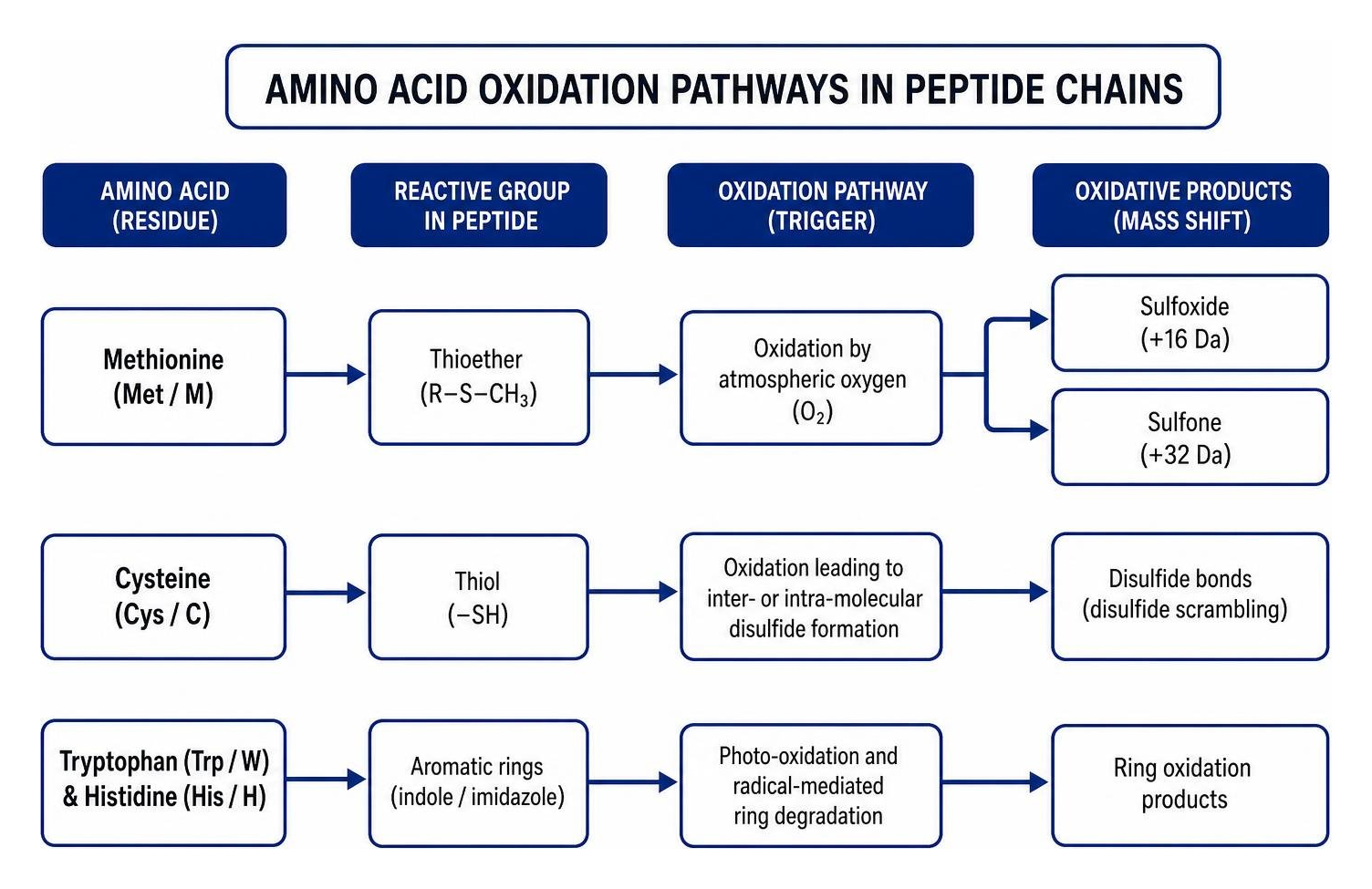
Specific residues are particularly susceptible to chemical degradation even in dry powder form:
- Methionine (Met / M): Highly prone to oxidation via atmospheric oxygen, converting the thioether into a sulfoxide (adding 16 Daltons to the molecular mass) or sulfone (adding 32 Daltons). Peptides like MOTS-c and VIP require strict temperature and atmospheric control.
- Cysteine (Cys / C): Contains reactive thiol (-SH) groups that can oxidize into unwanted inter- or intra-molecular disulfide bridges, causing disulfide scrambling. Cyclic peptides like oxytocin can lose structural conformation if stored warm.
- Tryptophan (Trp / W) & Histidine (His / H): Vulnerable to photo-oxidation and radical-mediated ring degradation, requiring strict protection from light and heat.
- Asparagine (Asn / N) & Glutamine (Gln / Q): Subject to non-enzymatic deamidation, particularly if trace moisture enters the container.
Sequences containing multiple vulnerable residues demand immediate refrigeration (2–8°C) or freezing (-20°C) with an inert gas purge, whereas sequences composed strictly of stable, aliphatic residues (such as Ala, Leu, Val) tolerate ambient temperatures with far less risk.
Laboratory Best Practices: Handling and Environmental Controls
Preserving dry peptide stability requires consistent laboratory handling protocols. Temperature control must be paired with strict environmental management to safeguard compound stocks. For a complete operational overview, review our guide to best practices for peptide storage & handling and our comprehensive external reference, the Peptide Storage Guide: Lyophilized, Reconstituted, and Degradation | Peptide Report.
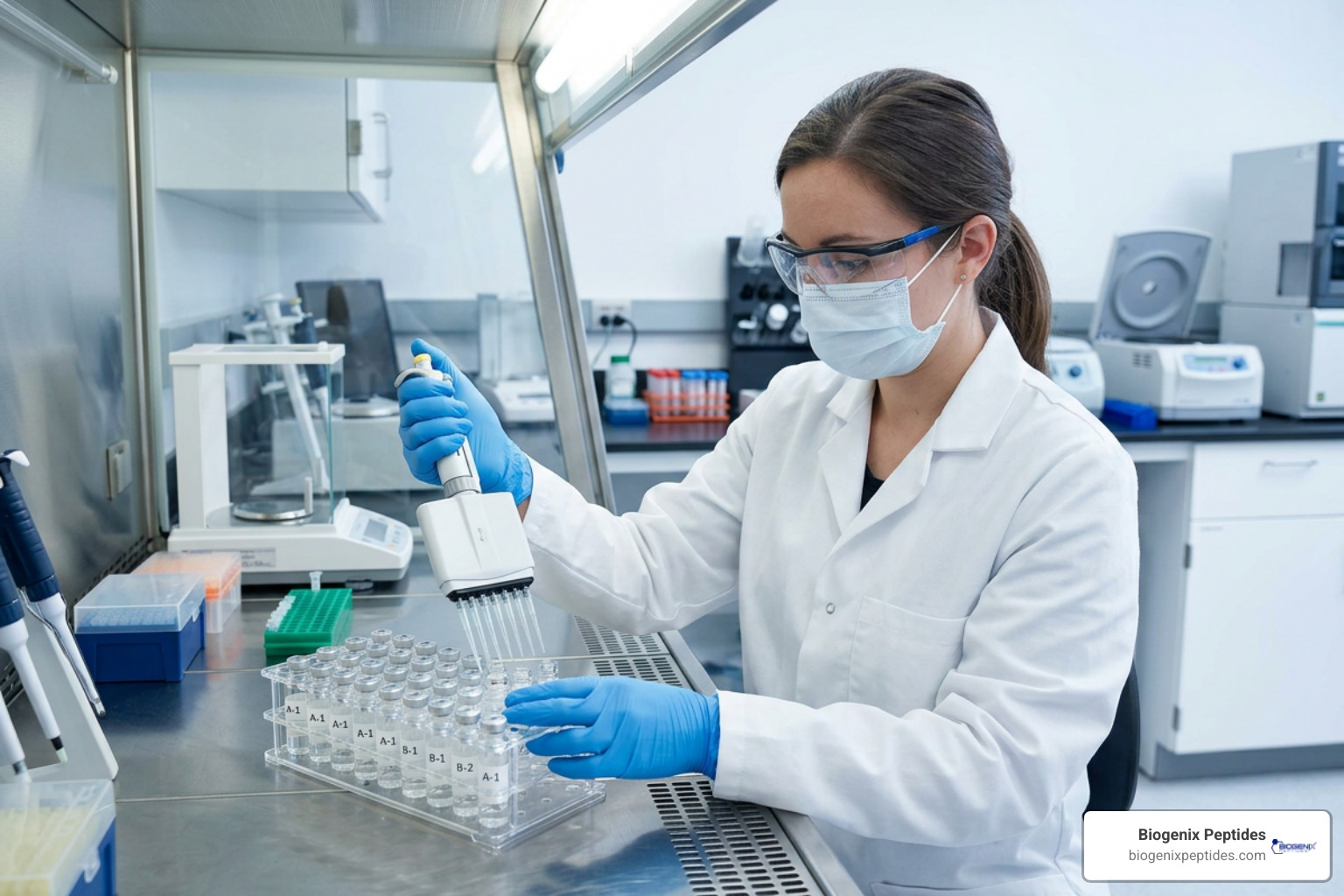
Preventing Condensation and Avoiding Frost-Free Freezers
The most common mistake when handling refrigerated or frozen dry peptides is opening the vial immediately upon removal from cold storage.
When a cold vial meets warm laboratory air, moisture condenses onto the cold interior glass and dry powder cake. This rapid condensation introduces liquid water, immediately triggering hydrolysis and sample caking.
The Laboratory Acclimation Rule: Always allow refrigerated or frozen vials to equilibrate to ambient room temperature on the benchtop (typically 30–60 minutes) before unsealing or piercing the septum.
Additionally, never store research peptides in consumer frost-free freezers. Frost-free units utilize periodic heating cycles to melt internal ice buildup. These temperature fluctuations create thermal cycling, causing repeated condensation and evaporation cycles inside sealed vials that degrade peptide stability. Always use manual-defrost freezers. To protect samples against environmental stressors, consult a practical guide to stopping peptide denaturation in its tracks and don’t let your peptides go bad in the fridge.
Selecting Secure Vials and Storage Cases
Container materials and closures play a direct role in maintaining long-term stability:
- Vial Composition: High-quality Type I borosilicate glass minimizes chemical leaching and surface adsorption compared to standard soda-lime glass. When using microcentrifuge tubes, opt for low-retention polypropylene.
- Closures and Septa: Butyl rubber stoppers with aluminum crimp seals provide the highest barrier against atmospheric oxygen and moisture.
- Inert Gas Overlay: For oxidation-sensitive sequences, purge the headspace with dry argon or nitrogen before final sealing.
- Organizers and Desiccant Secondary Storage: Store peptide vials inside airtight secondary storage boxes containing active silica gel desiccant packs to intercept ambient humidity.
To select optimal storage hardware, browse our reviews on peptide storage containers that won’t let you down, top-rated peptide vials and cases for secure storage, the ultimate peptide organizer for your freezer, and 3ml vial storage cases that will save your fridge space.
Identifying Degradation: Visual Inspection vs. Analytical Verification
A common question in the laboratory is whether visual inspection alone is sufficient to determine if a dry peptide has degraded during storage. While visible abnormalities indicate physical failure, chemical degradation often occurs without any outward macroscopic change.
| Parameter | Visual Inspection | Analytical Verification (HPLC / Mass Spectrometry) |
|---|---|---|
| Cake Integrity | Detects cake collapse, shrinkage, or gummy liquefaction from moisture ingress. | Measures exact moisture percentage and solid-state stability. |
| Color Changes | Detects severe chromophore oxidation (e.g., yellowing/browning of Trp/Tyr residues). | Identifies subtle optical density shifts and spectrophotometric purity drops. |
| Purity Quantification | Cannot measure purity percentage or detect minor degradation products. | High-Performance Liquid Chromatography (HPLC) resolves and quantifies trace impurities by peak area. |
| Methionine Oxidation | Completely invisible to the naked eye. | Mass Spectrometry (MS) detects the exact mass shift of 16 Daltons from single-oxygen additions. |
| Disulfide Scrambling | Completely invisible; powder appears identical. | Resolves retention time shifts in reverse-phase HPLC and confirms molecular weight via MS. |
| Truncation / Cleavage | Powder appearance remains unchanged despite hydrolysis. | Readily detects low-molecular-weight fragment peaks on mass spectra. |
Visual inspection serves as an initial quality gate: if the powder has changed color or collapsed into a sticky residue, the sample should not be used for rigorous research. However, analytical testing via HPLC and Mass Spectrometry remains the only definitive method to verify chemical purity and molecular identity.
Lyophilized vs. Reconstituted Storage Comparison
Once a dry peptide is dissolved in an aqueous solvent (such as sterile water or bacteriostatic water containing 0.9% benzyl alcohol), its degradation profile shifts dramatically. Liquid solutions are far more vulnerable to rapid hydrolysis, aggregation, and surface adsorption.
For detailed handling after dissolution, refer to cold storage secrets for keeping reconstituted peptides fresh and the definitive guide to how long reconstituted peptides last.
Frequently Asked Questions About Peptide Powder Storage
Do dry peptides need to be refrigerated during short transit?
Lyophilized peptides are generally stable at ambient temperatures during standard postal transit (1–5 days). Unless a sequence is exceptionally heat-labile or transit occurs during extreme summer heatwaves, ambient transit does not measurably compromise solid-state purity. However, vials should be transferred to 2–8°C or -20°C upon receipt in the laboratory.
How long does dry peptide powder remain stable at room temperature?
When stored in an airtight, light-protected container with desiccant, most solid lyophilized peptides maintain acceptable stability for several weeks at ambient room temperature (15–25°C). For long-term analytical reproducibility, prolonged room-temperature storage should be avoided.
Why must a cold peptide vial reach room temperature before opening?
Allowing a cold or frozen vial to reach room temperature before unsealing prevents atmospheric moisture from condensing inside the container. Moisture condensation introduces liquid water directly onto the hygroscopic powder cake, triggering rapid hydrolysis and localized degradation.
Conclusion
Dry lyophilized peptides possess significant thermodynamic stability compared to liquid formulations. While dry powders can tolerate ambient temperatures for short intervals, standard laboratory refrigeration at 2–8°C is recommended for active research timelines, and -20°C manual-defrost freezing is preferred for multi-year archival storage. Preserving stability requires a complete storage approach: controlling thermal energy, sealing against atmospheric moisture, protecting against ultraviolet light, and allowing cold vials to equilibrate before opening.
At Biogenix Peptides, we are committed to supporting reliable, high-precision laboratory research by providing high-purity compounds and rigorous technical data. When your research protocol calls for preparing working solutions from dry powder stocks, review our complete guide on reconstituting lyophilized peptides step-by-step.
Disclaimer: All compounds and materials discussed are intended strictly for laboratory research and development purposes and are not for human or clinical applications.