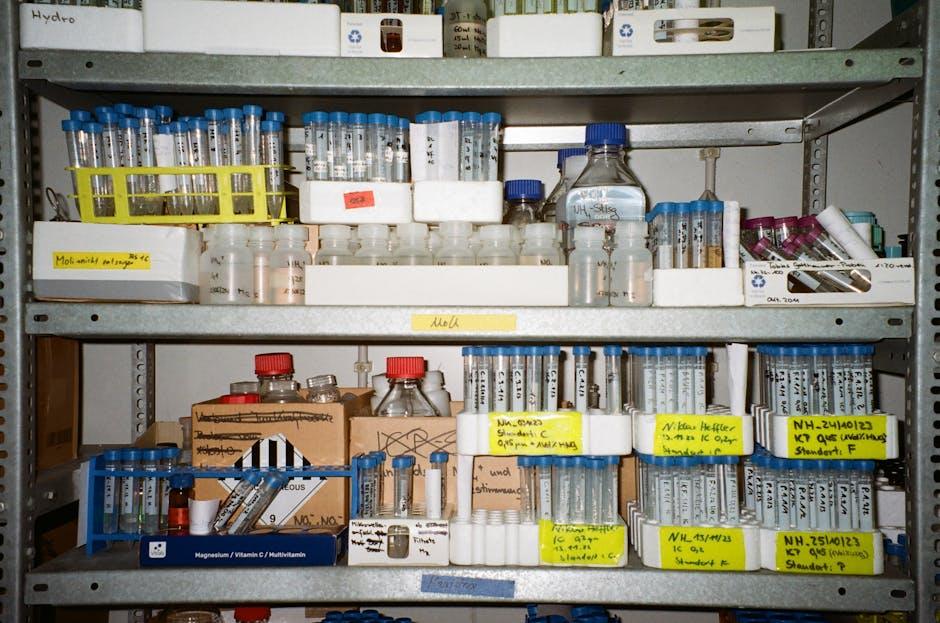
The ultimate peptide organizer for your freezer
Why Peptide Vial Storage Determines the Success of Your Research
Peptide vial storage is one of the most overlooked — and most critical — factors in getting reliable results from your research.
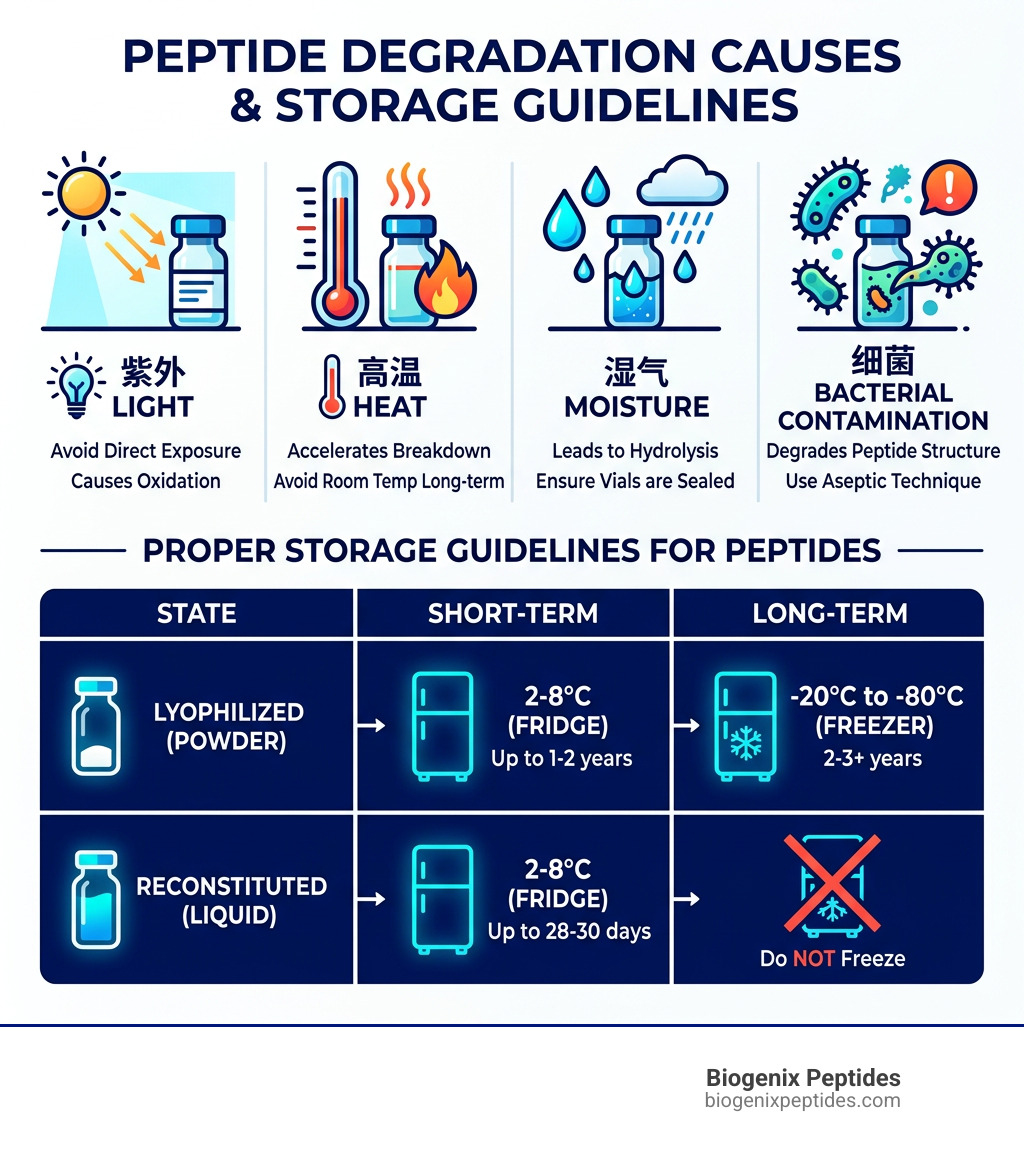
Here’s a quick reference for proper peptide storage conditions:
| State | Short-Term | Long-Term |
|---|---|---|
| Lyophilized (powder) | 2–8°C (fridge), up to 1–2 years | -20°C to -80°C (freezer), 2–3+ years |
| Reconstituted (liquid) | 2–8°C (fridge), up to 28–30 days | Do not freeze |
| Bacteriostatic water (opened) | 2–8°C (fridge) | Use within 28 days |
Key rules at a glance:
- Store lyophilized vials in a cool, dark, dry place — freezer for long-term
- Never freeze a reconstituted peptide solution
- Always allow frozen vials to reach room temperature before opening
- Protect all vials from light, moisture, and temperature swings
- Discard reconstituted solutions after 28–30 days
Peptides are proteins. Like all proteins, they break down when exposed to heat, light, moisture, and bacteria. Poor storage doesn’t just reduce potency — it can produce degradation byproducts you don’t want anywhere near your research.
The good news? Keeping your peptides stable isn’t complicated. It mostly comes down to organization — knowing which vials are lyophilized vs. reconstituted, when they were prepared, and where they’re being kept.
That’s exactly what this guide is about: finding the right peptide vial storage solutions to keep your freezer organized and your research on track.
I’m Jay Daniel, Founder and CEO of BioGenix Peptides, and I’ve spent years working directly with peptide sourcing, quality control, and laboratory handling protocols — including developing best practices around peptide vial storage to protect molecular integrity from the moment a vial leaves production to the moment it’s used in research. Let’s walk through the best storage solutions available right now.
Why Proper Storage is Critical for Research Integrity
When we talk about research integrity, we are really talking about the stability of the molecules we are studying. Peptides are essentially chains of amino acids held together by peptide bonds. While they are relatively sturdy in their lyophilized (freeze-dried) state, they are far from invincible.
The primary enemies of your research are oxidation and moisture contamination. Oxidation occurs when peptides are exposed to air, particularly those containing specific amino acids like Cysteine (C), Methionine (M), and Tryptophan (W). These specific “building blocks” are highly sensitive; if they oxidize, the peptide’s primary structure changes, and your research results will no longer be accurate.
Moisture is another silent killer. Because lyophilized powder is hygroscopic (it loves to suck moisture out of the air), opening a cold vial in a humid room can cause water to condense inside. This moisture triggers “hydrolysis,” a chemical reaction where water breaks those delicate peptide bonds. This is why we always emphasize peptide storage stability guidelines that include letting vials reach room temperature before opening.
Furthermore, light exposure—specifically UV light—can cause photodegradation. This is why many researchers prefer amber vials or opaque peptide vial storage cases. By understanding why research peptides are typically lyophilized, you can better appreciate that the “suspended animation” state of the powder is what allows us to store these compounds for years rather than days.
Choosing the Best Peptide Vial Storage Solutions
If you’ve ever opened your freezer to find a chaotic pile of identical-looking vials, you know the struggle. Choosing the right storage solution isn’t just about aesthetics; it’s about protecting your investment.
One of the biggest hurdles in storage is “adsorption loss.” This is a fancy way of saying that peptides—especially hydrophobic ones—tend to stick to the walls of the vial. When they stick to the walls, they aren’t in your solution, which messes up your concentration calculations.
Research published in the American Chemical Society journals (DOI:10.1021/pr400183v) suggests that while vial material is important, the composition of the solution often matters more. However, for the physical container, we generally see two main contenders: Borosilicate glass and Polypropylene.
| Feature | Borosilicate Glass | Polypropylene (Plastic) |
|---|---|---|
| Chemical Resistance | Excellent | High |
| Freezer Safety | Risk of cracking if liquid expands | Flexible and very safe for -80°C |
| Adsorption | Higher for certain hydrophobic peptides | Generally lower; better for low-concentration samples |
| Visibility | High (Clear or Amber) | Often translucent or opaque |
For long-term freezer storage, many researchers opt for polypropylene organizers because they handle extreme cold without becoming brittle. You can find specialized Peptide Vial Storage options that use these materials to keep vials upright and secure.
Optimizing Peptide Vial Storage for Long-Term Stability
When we move into long-term territory (anything over six months), the temperature requirements become much stricter. While a standard refrigerator (2–8°C) is fine for short-term holding of lyophilized powder, a freezer is mandatory for years of stability.
The “gold standard” is -80°C, but most researchers find that -20°C (a standard deep freezer) is sufficient for 2–3 years of storage. However, there is a catch: avoid frost-free freezers.
Frost-free freezers work by performing “warm-up” cycles to melt ice off the coils. These constant temperature fluctuations are devastating to peptides. Every time the temperature rises, the molecular motion increases, leading to a higher risk of degradation. We always recommend using a dedicated “chest” freezer or a lab-grade unit that stays at a constant temperature. For more on this, check our best practices for peptide storage handling.
Common Peptide Vial Storage Mistakes to Avoid
We’ve seen it all, and most mistakes come down to haste. One of the most common errors is repeated freeze-thaw cycles. Every time you freeze and then thaw a peptide, you create ice crystals that act like tiny “knives,” potentially denaturing the peptide structure.
Another mistake is “stopper-down” storage. Always store your vials upright. If a reconstituted peptide sits against the rubber stopper for weeks, it can lead to leaching of chemicals from the rubber into the solution, or the peptide may adhere to the stopper itself.
Lastly, never forget the “condensation trap.” As mentioned earlier, taking a vial straight from the freezer and popping the cap is a recipe for moisture contamination. Always give it 30 minutes to “acclimatize” to room temperature. These are just a few of the 10 most common mistakes in peptide research that can easily be avoided with a little patience.
Advanced Protocols for Reconstituted and Lyophilized Peptides
Once you add a solvent to that powder, the clock starts ticking much faster. Reconstituted peptides are far more fragile than their powdered counterparts.
The choice of solvent is the first line of defense. Bacteriostatic (BAC) water is the industry standard because it contains 0.9% benzyl alcohol. This alcohol doesn’t necessarily kill all bacteria instantly, but it prevents them from reproducing. This is vital because peptides are essentially “food” for bacteria. If your vial becomes contaminated, the bacteria will eat your peptides, and you’ll be left with a vial of useless (and potentially dangerous) waste.
For those looking to push the boundaries of stability, certain additives can help. Scientific data shows that adding 0.001% poly(ethylene glycol) (PEG) can substantially reduce adsorptive losses to the vial walls (p < 0.05). Other researchers use 6M urea or thiourea in specific proteomic workflows, though these are usually reserved for high-level lab analysis.
If you have a large amount of peptide, we recommend aliquoting. Instead of reconstituting a 10mg vial and drawing from it 20 times, you can divide the solution into 20 smaller, single-use vials. This prevents the “needle-puncture” contamination risk and keeps the bulk of your sample undisturbed. Following a reconstituting lyophilized peptides step-by-step guide is the best way to ensure you’re doing this safely.
Specific Requirements for GLP-1 and Healing Peptides
Not all peptides are created equal. Some are “sturdier” than others. For example, BPC-157 is known for being relatively resilient. However, GLP-1 agonists like Semaglutide and Tirzepatide are significantly more sensitive to temperature and light.
For GLP-1 research, the “28-day rule” is non-negotiable. Because these peptides are often used in multi-dose formats, the risk of bacterial growth in the BAC water increases after the first puncture. Even if the peptide itself remains stable, the preservative effectiveness of the benzyl alcohol drops off after about a month.
Always check more stability guidelines specifically for the sequence you are using, as some “healing” peptides may have different pH requirements for optimal long-term liquid storage.
Traveling with Peptides: Maintaining the Cold Chain
Research doesn’t always happen in one location. Whether you’re moving labs or traveling for a conference, maintaining the “cold chain” is essential.
For short trips (1–3 days), lyophilized peptides are generally fine at room temperature, provided they are kept in a dark, dry place. However, reconstituted peptides must stay cold. We recommend using Vial Guard | Premium Vial Storage Cases for 3 mL & 10 mL … or similar Peptide Vial Storage Cases that include slots for gel packs.
Travel Tips for Researchers:
- TSA Regulations: In the U.S., the TSA allows injectable medications and syringes. It is always helpful to have your research documentation or a “Letter of Intent” if you are carrying research-only compounds.
- Insulated Bags: Use a high-quality insulated case. Avoid letting the vials touch the ice packs directly, as this can cause localized freezing of a reconstituted solution (which we want to avoid). Wrap them in a paper towel first.
- Hotel Fridges: Be careful! Hotel mini-fridges are notoriously unreliable and can sometimes freeze items pushed to the back. Use a thermometer if possible.
For a deeper dive into the logistics of mixing on the go, see our step-by-step reconstitution guide.
Frequently Asked Questions about Peptide Vial Storage
How long do peptides last in the freezer vs. the refrigerator?
Lyophilized peptides can last 1–2 years in a standard refrigerator (4°C) but can remain stable for 3 years or more in a deep freezer (-20°C or -80°C). Once reconstituted, they should only be kept in the refrigerator and used within 30 days for maximum potency.
Can I freeze a peptide after it has been reconstituted?
We strongly advise against this. Freezing a liquid solution creates ice crystals that can denature the peptide’s delicate 3D structure. While some specific protocols allow for rapid flash-freezing in liquid nitrogen, for 99% of research applications, a reconstituted peptide should stay in the fridge, not the freezer.
What are the visual signs that a peptide vial has degraded?
For lyophilized powder, look for “clumping,” discoloration (yellowing), or a “melted” appearance. For reconstituted solutions, the most obvious sign is cloudiness or “floaties” (particulates). A healthy solution should be crystal clear. If it looks like a snow globe, it’s time to discard it.
Conclusion
At Biogenix Peptides, we know that your research is only as good as the materials you use. Proper peptide vial storage is the bridge between a high-quality product and high-quality data. By investing in organized storage, maintaining the cold chain, and following aseptic reconstitution protocols, you ensure that your research remains accurate and reproducible.
Don’t let poor organization or a “frost-free” freezer cycle ruin months of hard work. Keep your vials upright, keep them cold, and keep them dark.
Ready to level up your lab standards? Explore professional peptide handling and usage resources to ensure every vial in your freezer is ready for peak performance.