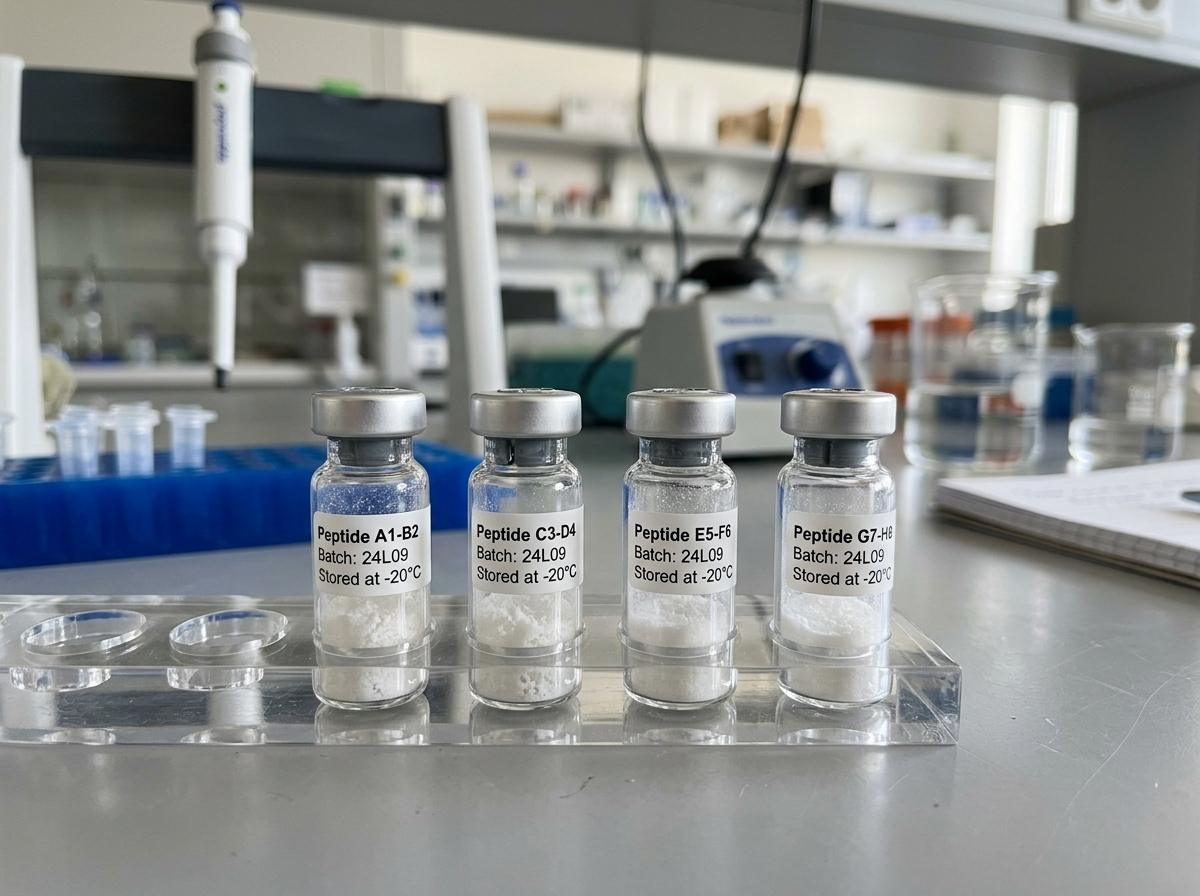
To Fridge or Not to Fridge: Your Peptide Storage Questions Answered
To Fridge or Not to Fridge: Your Peptide Storage Questions Answered
Disclaimer: The information provided in this article is for educational and informational purposes only. It is not intended as medical advice, diagnosis, or treatment. Products and compounds referenced are for research use only and are not approved for human or veterinary consumption. Always consult a qualified professional regarding health or medical decisions.
Why Proper Storage Is the Most Important Step in Peptide Research
Disclaimer: The information provided in this article is for educational and informational purposes only. It is not intended as medical advice, diagnosis, or treatment. Products and compounds referenced are for research use only and are not approved for human or veterinary consumption. Always consult a qualified professional regarding health or medical decisions.
Disclaimer: The information provided in this article is for educational and informational purposes only. It is not intended as medical advice, diagnosis, or treatment. Products and compounds referenced are for research use only and are not approved for human or veterinary consumption. Always consult a qualified professional regarding health or medical decisions.

Do lyophilized peptides need to be refrigerated? The short answer: yes — but it depends on how soon you plan to work with them in a research setting.
Here is a quick breakdown:
| Storage Condition | Temperature | Suitable For | Approximate Stability |
|---|---|---|---|
| Room temperature | ~25°C (77°F) | Short-term handling only | Up to 1-2 weeks |
| Refrigeration | 2-8°C (36-46°F) | Short- to medium-term storage | 3-12 months (dry, sealed) |
| Freezer | -20°C (-4°F) | Long-term storage | 1-3+ years |
| Ultra-low freezer | -80°C (-112°F) | Extended long-term storage | 3-5+ years |
Lyophilized peptides are significantly more stable than reconstituted (liquid) peptides because freeze-drying removes water — the main driver of most degradation reactions. But stable does not mean indestructible. Heat, moisture, light, and oxygen can still break down molecular structure over time, even in powder form.
If you are working with research compounds and want reliable analytical results, storage conditions are not a minor detail. A compound manufactured at high purity can degrade to unusable levels in days if handled incorrectly — while the same compound stored properly can remain intact for years.
I’m Jay Daniel, Founder and CEO of Biogenix Peptides, and with years of hands-on experience in peptide science and laboratory quality control, I’ve worked directly with the question of do lyophilized peptides need to be refrigerated across dozens of research contexts. In this guide, I’ll walk you through everything you need to know to help protect research compounds from receipt to analysis.

Do Lyophilized Peptides Need to Be Refrigerated?
When we receive a shipment of research peptides, the first instinct is often to tuck them away in the nearest cold storage. But understanding the nuances of temperature can save both time and the integrity of the compounds.
Technically, lyophilized peptides are “stable” at room temperature (around 25°C) for short periods. Research indicates they can remain viable for 1 to 2 weeks, and in some cases up to a month, without significant loss of purity. This is why most research-grade peptides are shipped at ambient temperatures. However, “stable” is a relative term. For any research intended to span more than a few days, refrigeration at 4°C (39°F) is the minimum recommended standard.
Under refrigeration (2-8°C), unmixed lyophilized peptides can maintain their stability for 3 to 6 months quite easily, and often up to 1-2 years if the seal remains unbroken and the environment is dry. For long-term preservation—anything beyond a few months—freezing at -20°C is the gold standard. At these sub-zero temperatures, the molecular motion is slowed to a crawl, and the risks of chemical degradation are nearly eliminated, allowing for a shelf life of 2 to 3 years or more.
For the most sensitive research applications, such as structural biology or drug discovery, an ultra-low freezer set to -80°C is preferred. This provides the ultimate “suspended animation” for the peptide, preserving it for 5 years or longer. To dive deeper into these specific timelines, you can review our Peptide Storage & Stability Guidelines.
The Science of Degradation: Why Storage Conditions Matter
To understand why we obsess over thermometers, we have to look at the chemistry. Peptides are essentially chains of amino acids held together by peptide bonds. These bonds are susceptible to several “enemies” in the lab environment:
- Hydrolysis: This is the chemical breakdown of a compound due to reaction with water. Lyophilization removes more than 99% of water, which is why powder is so much heartier than liquid. However, even trace moisture from the air can trigger hydrolysis over time.
- Oxidation: Certain amino acids—specifically Cysteine (C), Methionine (M), and Tryptophan (W)—are highly sensitive to oxygen. When exposed, they can undergo oxidative changes that alter the peptide’s primary structure and biological activity.
- Photodegradation: UV and blue light carry enough energy to break chemical bonds. This is why we recommend opaque storage or amber vials.
- Adsorption: A lesser-known risk involves the container itself. Scientific research on hydrophobic peptide adsorption shows that hydrophobic peptides can actually “stick” to the walls of plastic (polypropylene) vials, leading to significant loss of the compound in dilute samples.
The rate of these reactions is temperature-dependent. According to the Arrhenius relationship, chemical reaction rates roughly double for every 10°C increase in temperature. By moving a vial from a warm 25°C room to a 5°C refrigerator, we are effectively slowing down the “ticking clock” of degradation by four to eight times. This is why we emphasize that you should Don’t Let Your Peptides Lose Their Cool during your research.
Handling Protocols for Lyophilized Research Compounds

How we handle a vial before we even open it is just as critical as where we store it. One of the most common mistakes in the lab is taking a frozen vial and immediately popping the cap.
When a cold vial is opened in a warmer room, moisture from the air instantly condenses inside the vial. This “micro-moisture” introduces water to the lyophilized powder, triggering the very hydrolysis we worked so hard to avoid through freeze-drying.
The Gold Standard Handling Protocol:
- Equilibration: Always allow a vial to reach room temperature before opening. This usually takes 15–30 minutes. It ensures that no condensation forms on the powder.
- Moisture Control: Use desiccants (like silica gel packs) in your storage containers to keep the relative humidity between 20% and 60%.
- Inert Gas Purging: For peptides containing sensitive residues like Cys or Met, professional labs often purge the headspace of the vial with an inert gas like Nitrogen or Argon before sealing. This displaces oxygen and prevents oxidation.
- Minimal Exposure: Weigh out what you need quickly and reseal the vial immediately. The less time the “puck” of powder spends exposed to the atmosphere, the better.
Following these Best Practices for Peptide Storage & Handling ensures that the compound remains as pure on day 300 as it was on day 1.
Reconstitution and the Risks of Improper Storage
Once we add a solvent to the lyophilized powder, the rules of the game change entirely. Reconstitution “wakes up” the peptide, but it also makes it vulnerable. In a liquid state, peptides are much more susceptible to microbial growth and rapid chemical breakdown.
Generally, a reconstituted peptide in the fridge (4°C) is only stable for 1 to 4 weeks, depending on the solvent used. For example, using bacteriostatic water (which contains 0.9% benzyl alcohol) can extend this window by inhibiting bacterial growth, whereas sterile water without preservatives may only stay viable for a few days.
The Danger of Freeze-Thaw Cycles: If we need to store a liquid peptide for longer than a month, we must freeze it. However, repeated freezing and thawing is one of the fastest ways to destroy a peptide. Each time the liquid freezes, ice crystals form, which can physically “shred” the delicate molecular structure or cause aggregation (clumping).
To avoid this, we use the Aliquoting Strategy:
- Reconstitute the entire vial.
- Immediately divide the solution into single-use “aliquots” in small sterile tubes.
- Freeze all aliquots at -20°C or -80°C.
- When it’s time for research, thaw only one tube, use it, and discard any remainder.
This ensures the bulk of your compound only undergoes a single freeze-thaw cycle. For a detailed guide on this process, see Reconstituting Lyophilized Peptides Step-by-Step.
Frequently Asked Questions
Why do lyophilized peptides need to be refrigerated for long-term preservation?
While lyophilization puts the peptide into a “suspended animation” state by removing water, thermal energy still exists at room temperature. This energy allows for slow-motion molecular vibrations that can lead to deamidation (the loss of an amide group) or denaturation.
Freezing at -20°C effectively “locks” the molecules in place. This is especially important for larger, more complex peptides or those with disulfide bridges. Scientific research on peptide aggregation highlights that temperature fluctuations can cause peptides to clump together, rendering them biologically inactive. By maintaining a constant, sub-zero environment, we prevent these physical and chemical changes from occurring over the span of years.
Do lyophilized peptides need to be refrigerated during transit?
One of the most common concerns is receiving a package that feels warm to the touch. Fortunately, because lyophilized peptides are in a dry, vacuum-sealed state, they are remarkably resilient during shipping. Most peptides can tolerate “excursions” to room temperature for several days or even a couple of weeks without measurable degradation.
Shipping at room temperature is a standard industry practice because the cost and risk of “cold-chain” shipping (using dry ice or gel packs that eventually melt) often outweigh the benefits for a 48-hour transit window. As long as the vial is stored correctly upon arrival, short-term transit at ambient temperature will not ruin the compound.
How long can lyophilized peptides safely remain at room temperature?
In a typical laboratory setting (approx. 25°C), most lyophilized peptides can safely remain at room temperature for 1 to 2 weeks. Some robust, small peptides (under 1,500 g/mol) may even last up to a month.
However, we always recommend minimizing this time. If a vial is left on a countertop for several hours every day during research, those hours add up. Over a month, that vial might spend 40 or 50 hours at room temperature, which accelerates the degradation clock. The best practice is to remove the vial from the fridge, allow it to equilibrate, take what you need, and return it to cold storage as quickly as possible.
Conclusion
At Biogenix Peptides, we understand that the success of your research depends on the purity and reliability of your compounds. The question of do lyophilized peptides need to be refrigerated is more than just a storage concern—it is a quality control fundamental. By respecting the “four enemies” of stability—heat, light, moisture, and oxygen—you ensure that your experimental data remains consistent and reproducible.
Whether you are storing a small pentapeptide for a few weeks or a complex protein for several years, following these protocols will maximize your investment and your results. For more detailed information on specific compounds or advanced laboratory techniques, explore our category on usage and handling. Proper storage isn’t just a recommendation; it’s the foundation of sound science.