Don’t let your peptides go bad in the fridge
How Long Do Lyophilized Peptides Last? (Quick Answer)
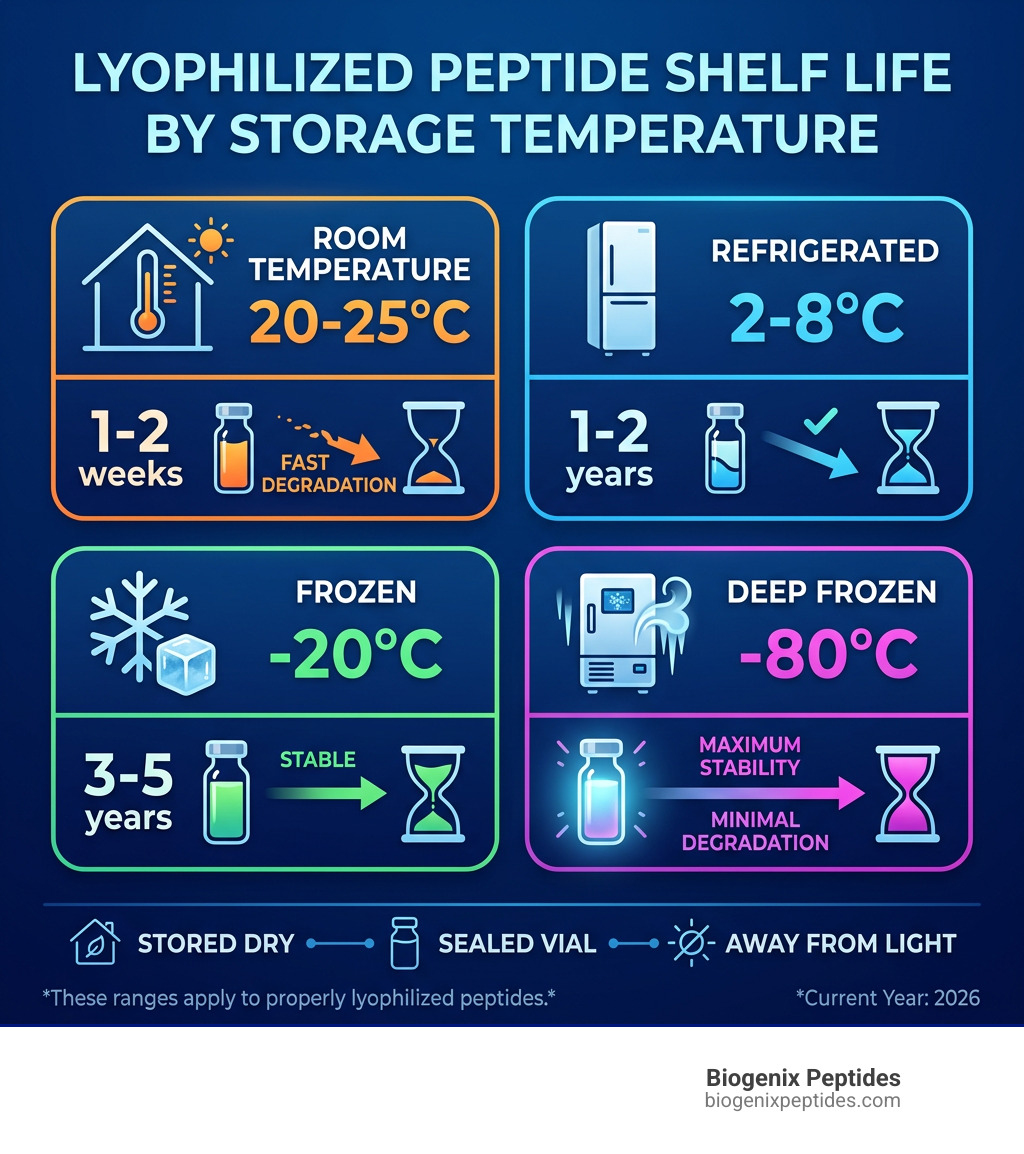
How long do lyophilized peptides last depends mainly on how you store them. Here’s a fast breakdown:
| Storage Condition | Typical Shelf Life |
|---|---|
| Room temperature (20-25°C) | 1-2 weeks (short-term only) |
| Refrigerated (2-8°C) | 1-2 years |
| Frozen (-20°C) | 3-5 years |
| Deep frozen (-80°C) | 5+ years, minimal degradation even after a decade |
These ranges apply to properly lyophilized peptides stored dry, sealed, and away from light.
You’ve invested in quality peptides. The last thing you want is to open a vial and wonder — did this just go bad?
It’s a more common problem than most researchers expect. Peptides are sensitive molecules. Without the right storage conditions, they degrade quietly — no obvious smell, no dramatic color change — just a slow loss of potency that quietly ruins your results.
The good news? Lyophilized (freeze-dried) peptides are remarkably stable when stored correctly. The freeze-drying process strips out water, which is the main driver of most peptide degradation. Without moisture, the chemical reactions that break down peptide bonds slow to a near halt.
But “stable” doesn’t mean invincible. Temperature, humidity, air exposure, and amino acid composition all play a role in how long your peptides stay usable.
This guide covers everything you need to know — from storage temperatures to warning signs of degradation — so your peptides last as long as possible.
I’m Jay D Daniel, Founder and CEO of BioGenix Peptides and a peptide research specialist with years of hands-on experience in peptide development, quality control, and storage protocols — including the practical question of how long do lyophilized peptides last under real lab conditions. In the sections below, I’ll walk you through the science and the practical steps to protect your investment.
What Are Lyophilized Peptides and Why Does the Process Matter?
To understand how to keep your peptides fresh, we first need to look at how they are made. Most high-quality research peptides arrive as a delicate, white, fluffy powder. This isn’t just a random choice; it’s the result of a sophisticated preservation method called lyophilization, or freeze-drying.
The Magic of Sublimation
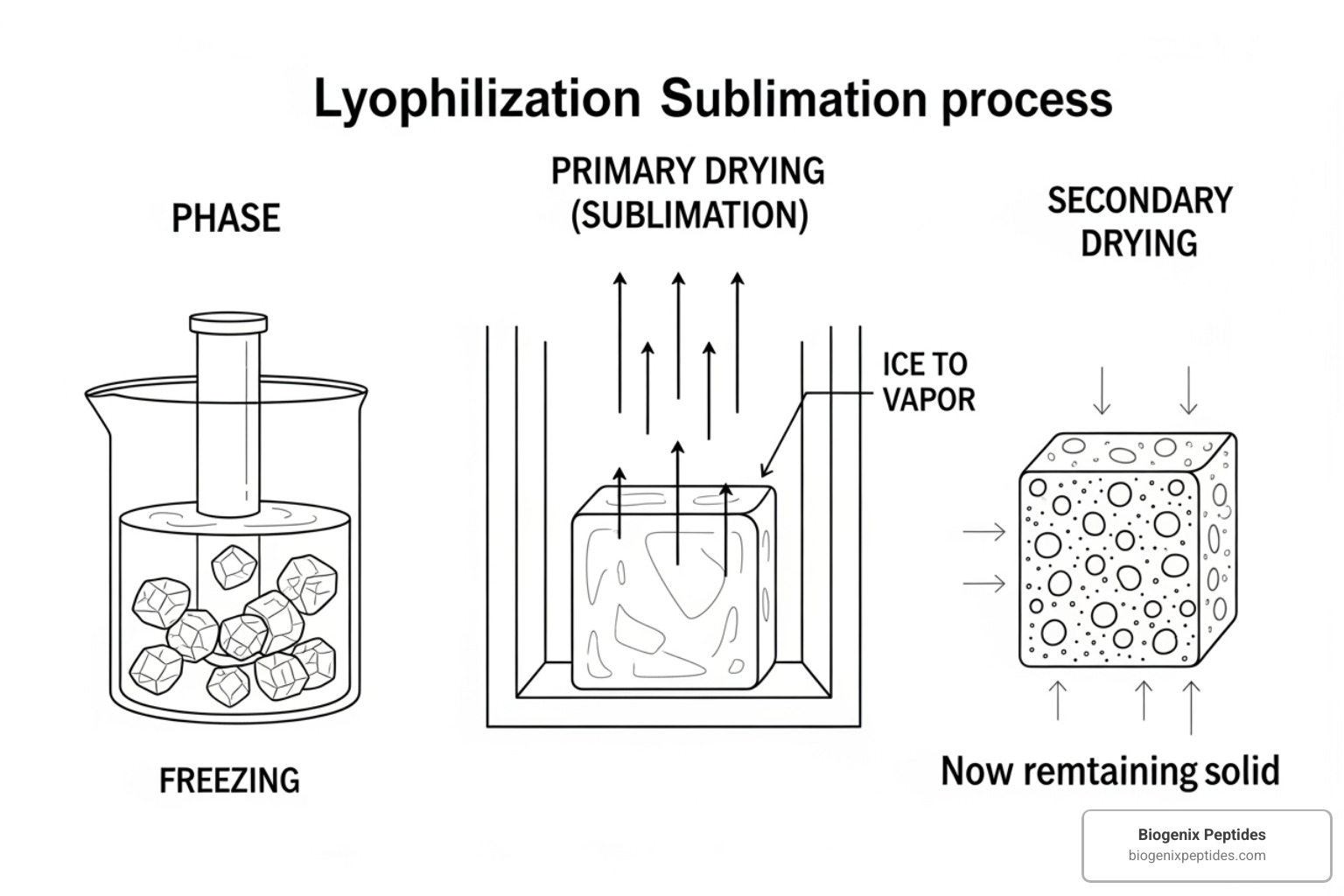
The lyophilization process works by freezing the peptide solution and then reducing the surrounding pressure. This allows the frozen water in the material to “sublimate”—meaning it turns directly from ice into vapor without ever becoming a liquid. By removing more than 99% of the water content (ideally leaving less than 1% residual moisture), we effectively put the peptide into a state of “suspended animation.”
Creating an Amorphous Glassy State
Beyond just removing water, lyophilization creates what scientists call an “amorphous glassy state.” In this state, the peptide molecules are physically locked in place. This chemical immobilization is crucial because it prevents the molecules from moving around and bumping into each other, which is how many degradation reactions start.
Why Research Peptides Are Typically Lyophilized is a topic we discuss often because this process is the gold standard for maintaining molecular integrity. According to Applications of Freezing and Freeze-Drying in Pharmaceutical Formulations, this method is the most reliable way to ensure that complex proteins and peptides remain stable for years rather than days.
How Long Do Lyophilized Peptides Last Under Different Conditions?
The environment you choose for your vials will dictate their expiration date. While a peptide might survive on a shelf for a short time, its biological “clock” ticks much faster at higher temperatures.
| Storage Temperature | Recommended Duration | Stability Level |
|---|---|---|
| Room Temp (25°C) | 1–2 Weeks | Low (Risk of oxidation/hydrolysis) |
| Refrigerator (4°C) | 12–24 Months | Moderate (Good for active projects) |
| Freezer (-20°C) | 3–5 Years | High (Standard long-term storage) |
| Deep Freeze (-80°C) | 10+ Years | Maximum (Archival quality) |
We always recommend following our Peptide Storage & Stability Guidelines to ensure you aren’t losing potency prematurely. Temperature fluctuations are the enemy here; every time the temperature rises, the molecules gain kinetic energy, increasing the chance of structural breakdown.
Typical shelf life of lyophilized peptides at room temperature
Can you leave a vial on your desk? Technically, yes—but only for a very short window. At room temperature (around 25°C), most lyophilized peptides are stable for about 1 to 2 weeks. This is usually enough time for shipping across the country, but it isn’t a long-term strategy.
Extended exposure to ambient light and heat triggers Factors Affecting the Physical Stability (Aggregation) of Peptide Therapeutics, leading to clumping or “aggregation” where the peptides stick together and lose their ability to bind to receptors properly.
How long do lyophilized peptides last in the freezer?
For most researchers, the freezer is the “sweet spot.” Storing your powder at -20°C can keep it viable for 3 to 5 years. If you have access to a medical-grade -80°C deep freezer, the degradation is so minimal that some studies have shown freeze-dried peptide vaccines remaining fully stable for over a decade. Check out our Peptide Storage & Stability Guidelines 2 for more on optimizing freezer setups.
Factors That Impact Peptide Stability and Longevity
Not all peptides are created equal. The specific “recipe” of amino acids in a chain determines how fragile it is. Some amino acids are like the “divas” of the molecular world—they require very specific conditions to stay happy.
- Cysteine (Cys): Highly prone to oxidation. It loves to form “disulfide bridges” with other cysteine molecules, which can change the entire shape of the peptide.
- Methionine (Met): Also extremely sensitive to oxygen, which can lead to the formation of sulfoxides.
- Tryptophan (Trp): Sensitive to light and oxidation; it can degrade into various sub-products if left in a clear vial on a sunny benchtop.
A A Longitudinal Proteomic Assessment of Peptide Degradation and Loss under Acidic Storage Conditions highlights that even the pH of the residual environment can impact how these residues behave over time.
How long do lyophilized peptides last when exposed to moisture?
Moisture is the “peptide killer.” Lyophilized powders are hygroscopic, meaning they act like tiny sponges, pulling water out of the air. When moisture enters the vial, it triggers hydrolysis—a chemical reaction where water molecules literally break the peptide bonds. This leads to clumping, a “melted” appearance of the powder, and eventually, bacterial growth. Using a desiccator and following Best Practices for Peptide Storage & Handling is essential to keep the powder bone-dry.
Best Practices for Storing and Handling Peptides
To get the most out of your research materials, you need a solid handling protocol. It’s not just about where you put the vial, but how you touch it.
- Aliquoting is Key: Don’t open and close the same large vial twenty times. Every time you open it, you introduce moisture and oxygen. Instead, Reconstituting Lyophilized Peptides Step-by-Step involves dividing the powder into smaller “aliquots” (single-use portions) so you only thaw what you need.
- The “Warming” Rule: Never open a vial straight from the freezer. Cold glass causes water from the air to condense inside the vial the moment you pop the cap. Allow the vial to reach room temperature in a desiccator before opening.
- Inert Gas Purging: For very sensitive peptides (those with Cys, Met, or Trp), we recommend purging the vial with an inert gas like Nitrogen or Argon before sealing. This pushes out the oxygen that causes degradation.
- Avoid Frost-Free Freezers: These freezers work by constantly cycling the temperature to prevent ice buildup. That constant “warm-cold-warm” cycle is terrible for peptide stability. Use a manual-defrost freezer whenever possible.
Referencing the NIBSC Peptide Handling, Dissolution & Storage Guidelines can provide further technical depth for laboratory managers looking to standardize their SOPs.
Frequently Asked Questions about Peptide Shelf Life
How can you tell if a peptide has degraded?
Sometimes it’s obvious, and sometimes it’s not.
- Visual Cues: Look for “clumping” or a change from a fluffy powder to a sticky, yellowish, or “shrunken” mass. This usually indicates moisture contamination.
- Solubility: If a peptide that used to dissolve instantly now requires heavy stirring or leaves “floaties” in the solution, it may have aggregated or degraded.
- Bioactivity: The ultimate test is whether it still works in your assay. A loss of potency is the most common sign of age.
What is the difference between lyophilized and reconstituted stability?
There is a massive difference. Think of lyophilized powder as “suspended animation” and reconstituted (liquid) peptides as “active life.”
- Powder: Lasts years in the freezer.
- Solution: Usually only lasts 2 to 4 weeks in the refrigerator.
Once you add a solvent like bacteriostatic water, the clock starts ticking fast. For more on this transition, see Reconstituting Lyophilized Peptides Step-by-Step 2.
Do freeze-thaw cycles damage lyophilized powder?
Yes. Every time a peptide goes through a freeze-thaw cycle, it experiences physical stress. In the powder form, the risk is mainly from condensation forming on the cold powder. In the liquid form, freeze-thaw cycles can physically shear the delicate peptide chains, rendering them useless. This is why we advocate for the “aliquot once, use once” rule.
Conclusion
At BioGenix Peptides, we know that your research depends on the quality of your materials. Understanding how long do lyophilized peptides last isn’t just about saving money—it’s about ensuring the reliability of your data. By keeping your vials cold, dry, and dark, you can preserve their potency for years.
Proper storage is the bridge between a successful experiment and a frustrating setback. Whether you are storing for a week or a decade, following these protocols will keep your molecular “tools” sharp and ready for use.
Maximize your research results with high-quality lyophilized peptides by choosing a provider that prioritizes proper lyophilization and handling from day one. Happy researching!