
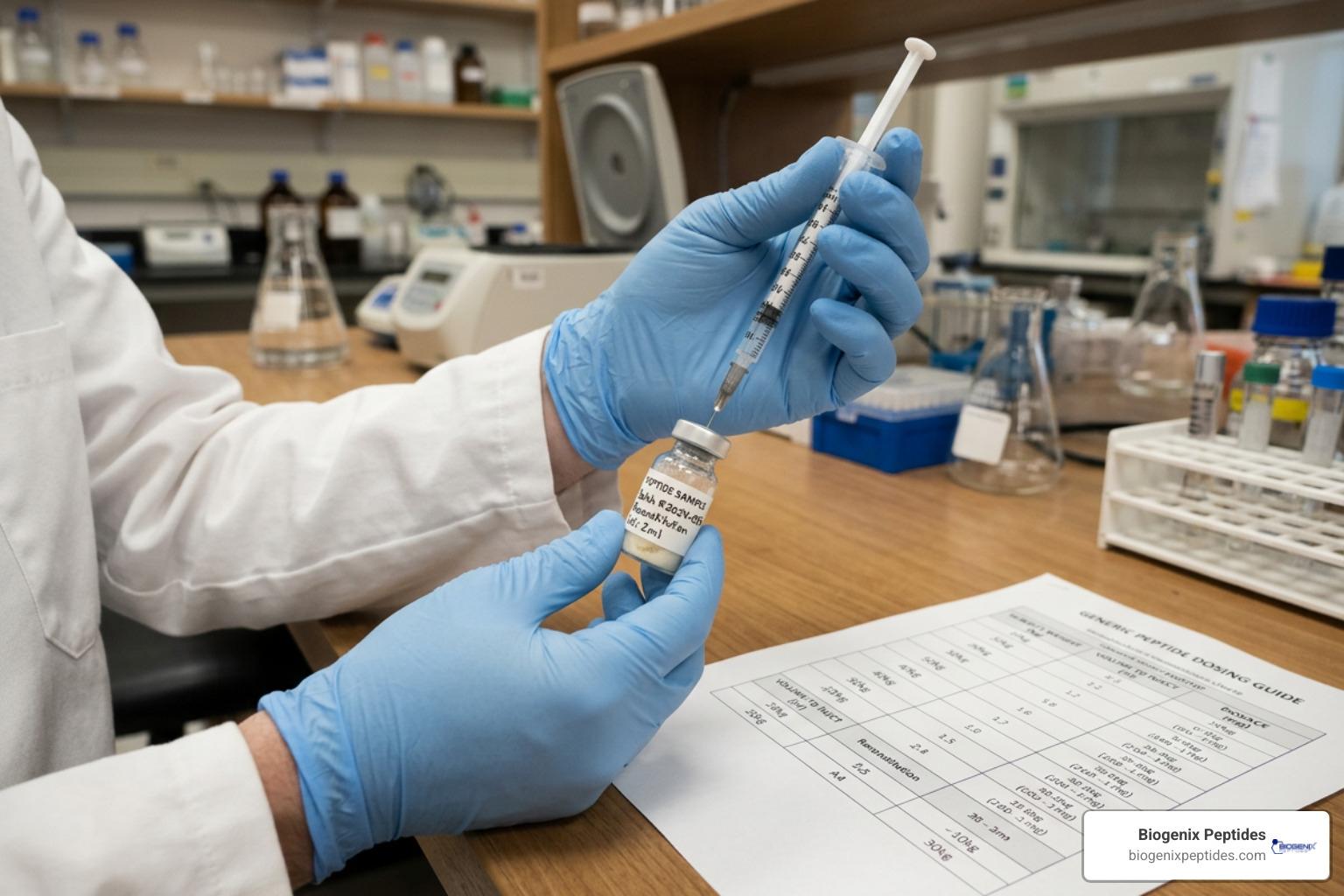
Mastering the Peptide Dosage Guide for Research Success
Master the peptide dosing chart for research success with accurate reconstitution, safe protocols, and lab-verified calculations.
Master the peptide dosing chart for research success with accurate reconstitution, safe protocols, and lab-verified calculations.
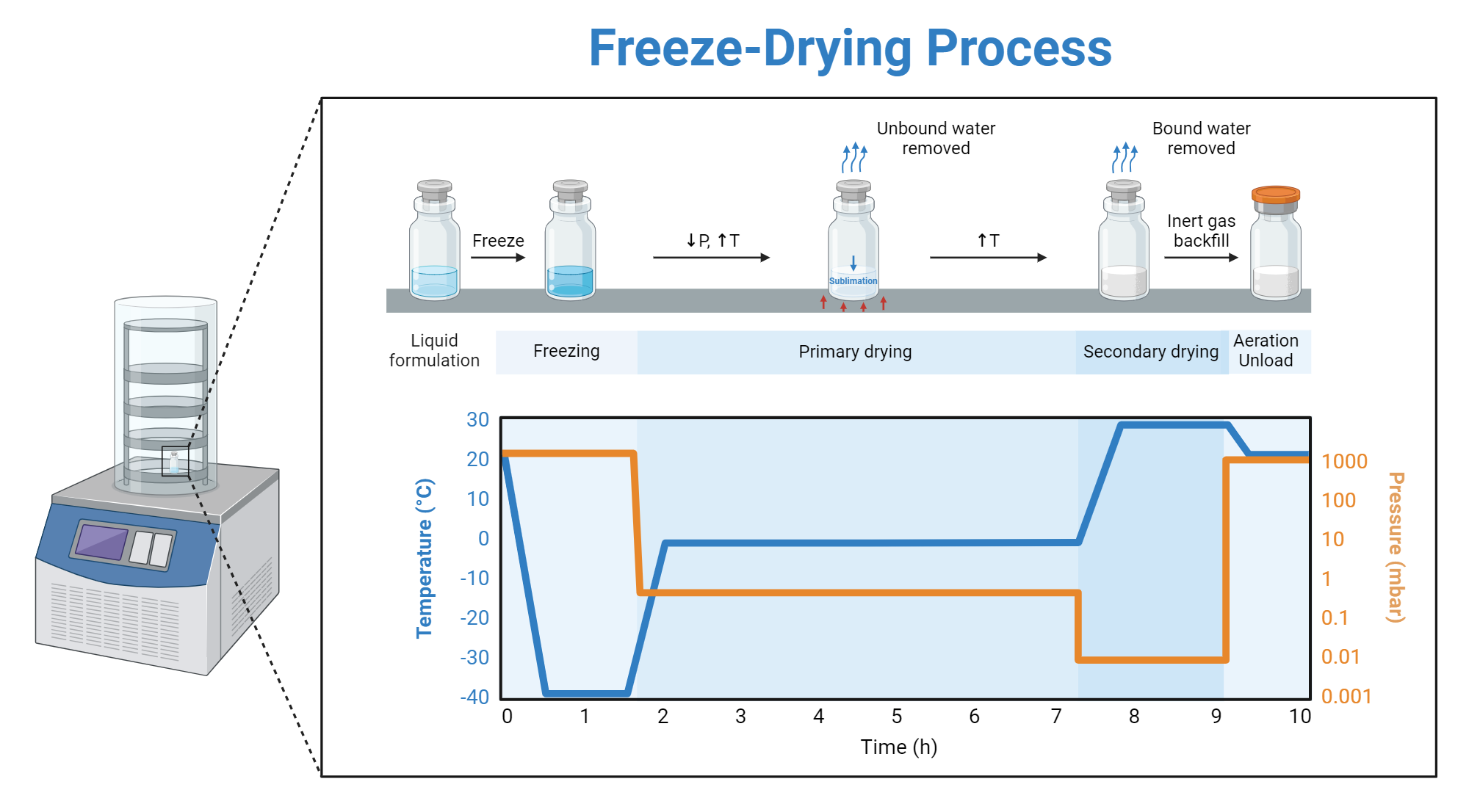
For educational and theoretical research discussion only. This content does not constitute medical advice and does not imply human or animal use. What Does “Lyophilized” Mean? Most high-quality research peptides are supplied in a lyophilized (freeze-dried) form rather than as a liquid. Lyophilization is a preservation process in which water is removed from a compound

Introduction When most people think about peptides, they picture recovery, fat loss, performance, or cosmetic benefits. But a growing body of research is shifting attention toward something far more fundamental: how peptides may influence the way cells protect themselves… and how they age. Two key biological “switches” sit at the center of this conversation: These

Exploring how this upstream regulator influences hormonal signaling, testosterone pathways, and libido—strictly for research and educational purposes. If you’ve spent any time researching hormones, performance, or peptide science, you’ve probably heard about testosterone, LH, FSH, and maybe even GnRH. But almost nobody talks about the molecule that helps control that entire chain of command: kisspeptin.

Introduction Sexual function is a multidimensional process driven by hormones, neurotransmitters, vascular health, and psychological factors. Researchers have become increasingly interested in peptides for their ability to influence these systems at the signaling level—upstream of traditional pharmaceuticals. Below is a scientific yet accessible overview written for educational and research discussion only. Why Researchers Study Peptides

Introduction In recent years, glucagon-like peptide (GLP)–based research has become a major focus within metabolic science. Three peptides in particular—Semaglutide, Tirzepatide, and Retatrutide—have gained significant attention for their distinct mechanisms and their study across metabolic signaling, appetite regulation, and energy balance pathways. Although these compounds are widely discussed in clinical and consumer circles, the scientific

Introduction How a next-generation amylin analog quietly amplifies the effects of GLP-1–based metabolic research. GLP-1–based research compounds like Semaglutide, Tirzepatide, and Retatrutide dominate the metabolic conversation. But quietly emerging alongside them is a different class of peptide—one that doesn’t compete with GLP-1 analogs at all. Instead, it appears to amplify and complement their activity. That

Introduction In the world of cutting-edge peptide science, few molecules have generated as much interest as MOTS-C. Though discovered only in the last decade, this short peptide has become one of the most researched mitochondrial-derived factors due to its potential role in metabolism, cellular energy regulation, and performance-related pathways. Unlike many peptides that originate from

Research Disclaimer: This article is provided for educational and informational purposes only and discusses theoretical, preclinical, and investigational research. It does not constitute medical advice. All compounds referenced are intended strictly for research, laboratory, and analytical use only and are not for human or animal consumption. Introduction Epithalon—also referenced in the literature as Epitalon or

Why purity, stability, and manufacturing quality matter more than most researchers realize. Two bottles on two different websites. Both are labeled with the same peptide name—BPC-157, CJC-1295, Semaglutide, or Epithalon. Same molecule. Same name. But somehow, the research outcomes are dramatically different. Why? Because peptides are not commodities. A peptide’s effectiveness depends on how it

Don’t lose your saved cart. Enter your email below so your research items are ready whenever you return.


Before entering this website, please read and agree
to the following statement:
You are not old enough to view this content.