3ml Vial Storage Cases That Will Save Your Fridge Space
The Real Problem with Storing 3ml Research Vials
Disclaimer: The information provided in this article is for educational and informational purposes only. It is not intended as medical advice, diagnosis, or treatment. Products and compounds referenced are for research use only and are not approved for human or veterinary consumption. Always consult a qualified professional regarding health or medical decisions.
3ml vial storage is one of those things that seems simple — until you’re digging through a cluttered fridge shelf trying to find the right vial without knocking the others over.
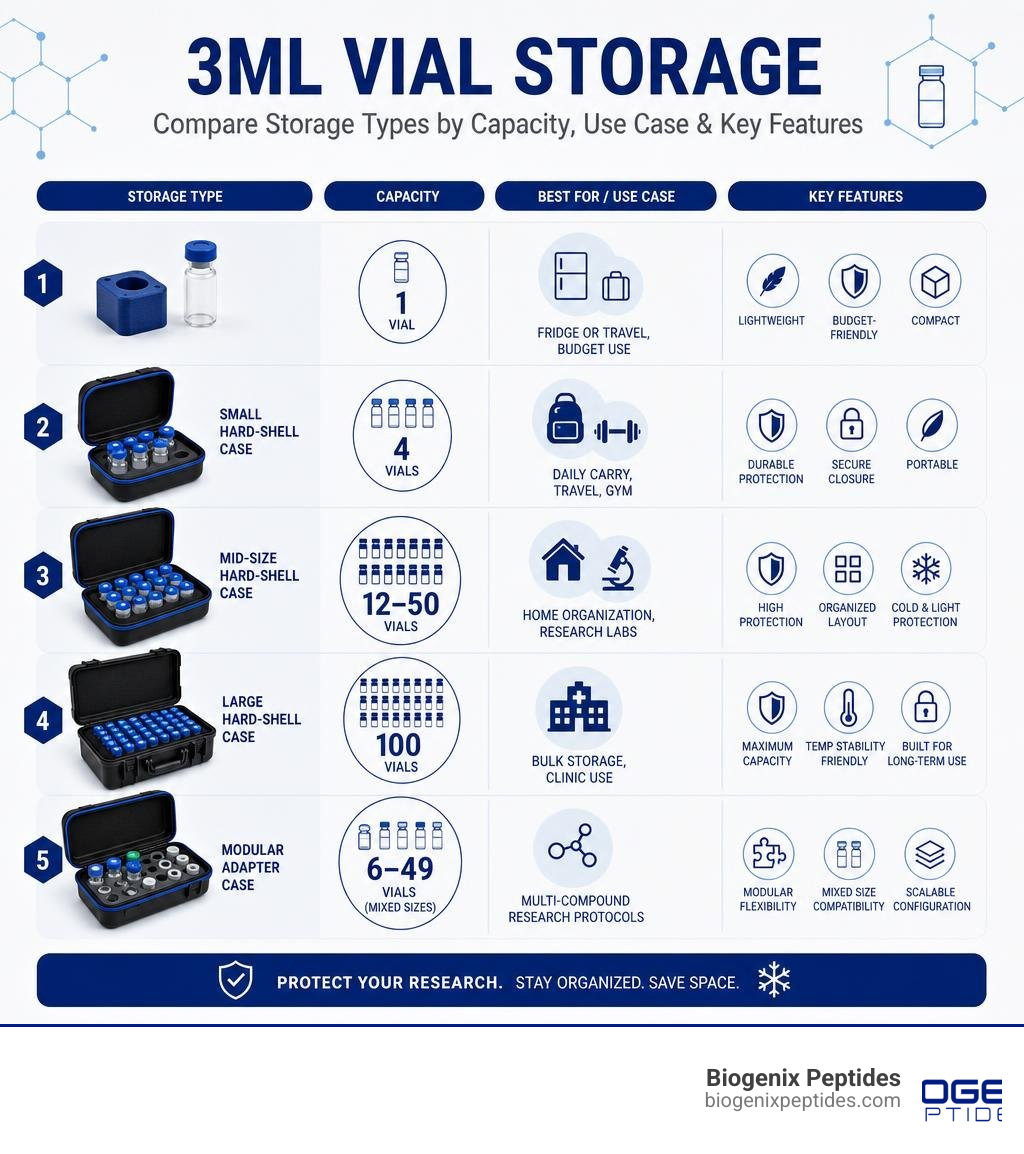
Here’s a quick look at the most common storage options available right now:
| Storage Type | Capacity | Best For |
|---|---|---|
| 3D-printed single holder | 1 vial | Fridge or travel, budget use |
| Small hard-shell case | 4 vials | Daily carry, travel |
| Mid-size hard-shell case | 12-50 vials | Home organization, research labs |
| Large hard-shell case | 100 vials | Bulk storage, clinic use |
| Modular adapter case | 6-49 vials (mixed sizes) | Multi-compound research protocols |
Most researchers start with whatever is on hand — a drawer, a small box, or a zip-lock bag. That works until it doesn’t. Vials tip over. Labels rub off. Temperature fluctuates. For research compounds that need consistent cold storage and protection from light, that approach creates real risk.
The stakes are higher than just staying organized. Peptides and similar research compounds can degrade quickly if stored improperly — even a few hours at the wrong temperature or in direct light can affect stability.
I’m Jay Daniel, Founder and CEO of BioGenix Peptides, and after years of working directly with peptide sourcing, quality control, and laboratory storage protocols, I’ve seen how the right 3ml vial storage setup protects compound integrity and keeps research on track. In this roundup, I’ll walk you through the best options available so you can find the right fit for your setup.
3ml vial storage word guide:
Why Proper 3ml Vial Storage Matters for Research Compounds
When handling fragile research compounds, physical organization is only half the battle. The primary goal of a dedicated 3ml vial storage system is preserving chemical stability. Many research peptides and biological compounds are highly sensitive to environmental factors. Without proper protection, your research materials can rapidly lose their integrity.
To understand why custom containers are so important, we have to look at the main environmental threats:
- Light Exposure: Many reconstituted peptides are photolabile, meaning they degrade when exposed to light. Standard clear glass vials offer zero protection from the ambient light of a room or the frequent opening of a refrigerator door. A solid, dark, or opaque storage case acts as a physical barrier, ensuring your compounds remain in total darkness.
- Temperature Fluctuations: Refrigerators do not maintain a completely uniform temperature. Every time the door opens, warm air rushes in. Vials kept loose on door shelves or open trays experience frequent micro-fluctuations in temperature. Keeping vials enclosed in a dedicated, insulated, or hard-shell case buffers them against these sudden changes, maintaining a stable microclimate.
- Physical Shock: Glass vials are fragile. When stored loosely in a drawer or on a crowded fridge shelf, they can easily clink together, tip over, or fall. Even minor impacts can cause micro-fractures in the glass, compromising the sterile seal. Furthermore, vigorous movement or dropping a vial can shear delicate peptide chains, rendering the compound useless.
- Contamination and Moisture: Refrigerators are humid environments. Over time, moisture can build up on the exterior of a vial, damaging labels and potentially introducing contaminants around the rubber stopper. A high-quality container seals out excess moisture and prevents direct contact with condensation.
For a deeper dive into how environmental factors impact research compounds, read our guide on Peptide Storage Stability Guidelines and check out our essential tips on Best Practices for Peptide Storage & Handling. If you want to make sure your investments do not go to waste, don’t let your research suffer from poor climate control—learn why you shouldn’t Don’t Let Your Peptides Lose Their Cool.
Key Features to Look For in a Protective Case
Choosing the right 3ml vial storage case requires looking past basic aesthetics. You need a solution designed specifically for the unique environment of a laboratory refrigerator or freezer.
Here are the essential features to evaluate before making a purchase:
- Material Durability: Look for rugged materials like impact-resistant ABS plastic, polycarbonate, or high-grade 3D-printed polymers (such as PETG or PLA+). These materials can withstand accidental drops and resist cracking in low temperatures.
- Fridge and Freezer Safety: Not all plastics are made equal. Standard cheap plastics can become brittle and crack when exposed to freezing temperatures. Ensure the case is specifically rated for cold storage.
- Secure Latching Systems: A reliable latch prevents the case from accidentally opening during transport. Double-latch designs are particularly popular for larger, heavier cases because they distribute pressure evenly across the lid.
- Custom-Fit Inserts: The interior should feature precise slots or flexible silicone/foam inserts. This prevents the vials from shifting, sliding, or knocking against one another.
- Light-Blocking Properties: Opaque or solid black finishes are ideal for sensitive compounds that require complete light protection.
To help you compare the most common materials used in vial cases, we have put together this comparison:
| Material | Cold-Storage Rating | Impact Resistance | Light Protection | Best Use Case |
|---|---|---|---|---|
| PETG / PLA+ (3D-Printed) | Excellent (Does not get brittle) | High (Flexible & tough) | Excellent (If opaque) | Custom lab setups, travel, fridge organization |
| ABS Plastic (Commercial) | Good | Very High | Excellent | Heavy-duty transit, rugged environments |
| Acrylic / Clear Plastic | Poor (Can crack in freezer) | Moderate | None (Transparent) | Basic dry cabinet display (not recommended for peptides) |
| Silicone / Flexible Foam | Excellent | High (Great shock absorption) | Moderate | Internal inserts and protective sleeves |

Selecting the Right Dimensions for 3ml Vial Storage
One of the most common mistakes researchers make is assuming all “3ml vials” are identical. In reality, manufacturing standards can vary slightly between glass blowers and suppliers.
A standard 3ml vial typically measures:
- Outer Diameter: Approximately 15mm to 17mm (0.59 to 0.67 inches)
- Height (including cap): Approximately 35mm to 40mm (1.38 to 1.57 inches)
Before purchasing a storage case, always use a caliper or ruler to measure your specific vials. A slot that is even 1mm too narrow will prevent the vial from fitting, while a slot that is too wide will allow the vial to rattle, defeating the purpose of a protective case.
If you use protective caps or silicone sleeves on your vials, you must factor in that extra width. Many commercial brands design their cases to fit standard dimensions, but recommend using flexible caps to ensure a perfect, snug fit.
For more information on selecting the right physical dimensions for your research setup, explore our resource on Top-Rated Peptide Vials and Cases for Secure Storage.
Custom 3D-Printed vs. Commercial 3ml Vial Storage Solutions
The market for 3ml vial storage is split into two main categories: mass-produced commercial cases and custom 3D-printed solutions. Both have distinct advantages depending on your budget, scale, and specific research needs.
Custom 3D-Printed Solutions
With the rise of high-quality desktop 3D printing, platforms like Etsy, Printables, and MakerWorld have become hubs for custom vial storage.
For example, a highly popular 3ml vial storage model on Printables.com has been downloaded 4,876 times with 1,683 likes, demonstrating a huge demand for DIY lab organization. Similarly, a single 3ml vial holder on MakerWorld has received over 1,200 downloads and 868 likes, prized by researchers who only need to protect one reconstituted vial at a time.
For those without a 3D printer, ready-to-use 3D-printed boxes are widely available. The Peptide Vial Box Storage 3ml Vials – Etsy listing is a prime example. This product has received 859 reviews with a perfect 5/5 rating across item quality, shipping, and customer service, with 5 people purchasing it in just the last 24 hours.
- Pros: Highly customizable, available in unique color-shifting/metallic finishes, affordable, and often designed by independent creators who understand the exact needs of the community.
- Cons: Can have slight surface textures due to the printing process; not dishwasher safe (must be hand-washed).
Commercial Solutions
Commercial options are molded under high pressure, resulting in a smooth, seamless finish.
- Pros: Uniform production quality, highly standardized sizing, and often built with heavy-duty commercial latches.
- Cons: Less color customization, higher entry price, and fewer layout options for mixed protocols.
Organizing and Managing Different Storage Capacities
Your storage needs will scale with the size of your research projects. A single-vial holder is perfect for a small, active experiment, but a clinic or busy lab will require high-density storage.
Here is how different capacities serve different research environments:
1-Vial to 4-Vial Cases (The Active Research Setup)
These ultra-compact cases are designed for daily handling and short-distance transport. If you are running a single protocol, a 4-vial case keeps your active materials organized in a neat 2×2 grid. It takes up virtually zero space in a refrigerator drawer and is highly portable if you need to move your research between lab benches.
12-Slot to 30-Slot Cases (The Mid-Sized Organizer)
These are the workhorses of home laboratories. A 12-slot mixed case allows you to store a complete sequence of compounds alongside necessary diluents (like bacteriostatic water). For instance, a popular mixed vial case configuration features 12 slots for 3ml vials, 3 slots for larger 5-10ml vials, and a dedicated slot for a 30ml bacteriostatic water vial. This mixed setup is highly rated by researchers, proving its utility for complex protocols.
50-Slot to 100-Slot Cases (The Bulk Vault)
For long-term storage or high-throughput laboratories, high-capacity cases are essential.
- The 50-slot 3ml vial case is favored by researchers who buy compounds in bulk to lock in volume pricing.
- The 100-slot 3ml vial case is a certified bestseller for high-volume storage.
- Similarly, heavy-duty 100-vial 3ml cases, often referred to as vial vaults, are highly popular, highlighting their role as the ultimate high-volume organizer.
To choose the best configuration for your space, check out our guide on The Ultimate Peptide Organizer for Your Freezer.
Modular and Adapter-Based Systems
What happens when your research protocol changes? If you buy a fixed-size storage case, you are locked into that specific vial size. This is where modular adapter systems shine.
Modular cases are natively designed to hold larger 5ml or 10ml vials, but they come with custom-fit reducers or adapters. By inserting a 3ml adapter into a larger slot, you can instantly convert it to hold a standard 17mm diameter 3ml vial.
- Protocol Flexibility: Run a mixed protocol combining a large 10ml hormone vial with multiple 3ml peptide vials in the exact same box.
- Cost-Effective: No need to buy multiple cases; simply swap out the internal adapters as your research inventory evolves.
- Future-Proof: As new compounds are introduced to your lab, your storage system adapts with you.
To explore these flexible configurations further, read our article on Vial Holder Options to Organize Your Medicine Cabinet.
Best Practices for Cold Storage and Travel
To keep your research compounds fresh and prevent degradation, physical storage must be paired with smart handling habits.
Here are the gold standards for cold storage and transit:
- Avoid the Refrigerator Door: Never store your vial cases in the door shelves of your fridge. The constant swinging exposing the vials to warm room air and physical vibrations. Instead, place your storage case on a middle or lower shelf, deep toward the back where the temperature is most stable.
- Combat Condensation: When moving a cold vial case from the fridge to room temperature, condensation will form on the cold surfaces. To protect paper labels from peeling or molding, ensure your case has drainage/airflow features, or wipe down the vials before returning them to the case.
- Keep It Upright: Although high-quality cases hold vials securely, always store and transport the case flat so the vials remain upright. This keeps the liquid compound away from the rubber stopper, reducing the risk of chemical interaction with the seal.
- Avoid Hot Cars: If you must transport your research materials, never leave your storage case in a vehicle. Even on a mild day, the interior temperature of a car can skyrocket within minutes, instantly ruining sensitive peptides.
For more advanced tips on managing your cold chain, read our guides on Cold Storage Secrets for Keeping Reconstituted Peptides Fresh and To Fridge or Not to Fridge: Your Peptide Storage Questions Answered. To prevent common mistakes, make sure you don’t Don’t Let Your Peptides Go Bad in the Fridge.
Frequently Asked Questions about 3ml Vial Storage
Can 3ml vial storage cases be used in the freezer?
Yes, but it depends heavily on the materials used. High-quality 3D-printed cases made from PETG or specialized PLA+, as well as commercial ABS cases, are perfectly safe for freezer temperatures. However, cheap acrylics or standard PLA can become incredibly brittle at sub-zero temperatures and may crack if dropped. Always verify the manufacturer’s cold-storage rating before placing a case in the freezer.
For more details on managing frozen research materials, check out our guide: Keep Your Powder Dry and Your Freezer Cold.
How do I clean my 3ml vial storage case?
Most protective vial cases—especially 3D-printed ones—are not dishwasher safe. The high heat of a dishwasher cycle can easily warp the plastic, ruining the precise fit of the vial slots.
- The Right Way: Hand wash the case using cold or lukewarm water and a mild dish soap.
- Drying: Allow the case to air dry completely before placing vials back inside to prevent trapping moisture.
For more maintenance tips, read our post on Peptide Storage Containers That Won’t Let You Down.
Are there regulatory considerations for transporting research vials?
Yes. When transporting research compounds, they should always be clearly labeled with their scientific names, batch numbers, and a clear “For Research Use Only” designation. If you are traveling by air, keep your storage cases in your carry-on luggage rather than checked baggage. The cargo hold of an airplane experiences extreme temperature drops and pressure changes that can freeze liquid compounds or shatter fragile glass vials. Keeping them with you in a hard-shell, TSA-compliant case ensures they remain safe and at a stable pressure.
Conclusion
Maximizing your laboratory organization is about more than just saving space in your refrigerator—it is about protecting the viability of your research. Whether you choose a compact 4-vial travel case, a highly customizable 3D-printed organizer, or a massive 100-slot bulk vault, investing in dedicated 3ml vial storage ensures your compounds remain secure, dark, and chemically stable.
For researchers running advanced protocols, maintaining precise storage conditions is non-negotiable. For example, if you are working with complex sequences, a single mistake in handling can ruin your entire project—make sure you Don’t Mess Up Your CJC-1295 No DAC Protocol.
Ready to upgrade your laboratory setup with premium research materials and reliable tools? Explore Biogenix Peptides Shop today to find high-quality compounds backed by rigorous quality control.