Keep your powder dry and your freezer cold
Keep your powder dry and your freezer cold
Disclaimer: The information provided in this article is for educational and informational purposes only. It is not intended as medical advice, diagnosis, or treatment. Products and compounds referenced are for research use only and are not approved for human or veterinary consumption. Always consult a qualified professional regarding health or medical decisions.
Why Peptide Powder Storage Determines Research Outcomes
Peptide powder storage done right is the difference between reliable research results and wasted materials. Here is a quick reference for how to store lyophilized peptide powder:
| Storage Location | Temperature | Estimated Stability |
|---|---|---|
| Room temperature | 20–25°C | Several weeks |
| Refrigerator | 2–8°C | 6–24 months |
| Freezer | -20°C | 1–3+ years |
| Ultra-low freezer | -80°C | Optimal long-term |
Key rules:
- Keep vials sealed, dark, and dry at all times
- Avoid humidity, light, and repeated temperature changes
- Only reconstitute what you need — powder lasts far longer than liquid
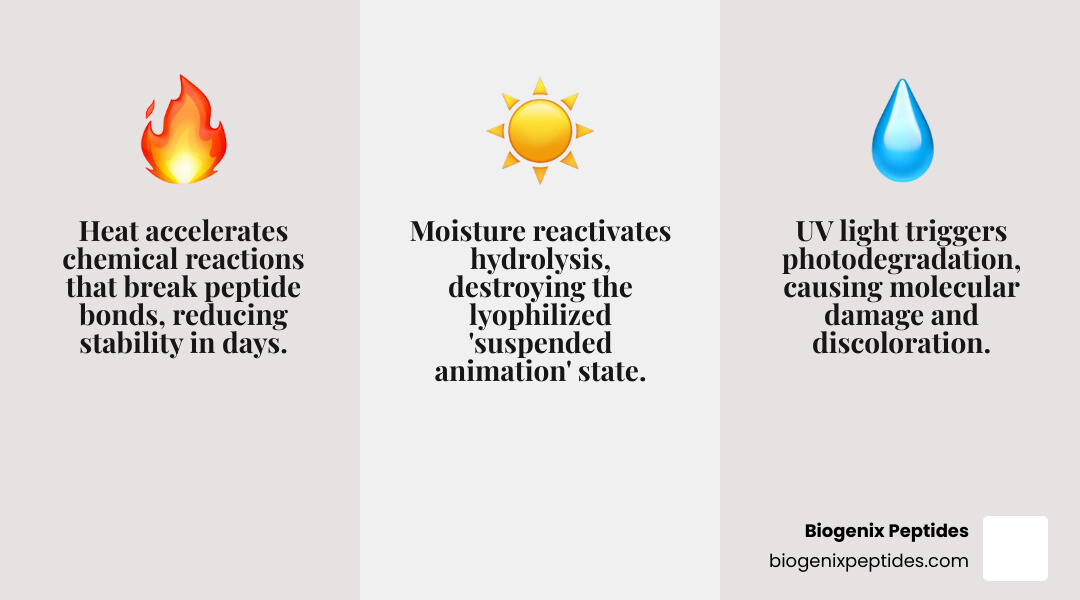
Peptides are proteins. Like all proteins, they break down when exposed to the wrong conditions. Heat speeds up chemical reactions that destroy peptide bonds. Light — especially UV — causes photodegradation. Moisture reactivates the very degradation processes that lyophilization was designed to stop.
The good news? Lyophilized peptide powder is remarkably stable when stored correctly. The freeze-drying process removes water and puts the peptide in a kind of suspended state, dramatically slowing degradation. But that stability depends entirely on how you store it from the moment it arrives.
Get it wrong — leave a vial on the counter, expose it to bathroom humidity, or skip the temperature equilibration step before opening — and you may compromise the integrity of your entire research batch without even knowing it.
I’m Jay Daniel, Founder and CEO of Biogenix Peptides, and my experience in peptide powder storage spans years of hands-on work in peptide sourcing, quality control, and laboratory best practices. In this guide, I’ll walk you through everything you need to protect your research materials from the most common — and most costly — storage mistakes.
The Science of Peptide Powder Storage
To understand why peptide powder storage is so critical, we first need to look at what is happening inside that tiny vial. Most research peptides arrive as a “lyophilized” powder. This isn’t just a simple drying process; it is a sophisticated method of freeze-drying where water is removed under a vacuum while the product is frozen.
This state of “suspended animation” is what allows these fragile molecular chains to remain intact. By removing water, we effectively hit the “pause” button on the chemical reactions that would otherwise cause the peptide to fall apart. However, even in this dry state, the molecules remain sensitive to their environment.
Research indicates that the primary drivers of peptide degradation are heat, moisture, and light. When a peptide is exposed to heat, the kinetic energy within the molecules increases, making it easier for the chemical bonds to break. According to research published in the Journal of Pharmaceutical Sciences, lyophilized peptides stored at -20°C show minimal degradation even after extended periods, making freezer storage the gold standard for long-term preservation.
For a deeper dive into why we use this specific form for our materials, you can read more about why research peptides are lyophilized.
Short-term vs. Long-term Peptide Powder Storage
How we choose to store our materials often depends on how quickly we plan to use them in our research protocols.
Room Temperature (Short-term): Lyophilized peptides are surprisingly resilient during transit. They can typically withstand room temperature (20–25°C) for several weeks without significant loss of integrity. This is why they are safely shipped without dry ice in many cases. However, once they arrive at your facility, they should be moved to a more stable environment immediately.
Refrigeration (2-8°C): For research spanning 6 to 12 months, a standard laboratory refrigerator is an excellent choice. This temperature range significantly slows down molecular degradation while keeping the vials ready for relatively quick transition to a research environment. Properly stored unreconstituted peptides typically remain stable for 12-24 months at refrigerator temperatures.
Freezer Storage (-20°C to -80°C): For long-term preservation (1–3+ years), the freezer is mandatory. A standard freezer at -20°C is sufficient for most common research peptides. However, for highly sensitive sequences or multi-year projects, an ultra-low freezer set to -80°C provides the ultimate protection. At these temperatures, molecular motion is virtually non-existent, preserving the peptide in its original state for years.
Temperature Equilibration Protocols
One of the most frequent mistakes we see in peptide powder storage happens right at the moment a researcher is ready to begin a project. It is the “sweating vial” phenomenon.
If you take a vial directly from the freezer and pop the cap, the moisture in the air will immediately condense on the cold powder. This introduces water—the very thing lyophilization was designed to remove. This moisture can trigger rapid degradation or “clumping” of the powder.
To prevent this, we always recommend a Temperature Equilibration Protocol:
- Remove the vial from the freezer.
- Place it in the refrigerator for 12–24 hours to begin a gradual warm-up.
- Bring the vial to room temperature (while still sealed) for at least 30–60 minutes before opening.
- Use a desiccator if your environment is high-humidity to ensure the air inside the vial stays dry.
For more detailed steps on this process, check our guide on best practices for peptide storage handling.
Protecting Lyophilized Peptides from Environmental Degradation
Beyond temperature, we must guard against the “silent killers” of peptide stability: light and air.
Photodegradation occurs when UV light or even intense indoor lighting provides enough energy to break the delicate covalent bonds within the peptide chain. This is why many researchers prefer amber vials, which filter out harmful light spectrums. If your materials arrive in clear vials, the best practice is to keep them in their original boxes or wrap them in foil to block light exposure.
According to established laboratory guidelines for peptides and proteins, materials should always be kept away from bright light to maintain their primary structure.
Preventing Moisture Contamination in Peptide Powder Storage
Moisture is perhaps the greatest enemy of a lyophilized cake. Once a vial’s seal is compromised, atmospheric humidity can begin to seep in. This is why we emphasize keeping the rubber stopper and aluminum seal intact until the exact moment of reconstitution.
If you are storing a large number of vials for a long-term study, consider using a desiccator. A desiccator is a sealed container containing a drying agent (like silica gel) that maintains an ultra-low humidity environment. This adds an extra layer of security, ensuring that even if a vial seal has a microscopic flaw, the peptide remains dry.
For more insights on maintaining environmental stability, see our peptide storage stability guidelines-2.
Oxidation Risks for Sensitive Amino Acids
Not all peptides are created equal. Some sequences contain specific amino acids that are “oxidation magnets.” If your peptide sequence includes Cysteine (C), Methionine (M), or Tryptophan (W), it is significantly more vulnerable to air exposure.
Cysteine residues, in particular, like to form disulfide bonds with one another when exposed to oxygen, which can completely change the shape (and therefore the function) of the peptide. To minimize this risk:
- Avoid opening vials unnecessarily.
- For high-value research, some labs use “nitrogen purging,” where the air in the vial is replaced with an inert gas like Nitrogen or Argon before sealing.
- Always ensure vials are tightly capped and stored in a cold, dark place.
Handling and Reconstitution Best Practices
When it comes time to transition from peptide powder storage to active research, the reconstitution process is where things get delicate. Once a peptide is in a liquid state, its shelf life drops from years to weeks.
We generally recommend using Bacteriostatic (BAC) water for reconstitution. BAC water contains 0.9% benzyl alcohol, which acts as a preservative to inhibit the growth of bacteria. However, even with BAC water, the “28-day rule” applies. Most research indicates that once a vial is punctured and reconstituted, it should be used within 28 to 30 days for maximum reliability.
Managing Freeze-Thaw Cycles and Aliquoting
A common question we hear is: “Can I just freeze the liquid after I mix it?” The answer is a firm no.
While you can freeze the powder, you should never freeze the reconstituted liquid. When water freezes, it forms ice crystals. These sharp crystals can physically shear the delicate peptide chains, a process known as denaturation. Additionally, the process of freezing and thawing causes “aggregation,” where the peptides clump together and lose their research efficacy.
To avoid this, researchers use aliquoting:
- If you have a large amount of powder but only need a little bit for each research session, do not reconstitute the whole vial.
- Instead, divide the lyophilized powder into smaller, single-use vials (aliquots) while in a dry, sterile environment.
- Freeze these dry aliquots.
- Only reconstitute one small vial at a time as needed.
This strategy ensures that the bulk of your material stays in its most stable, frozen, dry state. You can find more specific peptide handling and research storage tips in established laboratory literature.
Preventing Moisture Contamination in Peptide Powder Storage
Wait, didn’t we just talk about moisture? Yes, but it bears repeating because it is the #1 cause of failed research materials. When preparing for reconstitution, ensure your workspace is clean, dry, and away from any steam or high-humidity sources.
Always wipe the rubber stopper with a 70% isopropyl alcohol swab before inserting a needle to introduce the solvent. This ensures no contaminants—or stray moisture—enter the vial during the transition from powder to liquid.
For more on the nuances of handling these materials, refer to best practices for researchers regarding peptide storage.
Shipping and Traveling with Research Peptides
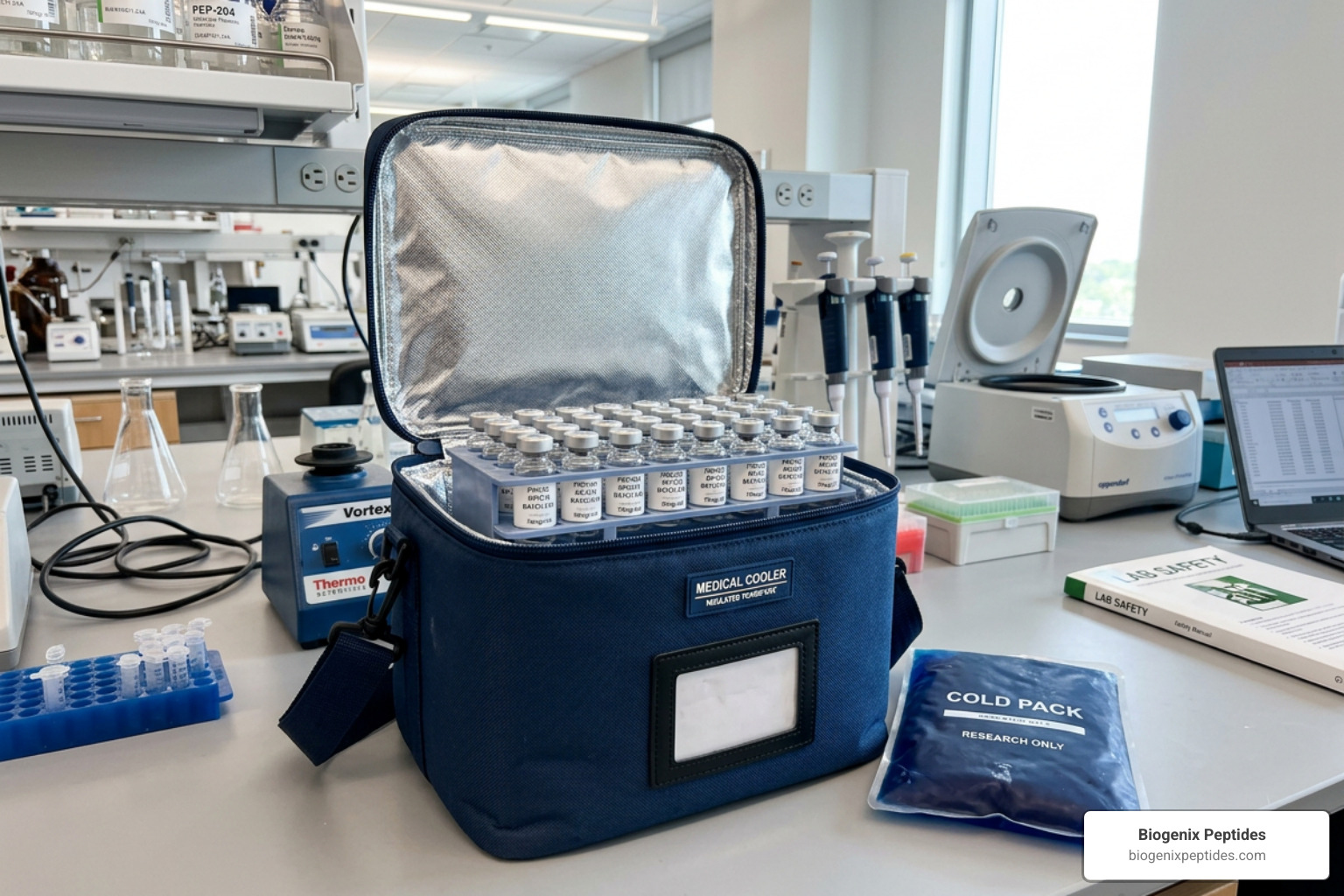
Researchers often need to move their materials between facilities or even travel across the country for collaborative studies. Because lyophilized peptides are stable at room temperature for short periods, shipping is generally straightforward. However, once you are in possession of the materials, you should take extra precautions.
If you are traveling with peptides:
- Use Insulated Containers: A small medical cooler bag with a gel cold pack is ideal.
- Avoid Direct Ice Contact: Ensure the vials are not touching the ice pack directly to prevent accidental freezing of any liquid components or extreme temperature shocks.
- TSA Regulations: According to TSA guidelines, research materials and associated tools are permitted in carry-on luggage. It is often helpful to keep them in their original packaging with the manufacturer’s documentation to avoid confusion during security screenings.
Maintaining Stability During Transit
The key to transit is minimizing “temperature excursions.” While a few hours at 75°F won’t destroy a lyophilized peptide, leaving it in a hot car at 110°F certainly might. We always recommend using overnight shipping for any peptide purchases and transferring them to a refrigerator or freezer immediately upon arrival.
If you are moving reconstituted materials, they must stay cold (2–8°C) at all times. Their stability is much more fragile than the powder form, and even a few hours at room temperature can begin the degradation process.
Frequently Asked Questions about Peptide Storage
How can I tell if a lyophilized peptide has degraded?
Visual inspection is your first line of defense, though it isn’t foolproof. Look for:
- Clumping: If the fine powder has turned into a sticky or hard “rock,” moisture has likely entered the vial.
- Discoloration: Most peptides are white or off-white. If you see yellowing or browning, oxidation has likely occurred.
- Solubility Issues: If the powder refuses to dissolve into a clear solution after reconstitution, or if it looks “cloudy” or has “floaties,” the peptide bonds may have broken or aggregated.
Can I freeze peptides after they have been reconstituted?
As mentioned earlier, we strongly advise against this. The formation of ice crystals can denature the protein structure. While some extremely hardy peptides might survive one freeze-thaw cycle in liquid form, it introduces an unnecessary variable into your research. Consistency is the hallmark of good science—keep your reconstituted vials in the refrigerator at 4°C.
How long is BPC-157 or Semaglutide stable in powder form?
While every sequence is different, common research peptides like BPC-157, TB-500, and Semaglutide are generally quite stable.
- Lyophilized: 12–24 months in the fridge; 2–3+ years in the freezer.
- Reconstituted: 4 weeks in the fridge is the standard window for maintaining peak integrity.
Conclusion
At Biogenix Peptides, we know that your research is only as good as the materials you use. Proper peptide powder storage isn’t just a suggestion—it is a fundamental requirement for scientific accuracy. By following the “Cold, Dark, and Dry” rule, you ensure that your materials remain potent and your results remain reproducible.
Remember:
- Store long-term in the freezer at -20°C.
- Always equilibrate to room temperature before opening.
- Protect from light and moisture at all costs.
- Only reconstitute what you will use within 30 days.
By mastering these storage protocols, you protect your investment and the integrity of your work. For more resources on how to handle your materials, explore research and handling resources on our site.