Cold Storage Secrets for Keeping Reconstituted Peptides Fresh
Why Knowing How Long Reconstituted Peptides Last in Fridge Can Save Your Research
How long does reconstituted peptides last in fridge is one of the most important questions any researcher working with peptides needs to answer — and the short answer is: it depends on the peptide and solvent used, but most last 28-30 days at 2-8°C.
Here is a quick reference:
| Peptide / Condition | Fridge Life (2-8°C) |
|---|---|
| Most peptides in bacteriostatic water | 28-30 days |
| BPC-157 in bacteriostatic water | 28-30 days |
| GHRPs (e.g., GHRP-6) in bacteriostatic water | 14-28 days |
| Melanotan I & II in bacteriostatic water | 21-30 days |
| Any peptide in sterile water (no preservative) | 7-14 days |
| Any peptide at room temperature | 24-72 hours max |
Once a peptide is reconstituted — meaning the freeze-dried powder is dissolved into liquid — it becomes far more vulnerable to degradation. Heat, light, air, and bacteria all start working against it immediately.
Getting this wrong doesn’t just waste money. It means injecting a less effective — or potentially contaminated — solution.
I’m Jay Daniel, Founder and CEO of BioGenix Peptides, and I’ve spent years researching peptide stability, sourcing protocols, and proper handling practices — including the critical question of how long does reconstituted peptides last in fridge under real-world conditions. In this guide, I’ll walk you through everything you need to know to protect your peptides and your research.
How Long Does Reconstituted Peptides Last in Fridge?
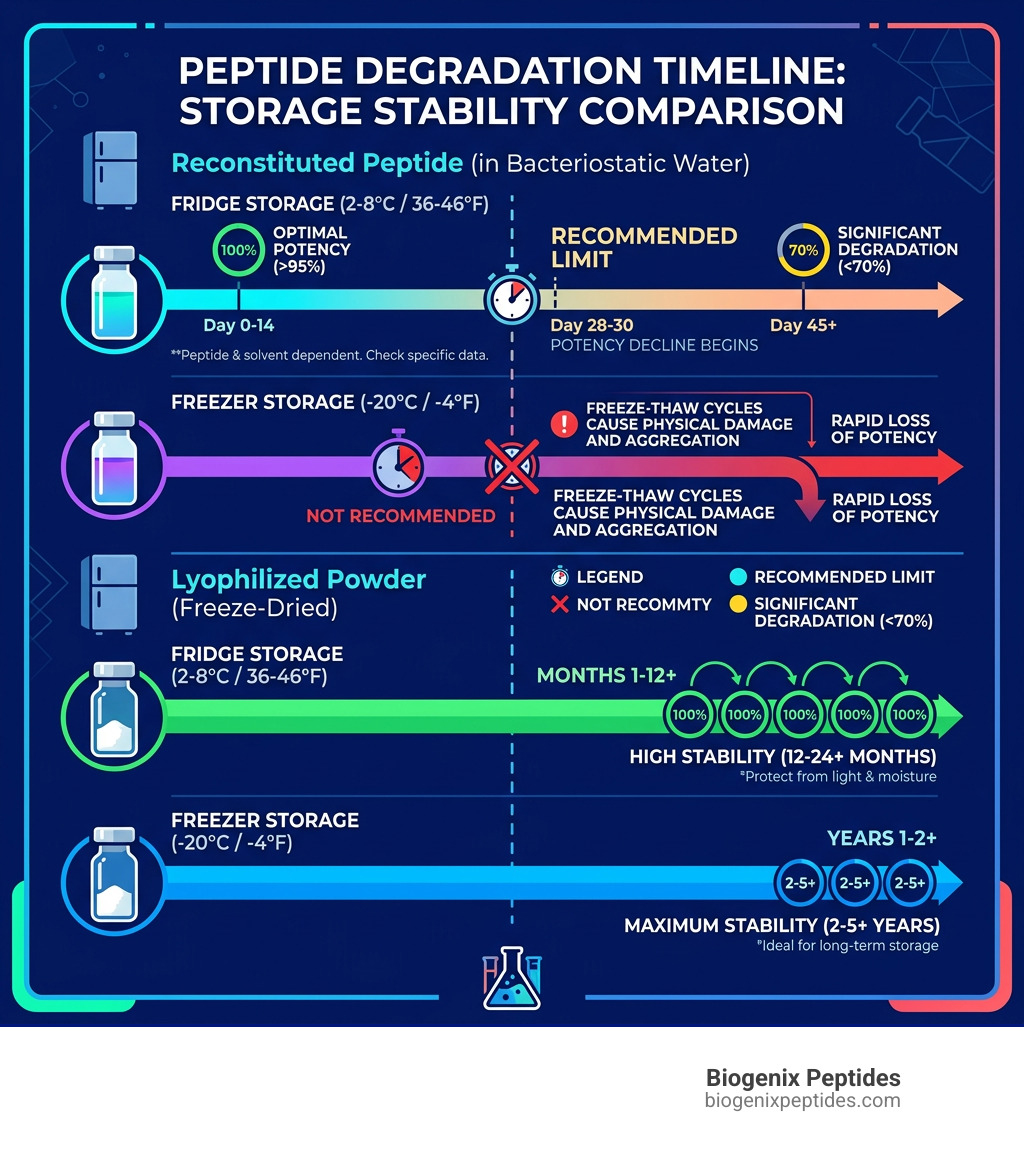
When we talk about the lifespan of these delicate amino acid chains, we have to distinguish between their “shelf life” (how long they stay potent) and their “safety life” (how long they stay sterile). In a standard refrigerator set between 2-8°C (36-46°F), the general consensus among researchers and manufacturers is the 28-30 day rule.
This 30-day window isn’t an arbitrary number. It is based on two primary factors: the chemical stability of the peptide bonds and the effectiveness of the preservative in your solvent. Most research peptides retain 95-100% of their potency during the first 28 days of refrigeration. After this point, potency begins a gradual decline. By day 45, you might only have 85-95% of the original activity, and after 60 days, it can drop below 70%.
For the most accurate results in your studies, following Peptide Storage & Stability Guidelines is essential. Maintaining a consistent temperature is the biggest hurdle in a home or office fridge; frequent door openings can cause “micro-fluctuations” that stress the peptide molecules. We recommend placing your vials in the back of the fridge, away from the door, to ensure they stay within that vital 2-8°C range.
How Long Does Reconstituted Peptides Last in Fridge for Different Peptide Types?
Not all peptides are created equal. Some are robust “tanks” that can handle a bit of stress, while others are “glass cannons” that break down if you look at them wrong. The molecular complexity—specifically the sequence and length of the amino acids—dictates how long they remain viable.
- Healing Peptides (BPC-157 & TB-500): These are relatively stable. BPC-157 is known for its resilience and typically stays potent for the full 28-30 days in the fridge. TB-500 is similar, though some researchers prefer using it within 4 weeks for maximum efficacy.
- GLP-1 Agonists (Semaglutide & Tirzepatide): These are the marathon runners of the peptide world. Pharmaceutical versions often contain extra stabilizers allowing them to last up to 56 days, but for research-grade versions, we suggest sticking to a 30-45 day limit.
- Growth Hormone Secretagogues (GHRP-6, Ipamorelin, CJC-1295): These are more sensitive. GHRPs generally have a shorter reliable window of 14 to 28 days.
- Cosmetic & Pigment Peptides (Melanotan II & GHK-Cu): GHK-Cu is particularly prone to oxidation and may show signs of degradation (like color shifts) after 21-28 days.
| Peptide Category | Typical Stability (2-8°C) | Sensitivity Level |
|---|---|---|
| Healing (BPC, TB) | 4-6 Weeks | Moderate |
| Metabolic (GLP-1s) | 4-8 Weeks | Low |
| GH Secretagogues | 2-4 Weeks | High |
| Copper Peptides | 3-4 Weeks | Very High |
Maximizing How Long Does Reconstituted Peptides Last in Fridge with Proper Solvents
The liquid you choose to dissolve your powder is the “life support system” for your peptide. If you use the wrong one, how long does reconstituted peptides last in fridge becomes a much shorter conversation.
Bacteriostatic Water (BAC Water) is the gold standard. It contains 0.9% benzyl alcohol, which acts as a mild preservative. This doesn’t necessarily “kill” all bacteria, but it inhibits their growth, allowing for multiple punctures of the vial over a 28-day period.
Sterile Water, on the other hand, contains no preservative. Once you puncture a vial of sterile water, it is susceptible to bacterial colonization within hours. Peptides reconstituted with sterile water should generally be used within 24 hours or, at most, 7-14 days if handled with extreme aseptic technique.
The pH level of the solvent also plays a role. Most peptides prefer a slightly acidic to neutral environment (pH 5-7). Using a solvent that pushes the pH too far in either direction can lead to immediate fragmentation of the peptide chain. For a detailed breakdown of the mixing process, see our guide on Reconstituting Lyophilized Peptides Step-by-Step.
Critical Factors Affecting Reconstituted Peptide Stability
Once you move a peptide from its lyophilized (freeze-dried) state into a solution, the “molecular clock” starts ticking faster. Several environmental factors act as catalysts for degradation:
- Light Exposure (Photodegradation): UV light and even high-intensity blue light can provide enough energy to break peptide bonds. This is why we recommend using amber glass vials or wrapping clear vials in aluminum foil.
- Oxidation: Every time you draw a dose, you introduce a tiny amount of air into the vial. Oxygen reacts with specific amino acids (like methionine or cysteine), changing the peptide’s chemical structure and rendering it inactive.
- Temperature Fluctuations: The Arrhenius equation in chemistry tells us that for every 10-degree Celsius increase in temperature, the rate of chemical degradation approximately doubles. Leaving your vial on the counter for 30 minutes while you prep your research can significantly cut into its total shelf life.
- Hydrolysis: This is the process where water molecules themselves break down the peptide bonds. While unavoidable in a reconstituted state, keeping the solution cold slows this reaction to a crawl.
Best Practices for Storing and Handling Reconstituted Vials
To ensure your research remains consistent, you need to treat your vials with “white-glove” service. Here are our top protocols for maximizing how long does reconstituted peptides last in fridge:
- Aliquoting for Long Protocols: If you have a large vial that will take 8 weeks to finish, don’t keep it all in one bottle. Reconstitute it, then immediately split (aliquot) the solution into several smaller, sterile vials. You can freeze the ones you won’t need for a few weeks (see the FAQ below for the “catch” regarding freezing).
- The “No-Shake” Rule: Peptides are structurally fragile. Shaking a vial can cause “aggregation” or “shearing,” where the proteins clump together or break apart. Always use a gentle swirling motion to dissolve the powder.
- Vial Orientation: Store your vials upright. This minimizes the surface area of the liquid in contact with the rubber stopper, which can sometimes leach impurities or absorb small amounts of the peptide over time.
- Pressure Equalization: When adding solvent, never “blast” the liquid directly onto the powder. Aim for the side of the glass. Also, ensure you equalize the pressure by drawing out an amount of air equal to the volume of liquid you are putting in.
For more professional handling tips, check out our Best Practices for Peptide Storage & Handling.
Identifying Degraded Peptides: When to Toss Your Vial
Sometimes, despite our best efforts, a vial goes bad. Using a degraded peptide is at best a waste of time and at worst a health risk due to potential bacterial growth or the presence of “degradation products”—fragments of the peptide that may trigger an immune response.
Visual Inspection Checklist:
- Cloudiness (Turbidity): A reconstituted peptide should be crystal clear. If it looks like there is “milk” or “fog” in the water, it has likely aggregated or become contaminated.
- Precipitation: If you see tiny “snowflakes” or particles floating in the liquid that won’t dissolve with a gentle swirl, the peptide has fallen out of solution.
- Discoloration: Most peptides are colorless. A shift toward yellow or brown usually indicates significant oxidation.
- Unusual Odor: If the vial develops a pungent or “off” smell when opened, bacteria have likely taken up residence.
Beyond visual signs, the most common indicator is a loss of biological efficacy. If a researcher notices that a previously effective protocol suddenly stops producing results toward the end of a vial’s life, degradation is the likely culprit.
Frequently Asked Questions about Peptide Storage
Can I freeze peptides after they have been reconstituted?
This is a controversial topic in the research community. The short answer is: We generally do not recommend it.
When a liquid solution freezes, ice crystals form. These sharp crystals can physically “denature” or shred the delicate amino acid chains. Furthermore, the process of freezing and thawing creates significant molecular stress.
However, if you must store a solution for several months, the only way to do it is to aliquot it into single-use portions before the first freeze. This way, each dose is only thawed once. Never refreeze a peptide that has already been thawed. For long-term storage of unmixed peptides, lyophilization is the key—learn Why Research Peptides Are Typically Lyophilized.
What happens if I leave my reconstituted peptide at room temperature?
We call this the “Danger Zone.” At room temperature (20-25°C), the degradation rate accelerates significantly. While a 24-hour “oopsie” on the counter might only result in a 5-10% loss of potency, leaving it out for 72 hours or more can lead to total loss of efficacy and rapid bacterial colonization. If a reconstituted vial has been sitting out overnight in a warm room, it is usually safer to discard it and start fresh.
How long does bacteriostatic water remain effective after the first puncture?
Even though it contains a preservative, bacteriostatic water doesn’t last forever. The 0.9% benzyl alcohol begins to lose its “punch” once exposed to air and repeated needle punctures. The industry standard is to discard any BAC water (and the peptides mixed with it) after 28 days.
This is the “Safety Ceiling.” Even if the peptide is still 90% potent, the risk of a microscopic bacterial colony forming in the vial increases every day after the 28-day mark.
Conclusion
At BioGenix Peptides, we believe that the quality of your research is only as good as the stability of your materials. Understanding how long does reconstituted peptides last in fridge is the difference between a successful study and a frustrated waste of resources.
By sticking to the 28-30 day rule, using high-quality bacteriostatic water, and protecting your vials from the “big three” enemies (heat, light, and air), you can ensure every dose is as potent as the first.
Ready to level up your lab protocols? Explore our full range of usage and handling resources to keep your research on the cutting edge.
Storage Checklist for Success:
- [ ] Reconstitute with Bacteriostatic Water for multi-dose use.
- [ ] Label the vial with the “Date of Reconstitution.”
- [ ] Store upright in the back of the fridge (2-8°C).
- [ ] Protect from light using an amber vial or foil.
- [ ] Inspect for cloudiness before every draw.
- [ ] Discard after 28-30 days—no exceptions!