Don’t Let Your Peptides Perish: The Powder Storage Handbook
Don’t Let Your Peptides Perish: The Powder Storage Handbook
Research Use Only Disclaimer
The compounds mentioned in this article are intended for laboratory research use only. They are not approved for human consumption, medical use, or veterinary use. This content is provided for educational and informational purposes only and is not medical advice.
Why Peptide Powder Shelf Life Matters More Than You Think
How long do peptides last in powder form is one of the most important questions any researcher working with these compounds needs to answer before storing or using them.
Here’s the quick answer:
| Storage Condition | Estimated Shelf Life (Lyophilized Powder) |
|---|---|
| Room temperature (20-25°C) | 2-3 weeks (up to ~1 month if sealed) |
| Refrigerated (2-8°C) | 1-2 years |
| Frozen (-20°C) | 2-3 years |
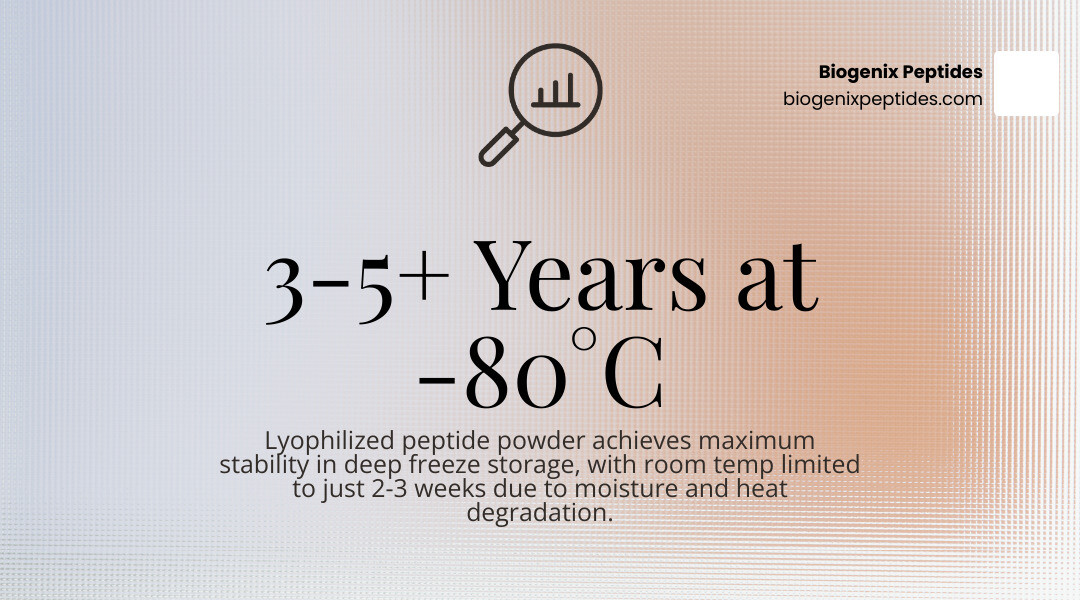
| Deep frozen (-80°C) | 3-5 years or more |
The key takeaway: the colder, drier, and darker the storage environment, the longer your peptides stay stable.
Peptides in lyophilized (freeze-dried) powder form are far more stable than their reconstituted liquid counterparts. But “more stable” doesn’t mean indestructible. Moisture, heat, oxygen, and light all quietly chip away at peptide integrity — even in powder form. Understanding exactly how and why this happens is what separates reliable research from wasted samples.
I’m Jay Daniel, Founder and CEO of BioGenix Peptides, and with years of hands-on experience in peptide sourcing, quality control, and laboratory best practices, I’ve seen how improper storage can compromise research outcomes — making the question of how long do peptides last in powder form critically relevant to every stage of the research process. In this guide, I’ll walk you through everything you need to know to protect your peptide investment from the moment it arrives to the moment it’s used.
Understanding Lyophilization and How Long Do Peptides Last in Powder Form
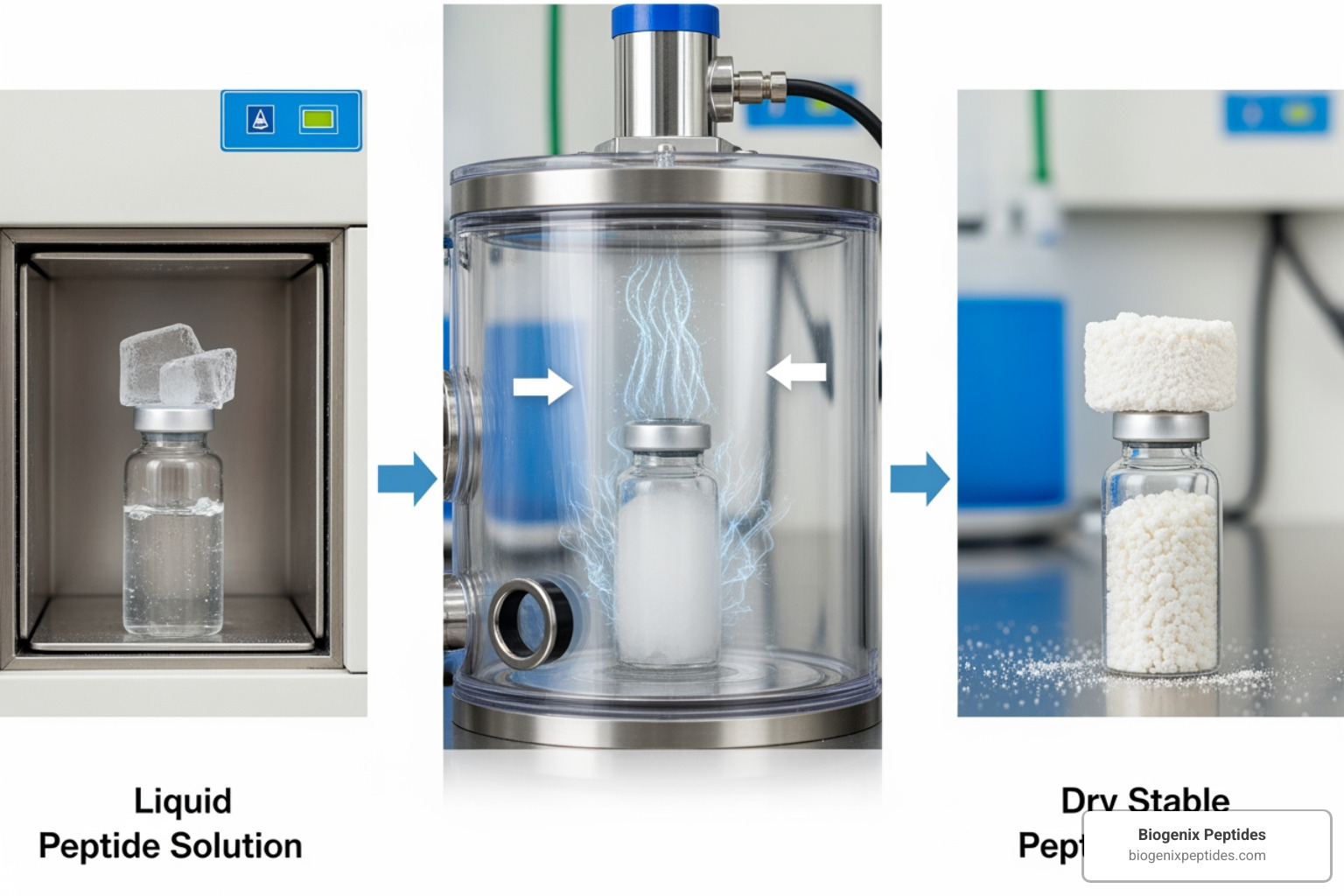
When you receive a vial of research peptides, they usually arrive as a fine, white, or off-white “cake” or powder. This isn’t just for ease of shipping; it’s a result of a process called lyophilization, or freeze-drying.
Lyophilization works by freezing the peptide solution and then reducing the surrounding pressure to allow the frozen water to sublime directly from the solid phase to the gas phase. This removes nearly all moisture, which is the primary driver of chemical degradation. By removing water, we essentially put the peptide into a state of “suspended animation.” Without water, the primary pathways for degradation—like hydrolysis and microbial growth—are significantly hindered.
However, even in this dry state, peptides possess a certain level of chemical fragility. They are thermodynamically stable but chemically sensitive to their environment. This is Why Research Peptides Are Typically Lyophilized (And How This Benefits Research), as it provides the most robust starting point for any long-term study.
How long do peptides last in powder form at room temperature?
We often get asked if a peptide is “ruined” if it sits on a desk for a few days. The short answer is: usually not.
How long do peptides last in powder form at room temperature (typically defined as 20-25°C or 68-77°F)? Most research indicates they are stable for about 2 to 3 weeks, and sometimes up to a month, provided the vial remains vacuum-sealed and protected from direct sunlight.
This stability is what allows for standard shipping without the need for expensive overnight cold-chain logistics in many climates. While they are stable for transport, ambient temperatures are not ideal for long-term storage. Extended exposure to room temperature increases the kinetic energy of the molecules, slowly encouraging hydrolysis (if any trace moisture is present) and oxidation.
How long do peptides last in powder form when frozen?
If you want to move beyond weeks and into years, you have to turn down the thermostat. Freezing is the gold standard for peptide preservation.
- At -20°C (-4°F): Most lyophilized peptides will remain stable for 2 to 3 years. Some sources suggest that under perfect conditions, they can last up to 48 months without significant loss of potency.
- At -80°C (-112°F): This is the “deep freeze” territory. At these ultra-low temperatures, molecular motion is almost entirely halted. Peptides can last 3 to 5 years, and in some cases, they are considered stable indefinitely for research purposes.
For a deeper dive into these timelines, our Peptide Storage & Stability Guidelines provide a comprehensive breakdown of what to expect when you tuck your vials away in the freezer.
Temperature Control: The Key to Peptide Longevity
In peptide chemistry, there is a general “rule of thumb” known as the Q10 rule. It suggests that for every 10°C increase in temperature, the rate of chemical degradation roughly doubles. Conversely, dropping the temperature by 10°C can halve the degradation rate.
This is why temperature control isn’t just a suggestion; it’s the single biggest determinant of your peptide’s shelf life. High temperatures provide the thermal energy required for chemical bonds to break or for unwanted new bonds to form (aggregation). By keeping things cold, we are essentially “slowing down time” for the peptide sequence. You can find more on these thermal dynamics in our Peptide Storage Stability Guidelines.
Refrigerated Storage (2-8°C)
The refrigerator is the “sweet spot” for peptides that you plan to use within the next year. At standard fridge temperatures (2-8°C), lyophilized powder is typically stable for 1 to 2 years.
However, the refrigerator presents one major enemy: moisture. Refrigerators are naturally humid environments. If a vial is not perfectly sealed, or if you open a cold vial in a warm room, moisture condensation will occur inside the vial. Because peptides are hygroscopic (they love to absorb water), this condensation can lead to “deliquescence,” where the powder begins to dissolve into a sticky goo, rapidly accelerating degradation.
Pro Tip: Always store your vials in an airtight secondary container (like a Tupperware or a sealed zip-lock bag) with a desiccant pack (silica gel) to absorb any stray moisture.
Deep Freeze Storage (-20°C to -80°C)
For long-term preservation (anything beyond a year), the freezer is mandatory. While a standard home freezer at -20°C is excellent, there is a hidden danger: the “frost-free” cycle.
Most modern consumer freezers use a frost-free cycle that periodically warms up the internal coils to melt ice buildup. This causes the internal temperature to fluctuate. While your frozen peas don’t mind, these micro-thawing cycles can be catastrophic for delicate peptide structures over several months.
If possible, use a “manual defrost” freezer or place your vials in the very back or bottom of the freezer, inside a secondary insulated container (like a small styrofoam box), to buffer against these temperature swings. For those with access to a lab-grade -80°C freezer, you are looking at a 3- to 5-year stability window, which is ideal for large-scale longitudinal studies.
Chemical Stability: Why Some Peptides Degrade Faster
Not all peptides are created equal. While the storage environment is crucial, the “internal” chemistry of the peptide sequence also dictates how long do peptides last in powder form. Some amino acids are simply more “dramatic” than others and require extra pampering.
Oxidation and Hydrolysis Pathways
The two most common ways a powdered peptide dies are oxidation and hydrolysis.
- Oxidation: This occurs when the peptide reacts with atmospheric oxygen. Amino acids like Cysteine (Cys), Methionine (Met), and Tryptophan (Trp) are highly prone to this. Cysteine residues can form unwanted disulfide bridges with other molecules, while Methionine can oxidize into sulfoxides. This often manifests as a slight yellowing or browning of the powder.
- Hydrolysis: This is the cleavage of peptide bonds by water. Even “dry” powder usually contains a tiny percentage of residual water. Sequences containing Asparagine (Asn) or Glutamine (Gln) are particularly susceptible to deamidation, while Asp-Pro (Aspartic Acid-Proline) motifs are notorious for being “fragile” bonds that break easily under stress.
For a full list of these chemical hurdles, see our guide on Best Practices for Peptide Storage & Handling.
Sequence-Specific Vulnerabilities
Beyond specific amino acids, the overall physical properties of the sequence matter:
- Hydrophobic Sequences: Peptides with a high percentage of hydrophobic (water-fearing) residues tend to aggregate or clump together. This can make them very difficult to dissolve later and can lead to a loss of biological activity.
- Fluorescent Tags: If your peptide is tagged (e.g., with FITC), it becomes highly light-sensitive. These must be stored in amber vials or wrapped in foil.
- Inert Gas Purging: For the most sensitive sequences (those heavy in Cys or Met), professional labs will often “blanket” the vial with an inert gas like Nitrogen or Argon before sealing. This pushes out the oxygen and significantly extends the shelf life.
Best Practices for Handling and Maximizing Shelf Life
You’ve invested in high-quality research materials; it only makes sense to handle them with care. Most peptide degradation happens not while the vial is sitting in the freezer, but during the moments it is being handled or prepared.
Preventing Moisture and Light Damage
We’ve mentioned the hygroscopic nature of peptides, but it bears repeating: Moisture is the enemy.
The most critical handling rule is the Equilibration Rule. When you take a vial out of the freezer, do not open it immediately. If you open a frozen vial in a room with 50% humidity, moisture from the air will instantly condense onto the cold powder. Instead, let the vial sit on the counter for at least 20 to 30 minutes until it reaches room temperature. Only then should you break the seal.
Light is another silent killer. UV light and even high-energy blue light can cause “photodegradation,” breaking peptide bonds through a process called photolysis. This is why we recommend:
- Storing vials in the dark (inside their original boxes).
- Using amber vials for light-sensitive compounds.
- Keeping work areas away from direct sunlight.
When you are ready to move from powder to liquid, follow our Reconstituting Lyophilized Peptides: Step-by-Step guide to ensure the transition doesn’t damage your sample.
The Dangers of Repeated Freeze-Thaw Cycles
Every time you freeze and thaw a peptide, you subject it to physical stress. As ice crystals form and melt, they can physically shear the peptide chains or cause them to denature (unfold).
To avoid this, we recommend the Aliquot Strategy. If you have a large amount of peptide powder, don’t keep opening and closing the same vial. Instead, weigh out smaller portions into multiple vials (aliquots) so that you only ever thaw what you need for a specific experiment. This keeps the bulk of your supply in a stable, frozen state. You can learn more about this in our Reconstituting Lyophilized Peptides Step-by-Step article.
Frequently Asked Questions about Peptide Powder Stability
How can I tell if my powdered peptides have degraded?
While chemical integrity is best verified via HPLC (High-Performance Liquid Chromatography) or Mass Spectrometry, there are several “red flags” you can look for:
- Discoloration: Pure peptides are usually white. If the powder turns yellow, brown, or grey, oxidation has likely occurred.
- Clumping/Gooeyness: If the powder looks like it’s melting or clumping into a “toffee-like” substance, moisture has entered the vial.
- Cake Collapse: If the nice, fluffy “cake” has shriveled or pulled away from the walls significantly, it might indicate moisture absorption (though some “cake collapse” is merely cosmetic from the lyophilization process).
- Solubility Changes: If a peptide that used to dissolve instantly now requires heavy sonication or refuses to dissolve, it may have aggregated or denatured.
Is it safe to use peptides that arrived warm during shipping?
In the vast majority of cases, yes. As we noted, lyophilized peptides are stable at room temperature for 2 to 3 weeks. Even if a package sits in a warm delivery truck for a few days, the degradation is usually negligible (often less than 1%). The vacuum seal inside the vial provides a significant buffer. Once the package arrives, simply move the vials to the fridge or freezer for long-term stability.
Can lyophilized peptides be stored indefinitely?
Theoretically, if a peptide is stored at -80°C in an oxygen-free, moisture-free environment, it could last for decades. One famous study even showed that certain lyophilized peptide mixtures remained stable for 17 years.
However, for practical research purposes, we usually rely on “retest dates.” Most manufacturers provide a retest date of 2 years. This doesn’t mean the peptide expires on that day; it means that after 2 years, you should verify its purity before proceeding with critical experiments.
Conclusion
The answer to how long do peptides last in powder form is ultimately in your hands. While lyophilization provides a sturdy foundation, your storage protocols determine whether your research will be based on high-potency compounds or degraded fragments.
To summarize the BioGenix Peptides gold standard for storage:
- Freeze for the long haul: Use -20°C or -80°C for anything you won’t use within a month.
- Control the environment: Use airtight secondary containers with desiccants to fight moisture.
- Handle with patience: Always equilibrate vials to room temperature before opening.
- Aliquot early: Avoid the “death by a thousand thaws” by dividing your supply.
By following these simple steps, you ensure experimental reproducibility and protect the efficacy of your research materials. Ready to dive deeper into the science of peptide handling? Learn more about proper peptide handling and storage at our research hub.

Author Disclaimer:
The content published under this author’s byline is provided for informational and educational purposes only and reflects theoretical research discussions related to peptides, biochemistry, and related scientific topics.
Any credentials or academic titles referenced are academic in nature only and do not imply medical licensure, clinical authority, or the practice of medicine.
This content does not constitute medical advice, diagnosis, or treatment, and should not be interpreted as such. The author is not providing clinical guidance and is not acting as a healthcare provider.
All products discussed by BioGenix Peptides LLC are intended strictly for research, laboratory, and analytical use only and are not for human or animal consumption.
BioGenix Peptides LLC makes no claims regarding the safety, efficacy, or approved use of any compounds discussed.
Best selling products
-

Bacteriostatic Water (Reconstitution Solution) 10mL
$16.00 -
RT (GLP-3 RT) 10mg
$120.00 -
RT (GLP-3 RT) 20mg
$195.00 -

Bacteriostatic Water (Reconstitution Solution) 3mL
$9.00 -
BPC-157 10mg
$72.00