Don’t Mess Up Your CJC-1295 No DAC Protocol
Getting Your CJC-1295 No DAC Protocol Right From the Start
Disclaimer: The information provided in this article is for educational and informational purposes only. It is not intended as medical advice, diagnosis, or treatment. Products and compounds referenced are for research use only and are not approved for human or veterinary consumption. Always consult a qualified professional regarding health or medical decisions.
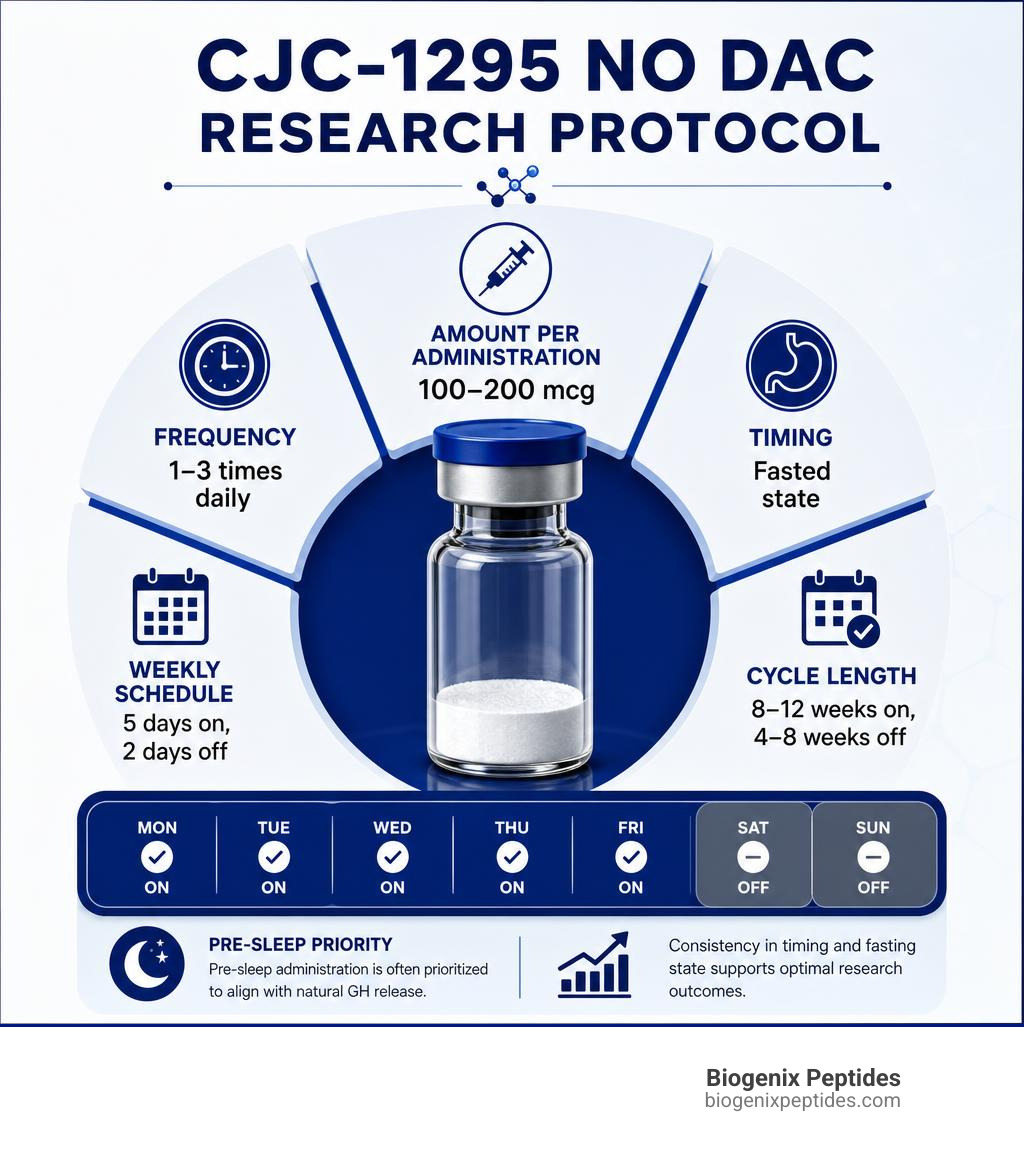
The standard CJC-1295 no DAC amount in research contexts is 100–200 mcg per administration, 1–3 times daily, administered in a fasted state. Here is a quick reference for researchers:
| Parameter | Standard Research Protocol |
|---|---|
| Amount per administration | 100–200 mcg |
| Frequency | 1–3 times daily |
| Timing | Fasted state, pre-sleep priority |
| Weekly schedule | 5 days on, 2 days off |
| Cycle length | 8–12 weeks on, 4–8 weeks off |
| Common pairing | Ipamorelin (100–200 mcg, same timing) |
Note: Amounts above ~150 mcg do not appear to produce proportionally greater GH output in research models, likely due to GHRH receptor saturation.
Getting a CJC-1295 no DAC research protocol wrong is surprisingly easy. The two forms of CJC-1295 — with and without DAC — are not the same compound. They have different half-lives, different administration frequencies, and different effects on GH pulse architecture. Confusing them is one of the most common errors researchers make before they even get started.
The no-DAC form (also called Modified GRF 1-29, or Mod GRF 1-29) has a plasma half-life of roughly 30 minutes. That short window is actually the point — it produces discrete, pulsatile GH release that more closely mirrors natural secretion patterns. But it also means that timing, frequency, and preparation all matter far more than with the longer-acting DAC version.
This guide covers the research protocols, reconstitution math, stacking considerations, and safety profiles you need to understand before working with this compound.
I’m Jay Daniel, Founder and CEO of BioGenix Peptides, with years of hands-on experience in peptide science, quality control, and research protocol development — including extensive work with GHRH analogs like CJC-1295 no DAC. In the sections ahead, I’ll walk you through everything the research currently supports, so you can approach your work with precision and confidence.
What is Mod GRF 1-29 and How Does It Differ From the DAC Version?
To understand this compound, we have to look at the pituitary gland’s natural signaling chain. Growth Hormone-Releasing Hormone (GHRH) is a peptide naturally produced by the hypothalamus. It travels to the anterior pituitary, where it binds to GHRH receptors on somatotroph cells, stimulating the synthesis and pulsatile release of growth hormone.
Native GHRH is incredibly fragile; it is degraded by enzymes in the bloodstream within minutes. To solve this in laboratory settings, scientists modified the first 29 amino acids of the GHRH chain, creating Modified GRF 1-29 (also known as Mod GRF 1-29 or CJC-1295 without DAC). These modifications preserve the peptide’s structural integrity, extending its half-life to approximately 30 minutes.
The massive point of confusion in the scientific community comes when comparing this to CJC-1295 with DAC (Drug Affinity Complex). The addition of the DAC affinity complex allows the peptide to bind covalently to albumin, a highly abundant blood protein. This modification dramatically stretches the half-life to between 5.8 and 8.1 days.
While a week-long half-life sounds convenient, it completely alters how the pituitary behaves. Instead of natural, rhythmic pulses of growth hormone, the DAC version causes a continuous, elevated baseline of GH release, often referred to as a “GH bleed.”
Alternatively, Mod GRF 1-29 (without DAC) respects the natural, episodic rhythm of the endocrine system. By introducing a brief, 30-minute signal, it amplifies the natural pulses without forcing the pituitary into a state of continuous, non-physiological hyper-secretion. This preserves receptor sensitivity and avoids long-term desensitization of the somatotrophs.
For a deeper dive into these molecular differences, you can read The Ultimate Guide to CJC-1295 Without DAC.
Establishing Safe CJC-1295 No DAC Protocols for Laboratory Research
When designing a laboratory protocol, precision is everything. GHRH receptors operate on a saturation curve. Research indicates that the saturation point for GHRH receptor activation occurs around 100 mcg. Beyond this limit (typically around 150 mcg), the receptors are fully occupied, meaning higher amounts do not yield a linear increase in GH release.
For standard research evaluations, a concentration of 100 mcg to 200 mcg per administration is the benchmark. Because of the rapid 30-minute half-life, this application is typically introduced 1 to 3 times daily to maintain meaningful experimental windows.
| Feature | Mod GRF 1-29 (No DAC) | CJC-1295 with DAC |
|---|---|---|
| Half-Life | ~30 minutes | 5.8 to 8.1 days |
| GH Release Pattern | Pulsatile (Physiological) | Continuous (GH Bleed) |
| Standard Research Amount | 100–200 mcg per application | 1,000–2,000 mcg per week |
| Frequency | 1–3 times daily | Once or twice weekly |
| Pituitary Adaptation Risk | Low (with scheduled breaks) | Moderate to High |
By utilizing a daily protocol of 100 mcg, researchers can study physiological responses without overloading the test subject’s signaling pathways. To prevent receptor downregulation, a weekly schedule of 5 days on followed by 2 days off is widely documented in literature.
Optimizing Administration Timing and Stacking Protocols
The timing of GHRH analog delivery is just as critical as the quantitative amount. Growth hormone release is highly sensitive to metabolic states and natural circadian rhythms. To maximize the experimental output of cjc-1295 no dac protocols, researchers must align the application with specific physiological windows.
Timing Guidelines to Maximize Growth Hormone Release
To achieve an optimal growth hormone response, the test subject must be in a fasted state. Both elevated blood glucose and circulating insulin blunt the pituitary’s response to GHRH. When insulin is present, somatostatin — the hormone responsible for inhibiting growth hormone — is released, which severely diminishes the effectiveness of Mod GRF 1-29.
- Fasted State Requirement: The compound should be administered at least 2 hours after the last food consumption, and no food should be consumed for at least 30 minutes following the application.
- The Nocturnal Window: The largest natural pulse of growth hormone occurs during the first few hours of deep, slow-wave sleep. Administering Mod GRF 1-29 right before bed amplifies this natural nocturnal surge, leading to more profound experimental observations.
- Post-Workout Window: A secondary application is often scheduled post-exercise, when the body’s natural demand for cellular repair and metabolic recovery is at its peak.
Stacking Mod GRF 1-29 with Ipamorelin
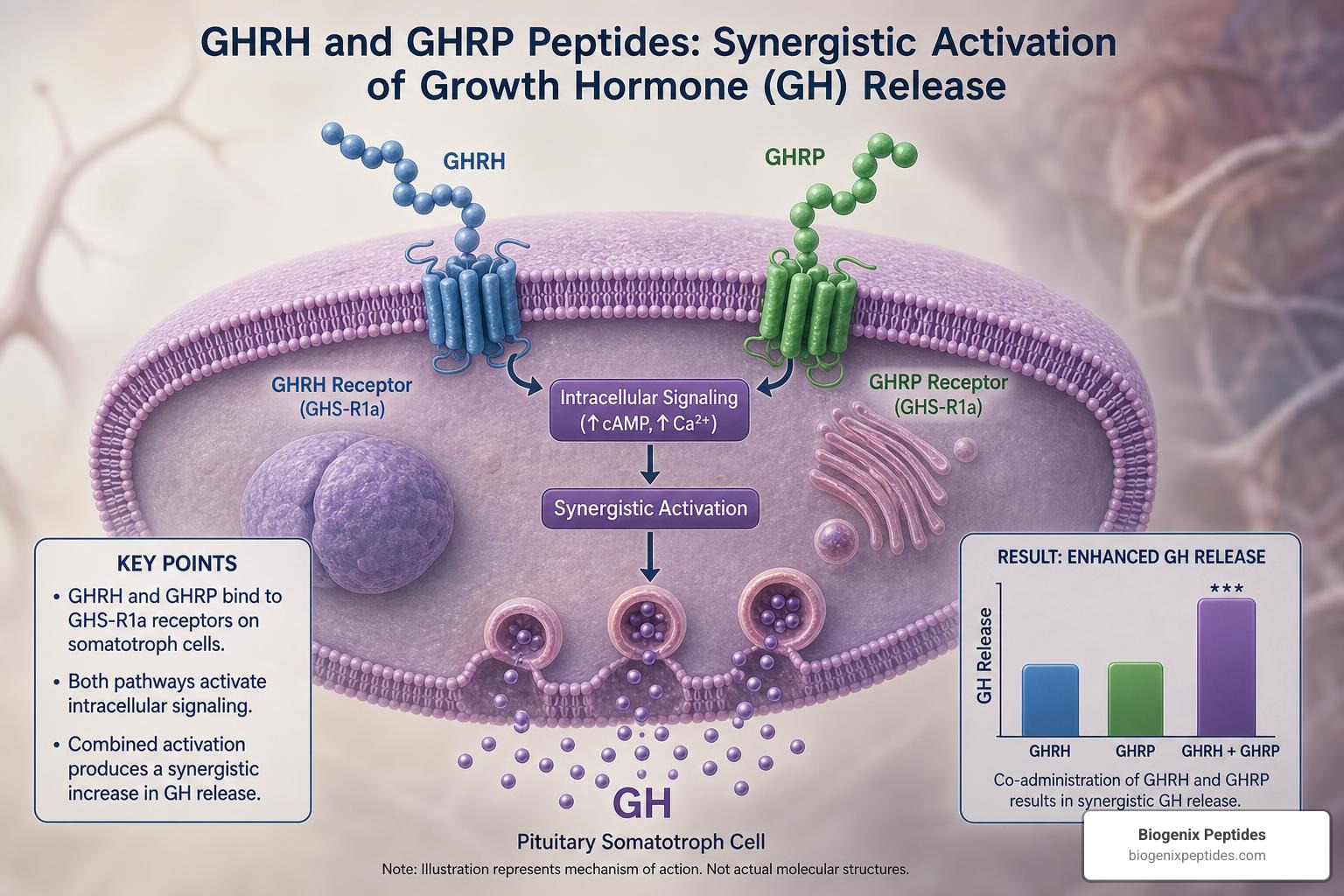
While Mod GRF 1-29 is effective on its own, its true power is unlocked when combined with a Growth Hormone Releasing Peptide (GHRP) like Ipamorelin.
To understand why this stack is considered the “gold standard” in peptide research, we must look at the dual-pathway control of the pituitary gland. The pituitary is governed by two opposing forces: GHRH (which stimulates GH release) and somatostatin (which stops it).
When you apply Mod GRF 1-29 alone, it acts as GHRH. However, if somatostatin levels are high in the subject’s body at that moment, the signal is partially blocked. Ipamorelin, a selective ghrelin receptor agonist, solves this problem. It works by directly triggering a growth hormone pulse while simultaneously suppressing somatostatin.
When administered together, Mod GRF 1-29 amplifies the pulse signal while Ipamorelin clears the pathway. The result is a synergistic release of growth hormone that is roughly 5 to 10 times greater than what either peptide can achieve on its own.
For detailed guidelines on structuring these combined regimens, refer to our resource on combining GHRH and GHRP secretagogues. If you are ready to acquire this specific combination for your lab, you can Shop Recovery CJC-1295 No DAC Ipamorelin directly from our store.
Reconstitution and Storage Best Practices
Peptides are delicate chains of amino acids held together by fragile peptide bonds. Improper handling, temperature fluctuations, or aggressive physical movement can easily shear these bonds, rendering your research material completely useless.
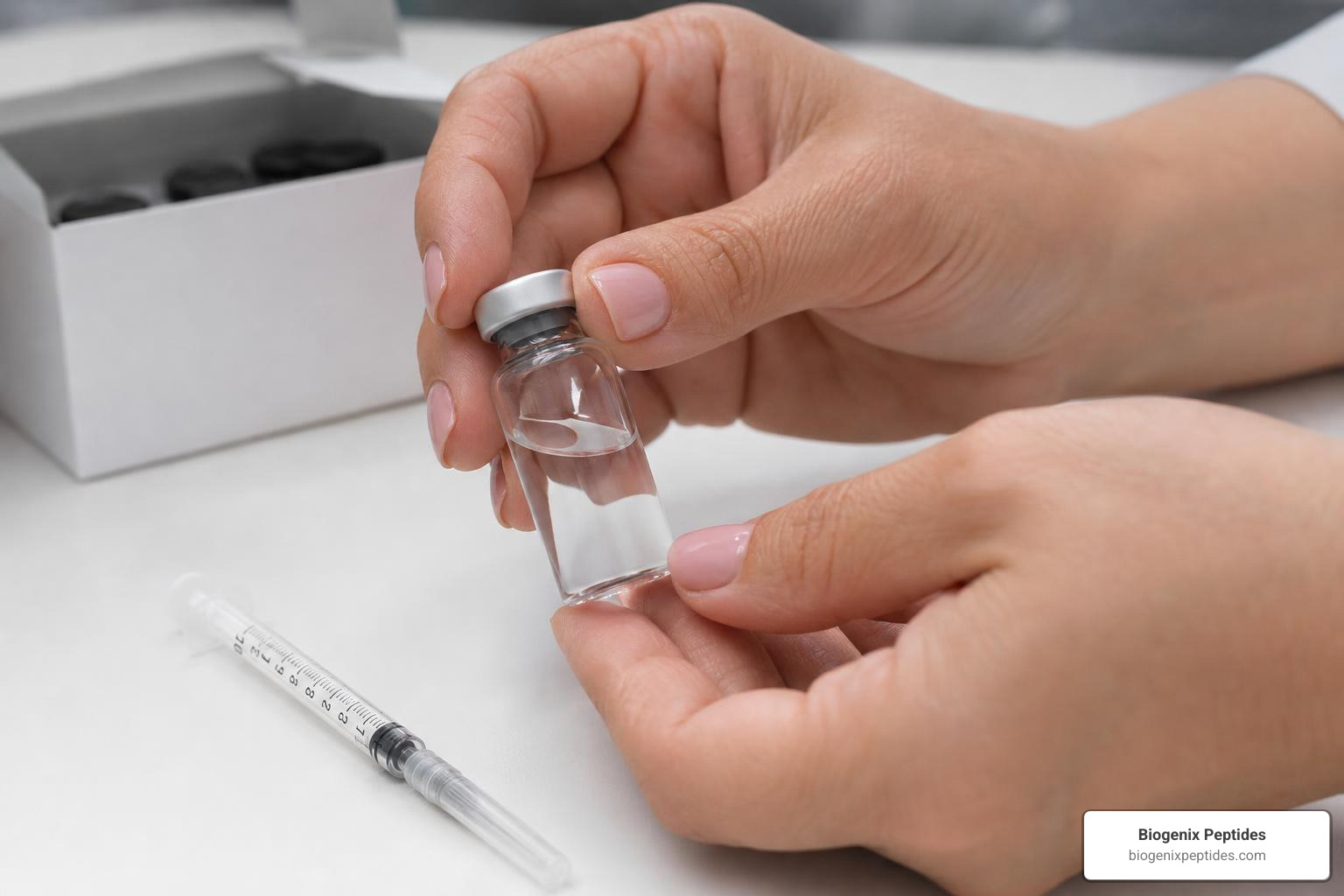
To prepare your lyophilized (freeze-dried) peptide for laboratory evaluation, you must reconstitute it using sterile bacteriostatic water (0.9% benzyl alcohol). The benzyl alcohol acts as a preservative, preventing bacterial growth and ensuring the stability of the solution.
Calculating the Correct CJC-1295 No DAC Quantity in Micrograms
Let’s walk through the math to ensure your fluid measurements align perfectly with your target microgram amounts. Confusing milligrams, milliliters, and insulin syringe units is one of the easiest ways to ruin an experiment.
Suppose you have a 5 mg vial of CJC-1295 no DAC and you want to reconstitute it to achieve a standard concentration where a single application equals 100 mcg.
- Determine the total milligrams: 5 mg = 5,000 mcg.
- Choose your diluent volume: Add 2.5 mL of bacteriostatic water to the vial.
- Calculate the concentration: 5,000 mcg divided by 2.5 mL = 2,000 mcg per mL.
- Translate to a U-100 insulin syringe: A standard U-100 syringe has 100 units per 1 mL.
- If 1 mL contains 2,000 mcg, then 0.1 mL (which is 10 units on the syringe) contains exactly 200 mcg.
- To get a 100 mcg amount, you would draw up exactly 5 units (0.05 mL) of liquid.
For a step-by-step visual tutorial on this process, check out our guide on mixing peptides at home like a pro.
Avoiding Common Mistakes in Peptide Preparation
When introducing the bacteriostatic water into the vial, never spray the liquid directly onto the lyophilized powder. The high pressure can damage the peptide structure. Instead, aim the needle at the glass wall of the vial and let the water slowly slide down.
Once the diluent is inside, do not shake the vial. Instead, gently roll the vial between your palms or swirl it in a slow, circular motion. Let it sit in the refrigerator for 2 to 3 minutes until the solution is completely clear and free of particles.
Always store your reconstituted vials in a secure refrigerator at 2°C to 8°C (36°F to 46°F). Never freeze a reconstituted peptide, as the formation of ice crystals will destroy the delicate molecules. For more comprehensive storage instructions, read our guide on best practices for peptide storage handling and review the 10 most common mistakes people make when they’re new to peptide research.
Expected Research Outcomes, Cycle Lengths, and Safety Profiles
In well-designed scientific models, the physiological effects of Mod GRF 1-29 are cumulative and subtle. Unlike synthetic growth hormone, which causes rapid, unnatural shifts in fluid balance, GHRH analogs work with the body’s natural endocrine machinery.
- Weeks 1–2: Improved slow-wave sleep architecture, characterized by deeper rest and more vivid dreams.
- Weeks 4–8: Gradual improvements in metabolic rate, fat oxidation (particularly visceral fat), and cellular repair.
- Weeks 8–12: Enhanced recovery from physical exertion, improved skin elasticity, and modest positive shifts in lean muscle tissue composition.
A standard research cycle typically spans 8 to 12 weeks, followed by an equivalent “off” period of 4 to 8 weeks. This scheduled break is essential because continuous, uninterrupted stimulation of the GHRH receptors can lead to a gradual attenuation of the signal pathway, reducing the overall efficacy of the compound.
While Mod GRF 1-29 has a very favorable safety profile, some transient side effects may be observed. The most common is a temporary “head rush” or flushing of the skin immediately following administration, which typically lasts 10 to 15 minutes. This is caused by a brief release of histamine and rapid vasodilation. Mild fluid retention and temporary joint stiffness may also occur as growth hormone levels begin to elevate.
Comparing Mod GRF 1-29 to Other GHRH Analogs in Research
Mod GRF 1-29 is not the only GHRH analog available for scientific evaluation, but it occupies a unique sweet spot in terms of receptor binding affinity and cost-effectiveness.
- Sermorelin: This was the original GHRH fragment (amino acids 1-29). However, it lacks the protective modifications of Mod GRF 1-29. As a result, its binding time to GHRH receptors is only 8 to 12 minutes, requiring significantly larger quantities to achieve the same growth hormone release.
- Tesamorelin: This is an FDA-approved GHRH analog specifically designed to reduce visceral fat in patients with HIV-associated lipodystrophy. While highly effective, its structural modifications are tailored for fat loss, and it is significantly more expensive to source for general laboratory research.
Monitoring Biomarkers During a CJC-1295 No DAC Protocol
To ensure the safety and validity of your research, tracking key blood markers is highly recommended. Baseline values should be established before the protocol begins and re-evaluated at the 6-to-8-week mark.
- IGF-1 (Insulin-like Growth Factor 1): This is the primary marker used to confirm that the pituitary is successfully translating the GHRH signal into systemic growth hormone activity. A typical successful protocol yields a 1.5- to 3-fold increase in circulating IGF-1.
- Fasting Glucose and HbA1c: Because growth hormone naturally mobilizes fatty acids and can reduce insulin sensitivity over extended periods, monitoring blood sugar levels is vital to ensure metabolic health is maintained.
- Thyroid Panel (TSH, Free T3, Free T4): Elevated growth hormone levels can sometimes accelerate the peripheral conversion of T4 to T3, which can temporarily alter thyroid dynamics.
Frequently Asked Questions About Mod GRF 1-29
Is Mod GRF 1-29 banned in competitive sports?
Yes. The World Anti-Doping Agency (WADA) classifies all growth hormone secretagogues, GHRH analogs (including both CJC-1295 variants), and GHRPs under Section S2 of the Prohibited List. They are strictly banned at all times for competitive athletes.
Can you mix Mod GRF 1-29 and Ipamorelin in the same syringe?
Yes, for the no-DAC version, this is a common laboratory convenience. After reconstituting both vials separately, researchers can draw the designated amount of Mod GRF 1-29 first, followed by the Ipamorelin, into the same syringe immediately prior to administration. Do not mix them together inside the storage vials, as this can alter the concentration math and stability.
Why is online self-sourcing risky for research?
Sourcing compounds from unverified online vendors carries substantial risks. Many of these products are manufactured without strict quality controls, leading to issues with purity issues, heavy metal contamination, or the presence of residual TFA (trifluoroacetic acid) from the synthesis process. High-quality research requires peptides verified by independent, third-party High-Performance Liquid Chromatography (HPLC) and Mass Spectrometry (MS) testing to guarantee a purity level of 99% or higher.
To learn more about navigating the online marketplace safely, read our Beginners Guide to Buying Peptides Online.
Conclusion
Executing a successful research protocol requires a deep understanding of endocrinology, precise concentration math, and meticulous storage habits. By choosing Mod GRF 1-29 (without DAC), you are selecting a compound that respects physiological feedback loops, offering a highly controlled, pulsatile model for growth hormone research.
At Biogenix Peptides, we are dedicated to providing researchers with the highest-purity, laboratory-grade compounds available. Every batch of our products undergoes rigorous third-party testing to ensure your experimental data remains accurate and reproducible.
If you are ready to begin your scientific evaluation with premium-grade materials, you can Shop Recovery CJC-1295 No DAC directly from our secure online catalog today.