
How to Reconstitute Peptides in 5 Easy Steps
Disclaimer: The information provided in this article is for educational and informational purposes only. It is not intended as medical advice, diagnosis, or treatment. Products and compounds referenced are for research use only and are not approved for human or veterinary consumption. Always consult a qualified professional regarding health or medical decisions.
Why Peptide Reconstitution Is the Most Critical Step in Any Research Protocol

Peptide reconstitution is the process of dissolving a freeze-dried (lyophilized) peptide powder into a liquid solvent — most commonly bacteriostatic water — to create a stable solution ready for research use.
Here is a quick overview of how it works:
- Gather supplies — bacteriostatic water, sterile syringes, alcohol swabs, nitrile gloves
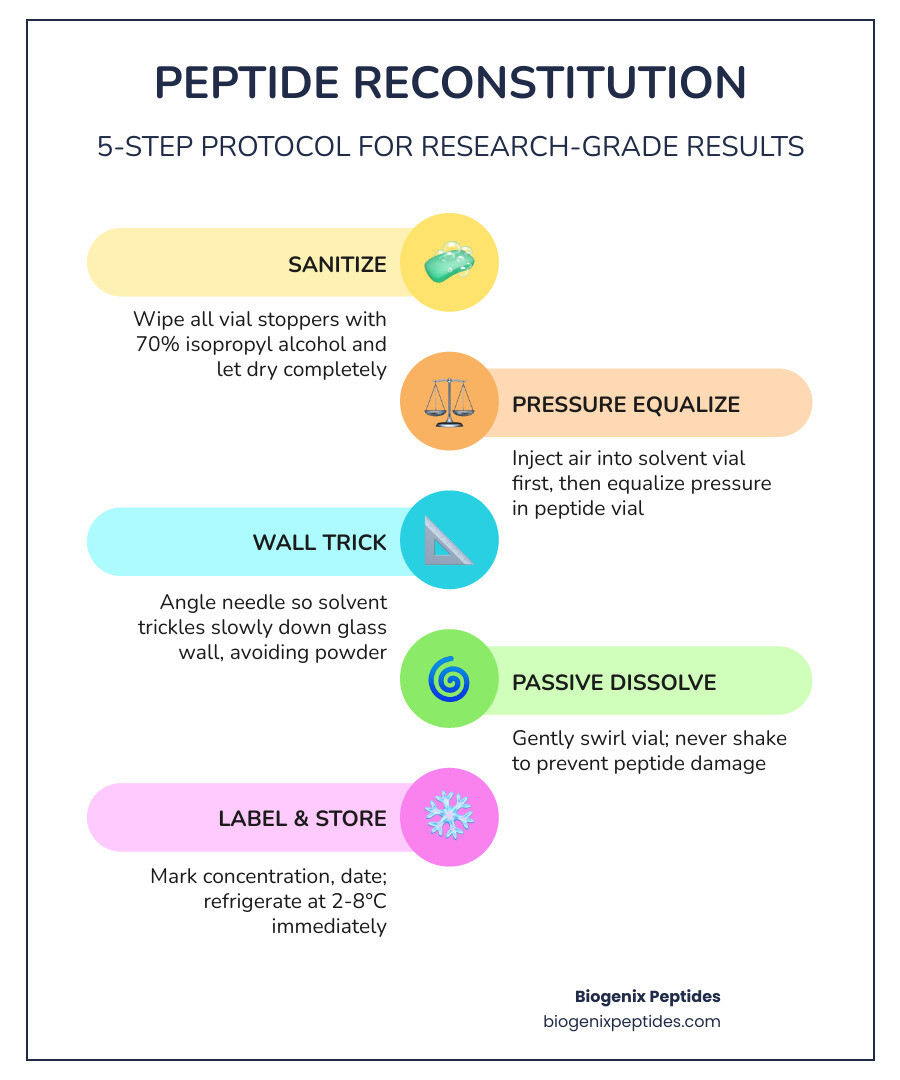
- Sanitize — wipe all vial stoppers with 70% isopropyl alcohol and let dry
- Add solvent slowly — angle the needle so liquid trickles down the inside glass wall
- Dissolve gently — swirl the vial; never shake it
- Label and store — note the compound name, concentration, and date; refrigerate at 2–8°C
Most research peptides arrive as a fragile white powder or thin cake inside a sealed glass vial. In that dry form, they can remain stable for weeks at room temperature — or even years when frozen. But they cannot be used in research until they are dissolved into a precise liquid volume.
Done correctly, reconstitution preserves the peptide’s biological activity and ensures consistent, repeatable results. Done carelessly — wrong solvent, forceful mixing, or skipping sterile technique — and the compound can degrade, aggregate, or become contaminated before a single experiment is run.
I’m Jay Daniel, Founder and CEO of BioGenix Peptides, with years of hands-on experience in peptide science and laboratory quality standards, including direct work with peptide reconstitution protocols across a wide range of research compounds. In the sections below, I’ll walk you through the exact 5-step process our team recommends for accurate, reproducible results.
Essential Supplies for Laboratory Preparation
Before we begin the process of peptide reconstitution, we must ensure our laboratory environment is prepared with the correct materials. Using the wrong supplies doesn’t just risk the integrity of the research; it can lead to the total degradation of the amino acid chains we are studying.
The Primary Solvent: Bacteriostatic Water
For the vast majority of research applications, bacteriostatic water (BAC water) is the gold standard. BAC water is sterile water containing 0.9% benzyl alcohol, which acts as a preservative to inhibit the growth of bacteria. This allows the researcher to perform multiple withdrawals from a single vial over approximately 28 days.
In contrast, sterile water lacks this preservative. While it is pure, it must be used within 24 hours of opening because it cannot prevent bacterial colonization once the seal is punctured. Understanding Sterile Water And Bacteriostatic Water Differences You Must Know is vital for maintaining a clean research environment.
Necessary Hardware and Sanitization Tools
- Insulin Syringes: Typically U-100 (1 mL) syringes are used for measuring the final solution. These are calibrated in “units,” where 100 units equal 1 mL.
- Reconstitution Syringe: We often recommend a slightly larger 3 mL syringe with a 20-22 gauge needle for the initial transfer of BAC water, as it provides better control than the tiny needles on insulin syringes.
- Alcohol Swabs: 70% isopropyl alcohol is mandatory for sanitizing the rubber stoppers of both the solvent and peptide vials.
- Nitrile Gloves: To maintain a sterile field and prevent oils or contaminants from transferring to the equipment.
- Sharps Container: For the safe disposal of all needles after a single use.
When preparing for your study, the quality of your solvent matters. Dont Dilute Your Success A Guide To Buying Bacteriostatic Water by ensuring you source USP-grade materials.
The 5-Step Protocol for Peptide Reconstitution
Now that the bench is set, let’s walk through the actual procedure. We follow these steps to minimize “mechanical denaturation”—the physical breaking of delicate peptide bonds.
Step 1: Sanitization
Wash your hands and don your gloves. Use a fresh alcohol swab to vigorously wipe the rubber stopper (septum) of both the peptide vial and the BAC water vial. Allow them to air-dry for at least 15–20 seconds. Never blow on the stoppers to dry them, as this introduces bacteria.
Step 2: Pressure Equalization
Vials are often vacuum-sealed. If you simply plunge a needle in, the vacuum may suck the liquid in too fast, damaging the powder. Draw a volume of air into your syringe equal to the amount of solvent you intend to use. Introduce that air into the BAC water vial to make it easier to withdraw the liquid. Once you have the solvent in the syringe, you can proceed to the peptide vial.
Step 3: The “Wall Trick”
This is the most important part of peptide reconstitution. Insert the needle into the peptide vial and aim the tip toward the glass side wall. Slowly transfer the solvent so it trickles down the glass rather than hitting the lyophilized powder directly. This prevents foaming and protects the fragile molecular structure.
Step 4: Passive Dissolution
Once the liquid is in, remove the needle. Do not touch the vial yet. Let it sit for 2–5 minutes. Many peptides will dissolve on their own through simple contact. If powder remains, gently roll the vial between your palms or swirl it in a slow, circular motion. For more on this, see our guide on Mixing Peptides In The Lab Like A Pro.
Step 5: Labeling
Every reconstituted vial looks like clear water. Without a label, your research is compromised. Immediately write the name of the compound, the date of reconstitution, and the concentration (e.g., 5mg/2mL) on the vial or a piece of tape.
For those conducting advanced studies, you may want to explore Advanced Laboratory Reconstitution Techniques to further refine your workflow.
Calculating Concentration During Peptide Reconstitution
To ensure your research measurements are accurate, you must calculate the concentration of the liquid. The math is straightforward:
Total Milligrams (mg) ÷ Total Milliliters (mL) = Concentration (mg/mL)
For example, if you have a 5mg vial and add 2mL of BAC water, your concentration is 2.5mg/mL. Since 1mL equals 100 units on a standard syringe, each unit contains 0.025mg (or 25mcg). Understanding The Secret To Reconstituting Peptides 5Mg Correctly is the difference between precise data and guesswork.
Handling Specific Research Compounds
Different compounds have unique characteristics during peptide reconstitution:
- BPC-157: Generally very stable and dissolves quickly. Check our Bpc 157 Reconstitution Ratios Made Easy For Research for specific volume suggestions.
- Semaglutide: May require more patience during the dissolution phase.
- GHK-Cu: Unlike most peptides, this will turn a distinct blue color due to the copper complex.
- TB-500: Often used in conjunction with BPC-157; ensure you follow the Bpc 157 Reconstitution Complete Guide if you are researching these together.
Storage and Stability Guidelines for Reconstituted Peptides
Once a peptide is in liquid form, the “clock” starts ticking. Lyophilized powder is stable, but liquid solutions are susceptible to heat, light, and time.
The Cold Chain
Reconstituted peptides must be stored in a refrigerator at temperatures between 2°C and 8°C (36°F–46°F). We recommend placing them in the back of the fridge rather than the door, as the door’s temperature fluctuates every time it is opened. Following Peptide Storage Stability Guidelines is essential to prevent premature hydrolysis (the breakdown of the peptide by water).
The 28-Day Rule
When using bacteriostatic water, most peptides remain stable for about 28 to 30 days. After this point, the preservative’s effectiveness wanes, and the peptide itself may begin to lose potency. Statistics show that most reconstituted peptides remain viable for 3–4 weeks at +4°C, but for the highest research integrity, they should be used within that 28-day window.
Light Sensitivity
Many compounds are light-sensitive. Store your vials in their original boxes or wrap them in aluminum foil to protect them from UV exposure, which can break the chemical bonds of the amino acid chains. For more tips, read about Maintaining Research Integrity in Storage and our updated Peptide Storage Stability Guidelines 2.
Troubleshooting and Common Mistakes to Avoid
Even experienced researchers can run into issues during peptide reconstitution. Here is how to handle the most common hurdles.
| Action | Result | Recommendation |
|---|---|---|
| Shaking | Denaturation & Bubbles | Never shake. Only gentle swirling. |
| Direct Stream | Molecular Shear | Aim at the glass wall. |
| Using Tap Water | Contamination | Use only Bacteriostatic Water. |
| Room Temp Storage | Rapid Degradation | Always refrigerate after mixing. |
Handling Cloudiness and Insolubility
If a solution appears cloudy after 5–10 minutes, it may indicate that the peptide has “crashed” or aggregated. This is common with hydrophobic (water-fearing) sequences.
- Wait: Let the vial sit in the refrigerator for 30 minutes.
- Temperature: Sometimes warming the vial slightly in your hand (not a microwave!) helps.
- pH Adjustment: Some research protocols require a drop of 0.6% acetic acid to help basic peptides dissolve.
- Solvents: In rare cases, a tiny amount of DMSO is used for highly hydrophobic sequences.
If you are stuck, our guide A Foolproof Way To Reconstitute Your Lyophilized Peptides offers deeper troubleshooting steps. You can also review Reconstituting Lyophilized Peptides Step By Step for a visual refresher.
Why Shaking Damages Peptide Reconstitution
Peptides are not like protein shakes. They are delicate chains held together by fragile bonds. Shaking introduces “mechanical shear,” which can literally unfold the protein structure. This is called denaturation. Once a peptide is denatured, it loses its biological activity, rendering the research results invalid. Furthermore, shaking creates foam at the air-liquid interface, which further encourages Reconstituting Lyophilized Peptides Step By Step 2 errors by trapping the compound in bubbles.
Frequently Asked Questions about Reconstitution
Can reconstituted peptides be frozen?
Generally, no. While lyophilized powder loves the freezer, liquid peptides do not. When a solution freezes, ice crystals form. These sharp crystals can physically shear the peptide chains. Research indicates that each freeze-thaw cycle can degrade approximately 5-15% of the peptide’s activity. If you must freeze a solution, it should be “aliquoted” into single-use vials first to avoid repeated cycles.
What if the solution remains cloudy?
Cloudiness usually points to the hydrophobicity of the specific amino acid sequence. It means the peptide is clumped together rather than dissolved. You can try adjusting the The Science Of The Bacteriostatic Water Peptide Ratio by adding a small amount of additional solvent, or using a pH-adjusting agent like acetic acid if the research protocol allows.
How long is the shelf life of a reconstituted vial?
When using BAC water and proper refrigeration (2-8°C), the shelf life is typically 28 days. While some peptides may remain stable for up to 3 months, the risk of bacterial growth and potency loss increases significantly after the first month. For the best results, always use Bacteriostatic Water For Research Purposes and track your dates closely.
Conclusion
At Biogenix Peptides, we believe that research integrity starts with the very first drop of solvent. Mastering peptide reconstitution is not just about following a recipe; it is about respecting the delicate chemistry of the compounds you are studying. By maintaining a sterile environment, using the “wall trick,” and adhering to strict storage protocols, you ensure that your laboratory data is accurate and reproducible.
For more detailed information on handling and advanced research protocols, we invite you to explore our full library of Research Handling and Protocols. Proper preparation is the foundation of successful science — let’s get it right every time.