BPC-157 Reconstitution Ratios Made Easy for Research
BPC-157 Reconstitution Ratios Made Easy for Research
Why Getting the Mix Right Matters for BPC-157 Research
Disclaimer: The information provided in this article is for educational and informational purposes only. It is not intended as medical advice, diagnosis, or treatment. Products and compounds referenced are for research use only and are not approved for human or veterinary consumption. Always consult a qualified professional regarding health or medical decisions.

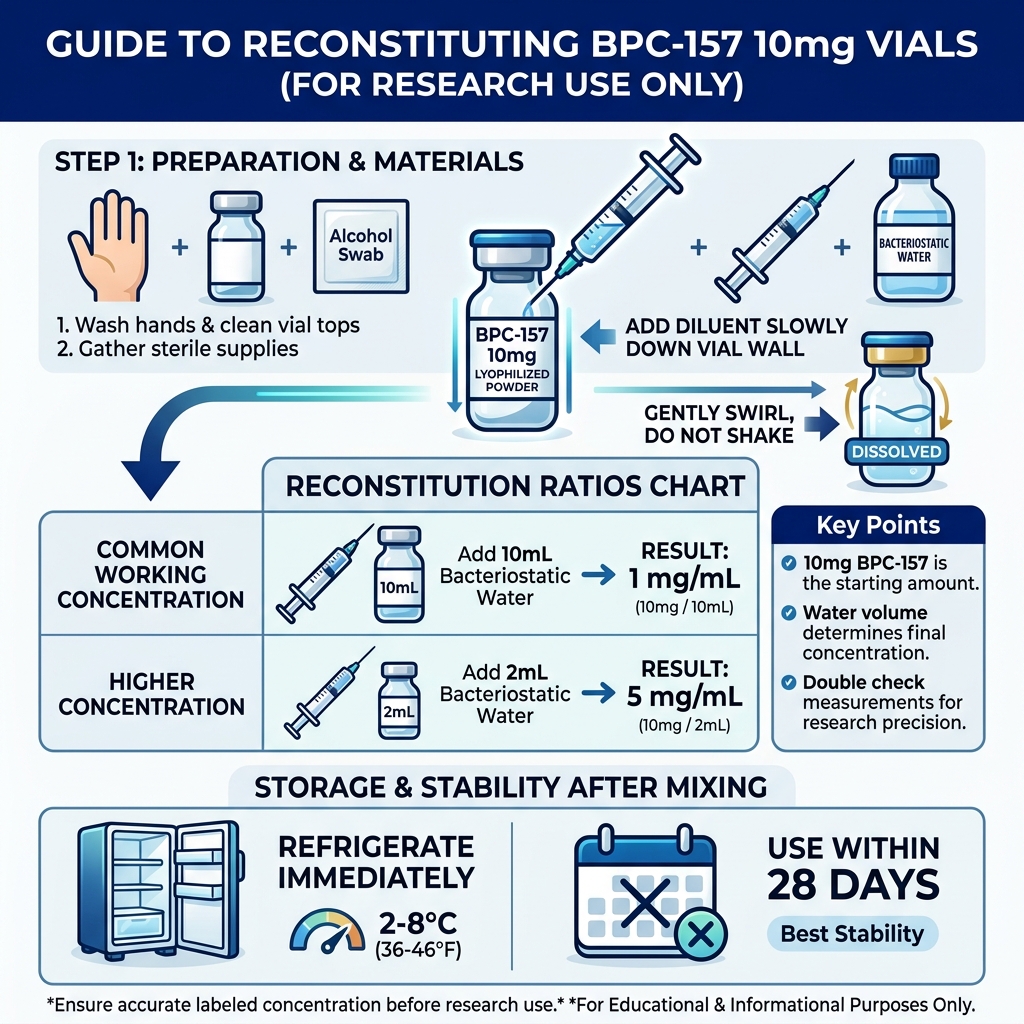
Reconstituting BPC-157 10mg is a straightforward process once you understand the core steps. Here is a quick overview for researchers:
- Allow the lyophilized vial to reach room temperature
- Add bacteriostatic water slowly down the inside wall of the vial using a sterile syringe
- Use 10mL of bacteriostatic water for a 1mg/mL working concentration (or 2mL for a 5mg/mL concentration)
- Gently swirl — never shake — until the powder fully dissolves
- Label the vial with the concentration and date, then refrigerate immediately at 2–8°C
- Use within 28 days of reconstitution for best stability
BPC-157 is a synthetic 15-amino acid peptide derived from a protein found in gastric juice. It arrives in research vials as a lyophilized (freeze-dried) powder. That powder form is what makes it shelf-stable — but it also means it needs to be carefully reconstituted with the right diluent before any research application can begin. Get the ratio wrong, and your concentration calculations fall apart. Get the technique wrong, and you risk contaminating or degrading the peptide entirely.
This matters more than many researchers initially realize. Accurate reconstitution is the foundation of reliable, repeatable research outcomes.
I’m Jay Daniel, Founder and CEO of BioGenix Peptides, with years of hands-on experience in peptide sourcing, quality control, and laboratory protocols — including the precise handling required when reconstituting BPC-157 10mg vials for research use. In this guide, I’ll walk you through everything you need to do it correctly and confidently.
Basic reconstituting bpc 157 10mg terms:
Essential Equipment for Reconstituting BPC 157 10mg
Before we even crack open a vial, we need to make sure our laboratory bench is stocked with the right tools. Attempting to mix research compounds without the proper equipment is like trying to bake a soufflé with a hairdryer—it’s just not going to end well.
When we are reconstituting bpc 157 10mg, we are working with a relatively high concentration of peptide. This means precision is our best friend. Here is the checklist of what we need:
- Lyophilized BPC-157 (10mg vial): Ensure the seal is intact and the powder (often appearing as a solid “puck”) is white and free of discoloration.
- Bacteriostatic Water: This is the industry standard for research. Unlike sterile water, which is one-time use, bacteriostatic water contains 0.9% benzyl alcohol, which inhibits the growth of bacteria. We recommend having a Bacteriostatic Water Reconstitution Solution 10ml or a 3ml version on hand.
- Alcohol Swabs: You can never have too many of these. We use them to sanitize the rubber stoppers of both the water and the peptide vials.
- Insulin Syringes (U-100): These are typically 1mL (100 units) and are perfect for measuring out the final solution with high accuracy.
- Mixing Syringe (3mL or 5mL): While insulin syringes work, a larger syringe makes it easier to transfer the bacteriostatic water into the 10mg vial, especially if you are using a higher volume of diluent.
- Sharps Container: Safety first! Always dispose of needles properly.
Maintaining a sterile environment is paramount. We always suggest Creating a Sterile Research Environment by wiping down the workspace with 70% isopropyl alcohol and wearing gloves. This prevents environmental contaminants from entering the vial during the transfer process.

Step-by-Step Guide to the Reconstitution Process
Now that our bench is ready, let’s get into the nitty-gritty of the mix. We follow a strict protocol to ensure the peptide remains stable and effective for research purposes.
1. Temperature Equalization
Don’t rush the process. If your BPC-157 was stored in the freezer or refrigerator, allow it to sit at room temperature for about 15–20 minutes. Adding cold liquid to a cold powder can sometimes cause clumping, which makes the dissolution process much slower and more frustrating.
2. Sanitization
Pop the plastic caps off your BPC-157 Body Protection Compound 157 10mg vial and your bacteriostatic water. Use a fresh alcohol swab to vigorously wipe the rubber stoppers. Let them air dry—don’t blow on them (your breath is full of bacteria!).
3. Pressure Equalization
This is a pro tip that many beginners miss. Research vials are often vacuum-sealed. If you just stick a needle in and start squirting water, the pressure change can cause the water to spray everywhere, potentially damaging the delicate peptide chains.
- Draw up the amount of air into your syringe that equals the amount of water you plan to add.
- Inject that air into the bacteriostatic water vial.
- Withdraw the water.
- Before injecting into the peptide vial, draw a small amount of air into the syringe again. Insert the needle into the peptide vial and let the vacuum naturally pull the water in, or gently release the pressure.
4. The “Slow Flow” Technique
When reconstituting bpc 157 10mg, you should never aim the stream of water directly at the powder puck. Instead, angle the needle so the water drips slowly down the inside glass wall of the vial. This “sliding” technique protects the peptide from mechanical stress. You can find more details on this in our guide on Reconstituting Lyophilized Peptides Step-by-Step.
5. The Gentle Swirl
Once the water is in, do not shake the vial. Shaking creates foam (denatured proteins) and can break the peptide bonds. Instead, gently roll the vial between your palms or swirl it on the table until the solution is clear. If a few particles remain, just wait 10 minutes; they usually dissolve on their own. For more advanced tips, check out Mixing Peptides at Home Like a Pro.
Calculating Concentrations for Reconstituting BPC 157 10mg
Mathematics is where most researchers get a little nervous, but it’s actually quite simple. The concentration depends entirely on how much bacteriostatic water you add to the 10mg of powder.
For a 10mg vial, here are the most common ratios:
| Amount of Bac Water | Resulting Concentration | Amount per 10 Units (0.1mL) |
|---|---|---|
| 1 mL | 10 mg / mL | 1,000 mcg |
| 2 mL | 5 mg / mL | 500 mcg |
| 4 mL | 2.5 mg / mL | 250 mcg |
| 5 mL | 2 mg / mL | 200 mcg |
| 10 mL | 1 mg / mL | 100 mcg |
We often suggest using 2mL or 4mL for a 10mg vial. Why? Because it makes the math easy to read on a standard insulin syringe. If you use 4mL of water, every 10 units on your syringe equals 250mcg of BPC-157. This is a very common increment used in research protocols.
If you are looking for specific data on how these concentrations relate to research subjects, the BPC-157 Patient Information provides an excellent external reference for understanding these metrics.
Common Mistakes When Reconstituting BPC 157 10mg
Even experienced researchers can slip up. We’ve seen it all at BioGenix Peptides. To help you avoid these pitfalls, we’ve compiled a list of The 10 Most Common Mistakes People Make When They’re New to Peptide Research.
Here are the “Big Three” to watch out for:
- Vigorous Shaking: We cannot stress this enough. BPC-157 is a “Body Protection Compound,” but it can’t protect itself from you shaking it like a polaroid picture. Shaking causes mechanical stress that can render the peptide useless.
- Using the Wrong Water: Never use tap water, bottled water, or even plain “sterile water” for multi-application vials. Sterile water lacks the preservative needed to keep the solution clean over several weeks. Always use bacteriostatic water.
- Ignoring the Vacuum: If you don’t control the pressure during reconstituting bpc 157 10mg, the vacuum can suck the water in so fast it “stings” the peptide, leading to foaming. If you encounter issues with a specific vial, you can often find troubleshooting tips in community resources like the Q&A: Reconstituting 10mg Vial.
Best Practices for Peptide Stability and Storage
Once you have successfully mixed your solution, the clock starts ticking. Peptides are essentially short chains of amino acids, and they are susceptible to heat, light, and kinetic energy.
Temperature is Key
Reconstituted BPC-157 must be stored in the refrigerator. The ideal temperature range is 2–8°C (35.6–46.4°F). We recommend placing the vial in the back of the fridge rather than the door. Why? Because the door’s temperature fluctuates every time you reach for the milk, and those constant changes can degrade the peptide faster.
Light Protection
BPC-157 is light-sensitive. Most vials come in amber glass or have protective labels, but it’s best to keep them in a dark spot. Some researchers even keep their vials inside a small, opaque container within the fridge to provide an extra layer of protection.
The 28-Day Rule
While some studies suggest BPC-157 can remain stable for up to 6 weeks when refrigerated, the gold standard for bacteriostatic water is 28 days. After this point, the effectiveness of the preservative (benzyl alcohol) begins to decline, increasing the risk of bacterial growth. For a deep dive into this, check out our Peptide Storage Stability Guidelines.
Can You Freeze It?
Lyophilized (powder) BPC-157 can be stored in the freezer for years. However, never freeze reconstituted BPC-157. The formation of ice crystals can physically shred the peptide chains, making the solution worthless. We have a great article on this: Don’t Let Your Peptides Go Bad in the Fridge.
Frequently Asked Questions about BPC-157
We get a lot of questions about the specifics of reconstituting bpc 157 10mg. Here are the most common ones we hear from the research community.
How long is BPC-157 stable after mixing?
As mentioned, once mixed with bacteriostatic water and kept at 2–8°C, BPC-157 is generally stable for about 28 days to 6 weeks. If the solution becomes cloudy, changes color, or develops visible particles, it has likely degraded or become contaminated and should be discarded immediately. You can read more about handling in our Best Practices for Peptide Storage & Handling.
Can BPC-157 be mixed with TB-500?
Yes, this is a very popular combination in tissue repair research. Many researchers choose to use a BPC-157 TB-500 20mg Blend to simplify the process. If you are mixing them yourself, you can technically reconstitute them in separate vials and draw them into the same syringe for administration, or buy a pre-mixed vial. Because they are often used synergistically, maintaining a 1:1 ratio is a common research protocol.
What is the best solvent for 10mg vials?
Bacteriostatic water is the undisputed champion for reconstituting bpc 157 10mg. The 0.9% benzyl alcohol acts as a preservative, which is essential for a 10mg vial because it will likely be used for multiple research applications over several weeks. Sterile water is only appropriate if the entire vial is being used in a single application, which is rare for a 10mg quantity.
Conclusion
At BioGenix Peptides, we believe that the quality of your research is only as good as the quality of your materials and your preparation. Reconstituting bpc 157 10mg is not just a technicality; it is the first step in ensuring scientific accuracy. By following the aseptic techniques, pressure equalization steps, and storage guidelines we’ve outlined, you can protect the integrity of your compounds and the validity of your results.
We are committed to providing the research community with high-purity peptides and the knowledge to use them correctly. Whether you are looking for BPC-157 or essential supplies like bacteriostatic water, we have you covered.
Ready to start your next project? Shop High-Quality Research Peptides at BioGenix Peptides today and experience the difference that purity and expertise can make. Happy researching!