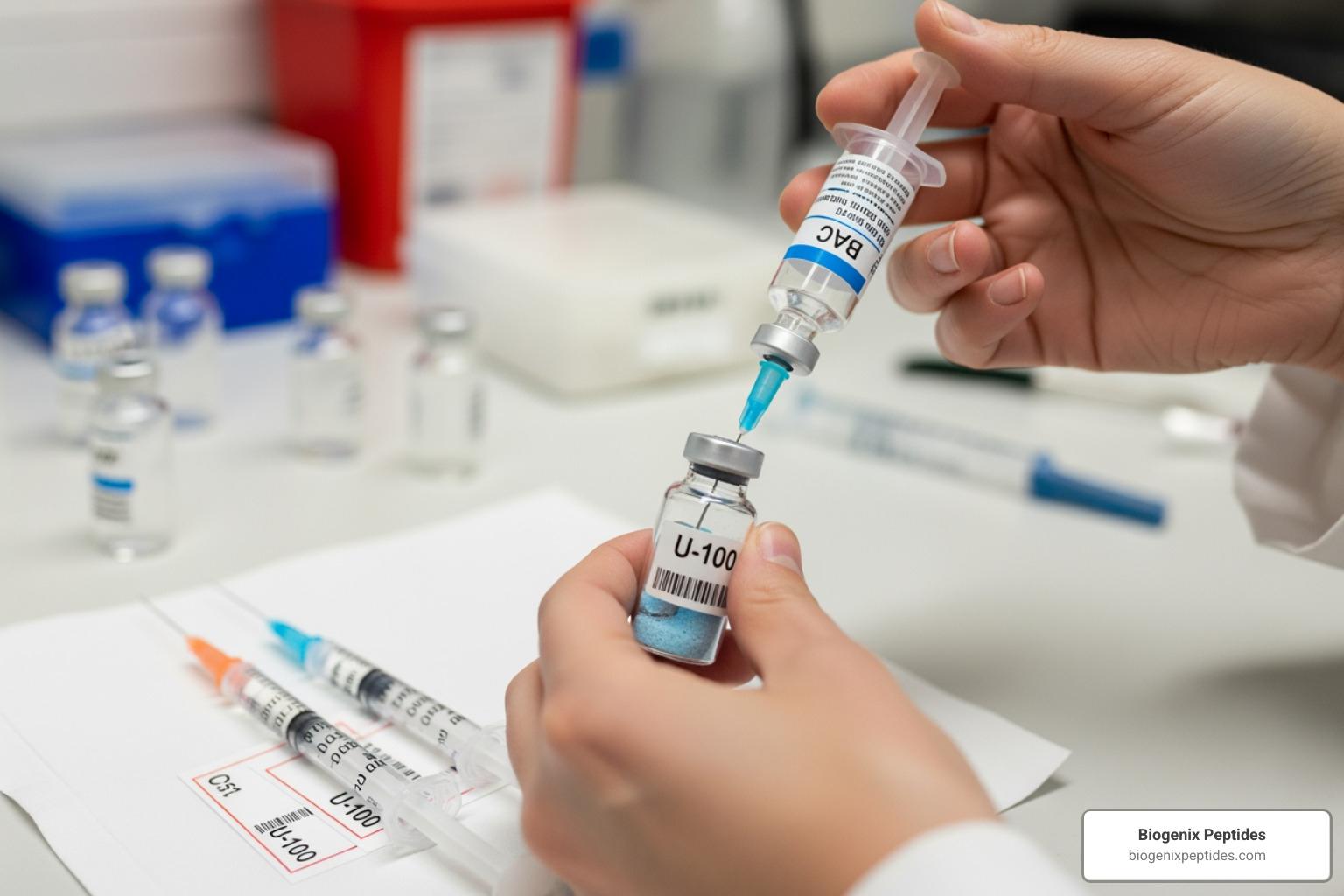
Mixing Peptides at Home Like a Pro
Why Getting BAC Water Volumes Right Makes or Breaks Your Peptide Research
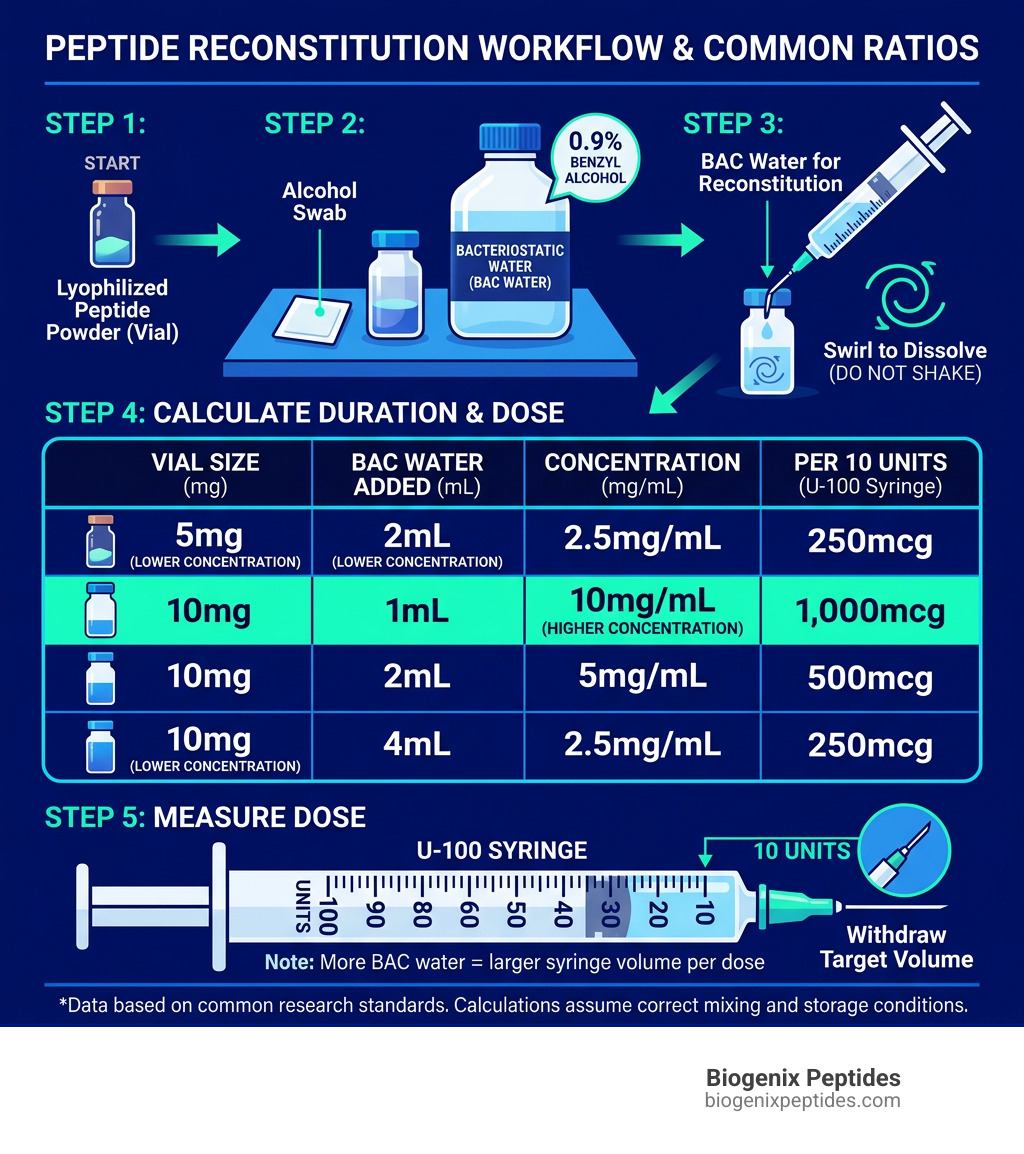
How much BAC water to reconstitute peptides depends on your vial size and your target concentration. Here are the most common ratios:
| Vial Size | BAC Water Added | Concentration | Per 10 Units (U-100 Syringe) |
|---|---|---|---|
| 5mg | 2mL | 2.5mg/mL | 250mcg |
| 10mg | 1mL | 10mg/mL | 1,000mcg |
| 10mg | 2mL | 5mg/mL | 500mcg |
| 10mg | 4mL | 2.5mg/mL | 250mcg |
More BAC water = lower concentration = larger syringe volume per dose. The total amount of peptide never changes — only how you measure it does.
You’ve invested in a quality lyophilized peptide. It arrives as a fine powder, stable and ready to go — until you add water. That’s where most dosing errors happen. Not at the injection stage. Not during storage. Right at reconstitution.
Get the BAC water volume wrong and you’re either injecting a fraction of the dose you think you are, or you’re cramming too much peptide into too little liquid to measure reliably. Either way, your research suffers.
This guide walks you through exactly how to get it right — the math, the method, and the mistakes to avoid.
I’m Jay Daniel, Founder and CEO of BioGenix Peptides, and I’ve spent years working directly with researchers and laboratory professionals on the precise handling of research-grade peptides — including the critical question of how much BAC water to reconstitute peptides for accurate, repeatable results. My work at BioGenix is built on scientific integrity and practical lab precision, and everything in this guide reflects that same standard.
Understanding Bacteriostatic Water and Its Role
When we talk about reconstituting peptides, we aren’t just talking about “adding water.” We are talking about creating a stable, sterile environment for delicate amino acid chains. This is why Bacteriostatic Water (BAC water) is the gold standard for multi-dose research vials.
Unlike sterile water, which is “one and done,” BAC water contains 0.9% benzyl alcohol. This specific concentration of alcohol acts as a preservative that inhibits the growth of bacteria. According to a Benzyl alcohol safety and utility review, this preservative is essential for preparations that will be punctured multiple times over several weeks.
When you use a needle to draw a dose, you are technically introducing a risk of contamination. The benzyl alcohol in BAC water suppresses any potential bacterial growth, extending the shelf life of your reconstituted peptide to approximately 28 days. At BioGenix, we provide both Bacteriostatic Water Reconstitution Solution 10ml and Bacteriostatic Water Reconstitution Solution 3ml to ensure your research stays sterile and safe.
Determining How Much BAC Water to Reconstitute Peptides
One of the biggest hurdles for new researchers is the math. It’s easy to get intimidated by milligrams (mg), micrograms (mcg), and milliliters (mL). But here is the secret: The amount of water you add does not change the amount of peptide in the vial. It only changes how “crowded” those molecules are.
To determine how much BAC water to reconstitute peptides, you first need to know your target dose. If you have a 10mg vial and you want to take a 500mcg dose, you have 20 doses in that vial (10,000mcg / 500mcg = 20).
- 1mg = 1,000mcg. Always convert to micrograms first to make the math easier.
- 1mL = 100 units on a standard U-100 insulin syringe.
If you add 1mL of water, those 20 doses are packed into 100 units. If you add 2mL, those same 20 doses are spread across 200 units. Using more water often makes it easier to measure “micro-doses” accurately because you have more room for error on the syringe markings. For the most precise results, many researchers use a peptide calculator to verify their volumes before starting.
Calculating how much BAC water to reconstitute peptides for 5mg vials
For a standard 5mg vial, a very common protocol is adding 2mL of BAC water.
Why 2mL? It creates a very user-friendly concentration of 2.5mg/mL. In practical terms, this means every 10 units (0.1mL) on your insulin syringe contains exactly 250mcg of the peptide. If your research protocol calls for 500mcg, you simply draw to the 20-unit mark. This ratio provides a great balance between keeping the volume small enough for comfort and large enough for visual accuracy. You can find more details on this in our guide on Reconstituting Lyophilized Peptides Step-by-Step.
Calculating how much BAC water to reconstitute peptides for 10mg vials
With 10mg vials, you have more flexibility. The choice typically comes down to how much you are dosing at once.
- 1mL of BAC Water: This creates a potent 10mg/mL concentration. Each 10-unit mark on the syringe represents 1,000mcg (1mg). This is great for high-dose protocols but can be difficult if you are trying to measure a tiny 100mcg dose (which would be just 1 unit!).
- 2mL of BAC Water: This is our “sweet spot” recommendation. It results in 5mg/mL. Every 10 units equals 500mcg. It’s easy to read, easy to calculate, and fits comfortably in most vials.
- 4mL of BAC Water: Used primarily for micro-dosing. This results in 2.5mg/mL, where 10 units equals 250mcg.
Understanding Why Research Peptides Are Typically Lyophilized helps you realize that the freeze-drying process creates a “puck” of powder that can easily absorb these different volumes of water without losing its structural integrity.
Step-by-Step Guide to Safe Reconstitution
Reconstitution is a delicate process. Peptides are held together by fragile peptide bonds that can be “sheared” or broken if handled roughly. Think of them as microscopic glass ornaments; you want to move them, not smash them.
1. Preparation and Aseptic Technique
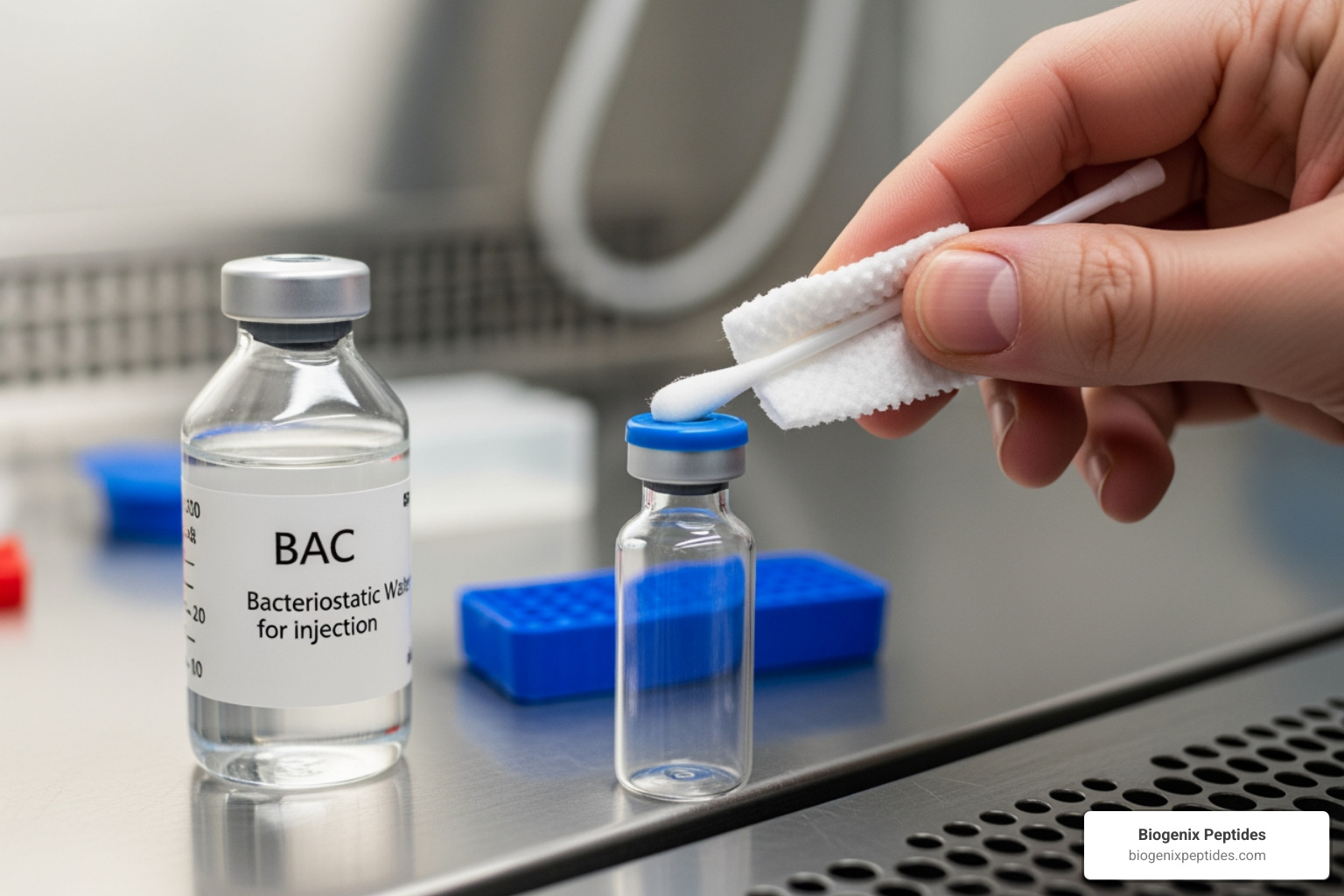
Clean your workspace. Wash your hands. Use an alcohol swab to vigorously clean the rubber stopper of both the BAC water vial and the peptide vial. Let the alcohol air dry completely—don’t blow on it!
2. Pressure Equalization
Peptide vials are often vacuum-sealed. If you just stick a needle in and let the water fly, the vacuum will “suck” the water in so fast it slams into the powder, potentially damaging the peptide. To avoid this, draw a bit of air into your syringe (equal to the amount of water you plan to add) and inject that air into the peptide vial first to equalize the pressure.
3. The “Slow Slide” Injection
When injecting the BAC water, aim the needle at the inside wall of the glass vial. Do not spray the water directly onto the powder. Let the water trickle down the side slowly. This “gentle introduction” is vital. According to Research on peptide stability and mechanical agitation, vigorous force can cause denaturation and irreversible aggregation.
4. Gentle Swirling
Once the water is in, do NOT shake the vial. Instead, gently swirl the vial between your fingers or roll it slowly across a flat surface. Let it sit for 5 to 15 minutes. Most high-purity peptides will dissolve completely on their own during this time. For more on proper handling, check our Category Usage & Handling section.
Storage, Stability, and Common Mistakes to Avoid
Once a peptide is liquid, the “clock” starts ticking. While lyophilized powder can last for years in a freezer, reconstituted peptides are much more sensitive to heat and light.
- Temperature: Always store your reconstituted peptides in the refrigerator at 2-8°C (36-46°F). Do not store them in the door of the fridge, as the temperature fluctuates every time you open it. Keep them toward the back.
- Light: Peptides are photosensitive. Keep them in the box they came in or a dark container to prevent UV degradation.
- The “No Shake” Rule: We can’t stress this enough. Shaking creates foam. Foam is made of air-liquid interfaces where peptides love to unfold (denature). Once a peptide denatures, it loses its bioactivity. Research on peptide aggregation and bioactivity shows that once these molecules clump together, they are effectively useless.
For a deep dive into maintaining your vials, see our Peptide Storage Stability Guidelines.
Frequently Asked Questions about Peptide Reconstitution
Can I use sterile water instead of BAC water?
Technically, yes, but only if you plan to use the entire vial immediately. Sterile water has no preservative. Once you puncture the vial, bacteria can begin to grow. If you plan to use the vial over the course of several days or weeks, you must use BAC water to ensure safety. Using sterile water for multi-dose vials significantly increases the risk of infection at the injection site.
Why is my peptide solution cloudy after mixing?
In almost all cases, a cloudy solution is a bad sign. It usually indicates that the peptide has “crashed” out of the solution or has denatured due to heat, shaking, or pH issues. A properly reconstituted peptide should be crystal clear.
The one major exception is AOD-9604 (and sometimes HGH Fragment 176-191), which is notoriously difficult to dissolve and often remains slightly cloudy or has visible particles. However, for 99% of other peptides, “if it’s cloudy, throw it out.” You can learn more about visual checks in our Best Practices for Peptide Storage & Handling guide.
Which peptides require acetic acid instead of BAC water?
Most peptides are “hydrophilic” (water-loving) and dissolve easily in BAC water. However, some are “hydrophobic” (water-fearing). The most common example is IGF-1 LR3.
If you add BAC water directly to IGF-1 LR3, it will likely degrade or clump within 24-48 hours. These peptides require a small amount of 0.6% Acetic Acid to stay stable. Once dissolved in the acid, you can then “buffer” it with a bit of BAC water to make the injection less stingy. Understanding Peptide stability in aqueous solution is key to knowing which solvent to pick for specialized research.
Conclusion
Mastering how much BAC water to reconstitute peptides is the first step in becoming a proficient researcher. It isn’t just about following a recipe; it’s about understanding the science of stability and the math of precision. By using the right solvent, equalizing pressure, and avoiding the “death shake,” you ensure that your research remains accurate and your results remain valid.
At Biogenix Peptides, we are committed to providing you with the highest quality lyophilized compounds and the supplies you need to handle them like a pro. Ready to start your next protocol? Shop high-quality peptides and supplies today and experience the difference that purity and precision make.