Mixing Your Peptides Like a Pro
Mixing Your Peptides Like a Pro
Disclaimer: The information provided in this article is for educational and informational purposes only. It is not intended as medical advice, diagnosis, or treatment. Products and compounds referenced are for research use only and are not approved for human or veterinary consumption. Always consult a qualified professional regarding health or medical decisions.
Mastering BPC-157 Reconstitution for Research
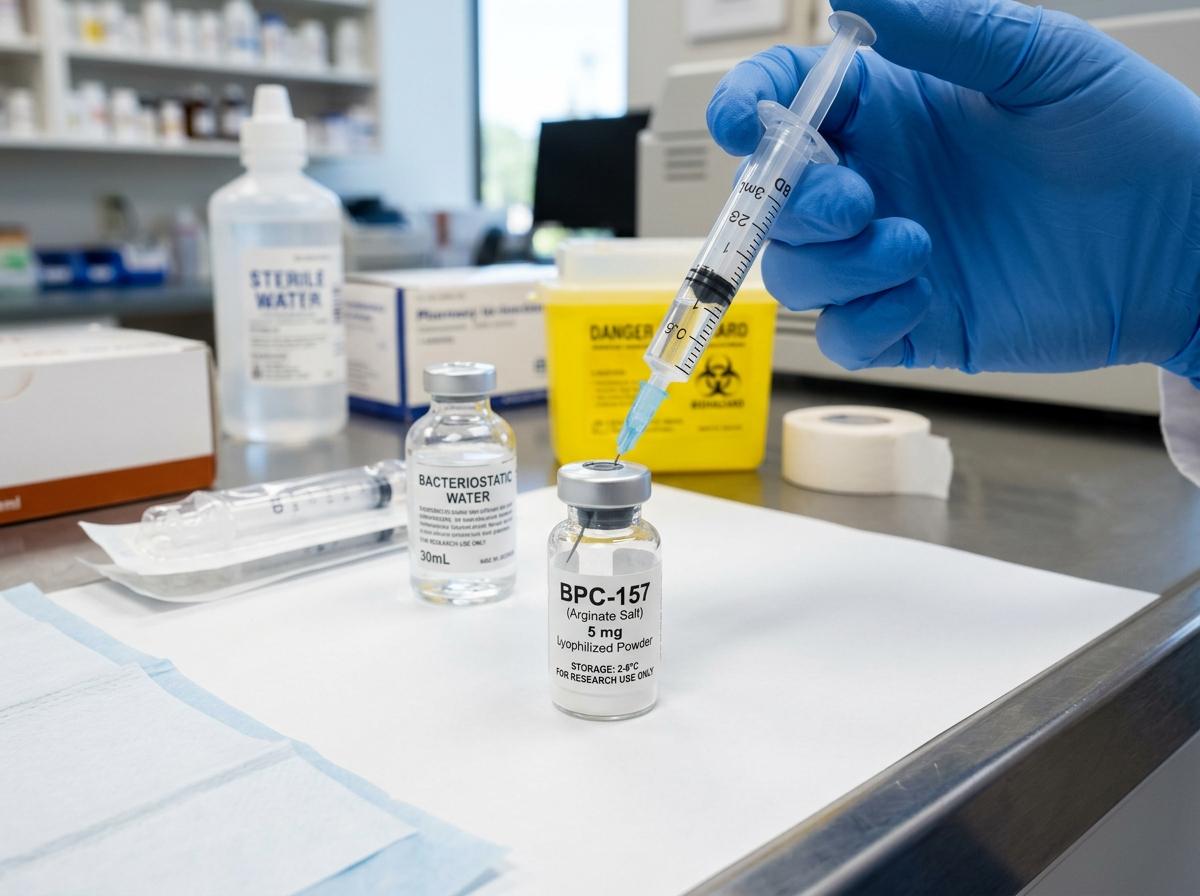
BPC 157 reconstitution is the process of dissolving lyophilized (freeze-dried) BPC-157 peptide powder into a liquid solvent — typically bacteriostatic water — to prepare it for research handling and laboratory protocols.
Here is a quick overview of how it works in a research setting:
- Gather your materials — a BPC-157 vial, bacteriostatic water, sterile syringes, and alcohol swabs
- Clean the vial stoppers with a 70% isopropyl alcohol swab and let them air dry
- Draw your solvent — 2 mL of bacteriostatic water is a common volume for a 5 mg vial in research preparation
- Add the solvent slowly by trickling it down the inside wall of the vial at a 45-degree angle
- Swirl gently until the powder dissolves — never shake the vial
- Label and refrigerate at 2–8°C immediately after mixing
Getting this process right matters. Incorrect reconstitution can compromise the integrity of the peptide and produce unreliable research results.
BPC-157 is a synthetic 15-amino acid pentadecapeptide derived from a protein found in gastric juice. It arrives in lyophilized form because freeze-drying removes moisture, which dramatically extends stability — lyophilized powder can remain stable for up to 3 years when stored properly. Once reconstituted, that stability window narrows significantly, which is why technique and storage are so important in research environments.
This guide shares general research-focused information on the process — from solvent selection to concentration calculations to troubleshooting — so your lab preparation starts on solid ground.
I’m Jay Daniel, Founder and CEO of BioGenix Peptides, and over years of hands-on work in peptide science and laboratory research, I’ve developed deep expertise in BPC 157 reconstitution and peptide handling best practices. The information below reflects research-focused handling opinions and general laboratory guidance only.
When you receive a vial of BPC-157, you’ll notice it isn’t a liquid. Instead, it’s a delicate, white “puck” or loose powder at the bottom of a vacuum-sealed glass vial. This is the result of lyophilization, or freeze-drying. We use this process because it is the gold standard for preserving the fragile peptide bonds of the 15-amino acid chain.
By removing water and sealing the compound in a vacuum, we help preserve the material during shipping and long-term storage for research purposes. Without this, the peptide would degrade rapidly at room temperature. For a deeper dive into this science, you can read Why Research Peptides Are Typically Lyophilized.
Mastering BPC 157 reconstitution is about “reactivating” this powder without causing mechanical stress. Think of the peptide as a fragile glass sculpture; if you expose it to liquid too forcefully or shake it violently, you risk damaging the molecular structure (denaturation), which can undermine research quality.
Essential Equipment and Solvent Selection
Before you even pop the cap off your vial, you need the right tools. Using the wrong solvent or contaminated equipment is one of the fastest ways to compromise research materials.
- Bacteriostatic Water (BAC): This is our preferred choice for most research. It contains 0.9% benzyl alcohol, which acts as a preservative to inhibit the growth of bacteria. This allows the solution to remain stable for up to 28 days when refrigerated.
- Sterile Syringes: We recommend using a larger syringe (3mL or 5mL) for the initial mixing to have better control, and standard 1mL U-100 insulin syringes for measuring small amounts during research handling.
- Alcohol Swabs: 70% isopropyl alcohol is mandatory for sanitizing the rubber stoppers of both the BAC water and the peptide vial.
- Clean Workspace: A flat, well-lit surface that has been wiped down with disinfectant.
For more on why the choice of water is so critical, check out Bacteriostatic Water for Research: Don’t Let Your Research Go Down the Drain.
The Step-by-Step Mixing Process
Precision is the name of the game here. Follow these steps to support a consistent research preparation process.
- Temperature Equilibration: Allow your lyophilized vial and your bacteriostatic water to reach room temperature (about 20-30 minutes). Cold liquids can sometimes cause the peptide to clump or “shock” the structure.
- Sanitization: Flip the plastic caps off both vials. Use a fresh alcohol swab to vigorously wipe the rubber stoppers. Let them air dry completely—don’t blow on them!
- Pressure Equalization: Draw a volume of air into your syringe equal to the amount of solvent you plan to add. Introduce that air into the BAC water vial to make drawing the liquid easier.
- The “Slow Trickle” Technique: Once you have your solvent in the syringe, insert the needle into the BPC-157 vial at a 45-degree angle. Aim the needle toward the side of the glass wall. Do not spray the liquid directly onto the powder puck. Let the water trickle down the glass slowly. This helps reduce foaming and shear stress.
- Dissolution: Most BPC-157 will dissolve almost instantly. If there are remaining particles, do not shake the vial. Instead, gently swirl the vial or roll it between your palms.
For a visual walkthrough of this process, see Reconstituting Lyophilized Peptides Step-by-Step.
Calculating Concentrations for Research Protocols
Math is where many researchers get tripped up, but it’s actually quite simple once you have a formula. The goal is to create a concentration that makes it easy to measure out specific amounts in your research.
Determining Concentration for BPC-157 Reconstitution
Most BPC-157 vials come in 5mg (5,000mcg) or 10mg (10,000mcg) sizes. The amount of solvent you add determines the concentration (mcg per mL).
A standard and highly recommended ratio for a 5mg vial is 2mL of bacteriostatic water. This creates a very “clean” math scenario:
- 5mg / 2mL = 2.5mg per mL.
- Since 1mL = 100 units on a standard syringe, each 10 units (0.1mL) contains 250mcg.
Precision in BPC-157 Reconstitution Math
If you are working with a 10mg vial, adding 2mL of solvent doubles the concentration:
- 10mg / 2mL = 5mg per mL.
- In this case, 10 units (0.1mL) would contain 500mcg.
Refer to the table below for quick reference:
| Vial Size | Solvent Volume | Concentration per 0.1mL (10 Units) | Total Volume |
|---|---|---|---|
| 5mg | 1mL | 500mcg | 1.0mL |
| 5mg | 2mL | 250mcg | 2.0mL |
| 5mg | 2.5mL | 200mcg | 2.5mL |
| 10mg | 2mL | 500mcg | 2.0mL |
| 10mg | 4mL | 250mcg | 4.0mL |
These examples are provided for research measurement reference only. For more tips on getting these numbers right, read The Secret to Reconstituting Peptides 5mg Correctly.
Storage, Stability, and Handling Best Practices
Once the BPC 157 reconstitution is complete, the “clock” starts ticking on stability. Peptides are sensitive to heat, light, and motion.
- Refrigeration: Reconstituted BPC-157 must be stored in a refrigerator at 2–8°C (36–46°F). Do not store it in the door of the fridge, as the temperature fluctuates too much when opened. Keep it toward the back.
- Light Protection: UV light can break down peptide bonds. Keep the vial in its original box or wrap it in foil if your fridge has internal lights that stay on.
- Stability Window: When mixed with bacteriostatic water, the solution is generally stable for about 28 to 30 days. After this point, the peptide may begin to lose its potency, even if it looks clear.
- No Freezing: Never freeze a peptide once it has been reconstituted. The formation of ice crystals can shear the peptide molecules and destroy them.
For long-term storage of unopened vials, the freezer is fine (up to 3 years), but once liquid hits that powder, the fridge is its only home. You can find more details in our Best Practices for Peptide Storage & Handling and Peptide Storage Stability Guidelines.
Troubleshooting and Avoiding Common Mistakes
Even experienced researchers run into issues sometimes. Here is how to think about a few common problems in a research setting:
- Foaming: If you see a layer of bubbles (foam) at the top, you likely added the water too fast or shook the vial. This is often associated with stress at the air-liquid interface. Let the vial sit in the fridge for an hour; the bubbles should settle, but be more gentle next time.
- Cloudiness: A properly reconstituted BPC-157 solution should be crystal clear. If it is cloudy or has “floaties” (particulate matter), it could mean the pH is off, the solvent was too cold, or the peptide has been contaminated. If it doesn’t clear up after 30 minutes of gentle rolling, it should be discarded.
- Vacuum Absence: If you insert the needle and the plunger isn’t “sucked” down by the vacuum, it doesn’t necessarily mean the peptide is bad, but it may indicate the seal was compromised. Extra care should be taken to maintain sterility.
For a deeper look at avoiding these pitfalls, see Mixing Peptides at Home Like a Pro.
Frequently Asked Questions about Reconstitution
Why is bacteriostatic water preferred over sterile water?
Sterile water (USP) does not contain a preservative. Once you puncture the lid, any bacteria that enters the vial can multiply. Sterile water is only good for about 24 hours. Bacteriostatic water, thanks to the benzyl alcohol, helps keep the solution more suitable for ongoing research handling for weeks.
Can the vial be shaken to speed up the process?
Absolutely not. Shaking creates mechanical stress that can break the delicate peptide chains. Always use a gentle swirling motion or simply let the vial sit; BPC-157 is highly soluble and will usually dissolve on its own within minutes.
What should be done if the solution remains cloudy?
If the solution remains cloudy after gentle swirling and reaching room temperature, check your solvent. If you used something other than BAC water (like saline), the salt concentration might be causing precipitation. In research, a cloudy solution is an unreliable solution.
Conclusion
At Biogenix Peptides, we believe that the quality of your research is only as good as your preparation. BPC 157 reconstitution is a straightforward process, but it requires a disciplined, sterile, and patient approach. By using the “slow trickle” method, calculating your concentrations accurately, and maintaining strict refrigeration protocols, you help support material integrity and more consistent research observations.
All information in this article is provided strictly for educational, informational, and research-focused discussion only and should not be interpreted as medical advice or human-use guidance. For more information on handling your research materials, check out our Research and Handling category.