Top Sterile Peptide Syringes for Wholesale and Retail Buyers
Why Choosing the Right Insulin Syringes for Peptides Matters in Research
Disclaimer: The information provided in this article is for educational and informational purposes only. It is not intended as medical advice, diagnosis, or treatment. Products and compounds referenced are for research use only and are not approved for human or veterinary consumption. Always consult a qualified professional regarding health or medical decisions.

Insulin syringes for peptides are the standard tool used in subcutaneous peptide research because of their fine-gauge needles, precise unit markings, and small barrel volumes — all ideal for handling tiny, accurate fluid volumes in a lab setting.
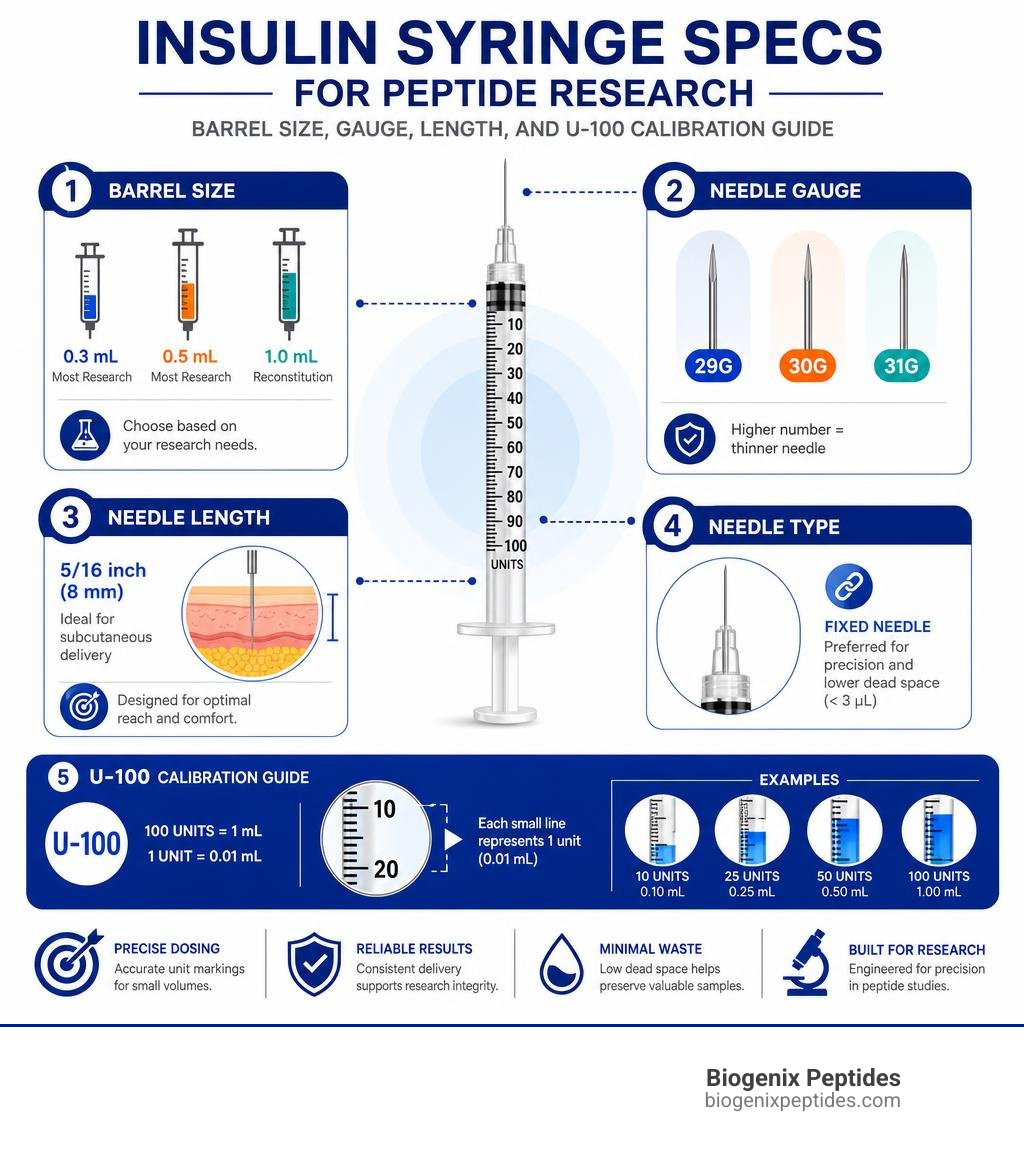
Quick answer — what to look for:
| Feature | Recommended Specification |
|---|---|
| Barrel volume | 0.3 mL or 0.5 mL for most research; 1.0 mL for reconstitution |
| Needle gauge | 29G, 30G, or 31G (higher = thinner) |
| Needle length | 5/16 inch (8 mm) for subcutaneous delivery |
| Calibration | U-100 (100 units = 1 mL; 1 unit = 0.01 mL) |
| Needle type | Fixed needle preferred — reduces dead space to under 3 µL |
Peptide research requires very small, precise fluid volumes. Standard syringes make that hard. Insulin syringes solve this because their unit markings — where each small tick equals just 0.01 mL — let researchers measure with a level of accuracy that millilitre-marked syringes simply can’t match at these scales.
The challenge most buyers run into isn’t finding syringes — it’s knowing which syringe specs actually matter for their research protocol, and avoiding the common measurement errors that come from misreading unit markings or choosing the wrong barrel size.
This guide walks through every key specification, so wholesale and retail buyers can make an informed, confident decision.
I’m Jay Daniel, Founder and CEO of BioGenix Peptides, and my years of hands-on experience in peptide sourcing, quality control, and laboratory protocols have given me a deep understanding of how insulin syringes for peptides affect research precision and outcomes. In the sections below, I’ll break down exactly what specs to prioritize — and what to avoid.
Technical Specifications of Insulin Syringes for Peptides
When selecting insulin syringes for peptides for laboratory studies, the technical specifications directly dictate the accuracy of your fluid transfers and the physical integrity of your research specimens. The three primary physical variables of any syringe are barrel capacity, needle gauge, and needle length.
The combination of these three dimensions determines not only how much fluid can be held, but also how much force is required to depress the plunger, how much tissue disruption occurs at the administration site, and how much fluid is lost in the syringe hub.
Understanding Dead-Space in Peptide Research
In laboratory protocols involving expensive or scarce research peptides, “dead-space” is a critical parameter. Dead-space refers to the residual fluid that remains inside the syringe and needle after the plunger is fully depressed.
- Fixed-Needle Syringes: These feature a needle permanently attached to the syringe barrel. Because there is no hub connection, the dead-space is virtually nonexistent (typically less than 3 µL). This makes them the gold standard for peptide fluid transfers.
- Detachable-Needle Syringes (Luer Lock/Luer Slip): These require separate needles to be twisted or slipped onto the barrel. The connection hub creates a chamber where fluid accumulates. This can result in a loss of 8 µL to 15 µL of peptide solution per transfer, leading to significant material waste over a multi-week study.
To assist wholesale and retail buyers in comparing these technical specifications, we have compiled a reference table below:
| Barrel Capacity | Common Needle Gauges | Needle Lengths | Common Calibration Scale | Best Research Application |
|---|---|---|---|---|
| 0.3 mL (30 Units) | 30G, 31G | 5/16″ (8 mm) | U-100 (1-unit increments) | High-precision micro-volume transfers (under 30 units) |
| 0.5 mL (50 Units) | 29G, 30G, 31G | 5/16″ (8 mm), 1/2″ (12.7 mm) | U-100 (1-unit increments) | Mid-range volume transfers (30 to 50 units) |
| 1.0 mL (100 Units) | 29G, 30G | 5/16″ (8 mm), 1/2″ (12.7 mm) | U-100 (2-unit increments) | Large-volume transfers and initial reconstitution |
How to Choose the Right Volume of Insulin Syringes for Peptides
Choosing the correct barrel volume is the first step toward ensuring measurement accuracy. The general rule in laboratory fluid dynamics is to use the smallest syringe barrel that can comfortably accommodate the target volume of your transfer.
- 0.3 mL Syringes: These are highly recommended for transfers under 30 units (0.3 mL). Because the barrel is narrow, the tick marks representing individual units are spaced further apart. This physical distance makes it much easier to read the markings at eye level, significantly reducing human error and parallax errors during measurement.
- 0.5 mL Syringes: This size offers a balanced middle ground, accommodating up to 50 units (0.5 mL). The spacing of the calibration marks still allows for high precision, making it suitable for a wide variety of standard peptide studies.
- 1.0 mL Syringes: While a 1.0 mL barrel can hold up to 100 units, the tick marks are physically closer together, and many brands print markings in 2-unit increments rather than 1-unit increments. This compressed scale makes micro-volume measurements highly challenging. Consequently, 1.0 mL syringes are best reserved for drawing and transferring diluents during the initial reconstitution phase.
To explore more about how these volumes translate to physical dimensions, researchers can consult this guide on Peptide Syringe and Needle Sizes.
Needle Gauge and Length Specifications for Research
The needle gauge refers to the outer diameter of the needle shaft. It is important to remember that the gauge scale is inverse: a higher gauge number indicates a thinner needle.
- 31G Needles: With an outer diameter of approximately 0.25 mm, 31G needles are exceptionally thin. This minimizes physical resistance and tissue trauma at the subcutaneous target site, which is beneficial for maintaining subject comfort in long-term studies. However, because the inner bore is so narrow, drawing highly viscous liquids can be slow.
- 30G and 29G Needles: These offer slightly wider inner diameters (0.30 mm and 0.33 mm, respectively). They provide a sturdier needle shaft that is less prone to bending when puncturing thick rubber vial septums, while still maintaining a very low profile for subcutaneous delivery.
For most subcutaneous applications, a needle length of 5/16 inch (8 mm) is preferred. This length is short enough to ensure the fluid is delivered directly into the subcutaneous adipose tissue layer, avoiding deeper intramuscular layers. A 1/2 inch (12.7 mm) needle may be used in specific models where a deeper subcutaneous layer must be reached, but it requires a careful angled approach (typically 45 degrees) to avoid muscular penetration.
For an example of a standard research configuration, you can view the U-100 0.5cc 30g 5/16″ Syringe product specifications.
Comparing U-100 and U-40 Insulin Syringes for Peptides
A critical point of confusion in peptide research is the distinction between U-100 and U-40 syringes. These designations refer to the concentration of insulin the syringes were originally calibrated to measure, and using them interchangeably in a peptide lab can lead to catastrophic calculation errors.
- U-100 Syringes: Calibrated such that 100 units of fluid equals exactly 1.0 mL. Therefore, 1 unit on a U-100 syringe represents exactly 0.01 mL of fluid volume. Because almost all peptide reconstitution mathematics are built around this 100-unit-to-1-mL ratio, U-100 syringes are the industry standard for peptide research.
- U-40 Syringes: Calibrated such that 40 units of fluid equals 1.0 mL. This means that 1 unit on a U-40 syringe represents 0.025 mL of fluid volume.
If a researcher uses a U-40 syringe but calculates their fluid volumes based on a standard U-100 scale, they will inadvertently transfer 2.5 times more fluid than intended. To maintain scientific accuracy and prevent experimental failure, always ensure your laboratory inventory is strictly stocked with U-100 syringes, unless your specific protocol explicitly demands U-40 calibration.
Reconstitution and Fluid Dynamics in Peptide Studies
Reconstitution is the delicate process of dissolving lyophilized (freeze-dried) peptide powder into a sterile liquid diluent so it can be measured and transferred. Because peptides are composed of fragile amino acid chains held together by sensitive peptide bonds, proper fluid dynamics must be maintained during this step to prevent structural degradation.

When preparing your compounds, refer to our detailed guides on Reconstituting Lyophilized Peptides and BPC-157 Reconstitution Ratios to ensure your calculations are perfectly aligned with your research goals.
Reconstitution Ratios and Diluent Selection
The choice of diluent determines the stability and shelf life of your reconstituted peptide solution.
- Bacteriostatic Water: This is sterile water containing 0.9% benzyl alcohol, which acts as an antimicrobial preservative. The presence of benzyl alcohol prevents the growth of bacteria, allowing the reconstituted vial to be accessed multiple times over a 28-day shelf life when stored in controlled refrigerated conditions.
- Sterile Water (without preservatives): This diluent contains no preservative agents. Once the vial is punctured, it must be utilized immediately and the remainder discarded. It is not suitable for multi-access peptide vials.
To understand the chemical properties of these diluents in depth, read our comparison of Sterile Water and Bacteriostatic Water Differences. For compound-specific protocols, see our BPC-157 Reconstitution Guide and learn how to safeguard your compounds with Bacteriostatic Water for Research.
Best Practices for Drawing Reconstituted Solutions
Once your peptide is fully dissolved, drawing the solution into the syringe requires careful physical technique to ensure volumetric accuracy:
- Equalize Vial Pressure: Before drawing liquid out of a sealed vial, draw an equivalent volume of air into your syringe and push it into the vial. This equalizes the internal pressure, preventing a vacuum from forming which would otherwise pull the plunger back and distort your measurement.
- Eliminate Parallax Error: Always read the syringe markings at eye level. Ensure the leading edge of the black rubber plunger tip (the top line of the plunger, not the middle or bottom) aligns precisely with your target calibration mark.
- Remove Air Bubbles: If air bubbles appear in the barrel, gently tap the side of the syringe with your finger to force the bubbles to the top, then push the plunger slightly to return the air back into the vial before finalizing your draw.
- Gentle Handling: Never shake a peptide vial to dissolve the powder. Shaking introduces shear forces that can denature the protein chains and create foam that traps the active compound. Instead, roll the vial gently between your palms for 10 to 20 seconds.
For practical tips on mastering these techniques, read our guides on Mixing Peptides Like a Pro and Reconstituting Peptides 5mg Correctly.
Safe Handling, Storage, and Disposal of Laboratory Syringes
Maintaining a sterile workflow is paramount to preventing contamination of both your research peptide vials and your subjects. Syringes must be treated as strictly single-utilization instruments to preserve experimental integrity.

To equip your laboratory with the necessary sterile prep materials, you can explore professional Medical Kits designed for precise fluid handling.
Sterility Maintenance and Storage Conditions
Unopened insulin syringes are sterilized during manufacturing, typically using ethylene oxide gas, and are sealed in individual blister packs or multi-pack bags. To maintain this sterile barrier:
- Store unused syringes in a clean, dry environment at room temperature (typically 15°C to 25°C), away from direct sunlight, high humidity, or chemical vapors.
- Inspect the packaging before utilization; if the paper backing or plastic seal is punctured or torn, discard the syringe immediately.
- Once a reconstituted peptide vial is prepared, store it upright in a dedicated laboratory refrigerator at 2°C to 8°C. Do not freeze reconstituted peptides, as the formation of ice crystals can physically shear and destroy the delicate peptide bonds.
For a comprehensive overview of how to protect your experimental setup, check out our guide on Reconstituting Your Lyophilized Peptides.
Sharps Disposal Protocols
Used needles and syringes represent biohazardous waste and must be handled in strict compliance with federal, state, and local regulations in the United States.
- Never Trash or Recycle: Used needles must never be placed in standard household trash cans or recycling bins. This poses a severe stick hazard to waste management personnel and risks transmitting pathogens.
- FDA-Cleared Sharps Containers: Immediately after a fluid transfer is complete, place the entire syringe and needle assembly into an FDA-cleared sharps container. These containers are constructed of puncture-resistant plastic and feature one-way drop lids.
- Safe Alternatives: If an official sharps container is temporarily unavailable, a heavy-duty plastic household container (such as an empty, upright laundry detergent bottle with a screw-on cap secured by duct tape) can serve as a temporary holding vessel, provided it is labeled clearly as biohazard waste.
When planning your disposal strategy and overall reconstitution logistics, you can also review HCG Reconstitution Alternatives for additional insights into managing research supplies safely.
Frequently Asked Questions About Peptide Syringes
What is the difference between U-100 and U-40 syringes?
U-100 syringes are calibrated so that 100 units of fluid volume equals exactly 1.0 mL (making 1 unit equal to 0.01 mL). U-40 syringes are calibrated so that 40 units of fluid volume equals 1.0 mL (making 1 unit equal to 0.025 mL). Because standard peptide math assumes a U-100 scale, utilizing a U-40 syringe will result in an accidental over-delivery of fluid by 250% unless complex manual conversions are performed.
Can syringes be reused in research settings?
No. Syringes and needles are strictly single-utilization items. Reusing a needle dulls the tip instantly, increasing tissue trauma and pain on subsequent administrations. Furthermore, reuse introduces environmental contaminants into sterile peptide vials, destroying the chemical purity of your research compounds and rendering experimental data invalid.
Where can researchers legally purchase sterile syringes?
Researchers can legally purchase sterile syringes through wholesale medical supply distributors, certified laboratory retailers, and verified online platforms. Depending on your state of residence within the United States, there may be legal limits on the quantity of syringes that can be purchased over-the-counter without a prescription. Always verify your local state regulations to ensure full compliance before ordering in bulk.
Conclusion
For both wholesale and retail buyers, selecting the correct insulin syringes for peptides is a foundational step in ensuring the accuracy, safety, and reproducibility of laboratory research. By prioritizing U-100 calibrated syringes with integrated, fixed needles, researchers can minimize dead-space fluid loss and maintain absolute control over their volumetric transfers.
Whether you are managing a large-scale research facility or conducting precise benchwork, matching your syringe barrel capacity and needle dimensions to your specific reconstitution protocols will dramatically improve your research efficiency.
To explore premium, research-grade compounds and complete your laboratory setup, browse the Biogenix Peptides Featured Products catalog today.