No BAC Water? No Problem: A Guide to hCG Reconstitution Alternatives
What Researchers Need to Know About hCG Dilution Free BAC
Disclaimer: The information provided in this article is for educational and informational purposes only. It is not intended as medical advice, diagnosis, or treatment. Products and compounds referenced are for research use only and are not approved for human or veterinary consumption. Always consult a qualified professional regarding health or medical decisions.
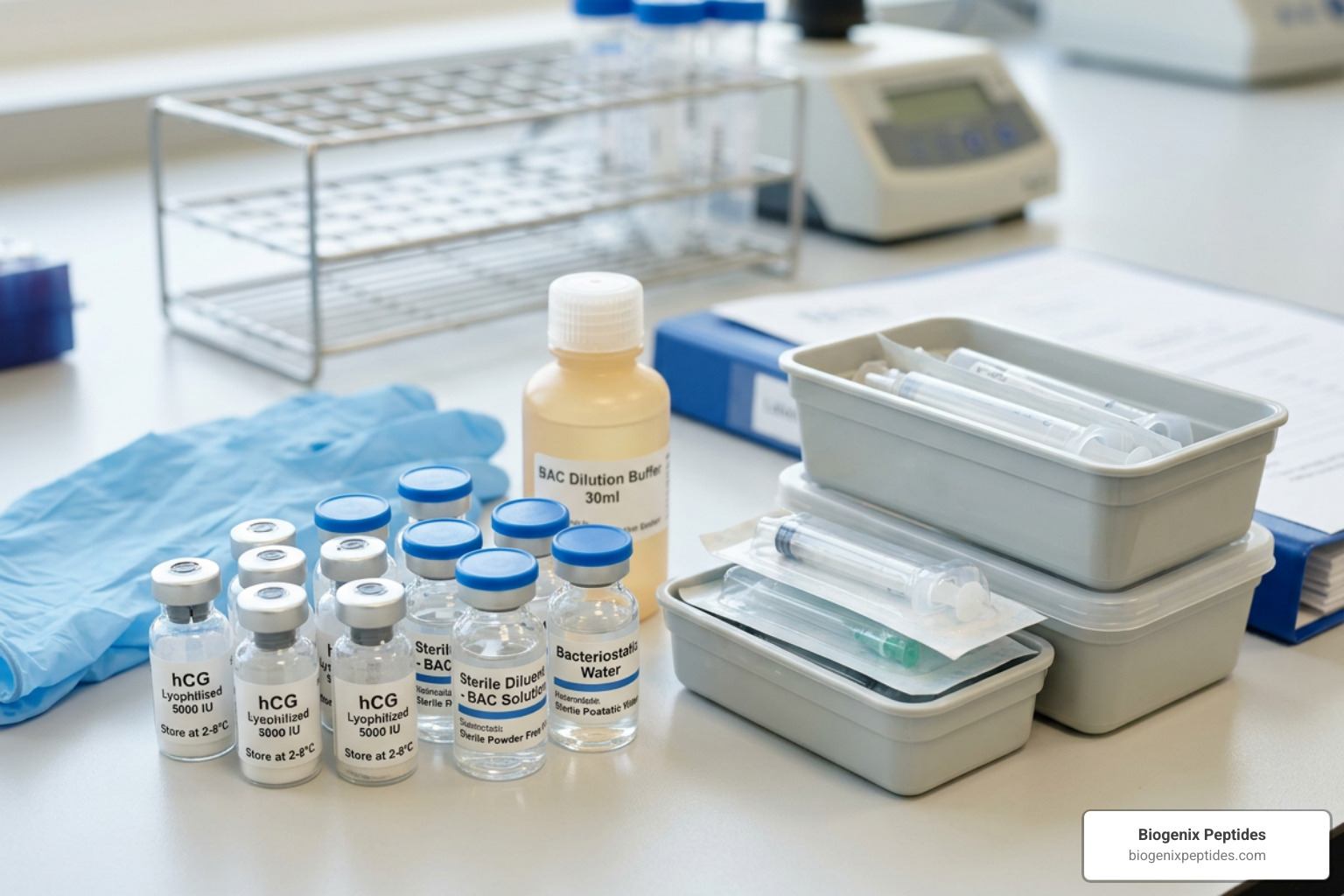
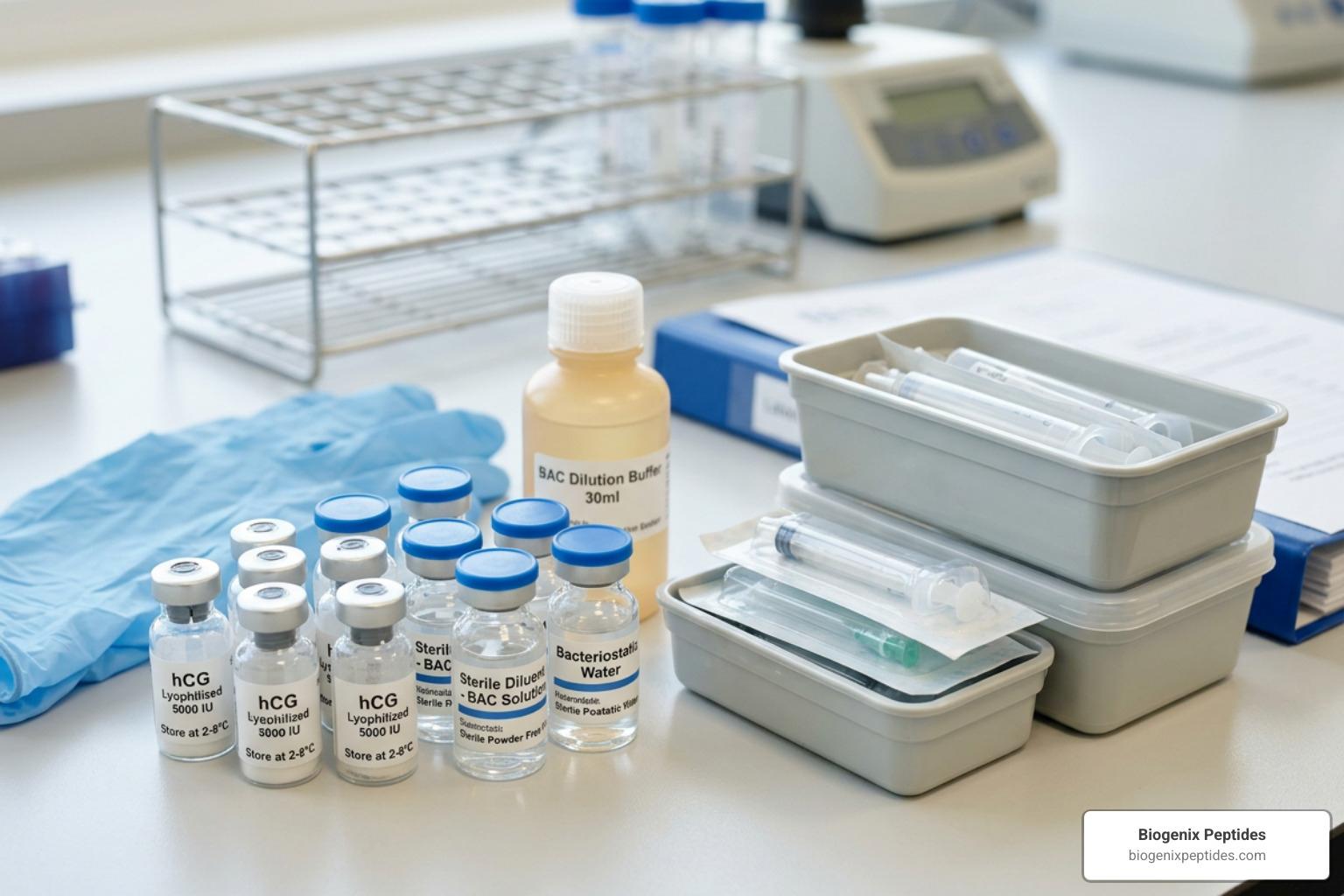
When working with hCG dilution free BAC (bacteriostatic water), the core question is simple: what sterile diluents can replace BAC water for reconstituting hCG in a research setting, and how do the calculations change depending on which one you use?
Here is a quick-reference answer:
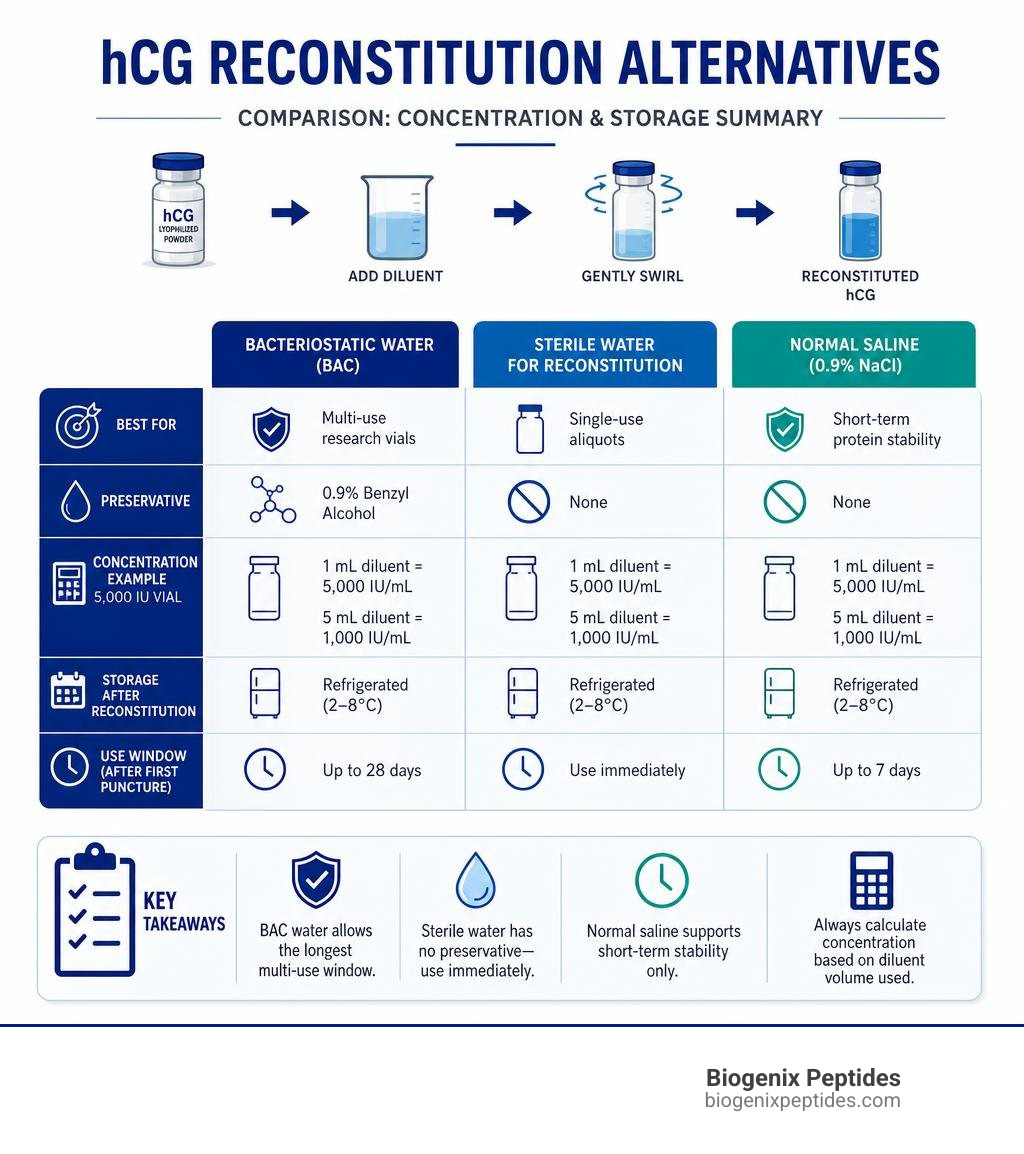
| Diluent Option | Best For | Key Limitation |
|---|---|---|
| Bacteriostatic water (BAC) | Multi-use research vials | Contains 0.9% benzyl alcohol preservative |
| Sterile water for reconstitution | Single-use aliquots | No preservative — use immediately |
| Normal saline (0.9% NaCl) | Short-term protein stability | Limited multi-use shelf life |
The short version: If BAC water is unavailable, sterile water or normal saline can be used to reconstitute hCG for research purposes — but storage windows shorten significantly, and single-use aliquots become essential.
hCG (human chorionic gonadotropin) is a glycoprotein hormone supplied as a lyophilized (freeze-dried) white powder. It must be reconstituted with a liquid diluent before it can be used in any research protocol. BAC water is the most commonly referenced diluent because the benzyl alcohol preservative helps maintain sterility across multiple uses. But researchers do not always have it on hand — and knowing your alternatives matters.
The concentration you achieve after reconstitution directly affects every downstream measurement in your protocol. Add 1 mL of diluent to a 5,000 IU vial and you get 5,000 IU/mL. Add 5 mL and you get 1,000 IU/mL. The math is straightforward — but only if you start with the right diluent and the right volume.
I’m Jay Daniel, Founder and CEO of BioGenix Peptides, with years of hands-on experience in peptide reconstitution protocols, quality control, and research-grade diluent sourcing — including navigating hCG dilution free BAC scenarios in laboratory settings. In this guide, I’ll walk you through every practical alternative, the concentration math, and the storage considerations that matter most for your research.
Understanding hCG Structure: Free Beta-hCG vs. Intact hCG in Research
To understand why reconstitution and dilution calculations must be highly precise, we first need to look at the unique molecular structure of human chorionic gonadotropin. In laboratory settings, researchers often evaluate either intact hCG or its individual subunits.
hCG is a complex heterodimeric glycoprotein. This means it is made up of two distinct, non-covalently linked subunits: the alpha (α) subunit and the beta (β) subunit.
- The alpha subunit is structurally identical to other glycoprotein hormones, including luteinizing hormone (LH), follicle-stimulating hormone (FSH), and thyroid-stimulating hormone (TSH).
- The beta subunit is unique to hCG and dictates its specific biological activity and receptor interactions.
In research and clinical assays, measuring these components accurately requires specialized tools like a Free beta-hCG ELISA kit. Understanding the exact ratio of free subunits to intact glycoproteins is critical, especially when determining how the compound behaves in liquid solutions. For a deeper look at how diluent ratios impact peptide stability and concentration dynamics, you can read about The Science of the Bacteriostatic Water Peptide Ratio.
Structural Differences and Molecular Mass
The intact hCG molecule has an approximate molecular mass of 37.9 kDa. A significant portion of this mass—roughly 31%—comes from its carbohydrate chains (glycosylation).
- Alpha Subunit: Consists of 92 amino acids and has a molecular mass of approximately 14.9 kDa.
- Beta Subunit: Consists of 145 amino acids with a molecular mass of about 23.0 kDa. It features specific N-glycosylation sites at the Asn13 and Asn30 positions, which are vital for its stability and half-life in laboratory models.
According to the Chorionic Gonadotropin Product Sheet, maintaining these glycosylation sites in their native state is essential. If the carbohydrate chains are degraded due to incorrect pH or improper diluents, the protein can lose its structural integrity, leading to inaccurate research outcomes.
Why Subunit Composition Matters for Dilution Calculations
In analytical chemistry and biological research, the presence of free beta-hCG versus intact hCG dramatically alters concentration measurements.
Because the free beta subunit represents only a fraction of the total molecular weight of intact hCG, standard assays must calibrate for cross-reactivity. For instance, high-quality ELISA assays maintain a cross-reactivity rate of less than 0.5% with intact hCG to prevent false readings when measuring free beta-hCG.
When performing a hCG dilution free BAC protocol, researchers must know whether their target is the intact hormone or the free subunit. If your testing platform is calibrated to detect international units (IU), it measures biological activity. If it measures mass (such as nanograms per milliliter), the molar concentration will differ depending on whether you are analyzing the intact 37.9 kDa glycoprotein or the lighter 23.0 kDa free beta subunit.
Reconstituting hCG Without BAC Water: The Best Alternatives
While bacteriostatic water is the standard diluent for extending the shelf life of reconstituted peptides, researchers frequently encounter situations where it is unavailable or unsuitable for specific experimental models. Fortunately, several high-quality alternatives can maintain solvent stability and preserve protein structure.
To explore the wider range of options available for laboratory preparations, you can read our comprehensive guide on The Best Substitutes for Bacteriostatic Water in Medical Reconstitution. Additionally, understanding the core chemical differences between your options is critical, which we outline in Sterile Water and Bacteriostatic Water: Differences You Must Know.
Sterile Water for Reconstitution
Sterile water is the most common alternative for a hCG dilution free BAC protocol. It contains no additives, preservatives, or antimicrobial agents.
Because it lacks a preservative like benzyl alcohol, sterile water is ideal for research models where alcohol might interfere with cellular assays or cause localized irritation in animal tissues. However, the lack of an antimicrobial agent means that once the vial is punctured, there is no protection against bacterial growth.
Therefore, when using sterile water, the reconstituted solution should be divided immediately into single-use aliquots and frozen or used right away. For tips on sourcing the correct sterile components for your laboratory, refer to Don’t Dilute Your Success: A Guide to Buying Bacteriostatic Water.
Normal Saline and Other Sterile Solutions
Another excellent alternative is sterile normal saline (0.9% sodium chloride). Saline provides an isotonic environment that closely mimics biological fluids, helping to preserve the osmotic balance of the solution and stabilize sensitive protein structures.
Some laboratory protocols also utilize specialized buffer solutions containing stabilizing agents like gelatin or serum proteins to prevent the hormone from adhering to the glass walls of the vial.
Below is a comparative breakdown of the primary diluents used in research:
| Diluent Type | Chemical Composition | Best Research Application | Sterility Window (Refrigerated) |
|---|---|---|---|
| Bacteriostatic Water | Sterile water + 0.9% Benzyl Alcohol | Multi-use testing, long-term protocols | 28 to 30 days |
| Sterile Water | 100% Pure $H_2O$ | Single-use assays, alcohol-sensitive models | Immediate use (or frozen aliquots) |
| Normal Saline | 0.9% Sodium Chloride in Water | Isotonic studies, short-term protein stabilization | 24 hours |
Reconstitution Calculations and the hCG Dilution Free BAC Protocol

Accurate reconstitution is the foundation of reliable research. Because hCG is measured in International Units (IU)—which reflect biological activity rather than physical mass—calculating the exact volume of liquid diluent is essential to achieving your target concentration.
To simplify this process, researchers often use an interactive hCG Reconstitution Calculator to verify their math. For a clear, step-by-step methodology on handling lyophilized powders, check out our guide on A Foolproof Way to Reconstitute Your Lyophilized Peptides.
Standard Vial Sizes and Reconstitution Volumes
hCG is typically supplied in standardized lyophilized vials containing either 5,000 IU or 10,000 IU. The volume of diluent you choose to add determines the concentration of the resulting liquid.
For a 5,000 IU Vial:
- Adding 1 mL of diluent yields a concentration of 5,000 IU/mL.
- Adding 2 mL of diluent yields a concentration of 2,500 IU/mL.
- Adding 5 mL of diluent yields a concentration of 1,000 IU/mL.
For a 10,000 IU Vial:
- Adding 2 mL of diluent yields a concentration of 5,000 IU/mL.
- Adding 5 mL of diluent yields a concentration of 2,000 IU/mL.
- Adding 10 mL of diluent yields a concentration of 1,000 IU/mL.
By plotting these volumes, researchers can establish predictable concentration curves to ensure their fluid transfers align perfectly with their experimental design.
Converting International Units to Syringe Units
Once the concentration is established, transferring precise micro-volumes requires converting International Units into the graduated markings on a standard U-100 syringe. A U-100 syringe represents 1 mL of total volume divided into 100 individual unit markings (where 1 unit = 0.01 mL).
Let us look at a standard example using a 5,000 IU vial reconstituted with 5 mL of sterile diluent, resulting in a clean concentration of 1,000 IU/mL:
$$\text{Target Volume (mL)} = \frac{\text{Target Quantity (IU)}}{\text{Concentration (IU/mL)}}$$
If your research protocol requires a target quantity of 250 IU:
$$\text{Target Volume} = \frac{250 \text{ IU}}{1,000 \text{ IU/mL}} = 0.25 \text{ mL}$$
On a U-100 syringe, 0.25 mL corresponds exactly to the 25 unit mark. For protocols requiring a target of 500 IU under the same dilution ratio, the calculation yields 0.50 mL, which corresponds to the 50 unit mark.
For further details on standard reconstitution volumes and handling instructions, you can consult the hCG Reconstitution Instructions document.
Research Protocols: Storage, Sterility, and Comparative Models
Maintaining strict sterile technique is paramount during any peptide reconstitution process. Because hCG dilution free BAC protocols lack a built-in preservative, even minor microscopic contamination can compromise the entire vial, leading to degraded proteins and skewed research data.
To protect the integrity of your work, read our guidelines on Bacteriostatic Water for Research and follow our detailed guide on Reconstituting Lyophilized Peptides Step-by-Step.
Storage Temperature and Potency Retention
Lyophilized hCG is highly stable at room temperature before reconstitution, but once it transitions into a liquid state, it becomes highly sensitive to environmental factors.
- Refrigeration: Reconstituted hCG must be stored at 2–8°C (36–46°F). Exposure to room temperature for extended periods accelerates the denaturation of the glycoprotein.
- Freezing: While lyophilized powder can be stored long-term in a freezer, reconstituted liquid solutions should never be subjected to repeated freeze-thaw cycles. Freezing reconstituted hCG can disrupt the delicate non-covalent bonds holding the alpha and beta subunits together, severely reducing its biological potency.
- Shelf-Life: While BAC-reconstituted solutions can remain viable for up to 30 days under refrigeration, a sterile-water-based solution should ideally be used immediately or divided into single-use aliquots to prevent potency loss and bacterial colonization.
Comparative Animal Models and Testicular Response
In veterinary and reproductive research, hCG is frequently utilized to study endocrine pathways and testicular response. Because hCG structurally and functionally mimics luteinizing hormone (LH), it binds directly to LH receptors on Leydig cells, stimulating the synthesis and secretion of testosterone.
A prominent example of this application is documented in an Alpaca Testicular Response Study, which evaluated the endocrine dynamics of male alpacas across various developmental stages:
- Testosterone Peak: Following a single intravenous administration of 3,000 IU of hCG, serum testosterone concentrations in adult male alpacas doubled within 2 hours and peaked at an impressive 300% above baseline at the 8-hour mark.
- Basal Correlations: The mean basal serum testosterone before stimulation was $1.3 \pm 0.2 \text{ ng/mL}$ (ranging from 0.3 to 3.2 ng/mL), demonstrating a strong correlation ($r = 0.64$) with paired testicular weight.
- Age-Related Sensitivity: In a cohort of 60 male alpacas aged 6 to 60 months, a 2- to 4-fold rise in testosterone was observed within 2 hours of administration, with the most significant relative increase occurring in the 13–14 month age group.
- Structural Changes: Seminiferous tubule diameter increased significantly after 12 months of age, showing a robust correlation with both pre- and post-stimulation testosterone levels.
- Estrogen and Aromatization: Detectable serum estrogen ($>1 \text{ pg/mL}$) appeared only after 14 months of age and only in males whose testosterone exceeded 3 ng/mL, marking a sharp rise in testicular aromatization capacity post-puberty.
These findings highlight how researchers rely on precise hCG concentrations to study receptor sensitivity, cellular maturation, and steroidogenesis in animal models.
Frequently Asked Questions about hCG Dilution Free BAC

What is the standard shelf-life of an hCG dilution free BAC solution?
Without bacteriostatic water, the shelf-life of reconstituted hCG is highly limited. When reconstituted with pure sterile water or normal saline, the solution contains no antimicrobial preservatives.
Under strict refrigeration (2–8°C), a sterile water solution should be utilized within 24 hours to ensure biological potency and minimize the risk of bacterial contamination. If long-term utilization is required, the solution must be divided into single-use aliquots immediately after reconstitution and stored frozen at -20°C, though some loss of potency may still occur during the freezing process.
How do you calculate syringe units for an hCG dilution free BAC protocol?
To calculate the correct syringe units, you must determine your solution’s concentration (IU per mL) and match it to the markings on your syringe. The formula is:
$$\text{Syringe Units (U-100)} = \frac{\text{Target Quantity (IU)}}{\text{Total IU in Vial}} \times \text{Diluent Volume (mL)} \times 100$$
For example, if you reconstitute a 5,000 IU vial with 2 mL of sterile water and your target is 250 IU:
$$\text{Syringe Units} = \frac{250}{5,000} \times 2 \times 100 = 0.05 \times 2 \times 100 = 10 \text{ Units}$$
Drawing the liquid to the 10-unit mark on a U-100 syringe will deliver the exact target quantity.
What are the most common mistakes in hCG reconstitution?
- Vigorous Shaking: hCG is a delicate glycoprotein. Shaking the vial rapidly can shear the protein chains and denature the molecule. Always tilt and gently swirl the vial to dissolve the powder.
- Direct Fluid Stream: Spraying the diluent directly onto the lyophilized powder can damage the protein structure. Aim the needle at the inner glass wall of the vial so the liquid flows down slowly.
- Ignoring the Vacuum: Lyophilized vials are vacuum-sealed. Allowing the diluent to be sucked in too quickly can cause structural damage to the peptide. Maintain control of the syringe plunger to let the liquid enter slowly.
Conclusion
Reconstituting hCG without bacteriostatic water is entirely feasible for laboratory research, provided you understand how your choice of diluent affects the stability, storage requirements, and concentration math of your solution. While sterile water and normal saline are excellent alternatives for preserving protein structure and avoiding alcohol-induced interference in sensitive assays, they require strict adherence to single-use protocols and immediate refrigeration.
By maintaining pristine sterile techniques, performing accurate conversions, and understanding the molecular differences between intact hCG and its free beta subunits, researchers can ensure consistent, reproducible results in their experimental models.
For all your laboratory preparation needs, explore our premium range of sterile solutions and Shop Bacteriostatic Water Reconstitution Solution 10ml directly from BioGenix Peptides to ensure your research always meets the highest standards of purity and accuracy.