The Quick-Fading Peptide: CJC-1295 No DAC Half-Life Explained
Disclaimer: The information provided in this article is for educational and informational purposes only. It is not intended as medical advice, diagnosis, or treatment. Products and compounds referenced are for research use only and are not approved for human or veterinary consumption. Always consult a qualified professional regarding health or medical decisions.
Why the CJC No DAC Half-Life Matters in Peptide Research
The CJC no DAC half-life is approximately 30 minutes — making it one of the fastest-clearing GHRH analogs studied in peptide research.
Here’s a quick-reference summary:
| Property | CJC-1295 No DAC (Mod GRF 1-29) |
|---|---|
| Half-life | ~30 minutes |
| Clearance mechanism | Enzymatic degradation |
| GH release pattern | Pulsatile (mimics natural rhythm) |
| Research frequency | 1–3 times per day |
| IGF-1 elevation duration | Short-lived per administration |
That rapid clearance is not a flaw. For researchers, it’s actually a defining characteristic — one that shapes everything from GH pulse patterns to how quickly the compound exits the system if a study needs to be halted.
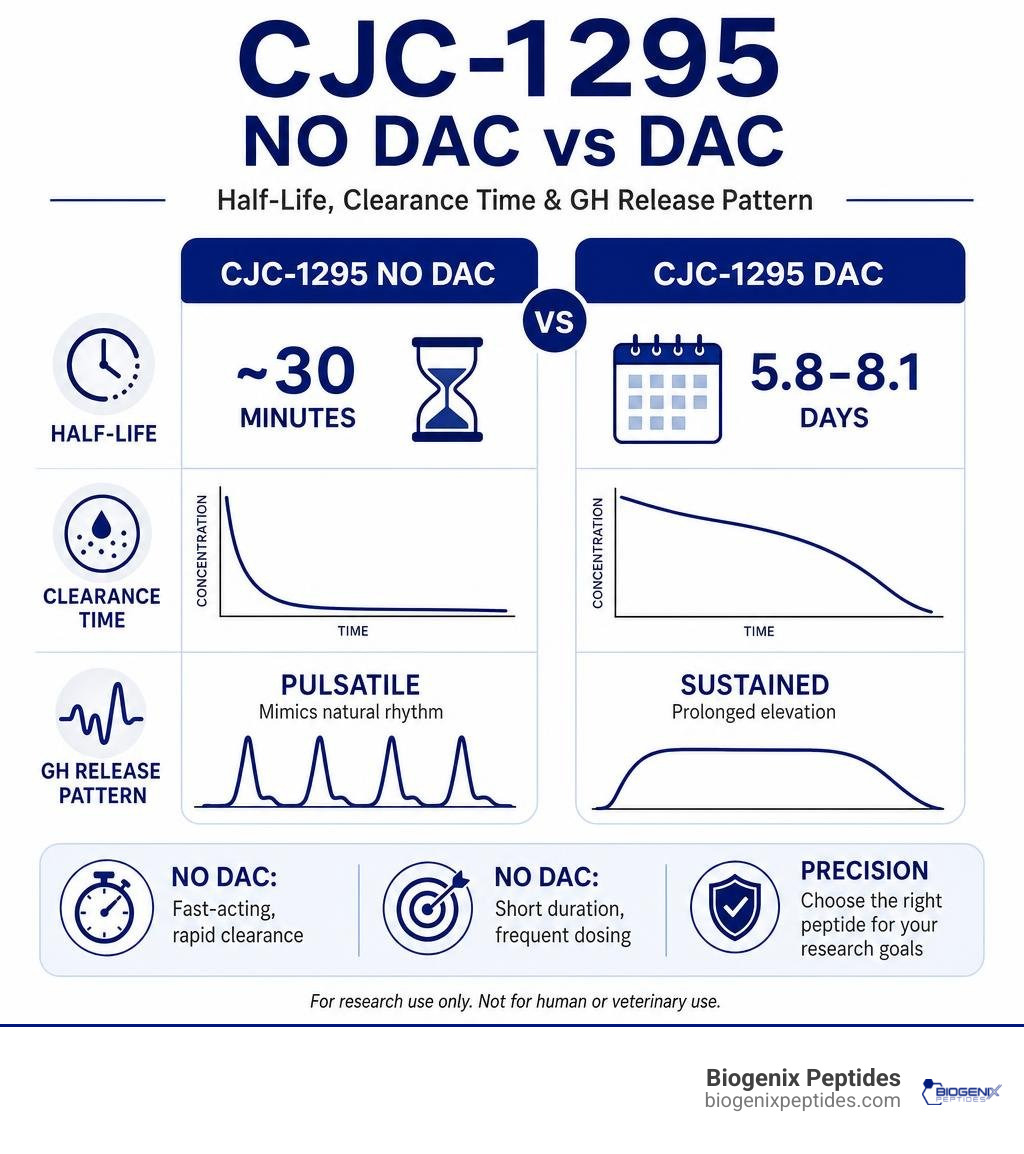
Compare that to CJC-1295 with DAC, which binds to albumin in the bloodstream and extends its half-life to an estimated 5.8 to 8.1 days, according to a randomized, double-blind, placebo-controlled clinical trial. The two compounds behave very differently in test models, and confusing them is a common — and consequential — mistake in research settings.
This guide breaks down exactly what the short half-life of CJC-1295 No DAC means for research protocols, GH secretion patterns, and clearance behavior.
I’m Jay Daniel, Founder and CEO of BioGenix Peptides, and understanding the pharmacokinetics of compounds like CJC no DAC half-life dynamics has been central to my years of hands-on work in peptide research and quality validation. In the sections ahead, I’ll walk you through the science clearly and precisely — so you can apply it confidently in your research context.
Simple guide to cjc no dac half-life:
Understanding the CJC No DAC Half-Life and Pharmacokinetics
To truly grasp the behavior of CJC-1295 No DAC, we have to look closely at its chemical structure. Also known in scientific circles as Modified GRF 1-29 (or Mod GRF 1-29), this compound is a synthetic analog of the naturally occurring Growth Hormone-Releasing Hormone (GHRH).
Natural GHRH consists of 44 amino acids, but scientists discovered that only the first 29 amino acids are required to fully activate the growth hormone receptors on pituitary cells. This shortened chain is called sermorelin (GHRH 1-29). However, natural sermorelin has an incredibly brief survival window in test models, clearing out in under ten minutes.
To overcome this rapid degradation, researchers modified four key amino acids in the peptide chain (at positions 2, 8, 15, and 27). These strategic modifications created Mod GRF 1-29, significantly bolstering the molecule’s resistance to rapid enzymatic breakdown.
Even with these structural upgrades, the cjc no dac half-life remains a brief 30 minutes. Once introduced to a test environment, the compound is progressively broken down by blood-borne enzymes and cleared via renal filtration.
For a deeper dive into the basic structure of this compound, check out The Ultimate Guide to CJC-1295 Without DAC. To explore the original clinical studies on how GHRH analogs were developed to extend metabolic clearance times, you can read the Scientific research on GHRH analogs.
This rapid clearance profile is highly valued by researchers who want to avoid the continuous, unnatural receptor stimulation caused by longer-acting analogs. By clearing out quickly, it allows the biological system to rest and reset between application intervals.
CJC-1295 No DAC vs. DAC: A Comparative Analysis
The presence or absence of the Drug Affinity Complex (DAC) is the single most critical factor determining how these GHRH analogs behave in laboratory models.
DAC is a chemical addition consisting of a maleimide group attached to the peptide. This group forms a strong covalent bond with serum albumin—the most abundant protein circulating in the blood. Albumin acts as a protective shield, preventing enzymes from degrading the peptide and keeping it from being filtered out by the kidneys.
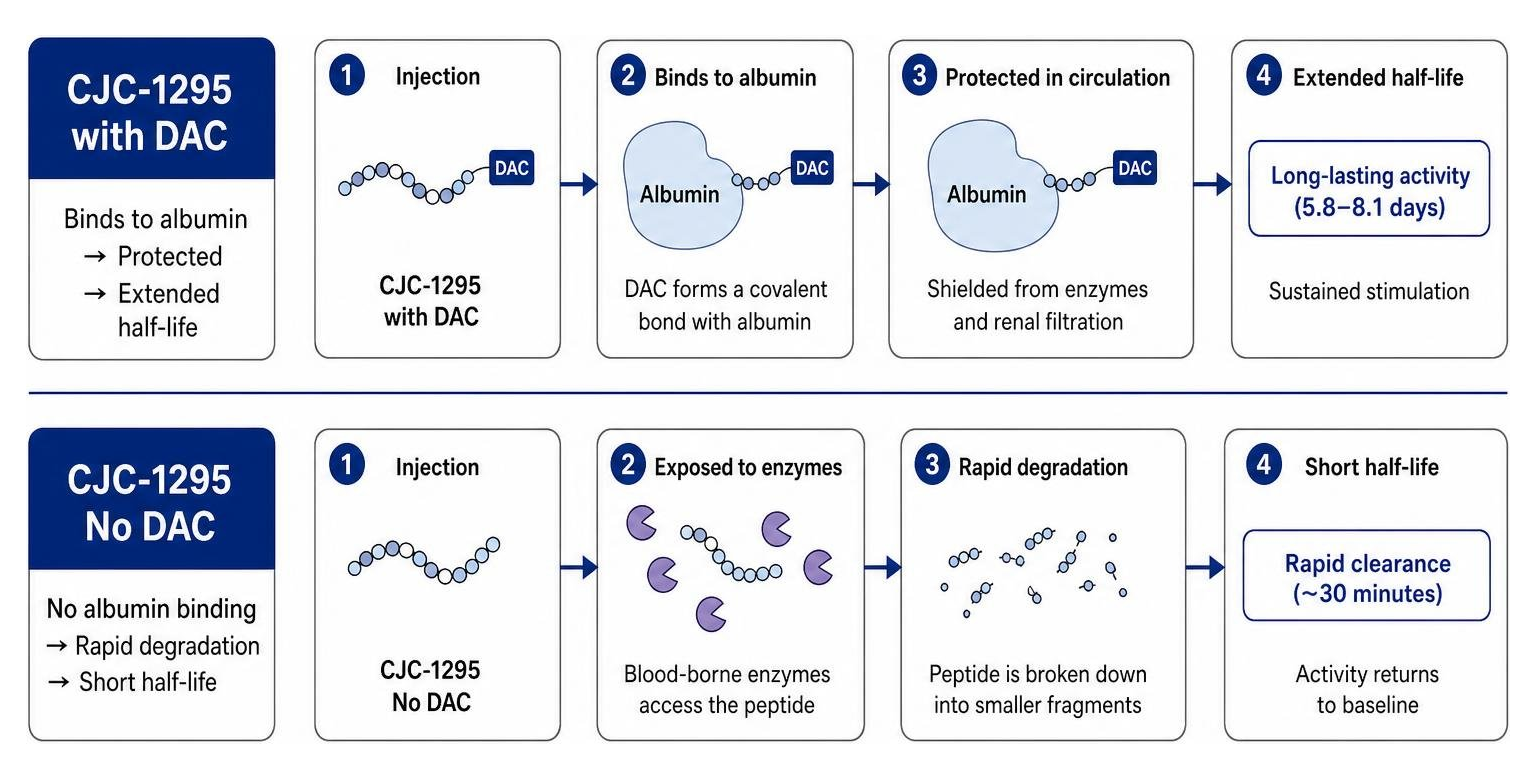
This structural difference leads to vastly different pharmacokinetic profiles:
- CJC-1295 with DAC: Boasts an extended half-life of 5.8 to 8.1 days. It provides continuous, steady stimulation of the pituitary gland, leading to a constant, elevated baseline of growth hormone and a sustained 1.5- to 3-fold increase in IGF-1 levels for over a week after a single application.
- CJC-1295 No DAC (Mod GRF 1-29): Lacks the albumin-binding complex. With its 30-minute half-life, it triggers a rapid, sharp release of growth hormone that mimics natural physiological pulses, returning to baseline within hours.
While the DAC version offers the convenience of weekly or bi-weekly laboratory protocols, the constant stimulation can lead to “pituitary bleed”—a state where growth hormone is released continuously rather than in natural, healthy pulses. This continuous elevation can sometimes desensitize receptors over extended observation periods.
Conversely, the No DAC version respects the natural pulsatile rhythm of the endocrine system. For a comprehensive review of the clinical data behind these two variations, refer to Growing Up Scientific: The Real Clinical Truth Behind CJC-1295.
Physiological Impact of a Short Half-Life on Growth Hormone Release
In healthy organisms, growth hormone is not released in a steady, continuous stream. Instead, the pituitary gland secretes it in distinct, coordinated bursts or “pulses” throughout the day and night, largely governed by the alternating influence of GHRH (which triggers a pulse) and somatostatin (which halts it).
Because the cjc no dac half-life is so brief, its physiological impact closely mirrors this natural pulsatile pattern. When the peptide is administered to a test model, it binds to GHRH receptors on pituitary somatotrophs, prompting an immediate release of stored growth hormone.
This artificial pulse peaks quickly and then tapers off as the peptide is cleaved by circulating enzymes. Because the peptide is cleared within a couple of hours, the pituitary gland is not subjected to constant, exhausting stimulation. This minimizes the risk of receptor down-regulation and allows the somatotrophs to replenish their hormone stores before the next pulse occurs.
This natural rise and fall also supports a more balanced elevation of Insulin-like Growth Factor 1 (IGF-1) without causing extreme, permanent shifts in baseline metabolic markers. For a detailed breakdown of how this pulsatile action affects cellular pathways and research outcomes, see Unlock Your Growth Potential with CJC-1295 No DAC Benefits.
How the CJC No DAC Half-Life Shapes Research Protocols
Because the peptide is cleared so quickly, designing a research protocol requires careful planning. A single daily application will only produce one brief spike in growth hormone, which may not be sufficient for studies evaluating long-term tissue regeneration, body composition changes, or metabolic adaptations.
To maintain a consistent level of pulsatile activity, researchers typically design protocols that call for multiple administrations throughout the day—often 1 to 3 times daily.
Furthermore, the timing of these administrations is critical. The presence of elevated blood glucose and insulin levels triggers the release of somatostatin, which acts as an biological “off switch” for growth hormone secretion. If the peptide is introduced when somatostatin levels are high, the resulting GH pulse will be significantly blunted.
Therefore, research protocols generally dictate that the compound be administered in a strict fasted state—typically at least two hours after a meal, and with a subsequent fasting window of 20 to 30 minutes to allow the peptide to complete its signaling cascade before nutrients enter the system. To avoid common experimental errors and refine your study parameters, consult Don’t Mess Up Your CJC-1295 No DAC Protocol.
Managing Side Effects and Clearance of the CJC No DAC Half-Life
One of the most practical advantages of a 30-minute half-life is the degree of control it offers researchers. In any experimental setting, the potential for adverse reactions is a key consideration.
With CJC-1295 No DAC, common side effects observed in test subjects—such as temporary flushing, mild water retention, or transient joint stiffness—are typically short-lived. Because the molecule is rapidly metabolized and eliminated, any unwanted physiological response generally resolves within hours of administration.
This is a stark contrast to the DAC version. If a test subject experiences an adverse reaction to CJC-1295 with DAC, the compound’s multi-day half-life means the peptide will remain active in the system for weeks, making it impossible to quickly halt the exposure.
The rapid clearance of the No DAC variant provides an inherent safety margin, allowing researchers to quickly adjust protocols or discontinue administration entirely if necessary. To read more about identifying and managing these transient responses, see The No-Nonsense Guide to CJC-1295 No DAC Side Effects.
Frequently Asked Questions About CJC-1295 No DAC
What is the exact half-life of CJC-1295 without DAC?
The exact half-life of CJC-1295 No DAC (Mod GRF 1-29) is approximately 30 minutes in vivo. This rapid clearance is due to enzymatic degradation by peptidases in the bloodstream and subsequent elimination by the kidneys.
How does the lack of DAC affect growth hormone secretion patterns?
Without the Drug Affinity Complex, the peptide cannot bind to albumin, meaning it does not remain in circulation for long. This lack of persistence prevents continuous pituitary stimulation, resulting in a clean, pulsatile release of growth hormone that mimics the natural physiological pulses of a healthy endocrine system, rather than a continuous “bleed.”
Can CJC-1295 No DAC be combined with other research peptides?
Yes, in research settings, CJC-1295 No DAC is frequently paired with Growth Hormone Releasing Peptides (GHRPs) such as Ipamorelin. Because GHRH and GHRPs work via different cellular pathways to stimulate the pituitary gland, administering them together produces a powerful synergistic effect, generating a significantly larger growth hormone pulse than either peptide could achieve alone.
For a comprehensive look at how these combinations are structured, check out the Step-by-Step Guide to CJC-1295 Blends. To understand the underlying biochemistry of these combined pathways, read HGH Secretagogues: The Most Misunderstood Pathway to Growth Hormone Optimization.
Conclusion
Understanding the cjc no dac half-life is fundamental to conducting precise, effective peptide research. With its rapid 30-minute clearance window, Mod GRF 1-29 offers a highly controllable, pulsatile method for stimulating growth hormone release without disrupting the natural endocrine rhythms of test models.
While it demands a more rigorous and frequent administration schedule than its long-acting DAC counterpart, its safety profile, lower risk of receptor desensitization, and rapid reversibility make it the preferred choice for many laboratory studies.
For high-quality, fully verified research materials, you can explore our dedicated product options at Shop Recovery: CJC-1295 No DAC and our popular synergistic blend at Shop Recovery: CJC-1295 No DAC Ipamorelin. Keep your research precise, your protocols structured, and always verify your peptide purity to ensure consistent, reliable experimental outcomes.