Unlock Your Growth Potential with CJC 1295 No DAC Benefits
Why CJC No DAC Benefits Are Reshaping Growth Hormone Research
Disclaimer: The information provided in this article is for educational and informational purposes only. It is not intended as medical advice, diagnosis, or treatment. Products and compounds referenced are for research use only and are not approved for human or veterinary consumption. Always consult a qualified professional regarding health or medical decisions.

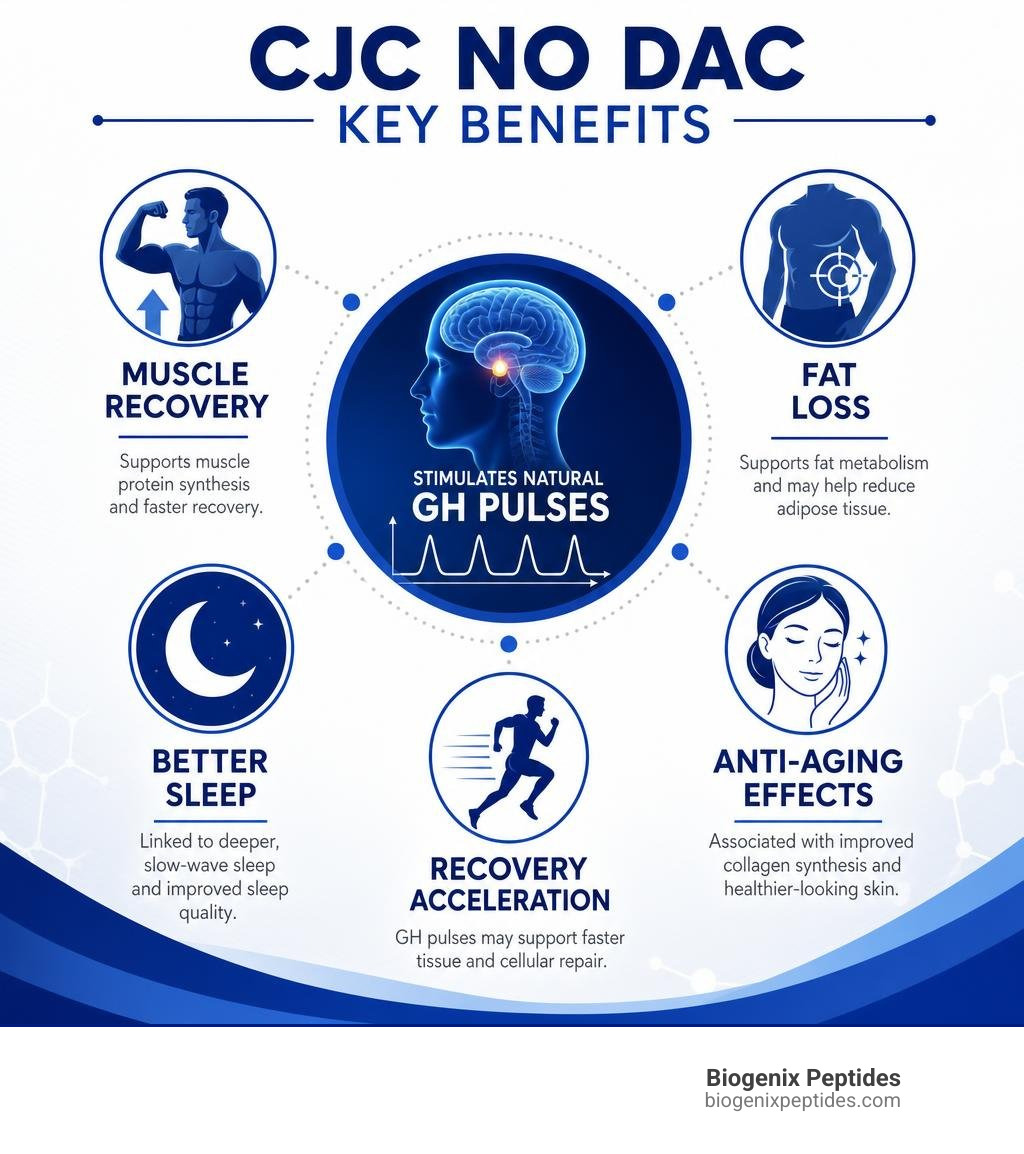
The CJC no DAC benefits observed in scientific research have made this compound one of the most studied growth hormone-releasing peptides in recent years. Here is a quick overview of what the research shows:
Key CJC No DAC Benefits at a Glance:
- Lean muscle support — stimulates endogenous GH pulses that research links to muscle protein synthesis
- Fat metabolism — elevated GH and IGF-1 levels are associated with reduced adipose tissue in research models
- Recovery acceleration — GH pulses may support faster tissue and cellular repair
- Sleep quality — GHRH analogs are linked to increased slow-wave (deep) sleep duration
- Anti-aging markers — research suggests improved collagen synthesis and skin health
- Pulsatile GH release — mimics the body’s natural hormone rhythm, potentially preserving receptor sensitivity
- Flexible research protocols — short ~30-minute half-life allows precise timing and easy adjustment
Growth hormone does not stay constant throughout life. After your mid-20s, GH output declines steadily — roughly 14% per decade according to research estimates. That decline is linked to changes in body composition, recovery speed, sleep depth, and cellular repair.
CJC-1295 without DAC (also known as Mod GRF 1-29) works differently from direct GH administration. Rather than replacing growth hormone, it signals the pituitary gland to produce its own. This distinction matters enormously in research, because pulsatile, endogenous GH release more closely mirrors natural physiology than sustained or exogenous elevation.
Research published in peer-reviewed literature has shown that CJC-1295 can increase serum GH levels by 200–1,000% following administration. That is a significant signal — and it happens without bypassing the body’s own feedback systems.
What makes the no-DAC formulation especially interesting to researchers is its short half-life of approximately 30 minutes. That brief window creates a sharp, discrete GH pulse rather than a prolonged elevation. Many researchers consider this pulsatile pattern more biologically faithful to how GH naturally operates.
I’m Jay Daniel, Founder and CEO of BioGenix Peptides, with years of hands-on experience in peptide research, quality control, and laboratory science — including deep study of CJC no DAC benefits and their implications for GH axis research. In this guide, I’ll walk you through what the science actually says, how this compound works at a cellular level, and what researchers need to know before designing a protocol.
Key terms for cjc no dac benefits:
What is CJC-1295 Without DAC (Mod GRF 1-29)?
To understand why this peptide is so highly regarded in modern research, we have to look at its structural history. CJC-1295 without DAC is a synthetic, modified version of Growth Hormone-Releasing Hormone (GHRH). Specifically, it is an analog of the first 29 amino acids of GHRH, which is the shortest fully functional fragment of the natural hormone.
In its unmodified state, this 29-amino-acid chain is known as Sermorelin. While Sermorelin is highly effective, it has a major practical limitation in a laboratory setting: its half-life is incredibly brief, lasting only about 5 to 10 minutes before metabolic enzymes break it down.
To solve this rapid degradation problem, scientists modified the chemical structure of the peptide. By substituting four specific amino acids in the chain, they created Modified GRF (1-29), which we commonly refer to as CJC-1295 without DAC. These deliberate structural substitutions dramatically improve the peptide’s resistance to enzymatic cleavage, extending its active half-life to approximately 30 minutes.
To explore the precise molecular architecture of this compound, researchers can review the CJC-1295 Structure and Properties via PubChem.
For a comprehensive breakdown of how this structural evolution impacts modern laboratory applications, you can read The Ultimate Guide to CJC-1295 Without DAC. This modification allows the peptide to survive long enough in the bloodstream to reach the target receptors in the pituitary gland, delivering a robust biological signal while still clearing quickly enough to prevent continuous, non-physiological hormone elevation.
Exploring the Core CJC No DAC Benefits in Scientific Research
When researchers examine CJC no DAC benefits, the primary focus is on how the compound interacts with the anterior pituitary gland. Specifically, the peptide targets specialized cells called somatotrophs, which are responsible for the synthesis and secretion of growth hormone.
Unlike administering synthetic, exogenous growth hormone directly—which can suppress the body’s natural feedback loops—CJC-1295 without DAC encourages the pituitary to release its own stored reserves. This preserves the natural feedback systems of the endocrine system. Because the peptide has a relatively short window of activity, it triggers a clean, pulsatile release of growth hormone that mimics the body’s natural circadian rhythm.
This pulsatile pattern is highly beneficial for maintaining receptor sensitivity. When hormone levels are constantly elevated, cellular receptors can become desensitized, requiring larger amounts to achieve the same effect over time. By providing a sharp, defined signal that clears rapidly, CJC-1295 without DAC avoids this downregulation risk.
For a deeper dive into the underlying science of these secretagogues, researchers can consult the Growth Hormone-Releasing Hormone Analog Research database.
Cellular Mechanisms of CJC No DAC Benefits
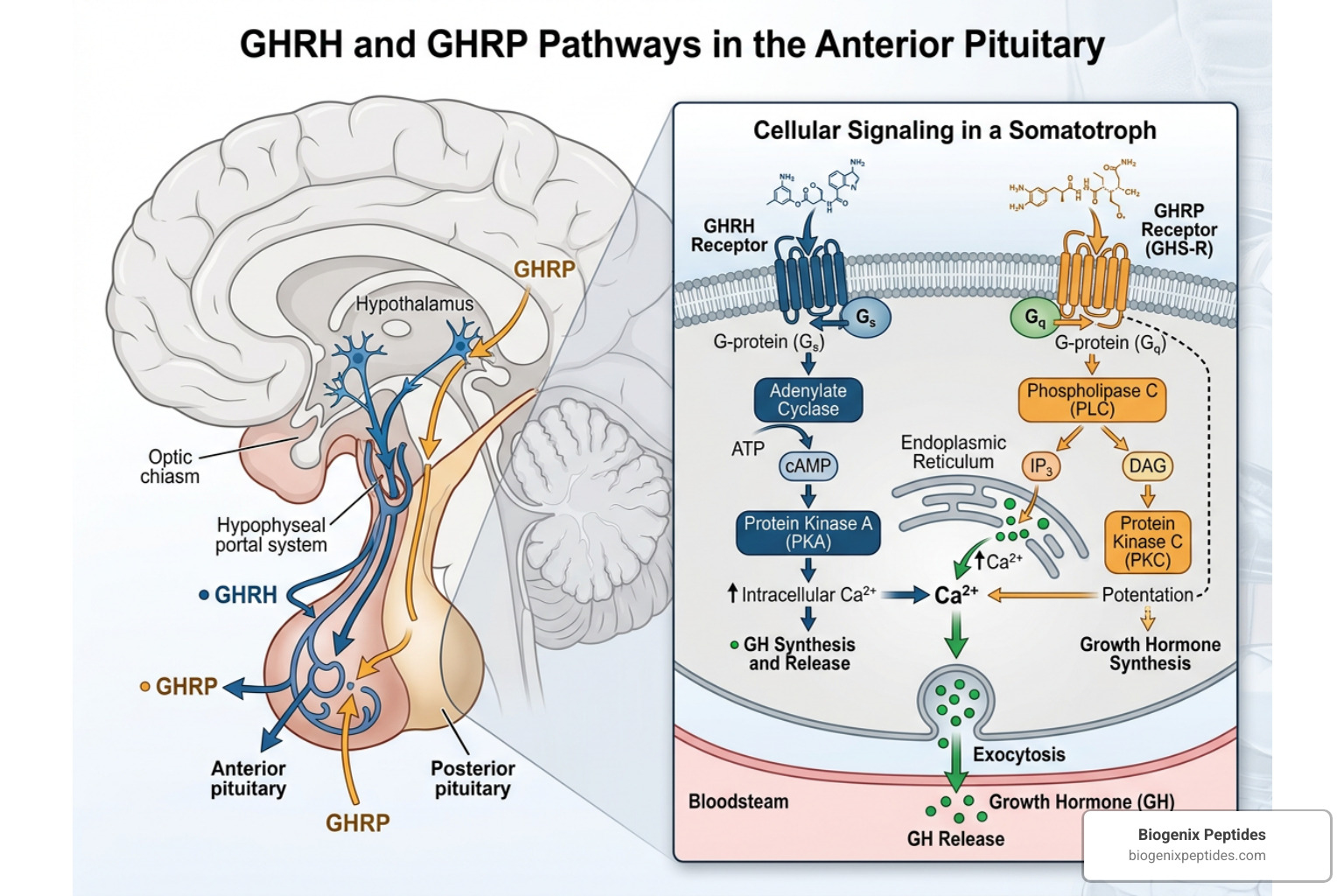
At the cellular level, the magic happens when the peptide binds directly to GHRH receptors on the somatotroph cells. This binding action initiates a cascade of intracellular events:
- Activation of Adenylate Cyclase: The receptor binding stimulates the enzyme adenylate cyclase.
- cAMP Pathway Stimulation: Adenylate cyclase converts adenosine triphosphate (ATP) into cyclic adenosine monophosphate (cAMP).
- Calcium Influx: The rise in intracellular cAMP activates protein kinase A, which opens calcium channels, letting calcium flood into the cell.
- Endogenous Secretion: This calcium influx triggers the somatotroph cells to fuse their growth-hormone-containing vesicles with the cell membrane, releasing a natural pulse of growth hormone into the bloodstream.
Because this pathway relies on the natural machinery of the cell, the body retains control over the intensity of the pulse, minimizing the risk of extreme, unsafe hormone spikes.
Physiological Impact and CJC No DAC Benefits
Once the pituitary gland releases growth hormone into circulation, it travels to the liver, where it stimulates the production of Insulin-like Growth Factor 1 (IGF-1). Together, GH and IGF-1 drive the major physiological responses observed in research models:
- IGF-1 Elevation: IGF-1 is the primary mediator of tissue growth, protein synthesis, and cellular hyperplasia, helping to repair and build structural tissues.
- Collagen Synthesis: Research indicates a notable increase in collagen synthesis—sometimes up to a six-fold increase in structural tissues like tendons and ligaments—supporting joint integrity and skin elasticity.
- Cellular Repair: Enhanced cellular turnover and repair mechanisms mean that tissues recover faster from physical stress, micro-tears, and environmental wear.
Comparing DAC vs. No DAC Formulations
The addition or absence of the “Drug Affinity Complex” (DAC) completely changes how this peptide behaves in a research environment. DAC is a chemical modification that allows the peptide to bind reversibly to serum albumin, a dominant protein in the bloodstream.
When DAC is attached, the peptide is protected from rapid clearance, extending its half-life from 30 minutes to an astonishing 6 to 8 days. While this sounds highly convenient, it completely alters the hormone release pattern from a natural, pulsatile rhythm to a continuous, flat-line elevation of growth hormone and IGF-1.
To help visualize these differences, we have compiled a direct comparison table:
| Characteristic | CJC-1295 Without DAC (Mod GRF 1-29) | CJC-1295 With DAC |
|---|---|---|
| Active Half-Life | ~30 minutes to 2 hours | 6 to 8 days |
| Release Pattern | Pulsatile (mimics natural rhythm) | Continuous, sustained elevation |
| Administration Frequency | Daily (often 1 to 3 times per day) | Once or twice weekly |
| Receptor Desensitization Risk | Low (allows pituitary “rest” periods) | Higher (due to constant stimulation) |
| Water Retention Risk | Low to moderate | Moderate to high |
| Synergy with GHRPs | Excellent (creates massive synergistic pulses) | Poor (blunts the pulse window) |
| Washout Period | Rapid (clears within hours) | Extended (takes 2 to 3 weeks to clear) |
Because of these differences, most modern telehealth practices and peptide researchers prefer the no-DAC formulation as the default starting point. It offers far greater control, lower risk of long-term pituitary desensitization, and a much cleaner side-effect profile.
To explore advanced strategies for structuring these research protocols, see the Master Your Gains with the CJC-1295 Advanced Protocol guide.
Synergistic Research Stacks and Safety Protocols
One of the most fascinating aspects of peptide research is the synergy between GHRH analogs and Growth Hormone-Releasing Peptides (GHRPs), such as Ipamorelin. When administered individually, both compounds trigger a modest release of growth hormone. However, when combined, they produce a synergistic effect that can result in a GH pulse 5 to 10 times larger than either compound could achieve alone.
This synergy occurs because the two peptides target different pathways in the pituitary gland. While CJC-1295 without DAC acts as a GHRH analog to stimulate the production and release of GH, Ipamorelin acts as a ghrelin receptor agonist. Ipamorelin suppresses somatostatin—the hormone responsible for halting GH release—while simultaneously boosting the signal to secrete GH.
To design an effective combined research protocol, you can read How to combine CJC-1295 and Ipamorelin. For research models requiring both compounds, we also offer a pre-formulated CJC-1295 No DAC + Ipamorelin Blend designed to simplify laboratory preparation.
Reconstitution and Administration Guidelines
To ensure the stability and accuracy of the peptide during research, proper handling is essential. Lyophilized peptide vials are highly delicate and must be stored at cold temperatures (ideally below -20°C for long-term storage, or 2-8°C once reconstituted).
To prepare the compound for research:
- Reconstitution: Gently introduce bacteriostatic water into the vial. Avoid spraying the water directly onto the lyophilized powder; instead, let it run slowly down the inside glass wall of the vial. Gently swirl—do not shake—until the solution is completely clear.
- Application Protocol: In laboratory models, subcutaneous application is typically preferred.
- The 5-On, 2-Off Schedule: To prevent receptor desensitization and maintain optimal pituitary sensitivity, researchers frequently utilize a schedule of 5 consecutive days of administration followed by 2 rest days each week.
- Timing Constraints: Because insulin and elevated blood glucose can severely blunt growth hormone secretion, the compound should ideally be administered in a fasted state (at least 2 hours after eating, and avoiding carbohydrates for at least 90 minutes post-administration).
To avoid common mistakes during laboratory preparation, review the guidelines in Don’t Mess Up Your CJC-1295 No DAC Protocol.
Frequently Asked Questions about CJC-1295 No DAC

When evaluating new compounds for laboratory study, researchers frequently raise questions regarding safety, physiological impact, and clearance times.
What is the half-life of CJC-1295 without DAC?
CJC-1295 without DAC has an active half-life of approximately 30 minutes to 1 hour. This rapid clearance profile is highly advantageous because it allows the compound to be processed quickly by the body, triggering a sharp, natural-acting pulse of growth hormone before returning to baseline levels. This rapid return to baseline prevents the continuous, unnatural elevation of GH that is often associated with joint pain, excessive water retention, and insulin resistance.
How does CJC-1295 without DAC affect sleep?
In research models, GHRH analogs have been shown to exert a direct, positive influence on the central nervous system, specifically promoting deeper and more restorative sleep. Because the largest natural pulse of growth hormone occurs during the first phase of deep, slow-wave sleep, administering the peptide in the evening helps align the induced pulse with the body’s natural nocturnal endocrine rhythm, enhancing both sleep quality and overnight cellular repair.
Is CJC-1295 without DAC safe for long-term research?
Because of its short half-life and pulsatile nature, CJC-1295 without DAC is generally considered to have a much safer long-term profile than the DAC version or direct HGH therapy. It allows the pituitary gland regular “rest periods” where it is not constantly stimulated. However, to maintain GHRH receptor sensitivity and prevent any potential downregulation, researchers typically implement cycling protocols (such as 12 to 16 weeks of active study followed by a 4 to 6-week washout phase).
For a detailed review of the safety profiles of growth hormone secretagogues, researchers can refer to the comprehensive study on Peptide Science and Safety Profiles.
Conclusion
The extensive body of research surrounding CJC no DAC benefits highlights why this peptide remains a cornerstone of growth hormone optimization studies in June 2026. By stimulating natural, pulsatile GH release rather than forcing a sustained, non-physiological elevation, it offers researchers a highly controllable and effective tool for investigating cellular repair, muscle preservation, fat metabolism, and sleep enhancement.
At BioGenix Peptides, we are dedicated to supporting the scientific community by providing the highest-quality compounds for laboratory research. All of our products undergo strict quality control to guarantee purity and consistency. If you are ready to implement this compound in your next research study, you can Shop CJC-1295 No DAC directly from our secure portal.