The No-Nonsense Guide to CJC 1295 No DAC Side Effects
What Researchers Need to Know About CJC No DAC Side Effects
Disclaimer: The information provided in this article is for educational and informational purposes only. It is not intended as medical advice, diagnosis, or treatment. Products and compounds referenced are for research use only and are not approved for human or veterinary consumption. Always consult a qualified professional regarding health or medical decisions.

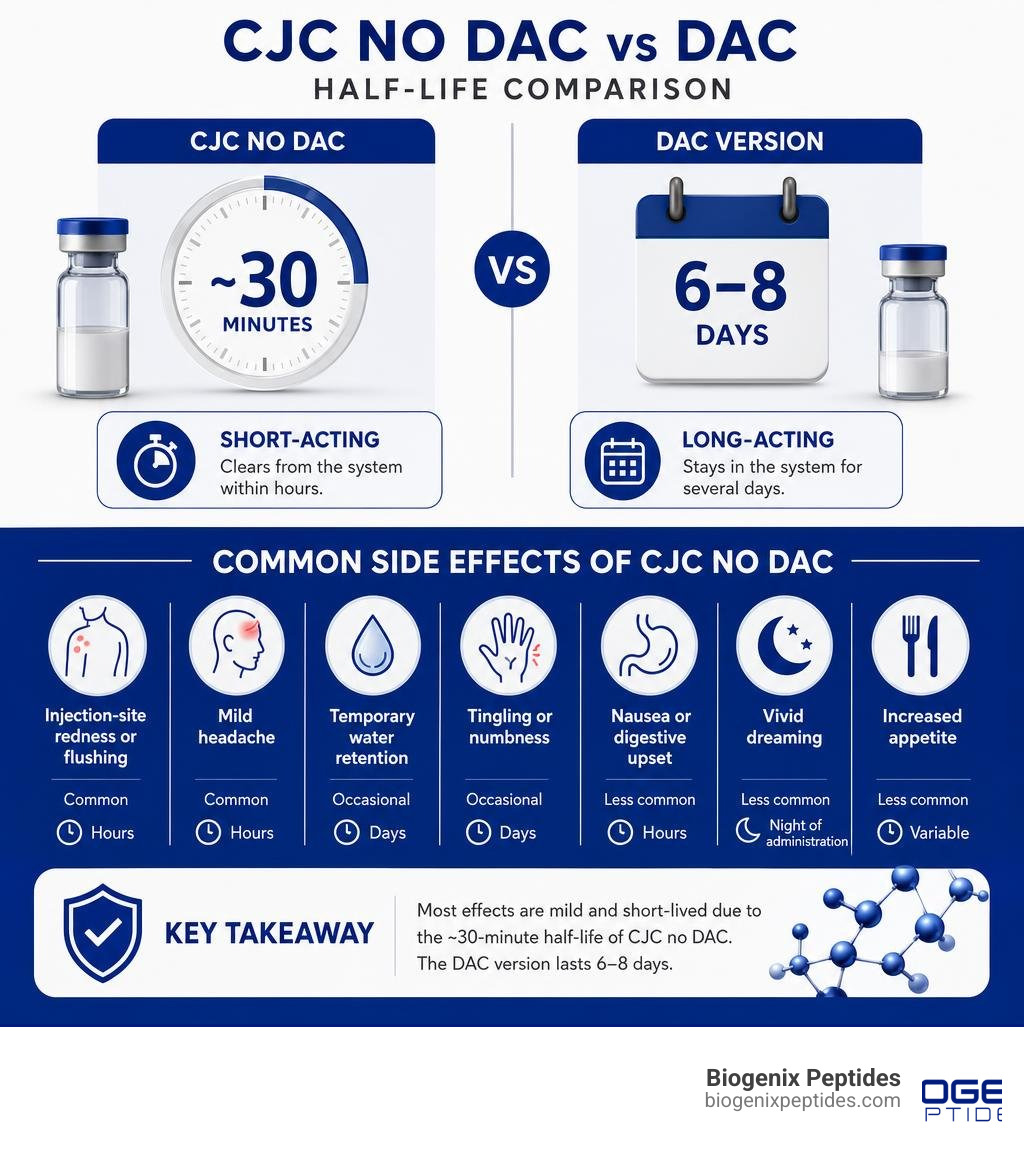
CJC no DAC side effects observed in research models are generally mild and short-lived compared to the DAC version. Here is a quick summary for researchers:
| Side Effect | Frequency | Duration |
|---|---|---|
| Application-site redness or flushing | Common | Hours |
| Mild headache | Common | Hours |
| Temporary water retention | Occasional | Days |
| Tingling or numbness | Occasional | Days |
| Nausea or digestive upset | Less common | Hours |
| Vivid dreaming | Less common | Night of administration |
| Increased appetite | Less common | Variable |
Key takeaway: Most effects resolve quickly due to the compound’s ~30-minute half-life, which is far shorter than the 6-8 day half-life of the DAC version.
Growth hormone secretagogue research has expanded rapidly over the past decade. CJC-1295 without DAC — also called Mod GRF 1-29 — has drawn significant scientific interest because of how it mimics the body’s natural pulsatile growth hormone rhythm. Unlike its longer-acting counterpart, the no-DAC form clears the system within hours. That short window changes its entire side effect profile.
But shorter-acting does not mean risk-free.
Researchers and clinicians alike want a clear-eyed picture of what this compound actually does — including where things can go wrong. The available data, while still limited in long-term human studies, gives us enough to work with.
I’m Jay Daniel, Founder and CEO of BioGenix Peptides, and my years of hands-on experience in peptide research and quality control have given me a close look at CJC no DAC side effects across research contexts. In the sections ahead, we’ll break down exactly what the current evidence shows — mechanism by mechanism, effect by effect.
Cjc no dac side effects terms to remember:
Pharmacological Profile: DAC vs. No DAC
To understand why cjc no dac side effects manifest the way they do, we first have to look at the chemistry. Both molecules are synthetic analogs of Growth Hormone-Releasing Hormone (GHRH), but they behave like completely different animals in a laboratory environment.
The primary differentiator is the Drug Affinity Complex (DAC).
The DAC modification allows the peptide to bind to blood albumin, preventing rapid enzymatic breakdown. This extends the half-life of the compound to an estimated 5.8 to 8.1 days. While this offers the convenience of weekly administration, it creates a constant, non-pulsatile elevation of growth hormone (GH) and Insulin-like Growth Factor 1 (IGF-1).
In contrast, CJC-1295 No DAC (often referred to as Mod GRF 1-29) lacks this complex. It possesses a brief half-life of approximately 30 minutes. This short window mimics the natural, pulsatile release of GH from the pituitary gland. For a deeper look at this mechanism, you can read The Ultimate Guide to CJC-1295 without DAC.
From a safety standpoint, this difference is massive. The continuous release profile of the DAC version carries a higher risk of receptor desensitization, systemic water retention, joint pain, and metabolic shifts. When researchers look at CJC-1295 DAC Risks & Legal Status Review 2026 | Peptide Protocol Wiki , they find that side effects from the DAC version can persist for up to two weeks after stopping administration because the compound lingers in the system. With the no-DAC version, any adverse reactions typically clear within hours of the compound being metabolized.
| Characteristic | CJC-1295 with DAC | CJC-1295 No DAC (Mod GRF 1-29) |
|---|---|---|
| Half-Life | 6 to 8 days | ~30 minutes |
| GH Release Pattern | Constant, sustained elevation | Pulsatile, mimicking natural rhythm |
| Receptor Desensitization | Higher risk due to constant exposure | Low risk; preserves natural signaling |
| Water Retention Risk | Moderate to High | Low to Moderate |
| Clearance Time | 1 to 2 weeks | Hours |
Understanding CJC No DAC Side Effects in Research Models

When we evaluate cjc no dac side effects in laboratory settings, we are looking at how animal models and cellular systems respond to rapid, transient pulses of growth hormone. Because GHRH receptors are spread throughout various tissues, the systemic responses can be wide-ranging, even if they are brief.
Some of the primary benefits under investigation in these models include tissue repair, fat loss, and muscle preservation. Researchers can explore these pathways in detail through our resource on how to Unlock Your Growth Potential with CJC-1295 No DAC Benefits. However, these positive shifts are often accompanied by predictable physiological trade-offs.
For instance, the sudden release of growth hormone can influence cardiovascular parameters. Some research models show a temporary drop in blood pressure accompanied by a compensatory increase in heart rate. Additionally, growth hormone naturally alters how the body handles fluids and glucose. Even with a short half-life, repetitive daily administration protocols can lead to mild metabolic and fluid shifts that researchers must carefully monitor. For general information on how GHRH analogs are discussed in clinical contexts, see CJC-1295 Peptide: The Basics, Benefits, and Risks – Midi Health .
Common and Transient CJC No DAC Side Effects
Most observed cjc no dac side effects are transient, occurring shortly after the compound is introduced and fading as it is cleared from the plasma.
- Warmth and Flushing: This is the most frequently reported response. It is caused by a rapid, GHRH-mediated vasodilation (widening of blood vessels), particularly around the face, neck, and chest. It typically begins within minutes of administration and resolves within a half-hour.
- Headaches: Often described as a mild “head rush” or pressure sensation, this is also linked to the rapid changes in blood pressure and vascular dilation. Staying well-hydrated before the research session often mitigates this response.
- Local Tissue Irritation: Because the peptide is administered subcutaneously, temporary redness, itching, or a small bump may appear at the site of application. This is generally a localized histamine reaction and can be managed by rotating administration sites.
- Vivid Dreaming: Many research protocols note a distinct change in sleep architecture, specifically an increase in highly vivid dreams. This occurs because growth hormone secretagogues promote deeper slow-wave sleep phases where natural GH release peaks.
- Mild Fatigue or Lethargy: Occasionally, a brief wave of tiredness is observed shortly after administration. This is believed to be a natural feedback mechanism as the pituitary gland releases its GH pulse.
How Stacking Amplifies CJC No DAC Side Effects
In many research environments, CJC-1295 No DAC is not studied in isolation. Instead, it is frequently combined with Ipamorelin, a selective ghrelin receptor agonist. This combination is designed to exploit a biological loophole: GHRH and ghrelin agonists act on different receptors in the pituitary, creating a synergistic effect that produces a far larger GH pulse than either compound could achieve alone.
To understand how these formulations are prepared and combined, researchers can consult our Step-by-Step Guide to CJC-1295 Blends. If you are looking to acquire these specific combinations for laboratory study, you can view the CJC-1295 No DAC + Ipamorelin product profile.
While this synergy maximizes the research outcomes, it also alters the side effect profile.
Because Ipamorelin is highly selective, it does not significantly increase cortisol or prolactin levels when utilized at standard research quantities. This makes the stack far cleaner than older combinations involving GHRP-2 or GHRP-6. However, the sheer volume of the resulting growth hormone pulse means that fluid retention, mild joint stiffness, and extremity tingling (pins and needles) can become more pronounced. For a comprehensive review of this stack’s safety and research parameters, see CJC-1295 + Ipamorelin | Benefits, Safety & Buying Advice [2026] .
Risk Mitigation and Research Precautions

To maintain the integrity of any scientific study and ensure the safety of the research environment, implementing strict risk mitigation protocols is essential. When working with growth hormone secretagogues, researchers must establish baseline metrics and monitor specific physiological markers throughout the study cycle.
Our complete framework on structuring these studies can be found in Don’t Mess Up Your CJC-1295 No DAC Protocol, while advanced research methodologies are detailed in the Master Your Gains with the CJC-1295 Advanced Protocol.
- Baseline and Periodic Bloodwork: Before initiating a research cycle, it is critical to measure baseline IGF-1, fasting blood glucose, and HbA1c levels. IGF-1 serves as the primary biomarker to verify that the GHRH analog is successfully stimulating the pituitary.
- Glucose Monitoring: Because elevated growth hormone can decrease insulin sensitivity over time, fasting blood glucose should be checked regularly. If glucose levels begin to climb significantly, the research protocol should be paused.
- Structured Cycling and Washouts: Continuous stimulation of the pituitary gland is not recommended. Typical research structures involve an 8-to-12-week administration phase followed by a mandatory 6-to-12-week washout period. This prevents receptor desensitization and allows the subject’s endocrine system to return to baseline.
- Clear Contraindications: These compounds must never be introduced to research models with active malignancies or a history of cancer. Because IGF-1 is a potent cellular growth factor, it can theoretically accelerate the proliferation of existing abnormal cells. Other contraindications include uncontrolled diabetes, severe carpal tunnel syndrome (which is worsened by fluid retention), and pre-existing heart failure.
Frequently Asked Questions about CJC-1295 No DAC
What are the primary cjc no dac side effects in animal models?
In animal models, the most common observable reactions are transient head-flushing, localized skin irritation at the administration site, and temporary lethargy immediately following the application. Because of the peptide’s rapid clearance, these responses typically resolve within 30 to 60 minutes without long-term intervention.
How does the lack of FDA approval affect research safety?
CJC-1295 No DAC is not FDA-approved for human use. In the United States, it has been placed on the FDA’s list of bulk drug substances that cannot be used in compounded medications for human patients. For clinical alternatives, some providers look to approved options as discussed in CJC Peptide Therapy – Women’s Health Services of Maryland .
Furthermore, the World Anti-Doping Agency (WADA) explicitly prohibits the compound in competitive athletics under the category of growth hormone secretagogues. Because it is restricted to laboratory research, finding high-purity, analytically verified material is a primary challenge. Research-grade peptides sourced from unverified online vendors often contain manufacturing impurities, heavy metals, or incorrect concentrations, which drastically increases the risk of unpredictable side effects.
Does CJC-1295 No DAC cause insulin resistance?
It can, though the risk is substantially lower than with the DAC version. Growth hormone naturally acts as an insulin antagonist, meaning it signals tissues to burn fat instead of glucose, temporarily raising blood sugar. Because the no-DAC version causes short, spiky pulses rather than a flat, continuous elevation, the body has time to restore insulin sensitivity between pulses. However, if the compound is administered multiple times daily without breaks, or if the research model has pre-existing metabolic dysfunction, insulin resistance and elevated fasting glucose can develop.
Conclusion
CJC-1295 No DAC remains one of the most promising GHRH analogs under scientific investigation. By preserving the natural, pulsatile rhythm of growth hormone release, it avoids many of the severe, long-lasting side effects associated with the continuous-release DAC formulation. The most common cjc no dac side effects — such as flushing, mild headaches, and localized redness — are transient and easily managed through proper research protocols, site rotation, and structured cycling.
However, because this compound is not FDA-approved and is restricted to laboratory research, scientists must take extraordinary care when sourcing their materials. Impure or mislabeled compounds are the most common source of anomalous data and severe adverse events.
At BioGenix Peptides, we are committed to providing the scientific community with the highest standard of analytically verified, high-purity compounds. If you are conducting authorized laboratory research and require reliable GHRH analogs, you can Shop CJC-1295 No DAC directly from our secure inventory. Always prioritize rigorous monitoring, baseline testing, and strict safety protocols to ensure the validity and safety of your research.