
Say Goodbye to Stubborn Belly Fat with Tesamorelin
Why Tesamorelin Abdominal Fat Research Is Changing What We Know About Visceral Fat
Disclaimer: The information provided in this article is for educational and informational purposes only. It is not intended as medical advice, diagnosis, or treatment. Products and compounds referenced are for research use only and are not approved for human or veterinary consumption. Always consult a qualified professional regarding health or medical decisions.
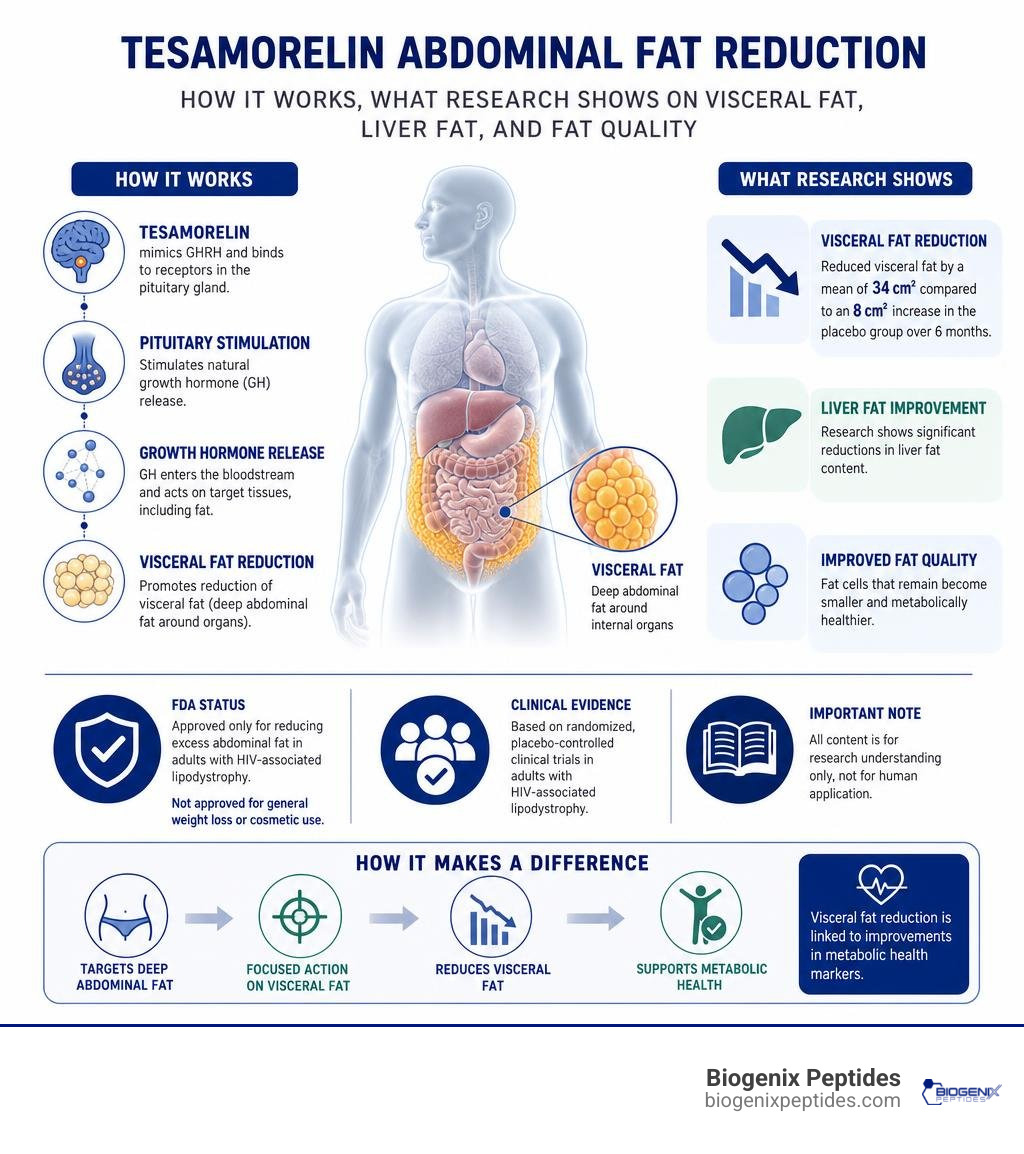
Tesamorelin abdominal fat reduction is one of the most well-documented effects of any peptide compound in clinical research. Here is a quick summary of what the research shows:
- What it is: Tesamorelin is a synthetic growth hormone-releasing hormone (GHRH) analog that stimulates the pituitary gland to produce natural growth hormone
- What it targets: Visceral adipose tissue (VAT) — the deep abdominal fat around organs — not just surface-level subcutaneous fat
- Key clinical finding: In randomized trials, tesamorelin reduced visceral fat by a mean of 34 cm² compared to an 8 cm² increase in the placebo group over 6 months
- Beyond fat quantity: Research shows it also improves fat quality — meaning the fat cells that remain become smaller and metabolically healthier
- FDA status: Approved only for reducing excess abdominal fat in adults with HIV-associated lipodystrophy — not for general weight loss or cosmetic purposes
- Important note: All content here is framed for research understanding only, not for human application
Stubborn belly fat is frustrating. You can improve your diet, move more, and still watch your midsection refuse to budge. For many people, the problem is not willpower — it is biology.
Visceral fat, the kind that accumulates deep inside the abdomen around organs, is metabolically active. It is linked to insulin resistance, cardiovascular disease, and chronic inflammation. And it is notoriously resistant to lifestyle changes alone.
That is where tesamorelin enters the research conversation. Unlike general fat-loss compounds, tesamorelin works by restoring a signaling pathway — the growth hormone axis — that naturally declines with age and is disrupted in certain medical conditions. The result, according to clinical trial data, is a targeted reduction in visceral abdominal fat that goes beyond what the scale alone can measure.
This guide explores what the research shows, how the mechanism works, and what the clinical data actually says about efficacy, fat quality, and safety.
I’m Jay Daniel, Founder and CEO of BioGenix Peptides, with years of hands-on experience researching peptide science and metabolic compounds, including an in-depth focus on tesamorelin abdominal fat reduction mechanisms and clinical evidence. In this guide, I’ll walk you through what the peer-reviewed research tells us — so you can understand the science clearly and make informed decisions.
Understanding Tesamorelin Abdominal Fat Reduction Mechanisms
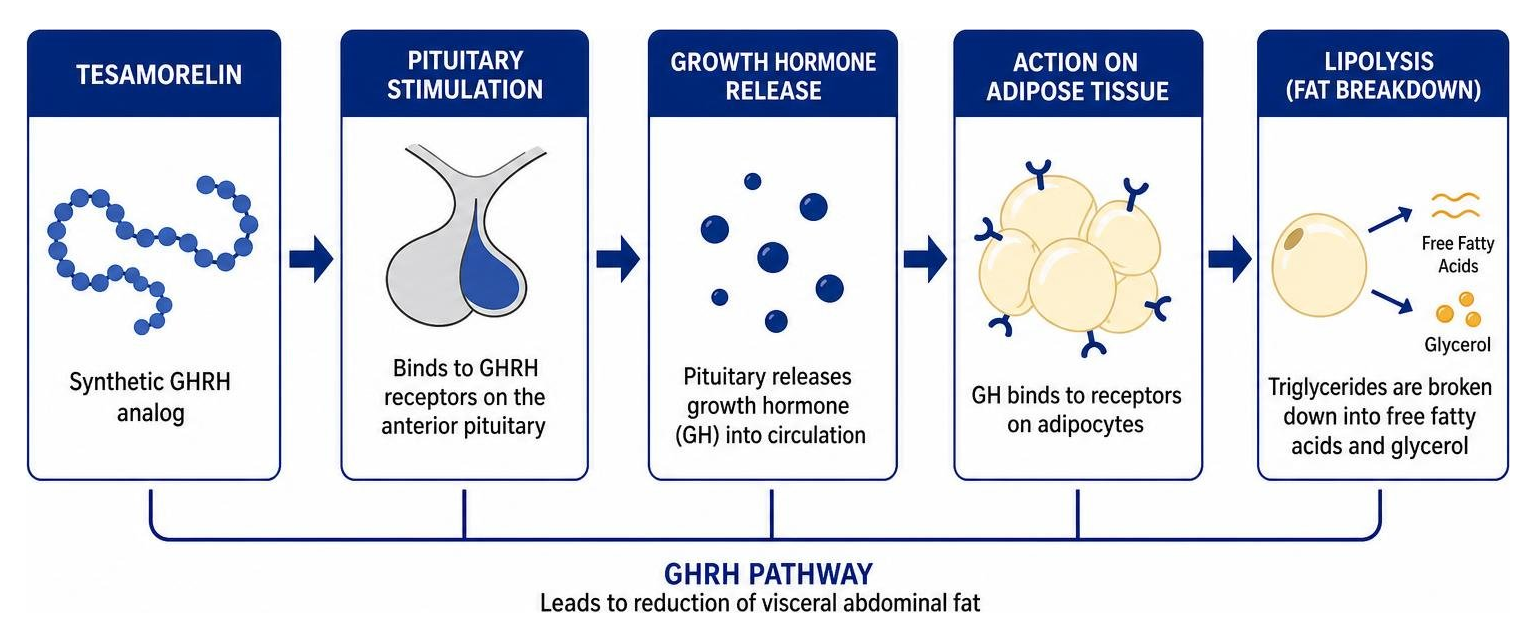
To understand how tesamorelin acts on tesamorelin abdominal fat depots, we have to look closely at the endocrine system. Tesamorelin is a synthetic growth hormone-releasing hormone (GHRH) analog consisting of 44 amino acids. By mimicking endogenous GHRH, it binds to specific receptors on the anterior pituitary gland, stimulating the pulsatile release of natural growth hormone (GH).
Once growth hormone is released into circulation, it acts directly on adipose tissue. Adipocytes (fat cells) express growth hormone receptors. When GH binds to these receptors, it triggers a cascade of intracellular events — specifically activating adenylate cyclase, increasing cyclic adenosine monophosphate (cAMP) levels, and activating hormone-sensitive lipase. This process, known as lipolysis, breaks down stored triglycerides into free fatty acids and glycerol, effectively shrinking the size of the fat cells.
Furthermore, growth hormone stimulates the liver to produce insulin-like growth factor 1 (IGF-1). IGF-1 plays a supportive role in overall metabolic regulation, lean muscle maintenance, and cellular repair. What makes this pathway highly unique is its selective nature. While some metabolic pathways cause generalized tissue loss, the growth hormone pathway is highly efficient at targeting visceral fat depots.
Researchers interested in how this mechanism differs from traditional growth hormone administration can read more about the peptide’s unique pathways in Tesamorelin Beyond Growth Hormone: What the Research Really Shows and explore the broader category of HGH Secretagogues: The Most Misunderstood Pathway to Growth Hormone Optimization.
Comparing Tesamorelin to Other Metabolic Peptides
When designing laboratory protocols, researchers often compare tesamorelin to other prominent compounds developed for metabolic and adipose tissue studies. Each compound utilizes a distinct pathway to influence body composition.
Below is a comparison table outlining how tesamorelin compares to Sermorelin and AOD-9604:
| Feature / Metric | Tesamorelin | Sermorelin | AOD-9604 |
|---|---|---|---|
| Primary Mechanism | GHRH Analog (highly stable structure) | GHRH Analog (rapidly degraded) | C-Terminal Fragment of GH (lipolytic only) |
| Primary Target | Visceral Adipose Tissue (VAT) | Overall GH Restoration & Sleep | General Fat Reduction & Lipolysis |
| IGF-1 Elevation | Significant | Moderate | None |
| Impact on Muscle | Preserves/Increases Lean Mass | Supports Muscle & Recovery | Minimal Direct Muscle Impact |
| Clinical Indication | HIV-Associated Lipodystrophy | GH Deficiency / Anti-Aging Research | Obesity Research (Fragment) |
For a deeper dive into these comparative compounds, researchers can review our detailed guides on AOD-9604 in Research: The Science Behind the Fat-Selective Growth Hormone Fragment and The Ultimate Guide to CJC-1295 Without DAC.
If you are setting up reconstitution protocols for comparative studies, you will also find our resource on Sermorelin 5mg Reconstitution: A Clear and Simple Guide highly beneficial. To view our complete selection of metabolic research tools, explore our Metabolic Weight Management Peptides catalog.
Clinical Efficacy: Visceral Fat, Liver Fat, and Adipose Quality
The primary body of evidence surrounding tesamorelin abdominal fat reduction comes from rigorous, double-blind, randomized clinical trials. The most prominent research highlights the compound’s dual impact on both deep visceral abdominal fat and ectopic liver fat.
In a landmark 6-month randomized clinical trial, researchers evaluated the effects of a daily 2 mg subcutaneous regimen of tesamorelin in patients presenting with severe abdominal fat accumulation. The results were striking:
- Visceral Adipose Tissue (VAT): Tesamorelin significantly reduced visceral adipose tissue by a mean of –34 cm² compared to the placebo group, which actually experienced a mean increase of +8 cm² over the same 6-month period. This represents a net treatment effect of –42 cm² (P = .005).
- Ectopic Liver Fat: Non-alcoholic fatty liver disease (NAFLD) is highly prevalent in populations with metabolic dysregulation, affecting an estimated 30% to 40% of HIV-infected patients. The clinical trial demonstrated that tesamorelin reduced liver fat (measured as hepatic lipid-to-water percentage) by a median of –2.0% compared to a +0.9% increase in the placebo group, yielding a net treatment benefit of –2.9% (P = .003).
These reductions in ectopic liver fat were positively correlated with the loss of visceral adipose tissue and improvements in homeostatic model assessment of insulin resistance (HOMA-IR), demonstrating a clear link between structural fat loss and systemic metabolic improvement.
For laboratory research focusing on these specific metabolic pathways, the Tesamorelin 10mg formulation is widely utilized in cellular and animal models.
Impact of Tesamorelin Abdominal Fat Protocols on Adipose Tissue Quality
Historically, researchers evaluated metabolic health solely by measuring the quantity of fat lost. However, modern scientific literature emphasizes that adipose tissue quality is just as critical as quantity. Adipose tissue is not merely a passive energy storage depot; it is an active endocrine organ that secretes inflammatory cytokines and regulatory hormones.
Adipose tissue quality can be non-invasively assessed via computed tomography (CT) scan attenuation, which is measured in Hounsfield Units (HU). A higher density (a less negative HU value) indicates smaller, tighter, and metabolically healthier adipocytes, whereas a lower density (more negative HU value) represents hypertrophied, dysfunctional, and highly inflammatory fat cells.
A post-hoc analysis of Phase 3 clinical trial data revealed that tesamorelin significantly improves fat quality independently of the physical reduction in fat area:
- Visceral Fat Density: Tesamorelin increased visceral adipose tissue (VAT) density by a mean of +6.2 HU compared to just +0.3 HU in the placebo group (P < 0.0001) over 26 weeks.
- Subcutaneous Fat Density: Interestingly, even though subcutaneous fat area did not shrink drastically, its density increased by a mean of +4.0 HU compared to +0.3 HU in the placebo group (P < 0.0001).
- Biomarker Correlations: These density increases strongly correlated with a boost in circulating adiponectin (a hormone that enhances insulin sensitivity) and significant reductions in total cholesterol and triglyceride levels.
This suggests that even in areas where the physical volume of fat remains relatively stable, the biological health of the tissue is fundamentally improved. Researchers studying these cellular signaling cascades can learn more in our article on Peptides That Talk to Fat Cells.
Long-Term Efficacy of Tesamorelin Abdominal Fat Research
A primary concern in metabolic research is whether fat loss can be sustained over extended periods. To address this, clinical investigators conducted a 52-week study to evaluate the long-term safety and durability of the peptide’s effects.
The pooled analysis of two Phase 3 trials showed that over 52 weeks of continuous administration, tesamorelin reduced visceral adipose tissue by approximately 17.4% in male subjects and 23.4% in female subjects. Approximately 70% of the treated participants achieved a clinically significant response, defined as a VAT reduction of 8% or more within the first 26 weeks, and maintained this reduction through week 52.
Importantly, the long-term loss of visceral fat was achieved without depleting beneficial subcutaneous adipose tissue or limb fat, avoiding the sunken appearance often associated with non-selective fat loss. For a comprehensive breakdown of this long-term data, researchers can review the Data on 52-Week Safety and Efficacy of Tesamorelin, a Growth Hormone-releasing Factor Analogue, in HIV-infected Patients with Abdominal Fat Accumulation clinical report.
Safety Profile, Side Effects, and Glucose Metabolism
While the metabolic benefits of GHRH stimulation are clear, evaluating safety parameters is paramount in any scientific investigation. Because growth hormone naturally counter-regulates insulin, its secretion can alter glucose metabolism.
In clinical trials, researchers closely monitored fasting glucose and HbA1c levels. When initiating a tesamorelin protocol, a transient increase in fasting glucose is often observed around week 2 (with a mean increase of approximately 9 mg/dL). However, as the body adapts and visceral fat is reduced, glucose levels stabilize. By month 6, the difference in fasting glucose between the active treatment group and the placebo group becomes clinically non-significant (stabilizing to a minor 4 mg/dL increase from baseline).
In the 52-week long-term safety study, the percentage of patients who shifted from normal to high fasting glucose levels was:
- 12.2% among those treated with tesamorelin for a full 52 weeks.
- 11.1% among those treated for 26 weeks.
- 10.0% in the placebo group at week 26.
This demonstrates that long-term accumulation of growth hormone does not result in progressive, severe diabetic shifts. However, a slight but significant net treatment increase in HbA1c of 0.19% to 0.20% was noted at the 6-month mark, indicating that glucose monitoring remains a critical safety parameter in these research protocols.
Aside from glucose fluctuations, other commonly observed side effects in clinical cohorts include local site reactions (redness, itching, or swelling), mild joint pain (arthralgia), muscle discomfort, and peripheral fluid retention.
For scientists comparing these metabolic profiles to other classes of weight-management compounds, such as incretin mimetics, our analyses on The GLP-1 Guide to Not Melting Away Your Muscle and Weight Loss Wonders or Risk Factors: A Deep Dive into Incretin Therapy offer valuable comparative insights into muscle preservation and glycemic control.
Frequently Asked Questions about Tesamorelin
Who is eligible for tesamorelin in clinical research?
In clinical trials and medical practice, tesamorelin is strictly indicated for adult patients living with HIV who exhibit lipodystrophy — specifically, excess accumulation of visceral abdominal fat while on a stable antiretroviral regimen (for at least 3 months). It is not approved for general weight loss, cosmetic fat reduction, or simple obesity management. Exclusion criteria in research models typically include active malignancies (as growth hormone can theoretically promote cellular proliferation), pregnancy, pituitary disorders, or pre-existing severe hypersensitivity.
Does tesamorelin cause general weight loss?
No. Tesamorelin is highly selective for visceral adipose tissue (VAT). Because it selectively reduces deep abdominal fat while preserving subcutaneous fat and actually increasing lean body mass (+1.4 kg of lean mass was sustained on average over 52 weeks), the overall number on the scale may not change dramatically. It is a body composition and fat-quality modulator, not a generalized weight-loss agent.
What is the recommended monitoring protocol for tesamorelin research?
In pre-clinical and clinical research designs, standard monitoring protocols include:
- Regular assessments of IGF-1 levels to ensure they remain within a safe physiological range.
- Periodic fasting glucose and HbA1c testing to track glycemic variations.
- Lipid panels to observe changes in systemic triglycerides and cholesterol.
- High-resolution imaging, such as single-slice abdominal L4-L5 CT scans, to measure changes in visceral fat area and Hounsfield Units (attenuation).
Conclusion
The body of scientific literature surrounding tesamorelin abdominal fat reduction reveals a highly specialized peptide capable of targeting the most dangerous, metabolically active fat depots in the body. By restoring the endogenous growth hormone pathway, it not only reduces the physical area of visceral and ectopic liver fat but fundamentally alters the quality of the remaining adipose tissue, rendering it less inflammatory and more metabolically functional.
At BioGenix Peptides, we are committed to providing the scientific community with high-purity, laboratory-grade research compounds to facilitate advanced metabolic and endocrine studies. For researchers interested in exploring multi-pathway approaches to cellular metabolism and body composition, we invite you to read our comprehensive resource, The Complete Guide to Peptide Blends.