
Peptide Biosciences Demystified: What Researchers Need to Know
Disclaimer: The information provided in this article is for educational and informational purposes only. It is not intended as medical advice, diagnosis, or treatment. Products and compounds referenced are for research use only and are not approved for human or veterinary consumption. Always consult a qualified professional regarding health or medical decisions.
Why Bioscience Peptides Matter in Research
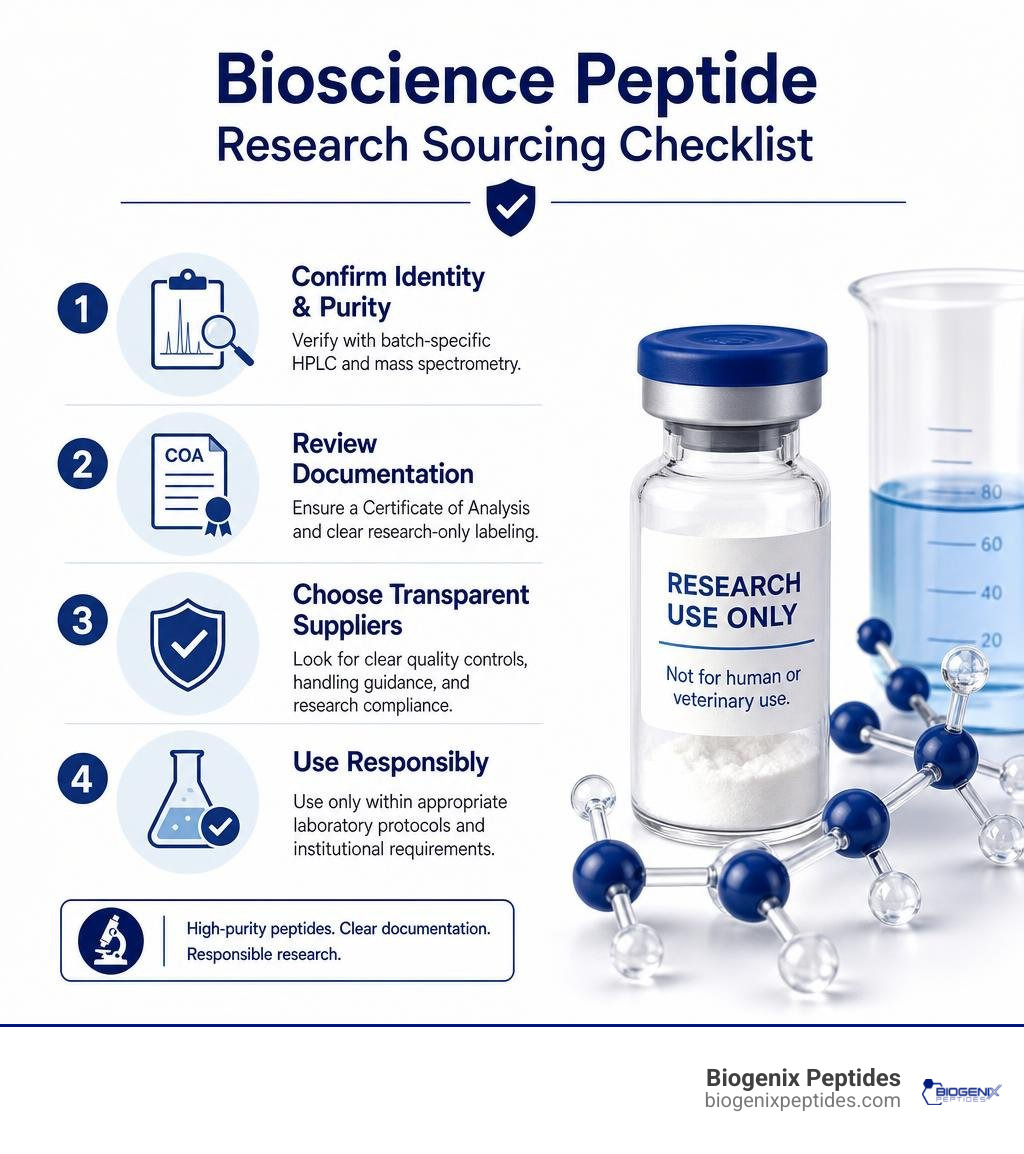
Bioscience peptides are short chains of amino acids developed or studied for their ability to interact with precise biological targets, including receptors and enzymes. For researchers seeking a trusted source, the essential checks are clear:
- Confirm identity and purity with batch-specific HPLC and mass spectrometry data.
- Review documentation such as a Certificate of Analysis and clear research-only labeling.
- Choose transparent suppliers that describe handling, quality controls, and research compliance.
- Use materials only within appropriate laboratory protocols and applicable institutional requirements.
These molecules sit between small chemical compounds and larger biologics: they can offer highly selective target binding while remaining practical to synthesize and study. From cell-signaling assays and enzyme studies to molecular probes and imaging research, peptide biosciences support a wide range of non-clinical research questions.
I am Jay Daniel, Founder and CEO of Biogenix Peptides, with hands-on experience in peptide sourcing, purity validation, quality-control processes, and emerging bioscience peptides research. This guide explains what researchers should know before evaluating peptide materials and their supporting analytical records.
Understanding Bioscience Peptides: Synthesis, Mechanisms, and Target Binding
To appreciate why bioscience peptides have captured the imagination of modern research laboratories across the United States, we first need to look at how amino acids bond together to orchestrate biological life. At their core, peptides are linear or cyclic polymers formed by peptide bonds linking L- or D-amino acid residues. While this fundamental chemistry might sound straightforward, the structural specificity of these short-chain molecules allows them to trigger remarkably complex cell-signaling pathways.
In our laboratory observations and review of academic literature, we consistently see that the spatial arrangement of amino acid side chains determines how a peptide folds, docks, and communicates with biological targets. Unlike crude extracts or non-specific chemical agents, bio-engineered peptides interact with molecular receptors through structural lock-and-key mechanisms. This structural fidelity enables upstream regulation—meaning researchers can evaluate cellular signaling at the initial point of biological contact rather than simply managing downstream chemical outcomes.
What Distinguishes Bioscience Peptides from Standard Synthetic Molecules?
What sets true bioscience peptides apart from generic synthetic fragments or standard small molecules? The answer lies in sequence purity, structural fidelity, and high signaling precision. Standard synthetic molecules often interact across broad, non-specific physiological sites, which can lead to off-target background noise during laboratory assays.
By contrast, specialized research peptides are engineered or selected to mimic exact biological motifs. To understand these core principles in depth, researchers frequently review foundational resources on What Are Peptides? The Complete Science-Backed Guide to Cell Signaling, Metabolism, Hormones, Longevity as well as general Peptide Basics. High structural fidelity ensures that every batch maintains the precise secondary structure necessary to trigger or inhibit a target signaling cascade without unwanted cross-reactivity in vitro.
Advanced Synthesis Methods and Enzymatic Ligation
The manufacturing of research-grade peptides has evolved dramatically from early benchtop chemistry. Modern laboratories rely heavily on two primary methodologies: Solid-Phase Peptide Synthesis (SPPS) and Solution-Phase Peptide Synthesis (LPPS).
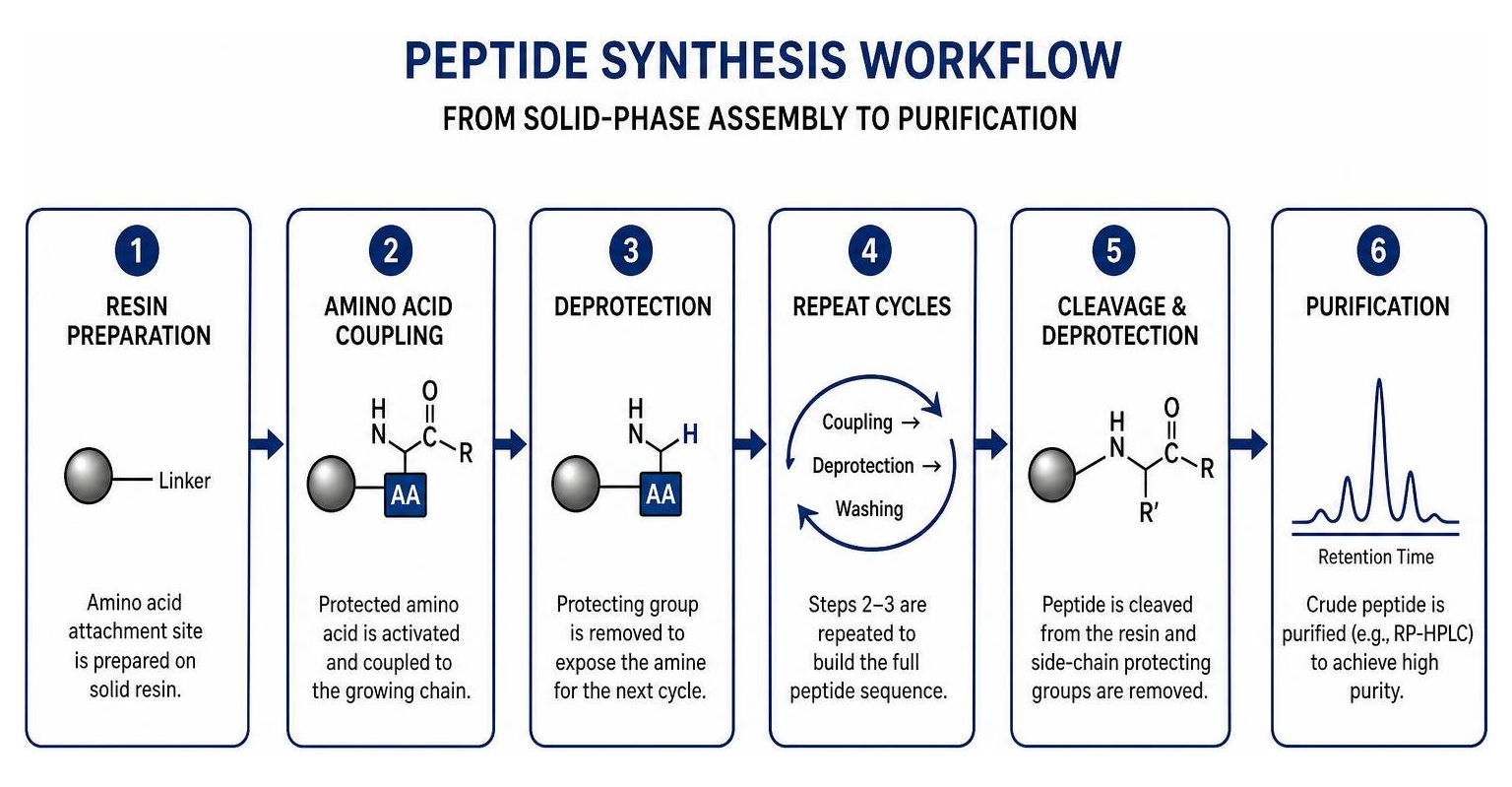
In SPPS, the growing peptide chain is covalently anchored to a solid resin bead, allowing unreacted reagents and side products to be washed away easily between coupling steps. While SPPS is excellent for short to medium sequences, LPPS is often favored for large-scale production of shorter fragments.
To bridge the gap between short synthetic chains and long, multi-domain proteins, modern biomanufacturing increasingly utilizes enzymatic ligation. By using specialized enzymes (such as modified subtiligases or sortases), scientists can stitch purified peptide fragments together with extreme chemo-selectivity and high chemical yield. For an in-depth exploration of these manufacturing techniques, researchers can consult our comprehensive Peptide Synthesis Complete Guide and read about Enzymatic Ligation in Peptide Synthesis: Why It May Be the Next Major Leap in Complex Peptide Manufacturing.
GPCR Binding and Enzyme Receptor Interaction
G-protein coupled receptors (GPCRs) represent one of the largest and most valuable classes of biological targets in laboratory research. Bioscience peptides serve as highly potent ligands for GPCRs, initiating complex signal transduction pathways upon binding. When a peptide docks into the extracellular binding pocket of a GPCR, it induces conformational shifts that activate intracellular G-proteins or arrestin pathways.
In addition to GPCR interactions, peptides frequently act as competitive or non-competitive enzyme inhibitors. By studying binding kinetics—such as association (kon) and dissociation (koff) rates, as well as equilibrium dissociation constants (Kd)—investigators can evaluate target affinity with extreme accuracy. As explored in our scientific analysis on How Peptides Work Upstream Instead of Downstream: Addressing Causes Not Just Symptoms, modulating cellular cascades right at the receptor level gives researchers unparalleled control over experimental in vitro models.
Primary Research Applications: Therapeutics, Diagnostics, and Imaging
The versatility of bioscience peptides has made them indispensable across various experimental frameworks, spanning oncology studies to advanced molecular diagnostics.
Therapeutic Domains in In Vitro and In Vivo Models
In preclinical laboratory settings, high-purity peptides enable precise cellular investigations across several critical research domains:
- Oncology Targets: Peptides designed to interrupt protein-protein interactions within tumor cell lines or target anti-apoptotic pathways.
- Metabolic Signaling: In vitro models examining insulin receptor sensitivity, glucagon-like peptide receptor pathways, and lipid oxidation cascades.
- Neurobiology and Tissue Repair: Research focused on neurotrophic factors, synaptic plasticity, and extracellular matrix remodeling.
- Mitochondrial Signaling: Peptides targeting mitochondrial membrane potential and reactive oxygen species (ROS) regulation.
Researchers investigating these multi-faceted pathways often reference our guides on The Cellular Upgrade: Peptides Focused on Energy, Repair, and Structural Signaling and Peptides That Cross Categories to structure their experimental protocols.
Emerging Horizons in Bioscience Peptides and Molecular Probes
Beyond functional assays, peptides excel as highly targeting molecular probes. By conjugating a peptide sequence to a fluorescent dye, radiolabel, or biotin tag, researchers can visualize specific cellular receptors in real time.
In diagnostic imaging research, radiolabeled peptides serve as targeted vectors that bind overexpressed receptors on target cells, enabling high-contrast PET or SPECT visualization. Because of their rapid target clearance and low systemic background retention, peptide-based molecular probes offer vastly superior imaging resolution compared to bulkier antibody constructs. You can learn more about these specialized scientific methodologies in The Complete Guide to Peptides in Scientific Research.
Overcoming Development Barriers: Bioavailability, Stability, and AI
Despite their biological precision, native peptides possess inherent physical vulnerabilities that researchers must navigate during assay design and laboratory handling.
Navigating Metabolic Degradation and Half-Life Challenges
The primary challenge when working with unmodified native peptides is their susceptibility to proteolytic enzymes. In biological media or serum-containing cell cultures, peptidases rapidly cleave amide bonds, yielding a short plasma half-life. Furthermore, environmental factors such as temperature changes and pH fluctuations can trigger aggregation or chemical degradation.
To overcome these barriers, modern peptide chemistry employs strategic structural modifications:
- N-Terminal Acetylation & C-Terminal Amidation: Protects terminal ends from exonucleases.
- D-Amino Acid Substitution: Replaces natural L-amino acids with mirror-image D-forms to evade cleavage by proteolytic enzymes.
- Cyclization: Creates rigid backbone structures (via disulfide bridges or head-to-tail amide bonds) that hinder enzymatic entry.
- Backbone Isosteric Replacement: Swaps standard peptide bonds with pseudopeptide bonds.
Understanding chemical stabilization is vital for maintaining assay integrity. For detailed technical reads on maintaining structural stability under research conditions, explore The Science of Making Peptides Heatproof and Purity Is Only the Beginning: Why Bioavailability May Be the Real Standard in Peptide Quality.
Innovations in Peptide Delivery Systems and Predictive AI
In addition to direct sequence modifications, advanced formulation technology plays a pivotal role in stabilizing peptides for in vitro research protocols. Nanocarriers, liposomes, and lipid nanoparticles (LNPs) encapsulate fragile peptide sequences, protecting them from environmental degradation and facilitating cellular uptake across lipophilic cell membranes. Discover more on modern vector technologies in our resource on The Next Generation of Peptide Carriers.

Simultaneously, computational biology and artificial intelligence are revolutionizing how bioscience peptides are designed. machine learning algorithms can now predict 3D folding dynamics, binding affinities, and proteolytic degradation points before a single chemical synthesis coupling step is performed. Researchers interested in computational tools can read our detailed article on How AI Is Predicting and Accelerating the Future of Peptide Innovation.
Comparative Analysis: Bioscience Peptides vs Small Molecules and Biologics
When designing laboratory assays, researchers often weigh the trade-offs between small molecule chemical drugs, peptide biosciences, and large monoclonal antibody biologics. The following comparative overview illustrates why peptides occupy a unique sweet spot in molecular research:
| Feature / Metric | Small Molecules | Bioscience Peptides | Biologics (e.g., Antibodies) |
|---|---|---|---|
| Molecular Weight | Typically < 500 Da | Typically 500 – 5,000 Da | Typically > 150,000 Da |
| Target Selectivity | Moderate to Low; potential off-target binding | Very High; precise lock-and-key receptor binding | Extremely High; antigen-specific binding |
| Synthesis Complexity | Low to Moderate chemical synthesis | Moderate (Controlled SPPS/LPPS/Enzymatic) | Complex cellular expression systems |
| Immunogenicity Risk | Low | Low to Moderate | Moderate to High |
| Binding Affinity | Moderate (Kd ~ µM) | High (Kd ~ nM to pM) | High (Kd ~ pM) |
| Manufacturing Scalability | High | High with modern SPPS automation | Complex and expensive batch purification |
As shown above, bioscience peptides offer target selectivity comparable to large biologics while maintaining the controllable synthesis profiles of smaller chemical compounds.
Sourcing Quality Research Peptides: Analytical Verification and Regulations
Because subtle structural flaws or chemical impurities can severely skew experimental results, validating material quality is a vital step for every research facility.
Reading Analytical Certificates: HPLC and Mass Spectrometry
A reliable source of research peptides must provide comprehensive, batch-specific documentation. The two gold-standard analytical methods for verifying quality are High-Performance Liquid Chromatography (HPLC) and Mass Spectrometry (MS).
- HPLC Analysis: Measures chemical purity by separating the main peptide compound from truncated sequences or synthesis side-products. Purity should ideally be displayed as a single sharp peak with a integrated peak area percentage (e.g., ≥ 98%).
- Mass Spectrometry (MS): Confirms the exact molecular weight of the sequence. The observed mass peak (m/z) must match the theoretical molecular weight to verify sequence identity.
We urge all investigators to carefully review analytical documentation before beginning lab work. To master reading these spectra, review How to Read a Peptide COA: Understanding HPLC & Mass Spectrometry (MS) and HPLC and Mass Spectrometry in Peptide Analysis.
Regulatory Frameworks and Research Compliance Standards
All research-grade bioscience peptides provided by vendors in the United States must strictly adhere to non-clinical regulatory frameworks. Products are supplied under Research Use Only (RUO) guidelines, meaning they are explicitly intended for laboratory experimentation, in vitro assays, and non-clinical models.
To maintain institutional compliance and research integrity, laboratories must establish strict quality assurance protocols:
- Store lyophilized powders and reconstituted solutions at verified temperatures (e.g., −20 °C or −80 °C).
- Verify that suppliers clearly display research-only designations and provide full batch traceability.
- Prevent cross-contamination by using sterile, enzyme-free lab equipment and buffers.
For further clarification on industry jargon and regulatory compliance, please refer to Research Peptides Terms Demystified and The Complete Guide to Finding a Reliable Peptide Shop.
Frequently Asked Questions
What are bioscience peptides used for in laboratory research?
Bioscience peptides are primarily utilized in non-clinical settings to explore cell-signaling pathways, evaluate GPCR dynamics, conduct biomarker imaging, and develop enzymatic inhibition assays. Their structural precision allows scientists to target specific biological receptors with high selectivity.
How do researchers confirm the purity and identity of bioscience peptides?
Researchers confirm purity and molecular identity by evaluating a batch-specific Certificate of Analysis (COA). Purity is determined through High-Performance Liquid Chromatography (HPLC), which quantifies sequence purity, while Mass Spectrometry (MS) verifies the exact molecular mass.
Why is bioavailability a primary challenge in peptide research?
Bioavailability remains a challenge due to rapid enzymatic degradation by proteases, limited permeability across cellular membranes, and quick clearance rates in biological media. Scientists overcome these obstacles by implementing chemical modifications like cyclization, terminal capping, or using liposomal nanocarriers.
Conclusion
The study of bioscience peptides represents one of the most dynamic frontiers in scientific discovery. By combining high target selectivity, manageable synthesis workflows, and deep signaling precision, these molecular tools empower researchers to address complex biological questions at their origin. As advancements in solid-phase synthesis, enzymatic ligation, and AI-driven predictive modeling continue to accelerate, the scope of peptide research will only broaden.
At Biogenix Peptides, we remain dedicated to supporting scientific integrity by delivering high-purity, fully verified research materials backed by transparent HPLC and Mass Spectrometry analytics. We invite your laboratory team to explore our extensive catalog and elevate your research protocols today.
Ready to advance your laboratory assays with validated materials? Shop Research-Grade Peptides from Biogenix Peptides.