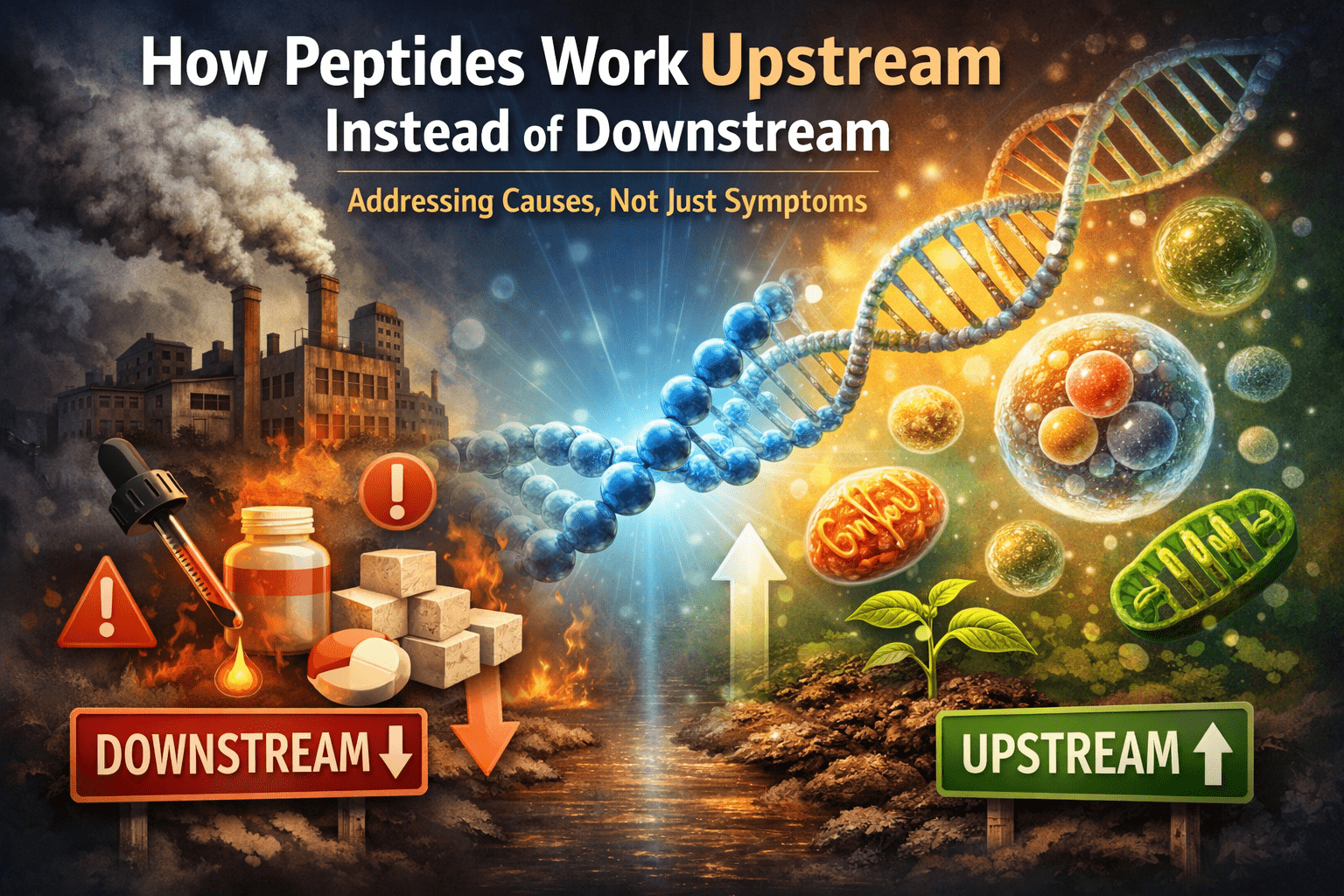
How Peptides Work Upstream Instead of Downstream: Addressing Causes, Not Just Symptoms
Research Use Only Disclaimer
The compounds mentioned in this article are intended for laboratory research use only. They are not approved for human consumption, medical use, or veterinary use. This content is provided for educational and informational purposes only and is not medical advice.
Introduction
Modern medicine often works downstream.
You have high blood sugar? Lower it.
You have inflammation? Block it.
You feel fatigued? Stimulate something.
These approaches can be useful and, in many cases, essential. But they often focus on the end result of dysfunction rather than the biological miscommunication that helped create it.
Peptides are different.
They are studied for how they work upstream—at the level of cellular signaling, regulatory pathways, and biological communication—where many problems begin long before symptoms appear.
That upstream approach is a big part of why peptide research has attracted so much attention in fields like metabolism, recovery, neurobiology, and longevity science.
Upstream vs. Downstream: A Simple Way to Think About It
Imagine a factory producing smoke.
- Downstream treatment is like installing a fan to blow the smoke away.
- Upstream intervention is like fixing the machine that is overheating and causing the smoke in the first place.
Both can change what you see. But only one is trying to address the source.
That is the key distinction.
Peptides are signaling molecules. They do not simply overpower biology. They interact with it. In many cases, they are studied for how they help guide cells, tissues, and systems back toward more coordinated function.
What “Upstream” Means in Biology
In biology, upstream refers to earlier events in a pathway—the signals and triggers that influence what happens later.
This may include:
- Cell-to-cell communication
- Gene transcription and expression
- Hormonal signaling
- Immune system modulation
- Mitochondrial regulation
- Tissue repair signaling
- Inflammatory pathway control
By contrast, downstream refers to the later consequences of those upstream events. Pain, swelling, poor glucose control, fatigue, and visible dysfunction often show up downstream—after a deeper biological imbalance has already been in motion.
That does not mean downstream effects are unimportant. It means they are often outputs of a process that started earlier.
Why Symptoms Are Not Always the Real Problem
Symptoms are often the body’s visible alarm system. They tell you that something is happening, but they do not always tell you why it is happening.
For example, fatigue may look like a lack of energy. But the deeper issue may involve mitochondrial inefficiency, poor cellular signaling, stress-response imbalance, or inflammatory burden. In the same way, inflammation may appear as swelling or discomfort, yet the real issue could be dysregulated immune communication or unresolved tissue stress.
This is why purely downstream approaches can sometimes feel incomplete. They may reduce what you feel without changing what is driving the process underneath.
Peptides are studied because they may act closer to the command signals themselves.
The Core Idea Behind Peptides: Signaling Instead of Forcing
Peptides are short chains of amino acids. Many of them resemble or mimic signaling molecules already used by the body.
That matters because biology runs on messages.
Cells are constantly receiving instructions about when to repair, when to grow, when to slow inflammation, when to release hormones, when to mobilize energy, and when to enter protective states. A peptide may bind to a receptor and influence that message flow.
In practical terms, peptides are often studied for how they:
- Bind to receptors
- Trigger signaling cascades
- Influence transcription factors
- Modulate inflammatory tone
- Support tissue-specific communication
- Alter how cells respond to stress
That is very different from simply blocking a symptom at the end of a pathway.
It is more like adjusting the instructions than silencing the alarm.
Example 1: Energy Problems Are Often Downstream of Mitochondrial Dysfunction

Low energy, poor endurance, slow recovery, and brain fog are all common downstream complaints. But the upstream issue may involve mitochondria.
Mitochondria are the energy-producing structures inside cells. They help generate ATP, regulate oxidative stress, influence cell survival signals, and contribute to overall metabolic resilience. When mitochondrial function is impaired, a person may feel the effects in many ways—but the visible symptom is not the true starting point.
This is one reason mitochondrial peptides have generated so much interest in research.
For example, compounds like MOTS-c and SS-31 (elamipretide) have been studied for their interactions with mitochondrial biology, metabolic regulation, and cellular stress responses. Rather than simply stimulating the body to feel more alert, these peptides are researched for how they may support the energy-producing machinery itself.
In simple terms, this is the difference between revving the engine harder and improving how the engine actually runs.
Example 2: Inflammation Is Often a Signal Problem, Not Just a Molecule Problem

Inflammation is not inherently bad. It is a normal protective response. The problem begins when inflammation becomes excessive, prolonged, poorly resolved, or disconnected from the original trigger.
Many conventional approaches focus downstream by attempting to block inflammatory mediators after the process is already active. That can be useful, but it may not explain why the inflammatory response became dysregulated in the first place.
Peptides are often studied for how they influence upstream inflammatory signaling and tissue protection pathways.
For example, BPC-157 has been investigated in preclinical research for its relationship to angiogenic signaling, nitric oxide pathways, tissue repair dynamics, and recovery-related processes. ARA-290, a peptide derived from erythropoietin-related biology, has been studied for tissue-protective and inflammation-modulating effects without acting like classic erythropoietin.
The idea is not necessarily to shut inflammation off completely. The more interesting question is whether upstream signaling can help inflammation become more proportionate, more targeted, and better resolved.
That is a very different frame of reference.
Example 3: Weight Gain Is Often the End Result, Not the Beginning

Body weight is one of the clearest examples of a downstream outcome being mistaken for the whole story.
Weight gain is not just about visible fat tissue. It can be influenced by satiety signaling, insulin sensitivity, mitochondrial output, nutrient partitioning, stress hormones, sleep disruption, appetite regulation, and neuroendocrine feedback loops.
That is why metabolic peptides have become such a major area of research.
Compounds like semaglutide, tirzepatide, and retatrutide are studied because they interact with upstream hormonal signaling related to appetite, glucose handling, and metabolic control. Tesamorelin has also been studied for its effects on growth hormone-releasing pathways and body composition-related mechanisms.
These peptides are interesting not because they “target weight” in a simplistic way, but because they act on signaling systems that influence how the body manages fuel, hunger, storage, and energy use.
In other words, they do not merely chase the symptom on the scale. They alter some of the biology that helps produce the number on the scale.
Example 4: Recovery and Healing Start Before the Pain Stops
Pain, stiffness, and loss of function are downstream experiences. But tissue breakdown, disrupted blood flow, inflammatory signaling, extracellular matrix damage, and poor regenerative communication often begin much earlier.
This is another reason peptides are being explored in research settings focused on tendon, ligament, muscle, gut, and systemic recovery pathways.
When a peptide influences angiogenesis, collagen-related signaling, cellular migration, or regenerative cross-talk, it may be acting upstream of the pain itself. The symptom may improve later, but the biological action of interest began before that moment.
This is important because true recovery is not the same as temporarily feeling better. A numb symptom and a repaired tissue are not the same event.
Example 5: Brain Function Is Also Built on Upstream Chemistry
Mood, focus, memory, stress resilience, and mental clarity are also downstream experiences. Underneath them are neurotransmitter systems, neurotrophic factors, inflammatory tone, synaptic plasticity, mitochondrial health, and neuroendocrine signaling.
Peptides studied in the nootropic and neuroregulatory space are often interesting precisely because they may influence these deeper regulatory systems rather than simply creating a blunt temporary effect.
That is why certain compounds in research are explored for their relationship to brain-derived neurotrophic factor, stress signaling, inflammatory regulation, and adaptive neural communication. The downstream experience may be better focus or better resilience—but the upstream story is about signaling.
Why the Upstream Approach Matters for Longevity Research
Aging itself can be viewed as an accumulation of upstream dysregulation.
This includes:
- Mitochondrial decline
- Cellular senescence
- Epigenetic drift
- Chronic low-grade inflammation
- Reduced repair signaling
- Hormonal communication changes
- Loss of adaptive stress response
Many outward signs of aging—reduced energy, poorer recovery, increased inflammation, metabolic slowdown, and declining resilience—are downstream reflections of those shifts.
This is why peptides draw so much attention in longevity science. Researchers are not just asking how to hide age-related symptoms. They are asking whether certain signaling pathways can be influenced earlier, before dysfunction fully expresses itself downstream.
That is a much deeper question than symptom management alone.
Why This Feels Different Than Traditional Symptom Suppression
One reason peptide science captures so much interest is that it feels more biologically coherent. Instead of treating the body like a machine that needs overriding, it treats the body like a communication network that may need better instructions.
That does not mean peptides are magic. It does not mean every peptide works. It does not mean downstream interventions are bad.
It simply means that upstream signaling offers a different framework.
Rather than asking, “How do we mute the symptom?” the better question may be, “What signal is producing this symptom, and can that signal be improved?”
Important Perspective: Upstream Does Not Automatically Mean Better
It is important to stay balanced.
Downstream treatments can be absolutely necessary. In some situations, symptom control is urgent, appropriate, and life-saving. Reducing pain, lowering glucose, controlling inflammation, or stabilizing acute dysfunction matters.
But a downstream solution is not always a root-cause solution.
The interest in peptides comes from the possibility that some compounds may influence earlier points in the chain—where tissues, organs, and systems are receiving the instructions that shape later outcomes.
That upstream lens is one of the most compelling ideas in peptide research today.
In Simple Terms
Here is the simplest way to understand it:
- Downstream means dealing with what already showed up.
- Upstream means addressing the signals and causes that helped create it.
Peptides are interesting because they are often studied as messengers. They may help influence how the body regulates repair, inflammation, energy, metabolism, and resilience at a deeper level.
Instead of just covering up the smoke, the goal is to inspect the machine.
Instead of only muting the alarm, the goal is to understand what triggered it.
Instead of chasing symptoms forever, the goal is to ask better biological questions.
Final Thoughts
Symptoms matter. They should never be ignored. But symptoms are often messages, not just problems.
Peptides are studied because they work in the language of biological messaging itself. They may influence receptors, pathways, transcription factors, mitochondrial responses, immune signals, and tissue-level communication before dysfunction fully expresses itself downstream.
That is what makes them so compelling.
They are not just about what you feel on the surface. They are about the signals underneath the surface that shape what you eventually feel.
That is the upstream difference.
References
- Walsh CT, Garneau-Tsodikova S, Gatto GJ Jr. Protein posttranslational modifications: the chemistry of proteome diversifications. Angew Chem Int Ed Engl. 2005;44(45):7342-7372.
- Lee C, Zeng J, Drew BG, et al. The mitochondrial-derived peptide MOTS-c promotes metabolic homeostasis and reduces obesity and insulin resistance. Cell Metab. 2015;21(3):443-454.
- Szeto HH. First-in-class cardiolipin-protective compound as a therapeutic agent to restore mitochondrial bioenergetics. Br J Pharmacol. 2014;171(8):2029-2050.
- Sikiric P, Seiwerth S, Rucman R, et al. Stable gastric pentadecapeptide BPC 157: novel therapy in gastrointestinal tract. Curr Pharm Des. 2011;17(16):1612-1632.
- Brines M, Patel NS, Villa P, et al. Nonerythropoietic, tissue-protective peptides derived from erythropoietin. Proc Natl Acad Sci U S A. 2008;105(31):10925-10930.
- Drucker DJ. Mechanisms of action and therapeutic application of glucagon-like peptide-1. Cell Metab. 2018;27(4):740-756.
- Jastreboff AM, Aronne LJ, Ahmad NN, et al. Tirzepatide once weekly for the treatment of obesity. N Engl J Med. 2022;387(3):205-216.
- Coskun T, Urva S, Roell WC, et al. LY3437943, a novel triple agonist of GIP, GLP-1, and glucagon receptors, for the treatment of obesity. Cell Metab. 2022;34(9):1234-1247.e9.
- Stanley TL, Grinspoon SK. Effects of growth hormone-releasing hormone on visceral fat, metabolic, and cardiovascular indices in human studies. Growth Horm IGF Res. 2015;25(2):59-65.
- López-Otín C, Blasco MA, Partridge L, Serrano M, Kroemer G. The hallmarks of aging. Cell. 2013;153(6):1194-1217.

Author Disclaimer:
The content published under this author’s byline is provided for informational and educational purposes only and reflects theoretical research discussions related to peptides, biochemistry, and related scientific topics.
Any credentials or academic titles referenced are academic in nature only and do not imply medical licensure, clinical authority, or the practice of medicine.
This content does not constitute medical advice, diagnosis, or treatment, and should not be interpreted as such. The author is not providing clinical guidance and is not acting as a healthcare provider.
All products discussed by BioGenix Peptides LLC are intended strictly for research, laboratory, and analytical use only and are not for human or animal consumption.
BioGenix Peptides LLC makes no claims regarding the safety, efficacy, or approved use of any compounds discussed.
Best selling products
-

Bacteriostatic Water (Reconstitution Solution) 10mL
$16.00 -
RT (GLP-3 RT) 10mg
$110.00 -
RT (GLP-3 RT) 20mg
$180.00 -

Bacteriostatic Water (Reconstitution Solution) 3mL
$9.00 -
BPC-157 10mg
$72.00