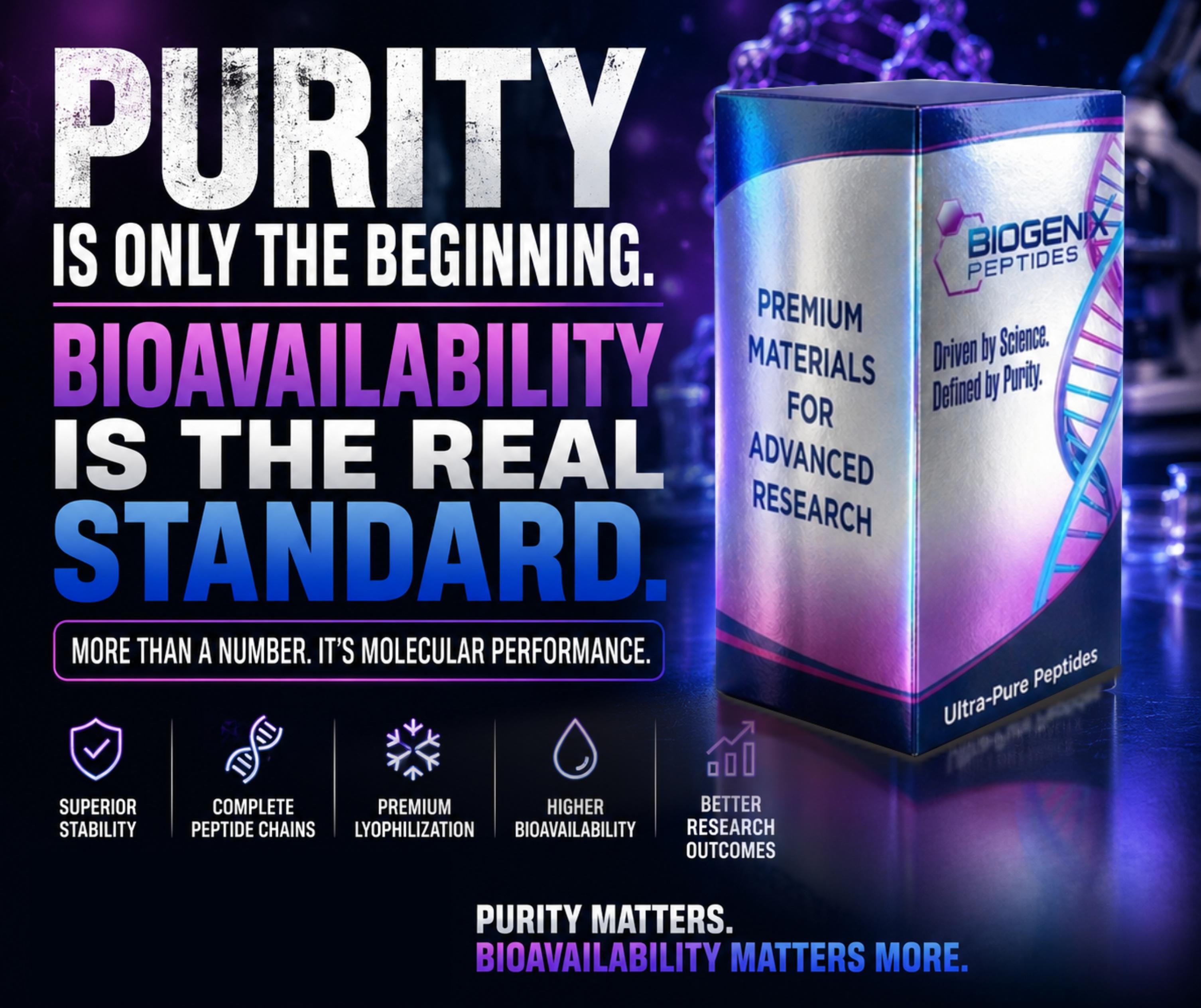
Purity Is Only the Beginning: Why Bioavailability May Be the Real Standard in Peptide Quality
Research Disclaimer: This article is for educational and research discussion only. BioGenix Peptides products are intended strictly for laboratory research purposes and are not for human or animal use. BioGenix Peptides does not provide medical advice, dosing guidance, or treatment recommendations.
The Problem With “99% Pure” Marketing
In the peptide world, nearly everyone talks about purity.
You see it everywhere: 99% purity, HPLC tested, third-party verified, and pharmaceutical-grade claims.
Purity absolutely matters. But purity is not the whole story.
A peptide can test extremely clean on paper and still perform poorly in a research environment if the molecule has been damaged, destabilized, oxidized, truncated, poorly lyophilized, or processed under weak manufacturing controls.
That is why the deeper question is not only “How pure is it?”
The better question is:
How much of that peptide remains structurally intact, stable, soluble, and biologically available for research interaction?
What Bioavailability Really Means in Peptide Science
In peptide research, bioavailability refers to how much of a compound remains structurally intact, stable, and biologically usable after preparation and exposure to a research system.
Bioavailability can be influenced by several factors, including:
- Molecular integrity
- Peptide chain completion
- Oxidation resistance
- Aggregation tendency
- Solubility behavior
- Carrier and stabilization chemistry
- Lyophilization quality
- Residual moisture content
- Temperature exposure
- Storage and shipping conditions
- Reconstitution behavior
This is where peptide quality becomes more complex than a purity number alone.
A compound may appear acceptable on a certificate of analysis, yet still lose meaningful research value if the peptide is unstable, fragmented, improperly dried, or prone to degradation after reconstitution.
Why Manufacturing Quality Matters More Than Most People Realize
Peptide manufacturing is not simple. It is a highly technical process that depends on precision at every stage.
High-quality peptide production involves:
- Sequential amino acid coupling
- Proper deprotection cycles
- Controlled cleavage chemistry
- Purification
- Filtration
- Moisture control
- Lyophilization
- Final analytical testing
- Careful storage and handling
Every one of these stages can affect the final molecule.
When manufacturers rush synthesis, use poor controls, shorten purification time, or cut corners during drying, the final material may contain more damaged or incomplete peptide structures than the purity number suggests.
The Hidden Problem: Truncated Peptides
One of the biggest issues in peptide manufacturing is truncation.
Truncated peptides are incomplete peptide chains that occur when amino acid sequencing does not fully complete during synthesis.
This can happen when coupling reactions are rushed, incomplete, poorly controlled, or not properly verified before moving to the next stage.
Truncation may be caused by:
- Incomplete amino acid coupling
- Rushed synthesis cycles
- Poor reagent quality
- Weak purification standards
- Temperature stress
- Improper pH handling
- Moisture exposure
The result is a material that may still appear similar visually, but may not contain the same percentage of fully intact, properly completed peptide chains.
That matters because research value depends on more than simply having peptide material in the vial. It depends on how much of that material remains complete, stable, and structurally useful.
Why Two “99% Pure” Peptides Can Behave Differently
Two peptide products may both claim high purity. They may both show strong third-party testing. They may even look similar in the vial.
But in practice, they can behave very differently.
One may reconstitute cleanly, remain stable longer, resist aggregation, and preserve molecular integrity more effectively.
Another may cloud, clump, gel, oxidize, degrade faster, or show inconsistent solubility behavior.
That difference often comes down to processing.
Purity testing can help confirm identity and detect impurities, but it does not always tell the full story of:
- Structural preservation
- Molecular stability
- Residual solvent quality
- Oxidation risk
- Aggregation tendency
- Post-reconstitution stability
- Peptide survivability
This is why BioGenix Peptides focuses on the complete quality chain, not just the final purity percentage.
The Importance of Proper Lyophilization
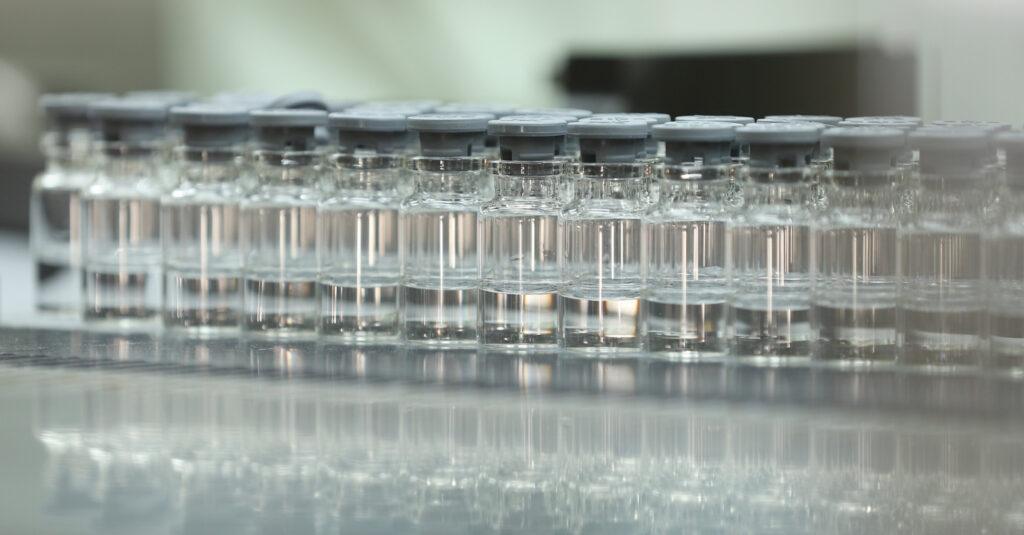
Lyophilization, commonly known as freeze-drying, is one of the most important steps in peptide preservation.
When done correctly, lyophilization helps reduce moisture, preserve structure, improve shelf stability, and support cleaner reconstitution behavior.
When done poorly, it can create major problems before the vial ever reaches the researcher.
Poor lyophilization may contribute to:
- Excess residual moisture
- Structural collapse
- Aggregation
- Oxidation risk
- Instability after reconstitution
- Reduced long-term integrity
This is why advanced peptide processing requires control over freezing temperature, chamber pressure, drying time, moisture endpoint, and environmental exposure.
Those details are not cosmetic. They directly affect how well the molecule is preserved.
Carrier and Stabilization Chemistry Matter
Some peptides are naturally delicate. Their stability depends heavily on the environment created around them.
The correct carrier or stabilizing system can help support solubility, protect the peptide structure, and reduce degradation risk.
The wrong system can contribute to cloudiness, aggregation, oxidation, instability, or poor reconstitution behavior.
At BioGenix Peptides, we do not treat carriers as filler. We view them as part of the stability system required to help preserve the molecule properly.
Our focus is not on unnecessary binders or cheap additives. It is on using only what is needed to support proper synthesis, stability, solubility, and research-grade molecular preservation.
Why We Do Not Rush the Process
Speed is one of the biggest enemies of peptide quality.
Mass-production environments often prioritize volume, faster turnaround, and lower cost. But peptide science rewards precision, not shortcuts.
Rushed processing can increase the risk of:
- Incomplete synthesis
- Truncated peptide chains
- Misfolded or unstable structures
- Residual impurities
- Poor solubility
- Moisture-related degradation
- Inconsistent reconstitution behavior
At BioGenix Peptides, we believe quality is built into the process long before final testing occurs.
That means greater attention to synthesis timing, purification, drying, stabilization, testing, storage, and packaging.
Because once a peptide has been structurally damaged, no certificate of analysis can undo that damage.
Why BioGenix Peptides Focuses on Bioavailability
BioGenix Peptides was built around a simple principle: purity matters, but molecular performance matters more.
Our approach emphasizes:
- High-purity peptide sourcing
- Controlled synthesis standards
- Careful purification workflows
- Reduced risk of truncation
- Proper lyophilization
- Stability-focused processing
- Solubility-conscious formulation
- Cold-chain aware storage practices
- Batch-specific quality review
- Third-party testing and COA access
This is how we think peptide quality should be measured: not by one isolated number, but by the full preservation of the molecule from synthesis through final research preparation.
Purity Tells Part of the Story. Bioavailability Tells the Rest.
Purity is important. It always will be.
But purity alone is not enough to define peptide quality.
The real standard is whether the molecule remains intact, stable, soluble, and biologically available for the intended research environment.
That is why BioGenix Peptides places such heavy emphasis on processing, preservation, lyophilization, stabilization, and quality control.
Because the highest-quality peptide is not simply the one that looks good on paper.
It is the one that has been protected at every stage of the process.
About the Author
I’m Jay D Daniel, Founder and CEO of BioGenix Peptides. I have spent years studying peptide science, molecular stability, manufacturing quality, and the real-world factors that separate premium peptide production from rushed commodity manufacturing.
One thing I have learned is that true peptide quality is far more complex than a purity percentage. The real goal is preserving the integrity of the molecule from synthesis all the way through final research preparation.
At BioGenix Peptides, our focus is quality, consistency, and molecular preservation. We do not believe in rushing the process just to move faster. We believe in doing it right.