
Compare Effective Peptide Blends for Fat Loss
Disclaimer: The information provided in this article is for educational and informational purposes only. It is not intended as medical advice, diagnosis, or treatment. Products and compounds referenced are for research use only and are not approved for human or veterinary consumption. Always consult a qualified professional regarding health or medical decisions.
Researchers comparing peptide blends for fat loss generally focus on three combination types: Growth Hormone secretagogue pairings such as CJC-1295 and Ipamorelin, which amplify pulsatile growth hormone release to support lipolysis; direct adipocyte and cellular modulators such as AOD-9604 paired with 5-Amino-1MQ, which target fat cells and cellular energy pathways directly; and multi-agonist incretin combinations, such as GLP-1/GIP/Glucagon co-agonists, which act on central satiety and thermogenic signaling. Each formulation engages a distinct biological pathway, and researchers often study them in combination to observe cross-talk between the gut, brain, pituitary gland, and adipose tissue that single-agent compounds cannot replicate. The sections below examine the mechanisms, comparative profiles, and research protocols associated with these formulations in greater depth.
Mechanisms of Action: How Peptide Blends for Fat Loss Target Adiposity
Understanding how multi-compound peptide formulations function requires examining cellular metabolism. At their core, these formulations attempt to orchestrate distinct metabolic signals simultaneously. Instead of relying on a single biological switch, combining metabolic agents allows researchers to evaluate cross-talk between the gut, brain, pituitary gland, and adipose tissue.
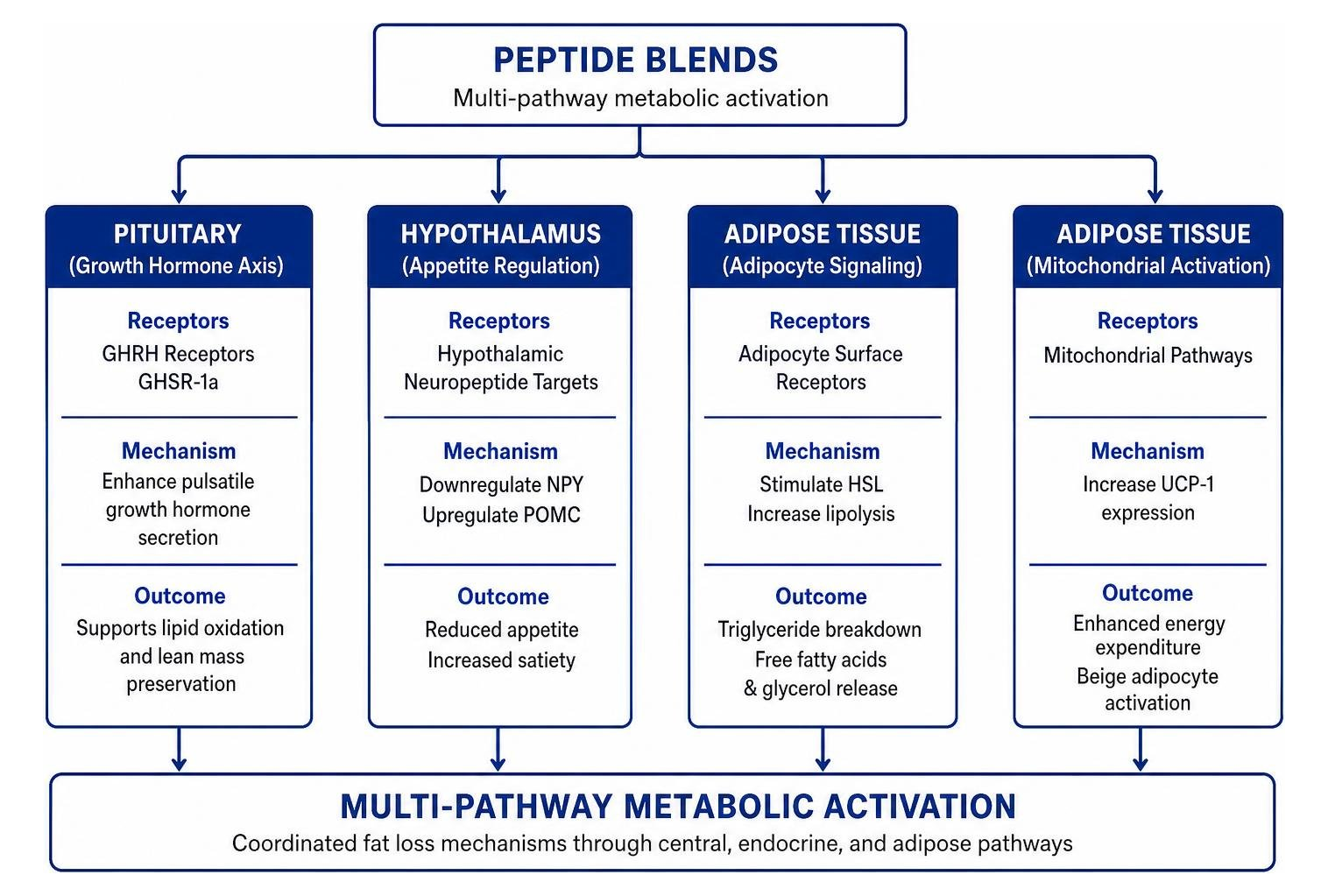
When examining metabolic signaling, several distinct pathways emerge:
- Direct Adipocyte Signaling: Certain chains interact directly with receptors on mature fat cells. Investigating how peptides communicate with adipocytes highlights pathways that stimulate hormone-sensitive lipase (HSL), which accelerates triglyceride breakdown into free fatty acids and glycerol.
- Central Appetite Regulation: Compounds interacting with hypothalamic circuits modulate satiety signaling, downregulating neuropeptide Y (NPY) and upregulating pro-opiomelanocortin (POMC) activity.
- Growth Hormone Axis Pulsing: Pituitary-targeted secretagogues enhance endogenous, pulsatile growth hormone output, which supports lipid oxidation while protecting structural lean protein.
- Mitochondrial Energy Expenditure: Novel mitochondrial-derived peptides enhance uncoupling protein-1 (UCP-1) expression, shifting white adipose tissue toward thermogenic beige phenotypes.
Attacking metabolic resistance from multiple biological angles produces fundamentally different cellular outcomes than single-agent approaches. This multi-pathway strategy is particularly relevant when evaluating peptide blends for fat loss, as it allows investigators to observe how distinct receptor systems interact under controlled laboratory conditions. For broader context on how these pathways are classified in metabolic research, the National Center for Biotechnology Information provides peer-reviewed literature on peptide signaling and adipocyte biology.
Secretagogue Synergy: Growth Hormone Axis Amplification
One of the most extensively studied combinations involves pairing Growth Hormone Releasing Hormone (GHRH) analogs with Growth Hormone Secretagogues (GHS/GHRPs). In isolated research models, administering either agent alone produces a modest, transient increase in serum growth hormone. However, their combination exhibits marked synergy.
GHRH analogs (such as modified GRF 1-29) bind specifically to pituitary receptors to amplify the natural production of growth hormone pulses. Concurrently, ghrelin-mimicking peptides (such as Ipamorelin) bind to the growth hormone secretagogue receptor (GHSR-1a), suppressing somatostatin—the body’s natural “brake” on growth hormone release. Exploring this specific CJC-1295 and Ipamorelin synergy reveals how dual stimulation triggers a natural, amplified burst of somatotroph activity without causing non-physiological hormone spikes. Researchers studying peptide blends for fat loss often prioritize this axis because pulsatile growth hormone output is closely linked to lipolytic activity in adipose tissue.
Incretin Co-Agonism and Dual Receptor Pathways
Beyond the pituitary axis, research has advanced toward gut-derived incretin mimetics and dual/triple co-agonists. Incretin hormones such as Glucagon-Like Peptide-1 (GLP-1), Glucose-Dependent Insulinotropic Polypeptide (GIP), and amylin coordinate nutrient sensing, gastric emptying, and insulin dynamics.
Recent work in multi-agonist metabolic signaling demonstrates that pairing GLP-1 receptor activation with complementary satiety peptides delivers synergistic effects on caloric intake and glycemic stability. For instance, pairing long-acting amylin analogs with incretins—as seen in studies on Cagrilintide and semaglutide synergy—engages distinct neurochemical pathways in the area postrema and ventral tegmental area, offering powerful dual-mechanism satiety control. These observations underscore why multi-pathway peptide blends for fat loss have become a focal point in metabolic research, as they may address compensatory signaling that single-agent approaches cannot overcome.
Comparative Analysis of Major Fat Loss Peptide Formulations
The most effective peptide blends for fat loss in metabolic research combine complementary biological pathways—principally Growth Hormone secretagogue pairings (like CJC-1295 and Ipamorelin for pulsatile lipolysis), direct adipocyte and cellular modulators (such as AOD-9604 with 5-Amino-1MQ), and multi-agonist incretins (such as GLP-1/GIP/Glucagon tri-agonists for central satiety and thermogenesis). To assess how different formulations compare across laboratory settings, we examine their primary mechanisms, metabolic targets, and kinetic properties. The table below summarizes key distinctions among commonly studied peptide blends for fat loss.
| Research Formulation / Stack | Primary Target Receptors | Cellular Mechanism | Kinetic Profile & Target |
|---|---|---|---|
| CJC-1295 (no DAC) + Ipamorelin | GHRH-R & GHSR-1a | Pulsatile GH elevation, enhanced lipolysis | Short half-life (~30 min), nightly pulsatile focus |
| AOD-9604 + 5-Amino-1MQ | Adipocyte beta-3 pathways & NNMT enzyme | Direct lipid mobilization + NAD+ pool elevation | Sustained cellular signaling, adipose tissue focus |
| GLP-1 / GIP / Glucagon Tri-Agonists | GLP-1R, GIPR, GCGR | Hypothalamic satiety, thermogenesis, lipid breakdown | Extended half-life (~120–168 hours), systemic metabolic rate |
| MOTS-c + SLU-PP-332 Stack | AMPK activation & ERR-alpha signaling | Exercise mimicry, mitochondrial biogenesis | Variable; targeted cellular energy flux |
Top-Tier Synergistic Peptide Blends for Fat Loss in Research
Several standalone and stacked compounds have garnered significant attention in metabolic research literature. Each offers a distinct mechanism that may contribute to the overall efficacy of peptide blends for fat loss in experimental models.
- AOD-9604: Derived as a truncated C-terminal fragment of human growth hormone (hGH 177-191), the AOD-9604 lipolytic fragment stimulates adipose beta-3 adrenergic receptors to drive lipid mobilization without perturbing systemic glucose or IGF-1 levels.
- 5-Amino-1MQ: This small-molecule compound functions via 5-Amino-1MQ NNMT inhibition. By blocking nicotinamide N-methyltransferase in adipocytes, it elevates intracellular NAD+ levels and upregulates Sirtuin-1 (SIRT1), enhancing basal energy expenditure.
- MOTS-c: Synthesized from mitochondrial DNA, research on MOTS-c exercise mimicry reveals its role as an exercise mimetic that activates the AMPK pathway, promoting fatty acid oxidation and cellular insulin sensitivity.
- Retatrutide: Representing the cutting edge of multi-receptor signaling, investigating triple-agonist retatrutide dynamics illustrates how simultaneous GLP-1, GIP, and glucagon receptor agonism increases resting energy expenditure while curbing appetite.
Single Agents Versus Multi-Peptide Blends
A single-target agent can produce significant changes, but it frequently encounters biological counter-regulation. For instance, continuous monotherapy can lead to receptor downregulation or trigger compensatory increases in appetite signaling. This is a central rationale for investigating peptide blends for fat loss rather than isolated compounds.
However, more is not always better. Unchecked stacking risks compound cross-reactivity and receptor competition. Researchers must recognize the risks of counterproductive peptide stacking, as uncalibrated multi-compound mixtures can overtax receptor binding affinities and provoke unwanted cellular stress instead of metabolic synergy. Careful selection of complementary pathways—rather than simply increasing the number of agents—is essential for meaningful experimental outcomes.
Protocols, Safety, and Clinical Efficacy Standards
Rigorous handling standards are paramount when working with fragile peptide sequences. Our comprehensive guide to peptide blending details the physical properties and stability profiles essential for maintaining sequence integrity in laboratory settings.

Synthesized peptides are typically supplied as lyophilized (freeze-dried) cakes that require reconstitution with bacteriostatic water. Maintaining low temperatures, minimizing ambient light exposure, and avoiding physical agitation are fundamental requirements for preserving secondary peptide structures. Researchers evaluating peptide blends for fat loss should establish standardized handling protocols to ensure reproducibility across experimental cycles.
Clinical Efficacy and Expected Timelines of Peptide Blends for Fat Loss
In experimental literature, the rate and magnitude of metabolic alterations depend directly on the pathways engaged. The following timeline reflects commonly observed patterns in controlled research settings:
- Weeks 1–2 (Acute Signaling): Initial shifts manifest primarily in glycemic stabilization, altered gastric transit times, and immediate AMPK or beta-3 receptor signaling.
- Weeks 3–6 (Adipose Mobilization): Measurable reductions in visceral and subcutaneous adipose tissue emerge as sustained lipolysis and continuous satiety signaling take hold.
- Weeks 8–12 (Sustained Remodeling): Long-term studies evaluate shifts in body composition, tracking preserved lean mass alongside diminished adipose depots.
Safety Profiles, Contraindications, and Drug Interactions
Every biological signaling pathway carries specific safety considerations. GHRH/GHRP combinations require careful observation regarding transient fluid balance changes and receptor desensitization, highlighting the importance of intermittent research cycles.
Meanwhile, incretin mimetics demand strict attention to gastrointestinal motility markers and potential hypoglycemic interactions when studied alongside exogenous glucose-lowering agents. Across all research models, pre-existing cellular proliferative markers and endocrine abnormalities represent clear contraindications. Investigators working with peptide blends for fat loss should document all observations meticulously, as multi-pathway interactions may produce effects not seen with single-agent administration.
Regulatory Landscape and Sourcing Quality Verification
The legal and regulatory framework surrounding synthesized research peptides is precise. When navigating US peptide regulatory standards, researchers must understand that unapproved synthetic peptides are designated strictly for in vitro laboratory and animal research, and are explicitly not approved for human or veterinary consumption. This classification applies equally to individual compounds and to peptide blends for fat loss.
To maintain laboratory validity, sourcing must meet exacting analytical criteria:
- High-Performance Liquid Chromatography (HPLC): Verifies purity by isolating and quantifying the primary peptide fraction, targeting purity levels of 98% or higher.
- Mass Spectrometry (MS): Validates the exact molecular weight and amino acid sequence of the target chain, ruling out synthesis errors.
- Endotoxin and Sterility Testing: Assures that batches are free from bacterial endotoxins and microbiological contaminants.
Researchers should request batch-specific documentation for every peptide blend under investigation, as even minor impurities can confound experimental results and compromise data integrity.
Frequently Asked Questions About Fat Loss Peptides
Can Peptide Blends Be Safely Combined with Caloric Restriction and Training?
In controlled research models, metabolic signaling compounds are routinely studied in conjunction with structured energy deficits and physical exertion models. These paradigms help investigators determine whether secretagogues or mitochondrial mimickers can mitigate the loss of lean tissue and prevent metabolic slowdown during periods of restricted energy availability. Peptide blends for fat loss are often evaluated under these conditions to assess whether multi-pathway signaling preserves metabolic rate more effectively than single-agent approaches.
How Quickly Do Metabolic Changes Occur During a Research Cycle?
Cellular signaling changes—such as elevated intracellular cAMP or phosphorylation of AMPK—occur within minutes to hours following introduction in experimental assays. Observable systemic outcomes, including measurable shifts in adipose weight and substrate oxidation profiles, typically take between three to six weeks of sustained experimental observation. The timeline may vary depending on the specific peptide blends for fat loss under investigation and the receptor systems they engage.
What Quality Markers Differentiate Research-Grade Blends from Counterfeit Products?
Legitimate research-grade materials are accompanied by verifiable, batch-specific Certificates of Analysis (COA) issued by independent, ISO-accredited third-party laboratories. Counterfeit or degraded products often exhibit substandard lyophilization (collapsed powder cakes), lack HPLC chromatography traces, or display purity figures below 98%. When sourcing peptide blends for fat loss, researchers should verify that analytical documentation matches the exact formulation being studied.
Conclusion
The evolution of metabolic research has shifted from simple single-agent compounds to sophisticated multi-pathway signaling stacks. By engaging pituitary release mechanisms, mitochondrial uncoupling, and gut-brain satiety pathways simultaneously, researchers can study lipid mobilization with greater cellular precision. Peptide blends for fat loss represent a significant advancement in this field, offering experimental models that more closely mirror the complexity of endogenous metabolic regulation.
At BioGenix Peptides, our mission is to support scientific inquiry with pure, precisely synthesized compounds validated by rigorous HPLC and mass spectrometry testing. Explore our complete catalog of advanced metabolic research peptide solutions to elevate your laboratory research with high-purity compounds.