The Best Substitutes for Bacteriostatic Water in Medical Reconstitution
Disclaimer: The information provided in this article is for educational and informational purposes only. It is not intended as medical advice, diagnosis, or treatment. Products and compounds referenced are for research use only and are not approved for human or veterinary consumption. Always consult a qualified professional regarding health or medical decisions.
Why Choosing the Right Solvent Matters in Peptide Reconstitution
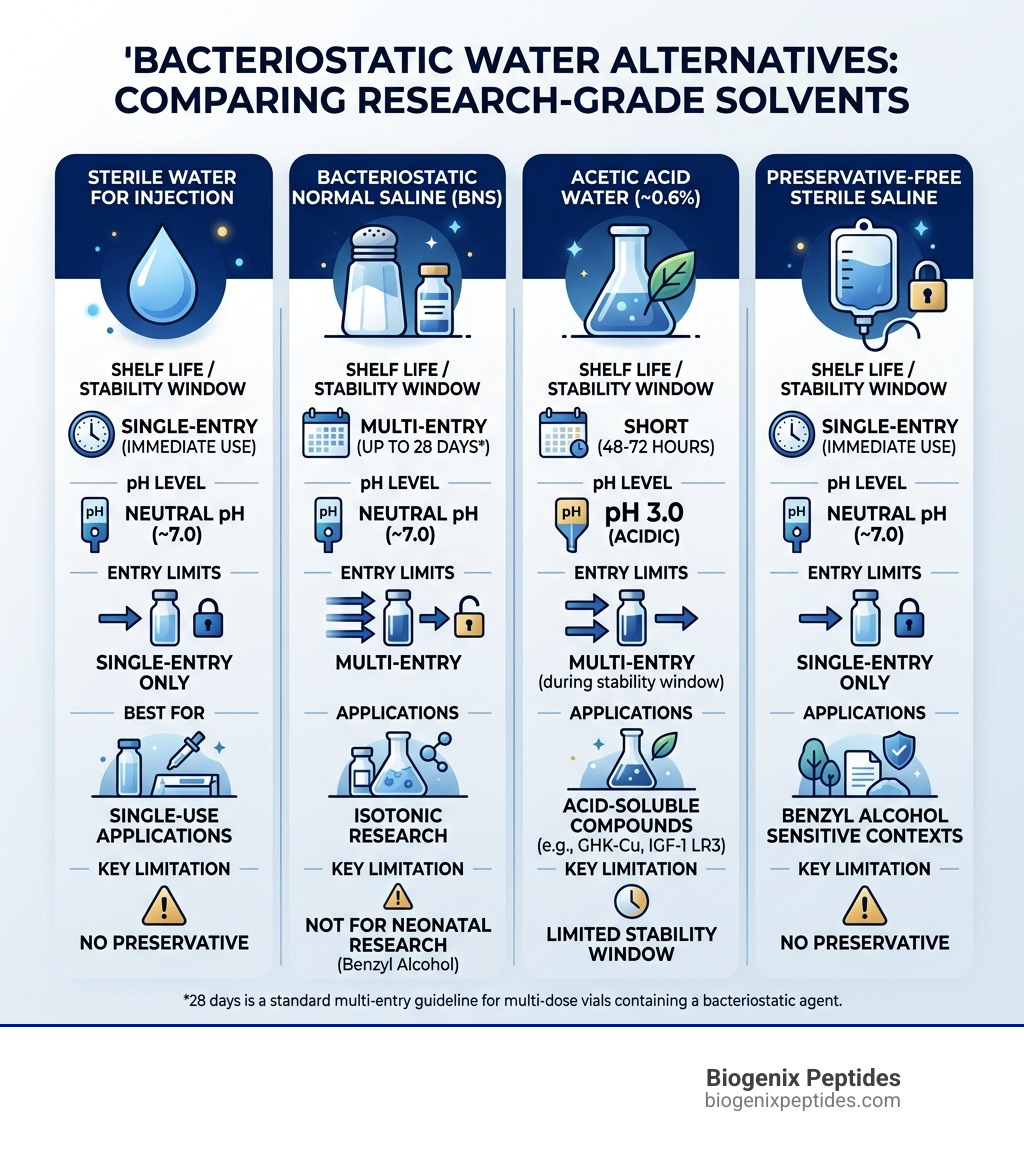
Bacteriostatic water alternatives include several research-grade solvents, each suited to different situations:
| Alternative | Best For | Key Limitation |
|---|---|---|
| Sterile Water | Single-entry, immediate-use reconstitution | No preservative; single-entry only |
| Bacteriostatic Normal Saline (BNS) | Multi-entry, isotonic applications | Contains benzyl alcohol; not for neonatal research |
| Acetic Acid Water (~0.6%, pH 3.0) | Acid-soluble peptides (e.g., GHK-Cu, IGF-1 LR3) | Short stability window (48–72 hours) |
| Preservative-Free Sterile Saline | Benzyl alcohol-sensitive research contexts | Single-entry only |
Never use tap water, distilled water, or homemade solutions for reconstitution in a research setting. These lack guaranteed sterility and can introduce contaminants like endotoxins or MRSA. According to CDC guidelines on laboratory sterility, maintaining a contaminant-free environment is paramount for experimental accuracy.
When working with lyophilized peptides in a research setting, the solvent you choose is not a minor detail — it determines whether your reconstituted compound stays stable, soluble, and uncontaminated. Bacteriostatic water is the most common solvent used in peptide reconstitution, thanks to its 0.9% benzyl alcohol preservative, which inhibits bacterial growth and allows multi-entry access to the same vial for up to 28 days. But what happens when it is not available, not compatible with a specific compound, or simply not the right tool for the job?
That question is more relevant than ever in April 2026, as research labs and independent researchers increasingly work with a wider range of peptides — each with its own solubility profile, pH sensitivity, and stability requirements. Picking the wrong solvent can mean a cloudy, unusable vial, or worse, a compromised research outcome.
I’m Jay Daniel, Founder and CEO of BioGenix Peptides, and my hands-on experience in peptide science has made solvent selection one of the most critical areas I focus on when discussing bacteriostatic water alternatives with researchers and lab professionals. In the sections below, we’ll walk through every practical substitute — what it is, when to use it, and what to watch out for.
Primary Bacteriostatic Water Alternatives for Reconstitution
When we talk about bacteriostatic water alternatives, we are generally looking for a solvent that maintains the integrity of the lyophilized (freeze-dried) peptide while ensuring the solution remains sterile. Bacteriostatic water is unique because it contains 0.9% (9 mg/mL) or 1.1% (11 mg/mL) benzyl alcohol. This additive is a bacteriostat, meaning it doesn’t necessarily kill all bacteria on contact, but it prevents them from reproducing.
Sterile Water
The most direct substitute is Sterile Water, USP. This is highly purified, non-pyrogenic water that has been sterilized to remove all microorganisms, including bacteria, fungi, and viruses.
However, there is a major “catch” with sterile water: it contains no antimicrobial agents. This means it is strictly for single-entry. Once the stopper of a sterile water vial is punctured, the “clock” starts immediately. Without a preservative like benzyl alcohol to suppress microbial growth, any bacteria introduced during the puncture can multiply rapidly. In a research environment, this means the reconstituted solution must be utilized immediately.
Single-entry limitations
In April 2026, the industry standard remains firm: if you use sterile water, you cannot save the leftover liquid for later. Unlike bacteriostatic water, which is rated for multi-entry over a 28-day period, sterile water vials or ampoules must be discarded after the first access. This makes it a less cost-effective choice for multi-entry research protocols but a necessary one when preservatives must be avoided.
Reconstituting with Sterile Water
When using sterile water, Creating a Sterile Research Environment is non-negotiable. Because there is no preservative “safety net,” your aseptic technique must be flawless.
- Aseptic Technique: Always swab the vial stoppers with 70% isopropyl alcohol and allow them to air dry completely before puncturing.
- Immediate Application: Once the sterile water hits the lyophilized powder, the solution should be used for the intended research step right away.
- Microbial Growth Risks: If a sterile water solution is left at room temperature or even refrigerated for more than a few hours, the risk of contamination increases exponentially.
For those transitioning from multi-entry vials to single-entry alternatives, we recommend reviewing our guide on Mixing Peptides at Home Like a Pro to ensure your environment meets the necessary cleanliness standards.
Bacteriostatic Normal Saline Options
Another robust alternative is Bacteriostatic Normal Saline (BNS). This solution consists of 0.9% Sodium Chloride (NaCl) in water, with the addition of 0.9% benzyl alcohol.
BNS is often preferred in research where osmotic balance is critical. Because it is isotonic (meaning it has the same salt concentration as many biological fluids), it can prevent the “osmotic shock” that some sensitive peptides might experience in pure water. Like bacteriostatic water, BNS allows for multi-entry access for up to 28 days after the first puncture, provided it is stored correctly—typically between 60-80 degrees Fahrenheit or refrigerated as specified by the peptide’s requirements.
Specialized Solvents: Acetic Acid and Saline Options
Not all peptides play nice with neutral water. Some compounds are “hydrophobic” or have an electrical charge that causes them to clump together (aggregate) when they hit a solvent with a neutral pH.
Acetic Acid Water
For these stubborn compounds, researchers often turn to acetic acid water. This solution is typically a 0.6% concentration of glacial acetic acid, resulting in a much lower pH of approximately 3.0 (compared to the ~5.7 pH of bacteriostatic water).
The acidity helps by altering the ionization state of the peptide, making it more soluble in water. Peptides like GHK-Cu, AOD-9604, and IGF-1 LR3 often require this acidic environment to reach full solubility. Without it, you might notice cloudiness, “floaties,” or a gel-like consistency in the vial. To ensure your research isn’t compromised by temperature fluctuations during this process, see our article Don’t Let Your Peptides Lose Their Cool.
When to Choose Acetic Acid
If you add bacteriostatic water to a vial and the solution remains cloudy or contains visible particles after gentle swirling, it is a sign you may need an acidic solvent.
We often suggest a “two-step” reconstitution protocol for these cases:
- Add a small amount (0.1–0.2 mL) of acetic acid water to the vial first to dissolve the powder.
- Once clear, dilute the solution to the final volume using bacteriostatic water to gain the benefits of the preservative.
Acetic acid solutions are less stable for long-term storage than those in bacteriostatic water. Generally, an acetic acid-reconstituted solution should be used within 48–72 hours, even when refrigerated. For a detailed walkthrough, check out our Reconstituting Lyophilized Peptides Step-by-Step guide.
Saline vs. Water in Research
Choosing between saline and water often comes down to the specific peptide’s stability profile. While most peptides like BPC-157 or Semaglutide are perfectly stable in bacteriostatic water, some may benefit from the electrolytes in saline to prevent aggregation. However, always check the specific research requirements, as some salts can interfere with certain analytical tests or cause the peptide to precipitate out of the solution.
Risks of Non-Medical Grade Substitutes in Research
In research, “water is water” is a dangerous myth. Using non-medical grade substitutes is one of the most common mistakes that can lead to “research going down the drain.”
The Danger of Homemade Solutions
Some researchers attempt to create “DIY” bacteriostatic water by mixing distilled water with benzyl alcohol. This is highly discouraged. Professional labs use specialized 0.2µ filtration and heat sterilization to ensure a zero microbial load.
Your home or standard lab environment is teeming with microscopic life, including MRSA and other resilient bacteria. A homemade solution may lack the precise pH balance (bacteriostatic water should be between 4.5 and 7.0) or the correct preservative potency required to keep the solution sterile for 28 days. Furthermore, distilled or tap water can contain endotoxins—cell wall fragments from dead bacteria—which can cause pyrogenic (fever-inducing) reactions in research models, even if the water is technically “sterile.”
Neonatal Research Contraindications
A critical safety note for any researcher: Bacteriostatic solutions containing benzyl alcohol are strictly contraindicated for neonatal research.
In the 1980s, it was discovered that neonates lack the liver enzymes necessary to break down benzyl alcohol. Cumulative exposure can lead to gasping syndrome, a fatal condition characterized by respiratory distress, metabolic acidosis, and central nervous system depression. For any research involving neonatal models, only preservative-free Sterile Water or preservative-free Normal Saline should be used. Toxicity can occur in infants at levels as low as 9 mL of a 0.9% solution for a 6 kg subject.
Frequently Asked Questions about Bacteriostatic Water Alternatives
Can sterile water be used as a bacteriostatic water alternative?
Yes, sterile water is the primary substitute for bacteriostatic water. However, its use is limited to single-entry applications. Because it lacks benzyl alcohol, it cannot prevent the growth of bacteria once the vial has been punctured. If you use sterile water for reconstitution, you must utilize the solution immediately and discard any remaining portion.
How does pH affect bacteriostatic water alternatives?
The pH of the solvent is the “key” that unlocks the solubility of the peptide. Bacteriostatic water is slightly acidic to neutral (pH 4.5–7.0). If a peptide is insoluble at this range, a more acidic alternative like acetic acid water (pH 3.0) is required. Using the wrong pH can lead to peptide degradation or the formation of a cloudy, unusable solution.
What is the 28-day rule for preserved solvents?
The “28-day rule” refers to the shelf life of a multi-entry vial after the first puncture. Even with 0.9% benzyl alcohol, the preservative’s potency begins to diminish over time, and the cumulative microbial load from repeated entries increases. After 28 days, the risk of contamination becomes too high, and the vial must be discarded. This rule applies to both bacteriostatic water and bacteriostatic normal saline.
Conclusion
At Biogenix Peptides, we believe that research integrity starts with the basics. Whether you are using Bacteriostatic Water Reconstitution Solution 10ml or exploring specialized bacteriostatic water alternatives like acetic acid or sterile saline, understanding the “why” behind your choice is essential.
As of April 2026, the landscape of peptide research continues to evolve, but the laws of microbiology remain the same. Sterility, pH balance, and preservative potency are the three pillars of successful reconstitution. By choosing the right solvent for your specific compound and adhering to strict aseptic techniques, you ensure that your research remains accurate, reproducible, and safe.
Always verify the requirements of your specific peptide before beginning the reconstitution process, and when in doubt, prioritize the solvent that offers the highest level of stability and microbial protection for your specific research goals.