
Navigating GLP-1 Therapy in the Elderly
Why GLP-1 Agonists in Elderly Patients Require a Different Conversation
Disclaimer: The information provided in this article is for educational and informational purposes only. It is not intended as medical advice, diagnosis, or treatment. Products and compounds referenced are for research use only and are not approved for human or veterinary consumption. Always consult a qualified professional regarding health or medical decisions.

GLP-1 agonists in elderly patients present a more complex picture than in younger adults — and the research makes that clear.
Here is a quick summary for researchers assessing safety in older adults:
| Key Consideration | What the Research Shows |
|---|---|
| Efficacy | Meaningful HbA1c reductions (1.2–2.1%) observed across age groups |
| GI adverse events | Occur in up to 30% of older adults; higher discontinuation rates than younger adults |
| Hypoglycemia risk | Remains low (<5%), which is clinically meaningful for this population |
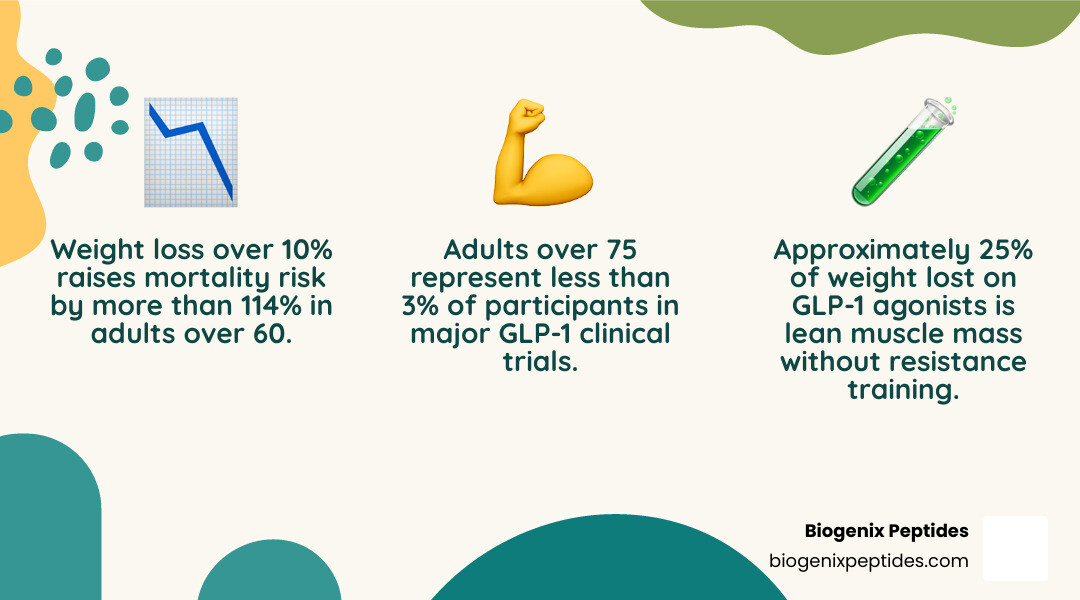
| Muscle/bone loss | ~25% of weight lost is lean mass — a serious concern without resistance training |
| Mortality risk | Weight loss exceeding 10% linked to >114% increased mortality risk in older adults |
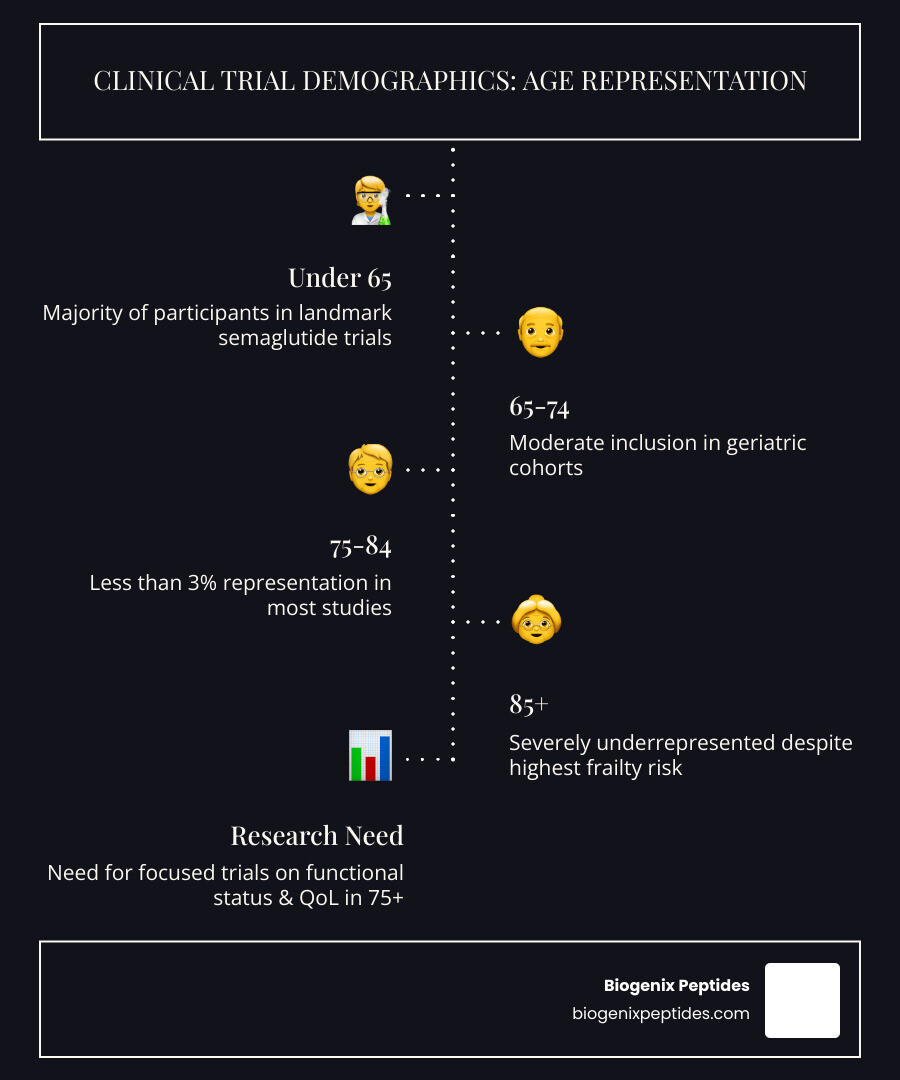
| Trial representation | Adults over 75 make up less than 1–3% of major GLP-1 clinical trial participants |
| Dementia risk | Appetite suppression in cognitively impaired subjects raises dehydration and delirium risks |
Obesity now affects more than 40% of adults aged 60 and older in the United States. That number has driven enormous interest in GLP-1 receptor agonists — drugs that have reshaped metabolic research in recent years.
But older adults are not simply older versions of middle-aged trial participants.
They carry decades of health history. They often live with multiple conditions. They take several medications at once. And their bodies respond to weight loss differently — sometimes dangerously so.
The question researchers and clinicians are now asking is not just “do GLP-1 agonists work in older adults?” The more important question is: “what does ‘working’ actually mean for this population?”
For many older adults, the goal is not a lower number on a scale. It is being able to walk farther, get up from a chair, or play with grandchildren — goals that require preserving muscle and bone, not just reducing body weight.
I’m Jay Daniel, Founder and CEO of BioGenix Peptides, where I focus on peptide science, research innovation, and evidence-based analysis of compounds like GLP-1 receptor agonists — including their specific implications for GLP-1 agonists in elderly patients. In this guide, I’ll walk through what the current research actually says, where the evidence is thin, and what responsible research practice looks like in this population.
Learn more about GLP-1 agonists elderly patients:
- GLP-1 agonists cardiovascular outcomes
- GLP-1 agonists muscle preservation
- GLP-1 receptor agonist benefits
Efficacy and Safety of GLP-1 Agonists Elderly Patients
When we look at the laboratory data, the efficacy of GLP-1 agonists in elderly patients is remarkably consistent with younger populations. Research indicates that these compounds are highly effective at improving glycemic control and offering cardiometabolic benefits. In studies like the SUSTAIN 1-5 trials, semaglutide reduced HbA1c by 1.2% to 1.8% in elderly subjects, with a significant majority reaching their glycemic targets.

However, efficacy is only one side of the coin. The safety profile in those over 65 requires a more nuanced view. While the risk of hypoglycemia remains low—often less than 5%—this is a critical advantage for older subjects who are particularly vulnerable to the cognitive and physical dangers of low blood sugar. Scientific research on GLP-1 in older adults suggests that the glucose-dependent mechanism of these peptides makes them a safer alternative to traditional options like sulfonylureas.
To understand how these compounds interact with the body’s natural systems, researchers often look at the GLP-1 Incretin Pathways Explained. These pathways regulate insulin secretion and satiety, but in older subjects, the “slow and low” approach to titration is vital to mitigate gastrointestinal side effects.
Weight Loss Outcomes Across Age Groups
| Agent | Age <65 Weight Loss | Age ≥65 Weight Loss |
|---|---|---|
| Semaglutide (1.0 mg) | 4.6–6.4 kg | 4.1–6.7 kg |
| Dulaglutide (1.5 mg) | Comparable | Similar to younger cohort |
| Tirzepatide (15 mg) | ~12.6% | ~11.8% (Non-obese subgroup) |
Managing Sarcopenia and Bone Density Risks
The most significant concern regarding GLP-1 agonists in elderly patients isn’t necessarily the drug itself, but the nature of the weight loss it induces. In geriatric research, we often discuss the “25% rule.” This rule suggests that for every pound of weight lost, approximately 25% comes from lean mass (muscle and bone) rather than fat.
In a 40-year-old, losing some muscle is a metabolic annoyance; in an 80-year-old, it can be the difference between independence and a nursing home. Sarcopenia—the age-related loss of muscle mass and function—is a major risk factor for falls and fractures. Research shows that weight loss without proper resistance training can accelerate functional decline.
To combat this, research protocols should emphasize:
- Resistance Exercise: Essential for maintaining muscle fiber integrity.
- Protein Supplementation: High protein intake is necessary to provide the building blocks for muscle repair.
- Bone Density Monitoring: Rapid weight loss can lead to decreased bone mineral density, increasing fracture risk.
For a deeper dive into protecting lean tissue, see The GLP-1 Guide to Not Melting Away Your Muscle.

Adverse Events in Frail and Cognitively Impaired Subjects
In frail populations, the common side effects of GLP-1 receptor agonists can escalate into serious medical events. Gastrointestinal distress—nausea, vomiting, and diarrhea—occurs in up to 30% of older participants in Phase 4 trials. While these are often transient in younger subjects, in the elderly, they frequently lead to dehydration.
Dehydration in a geriatric subject is a “gateway” complication. It can lead to:
- Acute Kidney Injury (AKI): Reduced fluid intake combined with GI loss puts immense strain on the kidneys.
- Delirium: Electrolyte imbalances and dehydration are leading causes of sudden confusion in the elderly.
- Falls: Dizziness from dehydration or low blood pressure can lead to catastrophic hip fractures.
Research on tirzepatide in non-obese seniors has shown that while efficacy remains high, discontinuation rates due to adverse events are significantly higher in older adults (16.8% vs 8.5% in the general population). This highlights the need for vigilant monitoring. Furthermore, understanding the systemic impact is crucial, as explored in Why GLP-1 Agonists are a Change of Heart for Cardiac Care.
Research Gaps and Geriatric-Specific Outcomes
There is a glaring gap in the current data: the underrepresentation of the “old-old” (those over 75). In many landmark semaglutide trials, less than 3% of participants were over age 75. This means we are often extrapolating data from “younger” seniors and applying it to a demographic with significantly more biological heterogeneity.
We need research that moves beyond the scale. In geriatric science, weight loss is a “surrogate endpoint.” The true endpoints should be:
- Functional Status: Can the subject still perform activities of daily living?
- Quality of Life: Does the weight loss improve mobility and reduce pain?
- Polypharmacy Interactions: How does the compound interact with the 5–10 other medications many seniors take?
Exploring the Advances in Longevity: Exploring the Science of Biological Aging can provide context on why these age-specific outcomes matter so much.
Clinical Protocols for GLP-1 Agonists Elderly Patients
For research purposes, the “start low and go slow” principle is the gold standard for GLP-1 agonists in elderly patients. Titration should be more gradual than the standard manufacturer recommendations to allow the aging gut time to adapt. A comprehensive geriatric assessment should be the first step, evaluating frailty, cognitive status, and social support.
An interprofessional approach—including dietitians to monitor protein intake and physical therapists to oversee resistance training—is essential. Scientific study on oral semaglutide in seniors found that while cognitive function didn’t necessarily hinder efficacy, the complexity of administration (especially for oral versions) requires clear instructions and often caregiver oversight.
Monitoring GLP-1 Agonists Elderly Patients with Dementia
Prescribing these compounds to subjects with dementia involves high risk. These patients may forget to hydrate or eat, and the appetite-suppressing effects of GLP-1s can lead to rapid, unintentional malnutrition.
- Caregiver Support: Essential for monitoring intake and side effects.
- Weight Tracking: Must be done in person, as remote monitoring is often unreliable in this group.
- Hydration Protocols: Scheduled fluid intake to prevent AKI and delirium.
Long-term Implications of GLP-1 Agonists Elderly Patients
The long-term effects of weight cycling in the elderly are concerning. If a subject stops the medication and regains weight, they often regain fat but not the muscle they lost. This “sarcopenic obesity” can leave them in a worse functional state than before they started.
Furthermore, weight loss of more than 10% in older adults has been linked to a 114% increased risk of mortality over the subsequent years. This “U-shaped” mortality curve suggests that while obesity is a risk, being underweight or losing weight too rapidly is even more dangerous for the elderly. Research into Metabolic Weight Management Peptides must account for these unique mortality risks.
Frequently Asked Questions about GLP-1 Therapy
Is there a U-shaped mortality curve for weight loss in seniors?
Yes. Unlike younger populations where thinner is generally associated with better health, older adults have a higher risk of mortality if they lose significant weight (especially >10%). This is often due to the loss of “metabolic reserve”—the muscle and fat stores the body needs to survive an acute illness or injury.
How does muscle loss compare to fat loss in older subjects?
Without intervention, about 25% of weight lost on GLP-1s is lean mass. In the elderly, this can trigger or worsen sarcopenic obesity—a condition where a person has high body fat but dangerously low muscle mass. This is why resistance training is not optional; it is a required component of the research protocol.
What are the primary GI risks for those over 75?
The “late elderly” (75+) report higher rates of nausea and vomiting, leading to discontinuation rates near 26%. Beyond the discomfort, the primary risk is dehydration and subsequent kidney injury. Maintaining oral health is also a factor, as discussed in How to Protect Your Pearly Whites on GLP-1 Therapy.
Conclusion
At Biogenix Peptides, we believe that the future of GLP-1 agonists in elderly patients lies in precision. We must move away from a “one-size-fits-all” weight loss model and toward an evidence-based application that prioritizes function, strength, and independence.
The research priorities for the coming years must include more robust studies on the 75+ demographic, better strategies for muscle preservation, and a deeper understanding of how these compounds impact the aging brain and heart. Ensuring equitable access to this research and the resulting evidence is vital for the health of our aging population.
Explore GLP-1 Research to stay updated on the latest findings in peptide science and metabolic health.