
Why Your Doctor is Obsessed with GLP-1 Receptor Agonists
Why Your Doctor is Obsessed with GLP-1 Receptor Agonists
Why GLP-1 Receptor Agonist Benefits Are Reshaping Modern Medicine
GLP-1 receptor agonist benefits go far beyond blood sugar control — and that’s exactly why doctors are paying close attention.
Here’s a quick summary of what the research shows:
| Benefit Area | What the Evidence Shows |
|---|---|
| Blood sugar control | Up to 5.9% HbA1c reduction in clinical trials |
| Weight loss | Up to 22.1% body weight loss with newer agents |
| Heart health | Reduced risk of heart attack and stroke (LEADER, SUSTAIN-6 trials) |
| Kidney protection | Reduced albuminuria and slower CKD progression |
| Liver health | Up to 25.9% reduction in liver fat with retatrutide |
| Brain and neurological health | 10–20% reduced risk of Alzheimer’s, dementia, and seizures |
| Addiction and mental health | Reduced risk of alcohol, opioid, and stimulant misuse |
These drugs were originally developed just to manage glucose in people with type 2 diabetes. But a growing body of research — including a landmark study of over 2 million veterans — shows they protect the heart, kidneys, liver, and even the brain.
That’s a remarkable range of effects from a single class of medication.
What makes this especially interesting is that some of these benefits appear to be independent of weight loss itself — meaning the drugs may be doing something deeper at the cellular and hormonal level.
This guide breaks down what the science actually says, which patients stand to benefit most, and what the next generation of these therapies looks like.
I’m Jay Daniel, Founder and CEO of BioGenix Peptides and a peptide research specialist with years of hands-on experience tracking clinical developments in GLP-1 receptor agonist benefits, from mechanism-level signaling to the latest dual and triple agonist trials. My work at BioGenix Peptides focuses on translating complex peptide science into clear, research-backed insights for labs and research professionals worldwide. Let’s dig into how these molecules actually work — and why the science behind them is so compelling.
Understanding the Incretin Pathway and Mechanism of Action
To understand why GLP-1 receptor agonist benefits are so broad, we have to look at the “incretin effect.” In simple terms, when we eat, our intestines release hormones called incretins. The most famous of these is Glucagon-Like Peptide-1 (GLP-1).
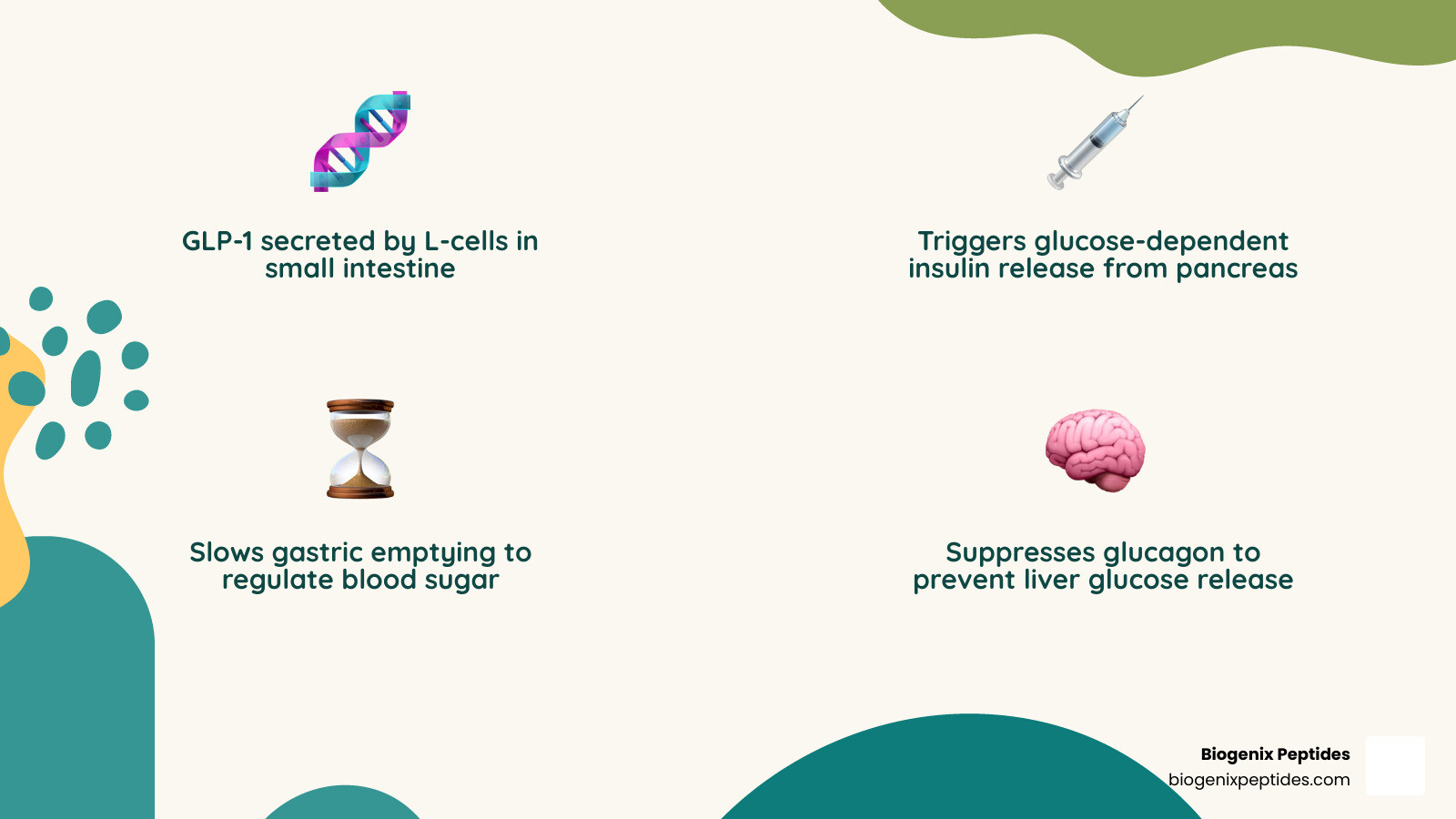
In our bodies, GLP-1 is secreted by specialized L-cells in the small intestine. Its primary job is to tell the pancreas to release insulin, but only when blood sugar is high. This “glucose-dependent” mechanism is why these drugs rarely cause dangerous drops in blood sugar (hypoglycemia) when used on their own. At the same time, GLP-1 suppresses the release of glucagon, a hormone that normally tells your liver to dump more sugar into the bloodstream.
But wait, there’s more! GLP-1 also acts on the stomach to slow down “gastric emptying.” This means food stays in your stomach longer, making you feel full for a longer duration. Most importantly, GLP-1 receptors are found in the brain’s satiety centers, directly signaling that we’ve had enough to eat.
The discovery of these pathways was a turning point in metabolic science. Early Scientific research on GLP-1 discovery proved that GLP-1 could stimulate insulin gene expression, while later Scientific research on insulinotropic effects confirmed its potent ability to stimulate insulin release in the pancreas. Essentially, these medications are taking a natural process and turning the volume up to eleven.
For a deeper dive into these biological tracks, check out our guide on GLP-1 Incretin Pathways Explained.
How GLP-1 Agonists Mimic Natural Hormones
If our bodies already make GLP-1, why do we need a drug? The problem is that natural GLP-1 is incredibly fragile. An enzyme in our blood called DPP-4 breaks it down in about two minutes. You’d have to be on a constant IV drip to get any lasting benefit from natural GLP-1.
Agonists are designed to be “tougher.” By slightly modifying the peptide structure, scientists created molecules that bind to the same receptors but resist being broken down. This increased peptide stability allows the drug to circulate for days (in the case of weekly injections) rather than minutes.
Once bound to the receptor, these agonists trigger a cascade of intracellular signals, primarily involving Cyclic AMP (cAMP). This messenger tells the cell to get to work—whether that’s a beta-cell in the pancreas releasing insulin or a neuron in the brain signaling fullness. We’ve moved from simple glucose management to complex hormonal orchestration.
GLP-1 receptor agonist benefits for Metabolic Health
When we talk about GLP-1 receptor agonist benefits, the “Big Two” are type 2 diabetes and obesity. These conditions are often two sides of the same metabolic coin, and GLP-1 agonists are uniquely positioned to treat both simultaneously.

The efficacy of these drugs is backed by staggering numbers. For example, recent Scientific research on oral GLP-1 efficacy involving the drug orforglipron showed an HbA1c reduction of up to 5.9% over 40 weeks. To put that in perspective, many traditional diabetes medications struggle to move the needle by even 1%.
Glycemic Control and Diabetes Management
For those living with type 2 diabetes, the goal isn’t just lowering blood sugar; it’s protecting the “machinery.” We know that chronic high sugar eventually wears out the beta-cells in the pancreas. GLP-1 agonists actually help preserve beta-cell function and may even reduce the rate at which these cells die (apoptosis).
By improving insulin sensitivity and controlling postprandial (after-meal) glucose spikes, these drugs help patients reach their A1c goals faster. Early Scientific research on long-term glycemic control showed that even a 6-week course could significantly improve insulin sensitivity and beta-cell function.
Weight Loss and Appetite Regulation
Perhaps the most talked-about benefit is weight loss. It’s not just about “willpower”—it’s about biology. These drugs change the hypothalamic signaling in the brain, effectively turning off what patients call “food noise.” You know that constant internal monologue wondering what’s for lunch while you’re still eating breakfast? GLP-1 agonists can silence it.
The results are significant. In the landmark STEP trials, Scientific research on semaglutide for obesity revealed that adults with obesity lost an average of 14.9% of their body weight over 68 weeks, compared to just 2.4% in the placebo group. This isn’t just “water weight”—it’s a fundamental shift in caloric intake and energy balance.
Systemic Protection: Heart, Kidney, and Liver Health
If we stopped at weight loss and diabetes, GLP-1 agonists would already be hall-of-fame drugs. But the research suggests they are actually “multi-organ protectors.”
A massive study of over 2 million patients in the Veterans Affairs (VA) system revealed that GLP-1 users had significantly lower risks of major adverse cardiovascular events (MACE). This includes heart attacks and strokes. Interestingly, the study suggested that these benefits aren’t just a side effect of losing weight; the drugs seem to have direct anti-inflammatory and protective effects on the organs themselves.
Cardiovascular and Hemodynamic Improvements
The heart loves GLP-1. Multiple large-scale trials, such as LEADER and SUSTAIN-6, have confirmed a significant reduction in the risk of heart attack and stroke. Liraglutide, for instance, showed a 13% reduction in MACE in the Scientific research on cardiovascular outcomes study.
Newer research is also looking at heart failure. Scientific research on heart failure benefits found that semaglutide significantly improved symptoms and physical limitations in patients with heart failure with preserved ejection fraction (HFpEF). By reducing blood pressure and improving endothelial function (the health of your blood vessel lining), these drugs take the strain off the entire circulatory system.
Renal Preservation and Liver Fat Reduction
Your kidneys and liver are also major winners here. Chronic kidney disease (CKD) is a frequent complication of diabetes, but GLP-1 agonists appear to slow this progression. The FLOW trial was even stopped early because the evidence of renal protection was so overwhelming. Scientific research on renal protection shows these drugs reduce albuminuria (protein in the urine) and help maintain the filtration rate of the kidneys.
As for the liver, Metabolic Dysfunction-Associated Steatotic Liver Disease (MASLD)—formerly known as fatty liver—is reaching epidemic proportions. GLP-1 agonists, particularly newer triple agonists like retatrutide, have shown up to a 25.9% reduction in hepatic fat fraction. By clearing out liver fat, we can prevent the inflammation and scarring (fibrosis) that leads to cirrhosis.
Emerging Frontiers in Neuroprotection and Addiction
This is where the science gets really “sci-fi.” We are now seeing that GLP-1 receptor agonist benefits extend to the brain in ways we never expected.
The brain is highly susceptible to inflammation. GLP-1 agonists appear to reduce the activation of microglia—the brain’s “immune cells” that, when overactive, can cause damage. By taming this inflammation and regulating dopamine (the brain’s reward chemical), these drugs are showing promise for conditions that have historically been very difficult to treat. A recent commentary on the Scientific research on expanding benefits highlights how these medicines are moving far beyond their original metabolic scope.
GLP-1 receptor agonist benefits for Alzheimer’s and Parkinson’s
Neurodegenerative diseases like Alzheimer’s and Parkinson’s are characterized by the buildup of toxic proteins and brain cell death. GLP-1 receptors are scattered throughout the brain, particularly in the hippocampus (the memory center).
Scientific research on neuroprotective mechanisms suggests that these agonists can cross the blood-brain barrier to reduce amyloid plaques and improve cognitive function. In fact, real-world data shows a 10–20% reduction in the risk of dementia and Alzheimer’s among patients using these medications.
GLP-1 receptor agonist benefits for substance use and addiction
Perhaps the most surprising discovery is the effect on addiction. Because GLP-1 influences the reward pathways in the brain, it doesn’t just reduce “food noise”—it might reduce “cravings” in general.
The VA study mentioned earlier found that patients on GLP-1 agonists had a significantly lower risk of alcohol use disorder, opioid overdose, and stimulant misuse. Scientific research on alcohol use disorder has even shown that semaglutide is associated with a lower incidence and recurrence of alcohol-related issues. Whether it’s tobacco, alcohol, or other substances, these drugs seem to help rebalance the brain’s reward system.
Next-Generation Therapies: Dual and Triple Agonists
The “first generation” of GLP-1 agonists (like exenatide and liraglutide) paved the way. The “second generation” (like semaglutide) took things further. Now, we are entering the era of multi-receptor agonists.
Instead of just hitting the GLP-1 receptor, these new molecules target two or even three different receptors at once. This “poly-agonist” approach mimics the way our bodies naturally use multiple hormones to regulate metabolism.
| Medication | Target Receptors | Average Weight Loss |
|---|---|---|
| Semaglutide | GLP-1 | ~15% |
| Tirzepatide | GLP-1 + GIP | ~21% |
| Retatrutide | GLP-1 + GIP + Glucagon | ~24% + |
| CagriSema | GLP-1 + Amylin | ~17% + |
For more on these advanced research topics, see our article on GLP-1 Dual and Triple Agonist Peptides.
The Rise of Biased and Multi-Receptor Agonists
Tirzepatide was the first big “dual agonist,” targeting both GLP-1 and Glucose-Dependent Insulinotropic Polypeptide (GIP). This combination is even more effective at lowering A1c and weight than GLP-1 alone.
But the current “king of the hill” in research is retatrutide. It adds a third target: the glucagon receptor. While that might sound counterintuitive (since we usually want to suppress glucagon), hitting the receptor in a controlled way actually increases energy expenditure (calorie burning) and helps the liver clear out fat even faster. Scientific research on retatrutide efficacy has shown weight loss results exceeding 22% in just 48 weeks.
We are also seeing the development of “biased agonists.” These are drugs designed to trigger the “good” signals (like insulin release) while avoiding the signals that cause side effects (like nausea). You can read more about these breakthroughs in our feature on Retatrutide: The Most Powerful Metabolic Tri-Agonist Yet.
Safety Profile and Managing Common Side Effects
No medication is a “free lunch,” and GLP-1 agonists are no exception. The most common side effects are gastrointestinal (GI) in nature. Because the drug slows down your stomach, if you eat the same portion sizes you used to, you’re going to feel very uncomfortable.
Common issues include nausea (affecting 25-60% of users), vomiting, and diarrhea. There are also more serious but rare risks, such as pancreatitis and gallbladder issues. Scientific research on gastrointestinal safety emphasizes that while these risks exist, they are relatively low compared to the massive health benefits of treating obesity and diabetes.
Strategies for Improving Tolerability
The secret to success with these drugs is “low and slow.” Most doctors use a titration schedule, starting at a tiny dose and gradually increasing it every four weeks. This gives your body (and your brain) time to adjust to the new hormonal signals.
- Eat smaller portions: Stop before you feel full.
- Prioritize protein: To prevent muscle loss during rapid weight loss.
- Stay hydrated: Dehydration can make nausea worse.
- Avoid high-fat foods: These take even longer to digest and can trigger “sulfur burps” or nausea.
Scientific research on titration schedules has shown that slower dose escalation can significantly reduce the number of people who stop the medication due to side effects.
Frequently Asked Questions about GLP-1 Agonists
Who is the ideal candidate for GLP-1 therapy?
In the U.S., these drugs are typically FDA-approved for adults with type 2 diabetes or those with a BMI of 30 or higher (obesity). They are also approved for those with a BMI of 27 or higher if they have at least one weight-related condition, like high blood pressure or high cholesterol. However, doctors are increasingly looking at “cardio-renal” risk—meaning even if your weight isn’t extremely high, you might be a candidate if you have heart or kidney issues.
How long does it take to see weight loss results?
While the metabolic changes (like blood sugar stabilization) start almost immediately, visible weight loss usually takes a few weeks. Most patients see significant changes once they reach the “therapeutic” (higher) doses, typically 2–3 months into treatment.
Are the benefits of GLP-1 agonists permanent?
The research is very clear on this: these are chronic medications for chronic conditions. If you stop the medication, the “food noise” usually returns, and the metabolic benefits (like slowed gastric emptying) disappear. Studies like STEP-1 extension showed that patients regained about two-thirds of their lost weight within a year of stopping the drug. For many, this is a lifelong tool for metabolic health.
Conclusion
The “obsession” doctors have with GLP-1 receptor agonists isn’t just hype—it’s based on a fundamental shift in how we understand human health. We’ve moved from simply “fixing a number” (like blood sugar) to protecting the entire body from the inside out.
From the heart and kidneys to the liver and the brain, GLP-1 receptor agonist benefits are proving that metabolic health is the foundation of overall longevity. Whether we are looking at the current gold standards or the next generation of triple agonists, the future of medicine is undeniably peptide-based.
At BioGenix Peptides, we are committed to staying at the forefront of this research. As we look toward future applications in Alzheimer’s, sleep apnea, and even addiction recovery, it’s clear that we’ve only just begun to scratch the surface of what these molecules can do.
Ready to explore the science further? Visit our Category GLP-1 section for the latest research updates and detailed peptide breakdowns.