
Why GLP-1 Agonists are a Change of Heart for Cardiac Care
How GLP-1 Agonists Are Reshaping Cardiovascular Outcomes in Research
GLP-1 agonists cardiovascular outcomes have become one of the most compelling areas in modern cardiometabolic research. Across more than a dozen large-scale clinical trials covering over 83,000 patients, these compounds have consistently shown meaningful reductions in heart attack, stroke, cardiovascular death, and all-cause mortality.
Here’s a quick summary of what the evidence shows:
| Cardiovascular Outcome | Observed Effect |
|---|---|
| Major Adverse Cardiovascular Events (MACE) | 14% reduction (OR 0.86, 95% CI 0.80–0.94) |
| All-cause mortality | 13% reduction (OR 0.87, 95% CI 0.82–0.93) |
| CV mortality | 13% reduction (OR 0.87, 95% CI 0.81–0.94) |
| Non-fatal stroke | 13% reduction (OR 0.87, 95% CI 0.79–0.96) |
| Fatal stroke | 26% reduction (OR 0.74, 95% CI 0.56–0.96) |
| Composite kidney outcome | 24% reduction (OR 0.76, 95% CI 0.67–0.85) |
These benefits appear to hold across both diabetic and non-diabetic populations, regardless of sex, BMI, prior cardiovascular disease history, or kidney function levels.
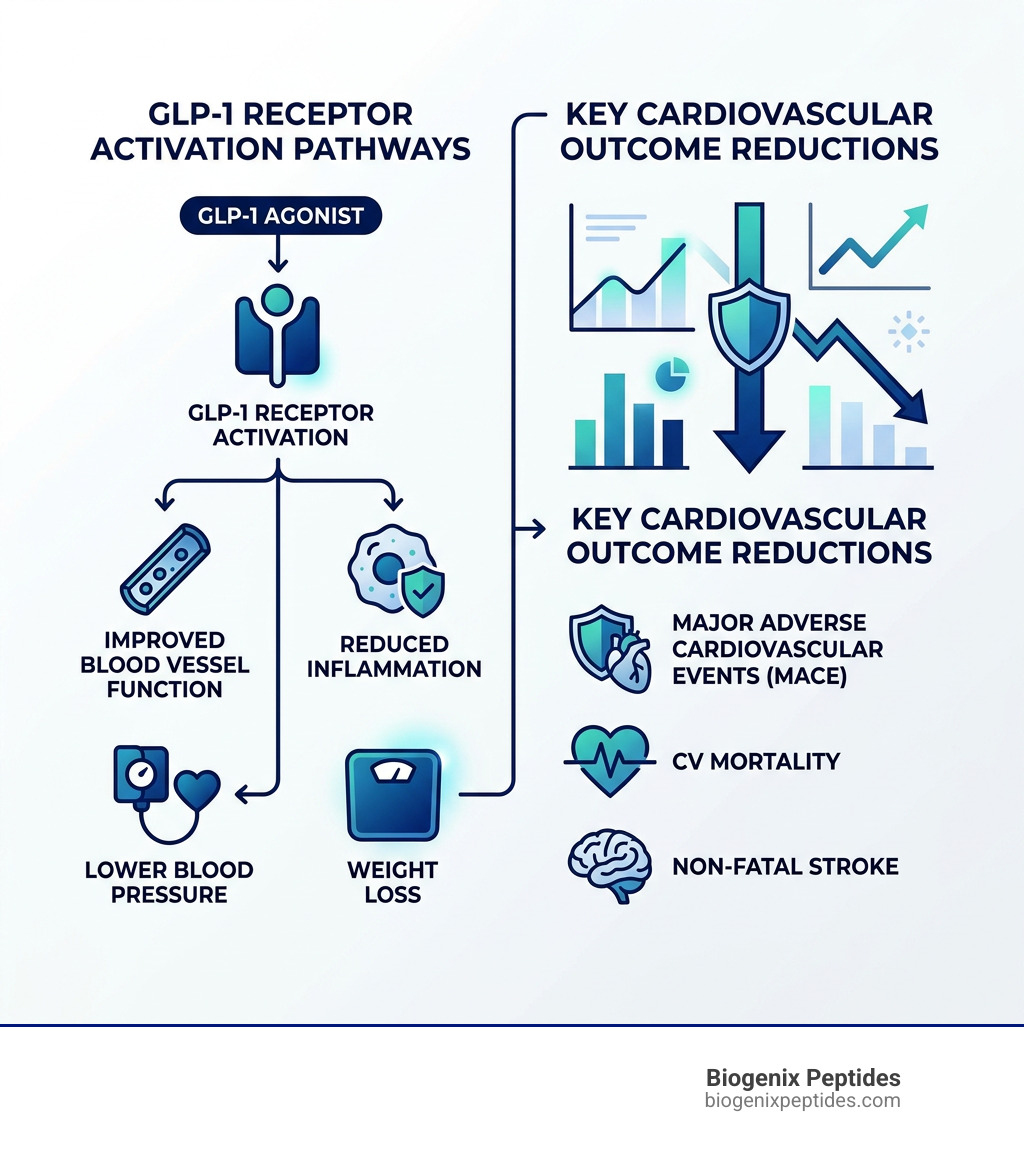
What makes this especially significant is that the heart-protective effects go well beyond simply lowering blood sugar. GLP-1 receptor agonists appear to reduce inflammation, improve blood vessel function, lower blood pressure, and support meaningful weight loss — all of which contribute to a healthier cardiovascular system.
As Jay Daniel, Founder and CEO of BioGenix Peptides and a peptide research specialist with years of experience tracking developments in GLP-1 science, I’ve closely followed how the evidence on GLP-1 agonists cardiovascular outcomes has evolved from early incretin research into one of the most active frontiers in cardioprotection today. In this guide, I’ll break down exactly what the research tells us — in plain language.
Cardioprotective Mechanisms Beyond Glycemic Control
When we first started looking at GLP-1 receptor agonists (GLP-1RAs), we thought they were just “sugar-lowering” tools. We were wrong—in the best way possible. While they do an excellent job of managing glucose, their impact on the heart is far more sophisticated.
To understand how they work, we have to look at the GLP-1 Incretin Pathways Explained. These peptides mimic the natural hormones our gut releases after a meal, but they stay active much longer. Beyond the pancreas, GLP-1 receptors are found throughout the cardiovascular system, including the heart muscle and the lining of the blood vessels (the endothelium).

One of the most exciting “non-sugar” benefits is the improvement in endothelial function. Healthy blood vessels need to be flexible and resilient; GLP-1RAs help them stay that way by reducing oxidative stress. In fact, scientific research on endothelial function and HFpEF suggests that these peptides could be a key avenue for treating heart failure with preserved ejection fraction (HFpEF) by helping the heart’s “plumbing” work more efficiently.
Other key mechanisms include:
- Anti-inflammatory Effects: Research shows a massive reduction in High-Sensitivity C-Reactive Protein (hs-CRP)—often as much as 38% to 39%. This means less “fire” in the arteries.
- Blood Pressure Management: We consistently see a drop in systolic blood pressure (roughly 3.3 to 3.8 mm Hg).
- Natriuretic Properties: These peptides help the kidneys flush out excess sodium, which takes the pressure off the heart.
- Lipid Profiles: Studies show an average 15.6% reduction in triglycerides and a 4.2% boost in “good” HDL cholesterol.
Clinical Evidence for GLP-1 Agonists Cardiovascular Outcomes
The gold standard for proving heart health benefits is the Cardiovascular Outcome Trial (CVOT). These massive studies look at MACE—Major Adverse Cardiovascular Events—which typically includes heart attack (MI), stroke, and cardiovascular death.
One of the landmark studies, the LEADER trial on Liraglutide, was among the first to show that a GLP-1RA could significantly lower the risk of death from heart disease. Since then, the evidence has only grown stronger. For instance, semaglutide has shown a 19% reduction in MACE and a 20% reduction in cardiovascular mortality across several major trials.
Even more recently, studies on semaglutide’s cardiovascular benefits like the SOUL trial have demonstrated that oral versions of these peptides are just as effective as the injectables, reducing MACE by 14% in high-risk adults with type 2 diabetes and established heart or kidney disease.
The statistics are hard to ignore:
- Heart Attack (MI): Risk reduced by approximately 22%.
- Stroke: Fatal stroke risk reduced by 26%, with non-fatal stroke risk down by 13%.
- All-Cause Mortality: A 13% reduction in the risk of dying from any cause.
Analyzing GLP-1 Agonists Cardiovascular Outcomes Across Patient Subgroups
One common question we get is: “Does this work for everyone?” The data says yes. A massive meta-analysis of 13 trials involving over 83,000 patients found that the 14% reduction in MACE was remarkably consistent across different groups.
According to the research on outcomes in patients with and without diabetes, the benefits aren’t limited to those with high blood sugar. In the SELECT trial, non-diabetic patients with obesity and heart disease saw a 20% reduction in MACE.
We also see consistent benefits regardless of:
- Sex: Both men and women experience similar levels of protection.
- BMI: Whether a patient’s BMI is above or below 30 kg/m², the heart-protective effect remains.
- Kidney Function: Patients with an eGFR above or below 60 ml/min/1.73m² both benefit, though the renal protection is especially vital for those with existing damage.
- Peripheral Artery Disease (PAD): In patients with both diabetes and PAD, GLP-1RAs reduced all-cause mortality by 17% and MACE by 14%.
Future Directions for GLP-1 Agonists Cardiovascular Outcomes and Renal Health
The heart and the kidneys are essentially two sides of the same coin; when one fails, the other usually follows. This is why the results of the FLOW trial were so groundbreaking. In patients with type 2 diabetes and chronic kidney disease (CKD), semaglutide reduced the risk of kidney failure and death from renal causes by 24%.
We are also seeing a shift toward using these peptides for Heart Failure with Preserved Ejection Fraction (HFpEF). In a pooled analysis of over 3,700 patients, semaglutide reduced the risk of cardiovascular death or heart failure events by 31%. It also improved functional markers like the NYHA class (how well a patient can handle physical activity) and lowered NT-proBNP levels—a key protein that indicates heart stress.
As we look toward the future, the research is moving into multi-agonist peptides and metabolic signaling. These “next-gen” peptides don’t just target the GLP-1 receptor; they also activate GIP and Glucagon receptors for even more potent metabolic and cardiac effects.
Exploring the Spectrum of GLP-1 Receptor Agonists: From Single to Multi-Agonists in Research
The landscape of peptide research is expanding rapidly. We’ve moved from simple daily injections to weekly doses, oral tablets, and now “triple-agonist” molecules that act on three different hormone pathways at once.
| Peptide Type | Key Examples | Primary Research Focus |
|---|---|---|
| Single GLP-1RA | Semaglutide, Liraglutide | MACE reduction, Glycemic control, Weight loss |
| Dual Agonist (GLP-1/GIP) | Tirzepatide | Enhanced metabolic health, Superior weight loss |
| Triple Agonist (GLP-1/GIP/GCG) | Retatrutide | Maximum weight reduction, Fatty liver (MASLD) |
| Oral Small-Molecule | Orforglipron | Accessibility, Consistent 24-hour plasma levels |
When comparing GLP-1 Dual and Triple Agonist Peptides, researchers are finding that adding more pathways often leads to greater weight loss but requires more careful management of side effects. For example, the clinical trial data on Orforglipron shows it can achieve nearly 6% HbA1c reduction and significant weight loss in an easy-to-take oral format, making it a major area of interest for long-term adherence.
Compounds like Survodutide (a dual GLP-1/Glucagon agonist) are also showing promise in treating liver inflammation, which is a major driver of cardiovascular risk. By clearing liver fat, these peptides may indirectly reduce the strain on the entire circulatory system.
Safety Profiles and Research Considerations
No therapeutic intervention is without its trade-offs. While the GLP-1 agonists cardiovascular outcomes are overwhelmingly positive, researchers must account for common side effects that can lead to discontinuation.
The most frequent hurdles are gastrointestinal. Nausea, vomiting, and diarrhea are common, especially during the initial “ramp-up” phase. In some trials, discontinuation rates due to adverse events reached up to 30% for high-dose multi-agonists, though they are typically much lower (around 5-10%) for standard GLP-1RAs.
One interesting finding in the research is a slight increase in resting heart rate—usually about 3 beats per minute. While this might sound counterintuitive for a heart-protective drug, the concurrent reduction in blood pressure and inflammation seems to far outweigh this minor increase.
Key considerations for research settings include:
- Dose Titration: Starting low and slow is essential to minimize GI distress.
- Hydration: Managing nausea often requires proactive fluid management.
- Monitoring: Tracking markers like NT-proBNP and hs-CRP provides a better picture of heart health than weight or blood sugar alone.
For those interested in how these safety profiles play out in the newest generation of peptides, you can read more about what we learned from the TRIUMPH-4 study on Retatrutide, which highlights the balance between massive efficacy and tolerability.
Frequently Asked Questions about GLP-1 Heart Health in Research
Do GLP-1 agonists show cardiovascular benefits in non-diabetic research populations?
Yes. The SELECT trial specifically looked at over 17,000 patients with obesity and established cardiovascular disease but without diabetes. The results showed a 20% reduction in MACE, proving that the heart-protective benefits of these peptides are independent of their ability to lower blood sugar.
How do the cardiovascular benefits differ among various GLP-1 receptor agonists in research?
While most GLP-1RAs show benefit, some appear stronger than others. Semaglutide and Liraglutide have the most robust data for MACE reduction. Dulaglutide (the REWIND trial) showed particular strength in stroke prevention. “Neutral” results were seen with older, shorter-acting compounds like lixisenatide, suggesting that long-acting formulations provide superior protection.
What is the impact of GLP-1 therapy on chronic kidney disease progression in research?
The impact is significant. GLP-1RAs reduce the risk of “composite kidney outcomes” (which includes starting dialysis, kidney transplant, or a massive drop in eGFR) by approximately 24%. By reducing inflammation and pressure within the kidney’s filtering units, they help preserve renal function over the long term.
Conclusion
The shift in how we view GLP-1 receptor agonists represents a true therapeutic evolution. We have moved from treating a single symptom (high blood sugar) to protecting the entire cardiorenal system. For researchers and clinicians, this means a move toward personalized medicine where the choice of peptide is dictated by a patient’s specific risks—whether that’s heart failure, kidney disease, or obesity.
At BioGenix Peptides, we believe that understanding the science behind these outcomes is the first step toward better health. The data is clear: GLP-1 agonists cardiovascular outcomes are not just a side benefit—they are a primary reason these compounds are changing the face of cardiac care.
If you are looking to deepen your understanding of these powerful metabolic tools, we invite you to explore the full range of research options in our GLP-1 Category. Whether you are focusing on traditional GLP-1s or the new frontier of triple agonists, the heart of the matter remains the same: these peptides are a game-changer for cardiovascular health.