How to Get GLP-1 Results on a Generic Budget
Why GLP-1 Receptor Agonist Generics Are Changing the Research Landscape
Disclaimer: The information provided in this article is for educational and informational purposes only. It is not intended as medical advice, diagnosis, or treatment. Products and compounds referenced are for research use only and are not approved for human or veterinary consumption. Always consult a qualified professional regarding health or medical decisions.
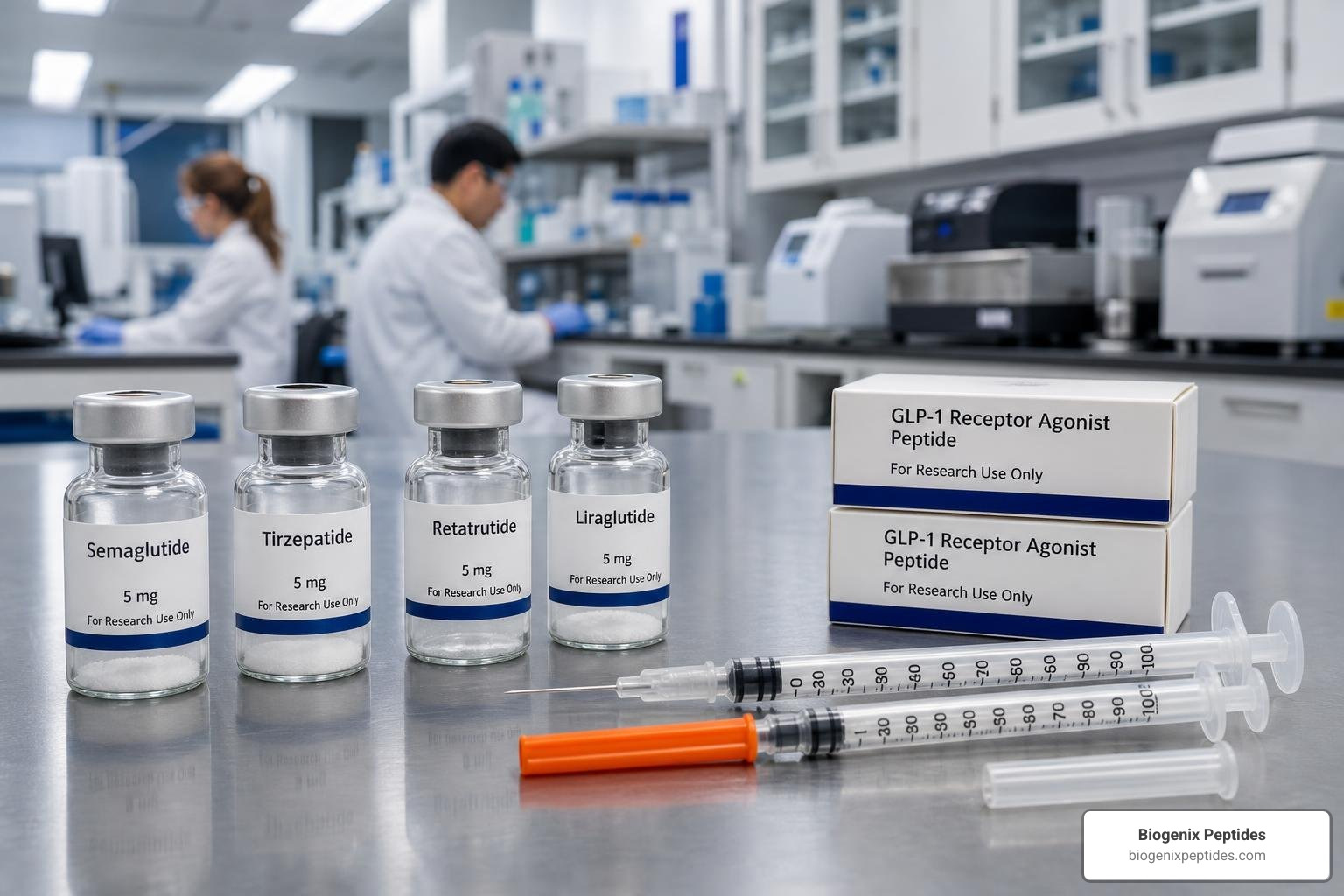
GLP-1 receptor agonist generics are now a reality — and for researchers tracking metabolic pathways, that matters enormously for budget planning.
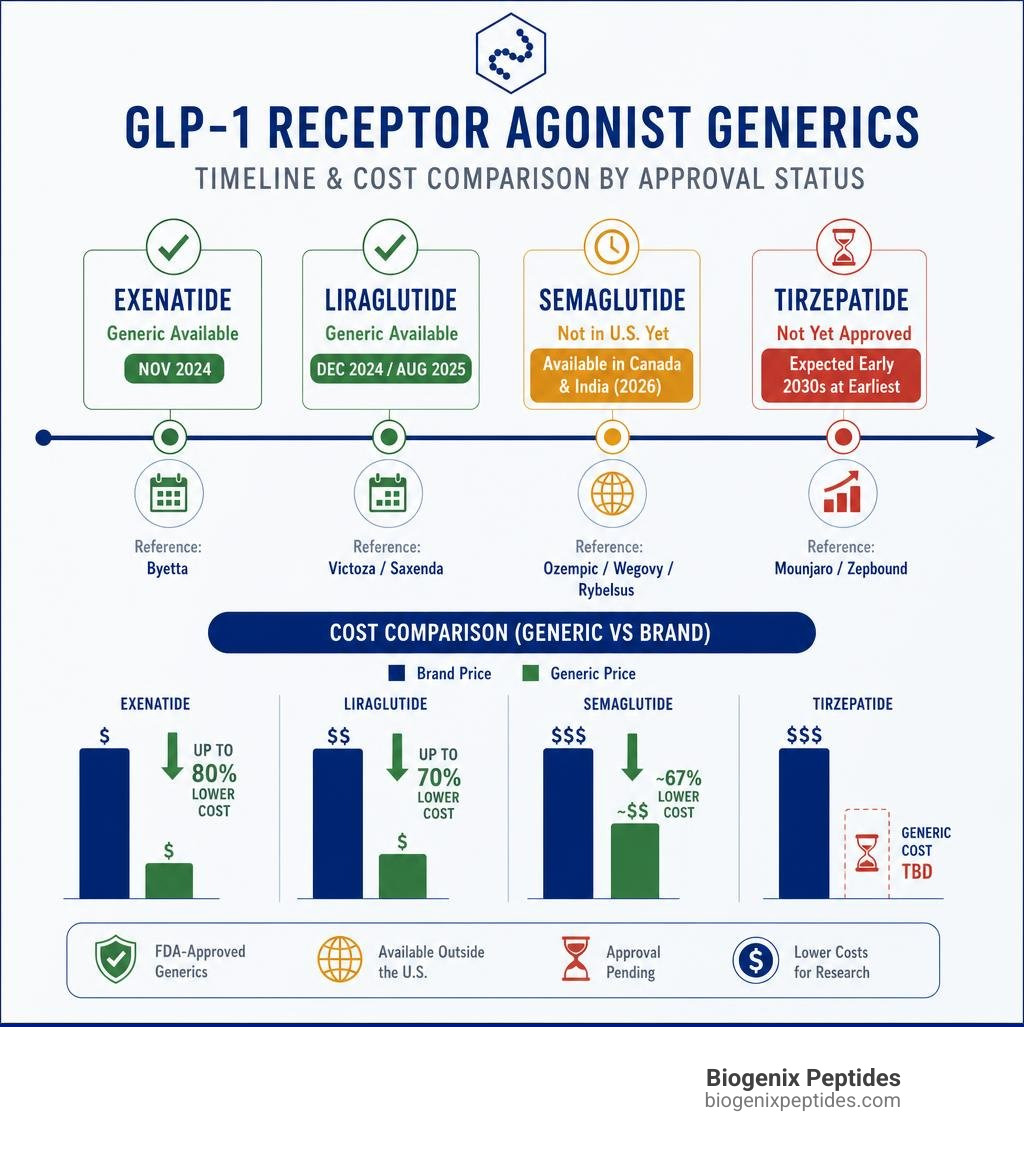
Here is a quick snapshot of where things stand right now:
| Compound | Generic Available? | Reference Product | Notes |
|---|---|---|---|
| Exenatide | Yes (Nov 2024) | Byetta | First FDA-approved GLP-1 generic |
| Liraglutide | Yes (Dec 2024 / Aug 2025) | Victoza / Saxenda | First generic GLP-1 for weight management |
| Semaglutide | Not in U.S. yet | Ozempic / Wegovy / Rybelsus | Available in Canada and India as of 2026 |
| Tirzepatide | Not yet | Mounjaro / Zepbound | Expected early 2030s at earliest |
For years, the high cost of brand-name GLP-1 compounds put serious strain on research budgets. Ozempic and Wegovy dominate public conversation, but their price points — often hundreds of dollars per month — have made large-scale metabolic research expensive. The arrival of FDA-approved generics for exenatide and liraglutide is a meaningful first step. And globally, the picture is moving fast: Canada became the first G7 country to approve generic semaglutide, with two versions arriving in pharmacies in 2026 at roughly one-third the cost of the brand-name product.
The core question for researchers is no longer “will generics arrive?” — it’s “how do we plan around what’s available now, and what’s coming next?”
I’m Jay Daniel, Founder and CEO of BioGenix Peptides, and my work in peptide science and quality-controlled compound sourcing gives me a practical lens on how GLP-1 receptor agonist generics are reshaping research accessibility. In the sections below, I’ll break down exactly what’s approved, what’s coming, and how to think about cost-effective research models without compromising on compound integrity.
GLP-1 receptor agonist generics terminology:
- GLP-1 receptor agonist benefits
- GLP-1 agonists cardiovascular outcomes
- GLP-1 agonists exercise synergy
The Current Landscape of GLP-1 Receptor Agonist Generics
The term “generic” sounds simple, but when we apply it to large peptide molecules like those in the GLP-1 category, the science becomes highly sophisticated. Unlike small-molecule drugs (such as aspirin), GLP-1 receptor agonists are complex generics. They are composed of long chains of amino acids that must fold into precise three-dimensional shapes to activate target receptors.

To secure approval for a generic peptide, manufacturers must submit an Abbreviated New Drug Application (ANDA) to the FDA. Rather than repeating massive clinical trials, the applicant must demonstrate strict bioequivalence to the reference standard. This means proving that the generic version has the exact same active peptide ingredient, behaves identically in biological systems, and utilizes a comparable delivery system. For more background on these pathways, you can explore our More info about GLP-1 research resource.
What are the FDA-Approved GLP-1 Receptor Agonist Generics?
At present, the U.S. landscape of FDA-approved GLP-1 receptor agonist generics consists of two primary peptide compounds:
- Exenatide: Approved as the first-ever generic GLP-1 in November 2024, referencing the brand-name product Byetta. It is a synthetic version of the salivary protein found in the Gila monster, which mimics human GLP-1.
- Liraglutide: Approved shortly after exenatide. The FDA approved the first generic liraglutide referencing Victoza in December 2024, followed by a generic version referencing Saxenda in August 2025.
These milestones are highly significant. Prior to these approvals, brand-name liraglutide commanded massive market shares; for instance, Victoza recorded annual sales of $1.656 billion as of April 2024, while Saxenda generated $165 million as of June 2025. To read the official announcements, you can review Teva’s authorized generic liraglutide announcement and the subsequent Teva’s generic Saxenda launch release.
These approved generics provide researchers with established, highly regulated reference standards that have undergone rigorous evaluation under FDA generic peptide approval standards.
When Will We See More GLP-1 Receptor Agonist Generics in the U.S.?
While liraglutide and exenatide are readily available, the scientific community is eagerly waiting for generic versions of newer-generation compounds: semaglutide (the peptide behind Ozempic and Wegovy) and tirzepatide (the dual GIP/GLP-1 agonist behind Mounjaro and Zepbound).
The timeline for these approvals in the U.S. is governed by complex patent protections. Although the foundational compound patent for semaglutide expired in several international markets in March 2026, secondary patents in the U.S. extend its exclusivity much further. We do not expect FDA-approved generic semaglutide to arrive on the U.S. market until approximately 2031 or 2032. Tirzepatide, being a newer compound, will likely not see generic competition in the U.S. until the mid-to-late 2030s.
For a deeper dive into how these development pipelines operate, check out our Overview of generic peptide development.
Comparing Approved Generics to Brand-Name Giants
How do these first-generation generic GLP-1s compare to the highly publicized brand-name giants currently dominating metabolic research?
When evaluating these compounds in laboratory models, researchers look at several key parameters: glycemic control markers, weight management metrics, and the required application frequency. Older-generation peptides like liraglutide require daily administration due to their shorter half-lives. In contrast, newer brand-name standards like semaglutide and tirzepatide utilize advanced structural modifications that permit weekly administration protocols.
The table below outlines how these reference standards compare:
| Peptide Compound | Brand-Name Reference | Key Metabolic Targets | Administration Schedule | Primary Research Focus |
|---|---|---|---|---|
| Exenatide (Generic) | Byetta | GLP-1 Receptor | Twice-Daily | Glycemic control, early incretin pathway studies |
| Liraglutide (Generic) | Victoza / Saxenda | GLP-1 Receptor | Once-Daily | Glycemic control, weight management in models |
| Semaglutide (Brand) | Ozempic / Wegovy | GLP-1 Receptor | Once-Weekly | High-efficiency glycemic control, cardiovascular markers |
| Tirzepatide (Brand) | Mounjaro / Zepbound | GLP-1 & GIP Receptors | Once-Weekly | Dual-pathway metabolic research, profound weight reduction |
While brand-name semaglutide and tirzepatide yield stronger metabolic changes in research models, generic liraglutide remains an incredibly valuable and cost-effective tool for studying baseline incretin receptor activation. Understanding these differences is crucial for selecting the right compound for your laboratory’s specific goals. You can read more about these mechanisms in our guide on Understanding incretin pathways.
Global Market Access and the Future of Generic Semaglutide
While U.S. researchers face a wait for generic semaglutide, the international landscape is moving at a completely different speed. In March 2026, the foundational compound patent for semaglutide expired in several jurisdictions, triggering immediate generic launches.
Canada has led the way among G7 nations, with Health Canada approving its first generic semaglutide versions. Manufacturers like Apotex and Dr. Reddy’s began shipping generic semaglutide to Canadian pharmacies in early 2026 at approximately one-third the cost of brand-name Ozempic. This approval is discussed in detail in Canada’s generic semaglutide regulatory updates.
Meanwhile, India and China are experiencing a massive surge in generic GLP-1 manufacturing:
- India: Home to over 101 million people living with diabetes, India’s market saw immediate “Day-1” generic semaglutide launches upon patent expiry. Over 40 local companies introduced affordable versions. Dr. Reddy’s launched its DCGI-approved generic semaglutide under the brand name Obeda, supported by their digital integration program. You can read more in Dr. Reddy’s generic semaglutide announcement. Simultaneously, Sun Pharmaceutical received approval for its weight-management generic under the brand Noveltreat, as detailed in Sun Pharmaceutical’s regulatory filing.
- China: With an estimated 148 million adults living with diabetes, at least 16 Chinese biopharmaceutical firms are actively developing generic semaglutide, with several running concurrent Phase III comparative trials.
These global developments are critical because they establish robust, high-volume manufacturing pipelines for these complex peptides. To understand how these single-receptor generics compare to multi-receptor research compounds, read our Research on dual and triple agonist peptides.
Barriers to Entry: Why We Must Wait for U.S. Semaglutide and Tirzepatide Generics
If generic semaglutide is already circulating in Canada, India, and China in 2026, why can’t U.S. laboratories access FDA-approved generic versions?
The answer lies in the highly sophisticated intellectual property strategies employed by brand-name pharmaceutical companies, often referred to as “patent thickets.”
Even when a foundational compound patent expires (the patent covering the basic sequence of the amino acids), several layers of secondary patents remain active:
- Formulation Patents: Patents covering the specific buffers, preservatives, and liquid mediums used to keep the peptide stable in solution.
- Manufacturing Patents: Patents protecting the recombinant DNA techniques or synthetic processes used to yield the peptide at scale.
- Device Patents: Patents protecting the mechanical design of the delivery pens. Because generic manufacturers must provide a user-friendly delivery method, patent disputes over pen needles and dial-back mechanisms often delay generic entry for years.
In the U.S., these secondary protections and patent term extensions are expected to block generic semaglutide until at least 2032. For an expert breakdown of this legal landscape, see the Analysis of Ozempic patent expiry.
For researchers, navigating these delays means finding reliable, high-purity sources for laboratory study. To learn how to verify your compounds, read our guide on Identifying authentic tirzepatide in research.
Frequently Asked Questions about Affordable Metabolic Research
What is the difference between FDA-approved generics and research-grade peptides?
FDA-approved generics are commercial drug products evaluated through the ANDA pathway. They are manufactured under strict Current Good Manufacturing Practice (cGMP) regulations and are approved for clinical applications.
Conversely, research-grade peptides are intended strictly for in vitro laboratory experiments or animal models. They are not approved for human consumption. While commercial generics are bound by specific clinical delivery formats, research-grade peptides provide laboratory professionals with the flexibility to customize concentrations and study design. The quality of research-grade peptides is verified using analytical chemistry techniques like High-Performance Liquid Chromatography (HPLC) and Mass Spectrometry (MS) to ensure precise purity profiles.
How do generic GLP-1 prices compare to brand-name versions?
Historically, the entry of generic options drives dramatic cost reductions:
- The First Generic: Typically enters the market at a price 75% to 85% lower than the brand-name version.
- The Second Generic: When a second competitor enters, the price for both typically drops to about 50% of the original brand price.
- Three or More Generics: When three or more generic options are available, prices regularly fall to 35% (or a 65% discount) of the brand-name cost.
For laboratory budgets, utilizing generic reference standards or high-purity research equivalents allows for larger sample sizes and longer study durations. For a comprehensive look at cost-effective research pathways, refer to our Guide to affordable GLP-1 research options.
How are generic GLP-1s handled in research budget planning?
When planning metabolic research budgets, funding allocation must balance compound cost with experimental integrity. Utilizing established generic standards like exenatide or liraglutide is highly efficient for basic receptor-binding assays. However, if your project focuses on advanced dual-receptor pathways or long-acting kinetics, sourcing high-purity research-grade semaglutide or tirzepatide from trusted suppliers is often the most cost-effective way to optimize your laboratory’s resources.
Conclusion
The arrival of GLP-1 receptor agonist generics represents a major shift in metabolic research. While U.S. investigators must wait several more years for domestic generic versions of semaglutide and tirzepatide due to complex patent landscapes, the successful rollouts of generic liraglutide and exenatide show that the era of affordable metabolic research is well underway.
At BioGenix Peptides, we are committed to supporting the scientific community by providing access to premier, rigorously tested compounds for laboratory study. By understanding the evolving generic landscape, you can make informed decisions that maximize your research budget while maintaining absolute scientific standards.
Ready to explore high-purity compounds for your next project? Explore the GLP-1 research category to view our full selection of quality-verified research peptides.