GHRP-6 Reconstitution Steps for Accurate Dosing
What Researchers Need to Know About Reconstituting GHRP-6 5mg
Disclaimer: The information provided in this article is for educational and informational purposes only. It is not intended as medical advice, diagnosis, or treatment. Products and compounds referenced are for research use only and are not approved for human or veterinary consumption. Always consult a qualified professional regarding health or medical decisions.
Reconstituting GHRP-6 5mg is a precise laboratory process that directly affects the quality and reliability of your research outcomes. Getting it wrong — wrong solvent, wrong volume, wrong technique — can degrade the peptide before you even begin your study.
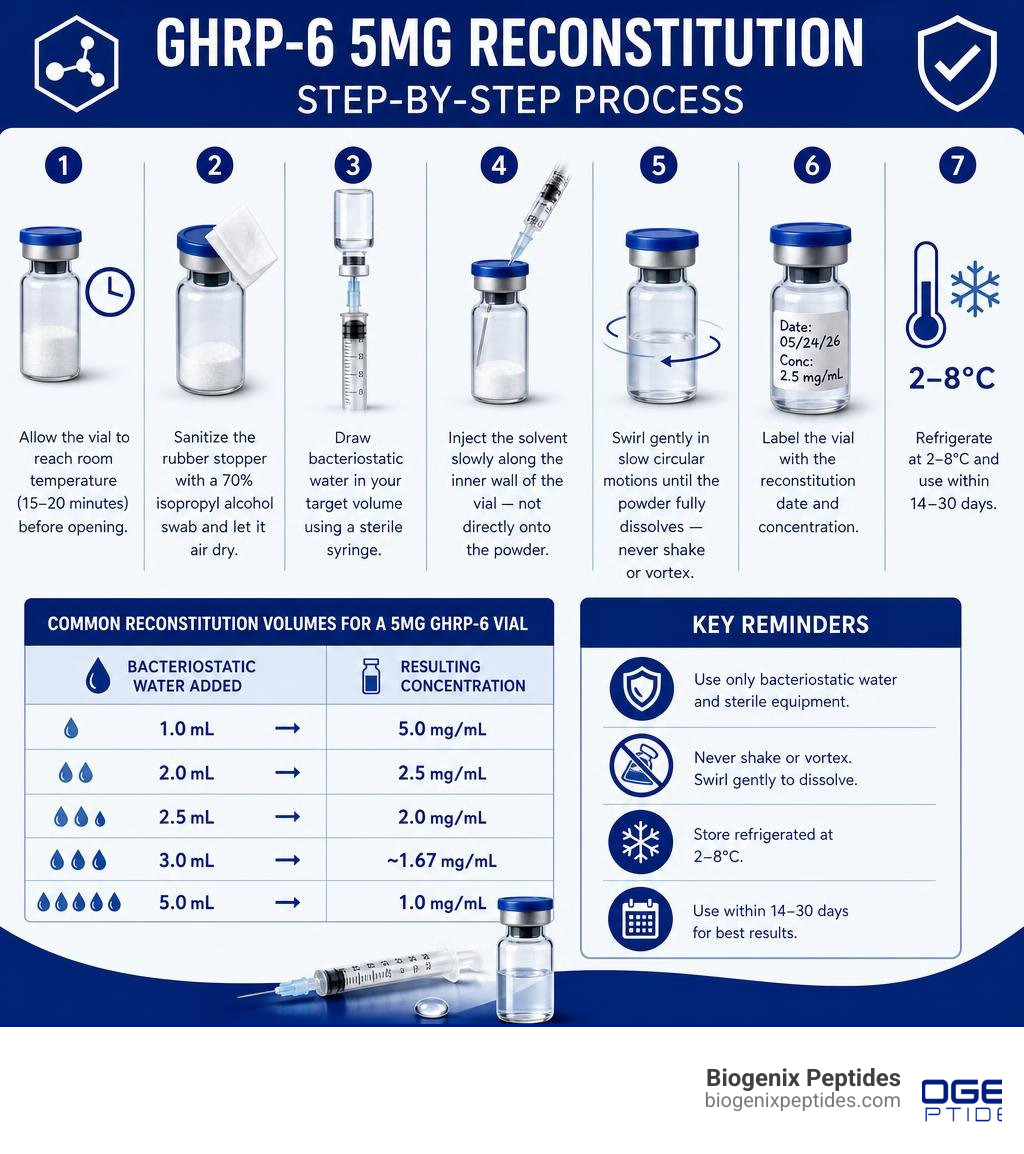
Here is a quick reference for the core steps:
- Allow the vial to reach room temperature (15–20 minutes) before opening
- Sanitize the rubber stopper with a 70% isopropyl alcohol swab and let it air dry
- Draw bacteriostatic water in your target volume using a sterile syringe
- Introduce the solvent slowly along the inner wall of the vial — not directly onto the powder
- Swirl gently in slow circular motions until the powder fully dissolves — never shake or vortex
- Label the vial with the reconstitution date and concentration
- Refrigerate at 2–8°C and use within 14–30 days
Common reconstitution volumes for a 5mg GHRP-6 vial:
| Bacteriostatic Water Added | Resulting Concentration |
|---|---|
| 1.0 mL | 5.0 mg/mL |
| 2.0 mL | 2.5 mg/mL |
| 2.5 mL | 2.0 mg/mL |
| 3.0 mL | ~1.67 mg/mL |
| 5.0 mL | 1.0 mg/mL |
Growth Hormone Releasing Peptide-6 is a synthetic hexapeptide with the sequence His-D-Trp-Ala-Trp-D-Phe-Lys-NH₂. It is used extensively in research settings to study growth hormone secretion via activation of the ghrelin receptor (GHS-R1a).
Because it arrives as a lyophilized (freeze-dried) powder, it must be reconstituted with a suitable solvent before any in vitro application. The reconstitution step is not just routine lab prep — it sets the foundation for every downstream result.
Even small errors at this stage — using the wrong solvent, adding liquid too forcefully, or storing at the wrong temperature — can cause peptide degradation through hydrolysis, tryptophan oxidation, or physical denaturation. The research is only as good as the preparation.
I’m Jay Daniel, Founder and CEO of BioGenix Peptides, with years of hands-on experience in peptide sourcing, quality control, and laboratory protocols — including the precise steps for reconstituting GHRP-6 5mg vials to research-grade standards. In this guide, I’ll walk you through every step of the process so your lab work starts on solid ground.
Relevant articles related to reconstituting ghrp 6 5mg:
Required Laboratory Supplies for Reconstituting GHRP-6 5mg
Before we begin handling the delicate lyophilized powder, we must gather the necessary laboratory equipment. Having everything laid out in advance prevents contamination risks and ensures a smooth, uninterrupted preparation process.
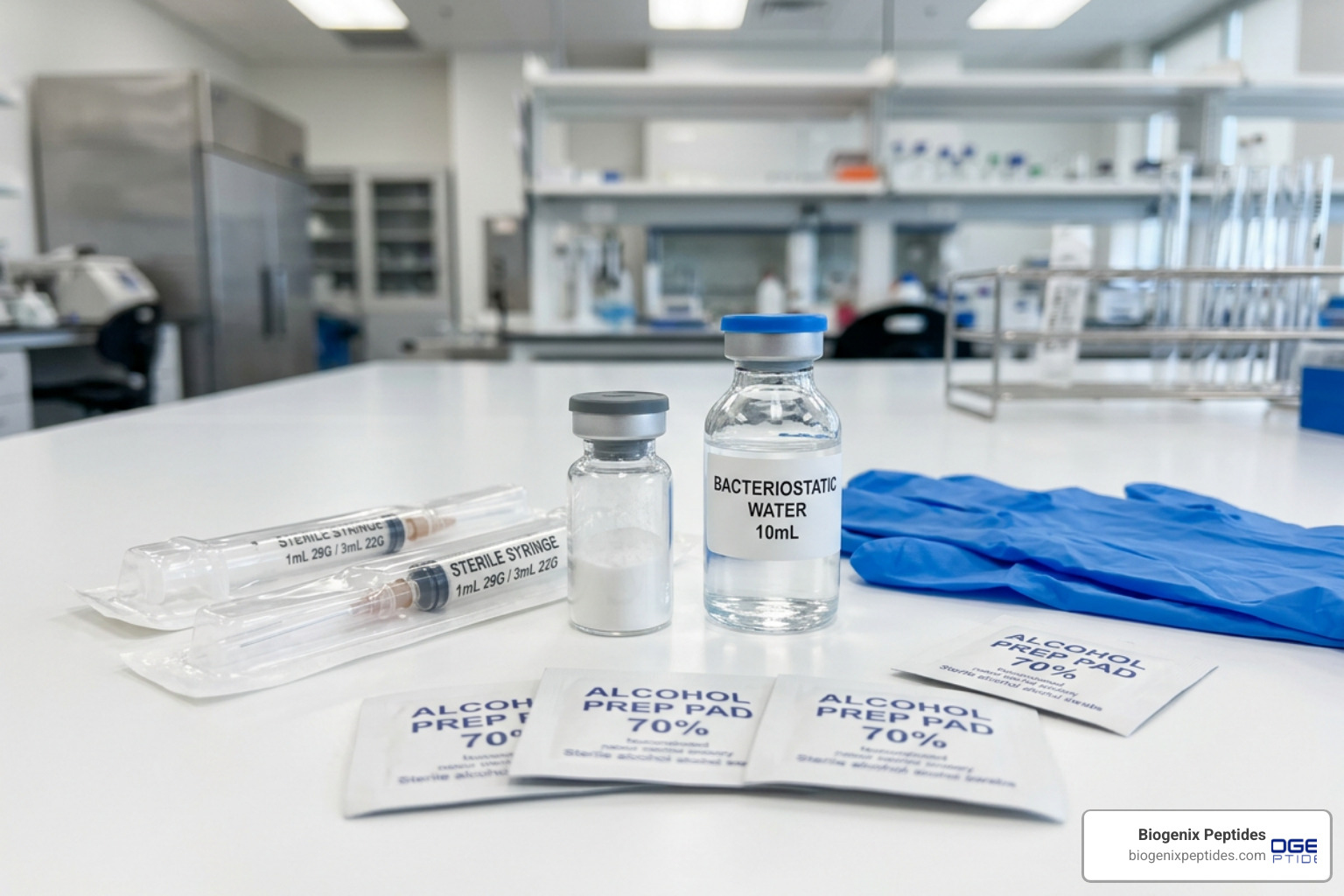
To safely prepare a 5 mg vial of GHRP-6, you will need the following high-grade supplies:
- A 5 mg vial of lyophilized GHRP-6: Ensure the vial is intact, vacuum-sealed, and has been stored in cold conditions prior to preparation.
- Bacteriostatic Water (0.9% Benzyl Alcohol): This is the gold standard diluent for multi-use research vials. The benzyl alcohol acts as a mild preservative, inhibiting any potential bacterial growth.
- Sterile Syringes: Standard 1.0 mL or 3.0 mL sterile syringes are required for measuring the diluent, while high-precision U-100 micro-syringes are typically used to extract precise test quantities.
- 70% Isopropyl Alcohol Swabs: Essential for sanitizing the vial tops and maintaining aseptic conditions.
- Sharps Disposal Container: For safe disposal of all needles and syringes post-preparation.
Choosing the right solvent is critical. While sterile water is sometimes used, it lacks any preservative. This means that once the vial is punctured, any microscopic contaminant can multiply rapidly. For research protocols extending over several days or weeks, bacteriostatic water is highly recommended because it maintains sterility for up to 30 days.
To dive deeper into how these two diluents differ, read our guide on Sterile Water and Bacteriostatic Water Differences You Must Know. For a comprehensive overview of the preparation process for 5mg vials, you can also consult our resource on The Secret to Reconstituting Peptides 5mg Correctly.
Pre-Preparation Steps for Reconstituting GHRP-6 5mg
A successful reconstitution starts long before the liquid touches the powder. Creating a pristine, controlled environment is the best way to protect your research materials from microscopic contaminants.
First, establish an aseptic workspace. Ideally, this should be done under a laminar flow hood. If a hood is not available, select a clean, flat surface in a draft-free room. Wipe down the entire work surface with a 70% isopropyl alcohol solution and allow it to air dry. Wash your hands thoroughly and put on sterile nitrile gloves.
Next, address temperature equilibration. Lyophilized peptides are typically stored in deep freeze conditions. Puncturing a freezing cold vial can draw in warm, humid air, causing condensation to form inside. This moisture can prematurely degrade the peptide. Allow both the GHRP-6 5mg vial and the bacteriostatic water to sit at room temperature for 15 to 20 minutes before proceeding.
Once the vial has reached room temperature, pop off the plastic flip-cap. Take a fresh alcohol swab and vigorously clean the exposed rubber stopper. Repeat this step for the bacteriostatic water vial. Allow the alcohol on both stoppers to evaporate completely (about 10 to 15 seconds) to ensure a sterile entry point. For a detailed, visual walkthrough of these initial steps, check out our article on Reconstituting Lyophilized Peptides Step-by-Step.
Step-by-Step Guide to Reconstituting GHRP-6 5mg
Now that your workspace is sterile and your supplies are ready, it is time to perform the physical reconstitution. This process requires a steady hand and a bit of patience. Peptides are held together by delicate peptide bonds; treating them roughly can shear the molecules, rendering your research material useless.
- Draw the Diluent: Attach a sterile needle to your diluent syringe. Insert the needle into the sanitized bacteriostatic water vial, invert it, and slowly draw your calculated volume of liquid (for example, 2.0 mL). Tap the syringe gently to force any air bubbles to the top, and push them back into the vial. Withdraw the needle.
- Angle the Needle: Insert the needle of the diluent syringe through the center of the GHRP-6 vial’s rubber stopper at a 45-degree angle. Position the tip so that it points toward the inner glass wall of the vial, rather than directly down at the lyophilized powder cake.
- Introduce the Liquid Slowly: Slowly depress the plunger to let the bacteriostatic water trickle down the side of the glass. The vacuum seal inside the vial may try to pull the liquid in rapidly. Hold the plunger firmly to resist this pull, ensuring the liquid flows slowly over 15 to 20 seconds. Rapid spraying can cause the peptide to denature or foam.
- Equalize the Pressure: Before withdrawing the needle, draw a small amount of air back into the syringe to equalize the pressure inside the vial. This prevents liquid from spraying out of the stopper when you pull the needle out.
- Gently Dissolve the Powder: Remove the syringe. Gently swirl the vial in slow, circular motions. Do not shake, tap, or vortex the vial. Shaking introduces air bubbles and can cause surface denaturation. Let the vial sit on the counter for 2 to 3 minutes, then swirl again. The powder should dissolve completely, leaving a crystal-clear, colorless liquid.
Concentration Calculations and Diluent Ratios
Calculating the precise concentration of your reconstituted solution is critical for accurate experimental measurements. Because the vial contains a fixed mass of 5 mg (which is equal to 5,000 micrograms), the volume of bacteriostatic water you add determines the final concentration.
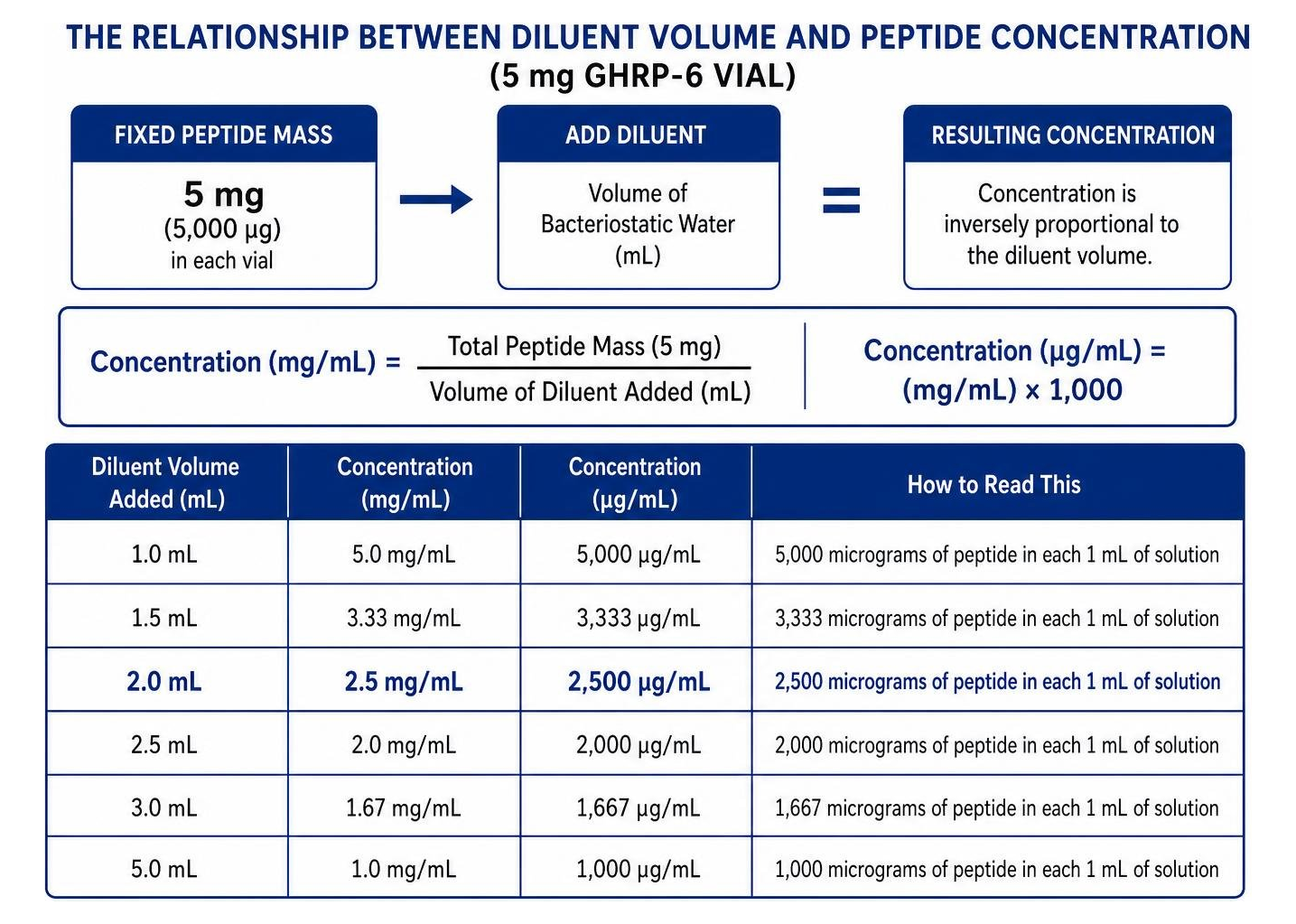
The basic mathematical formula for this calculation is:
$$\text{Concentration (mg/mL)} = \frac{\text{Total Peptide Mass (5 mg)}}{\text{Volume of Diluent added (mL)}}$$
To convert this into micrograms per milliliter ($\mu\text{g/mL}$), multiply the result by 1,000. Let’s look at how different volumes of bacteriostatic water change the concentration profile of a 5 mg vial:
| Bacteriostatic Water Volume (mL) | Concentration (mg/mL) | Concentration ($\mu\text{g/mL}$) | Volume Needed for a 100 $\mu\text{g}$ Aliquot |
|---|---|---|---|
| 1.0 mL | 5.0 mg/mL | 5,000 $\mu\text{g/mL}$ | 0.02 mL (2 Units on a U-100 syringe) |
| 2.0 mL | 2.5 mg/mL | 2,500 $\mu\text{g/mL}$ | 0.04 mL (4 Units on a U-100 syringe) |
| 2.5 mL | 2.0 mg/mL | 2,000 $\mu\text{g/mL}$ | 0.05 mL (5 Units on a U-100 syringe) |
| 3.0 mL | 1.67 mg/mL | 1,667 $\mu\text{g/mL}$ | 0.06 mL (6 Units on a U-100 syringe) |
| 5.0 mL | 1.0 mg/mL | 1,000 $\mu\text{g/mL}$ | 0.10 mL (10 Units on a U-100 syringe) |
For most laboratory research assays, a reconstitution volume of 2.0 mL or 2.5 mL is preferred. These ratios provide a clean, concentrated solution that is easy to measure using standard U-100 syringes, where small volumes can be extracted with high precision. To explore the chemistry behind these calculations further, check out our resource on The Science of the Bacteriostatic Water Peptide Ratio.
Storage Conditions and Stability Timelines
Once reconstituted, GHRP-6 is highly sensitive to environmental factors. Heat, light, and physical agitation will accelerate the degradation of the peptide chain. To preserve the integrity of your compound, strict storage protocols must be followed.

Lyophilized (Unreconstituted) Peptide Storage
In its freeze-dried state, GHRP-6 is relatively stable. However, long-term exposure to warmth can still cause slow degradation.
- Deep Freeze (-20°C): Lyophilized vials can be stored at -20°C for 12 to 24+ months. Ensure the freezer is a non-frost-free model, as temperature fluctuations during defrost cycles can harm the peptide.
- Refrigeration (2–8°C): Unopened vials remain stable for up to 12 months when refrigerated.
- Room Temperature (approx. 20–22°C): Lyophilized GHRP-6 can tolerate room temperature for up to 3 weeks if kept desiccated and protected from direct sunlight. This makes standard shipping safe, but vials should be placed in cold storage immediately upon arrival.
Reconstituted Peptide Storage (July 2026 Standards)
Once the solvent is introduced, the clock begins to tick. The peptide is now in a liquid state, making it far more vulnerable to hydrolysis and temperature-induced breakdown.
- Refrigeration (2–8°C): Reconstituted GHRP-6 must always be kept in the refrigerator. When mixed with bacteriostatic water, the solution remains stable for up to 30 days. However, for highly sensitive in vitro assays where maximum potency is required, research indicates that utilizing the solution within 14 days yields the most consistent experimental outcomes.
- Freezing Reconstituted Solutions (-20°C): If you need to store the liquid peptide for longer than a month, you can freeze it at -20°C. Under these conditions, it will remain stable for 3 to 4 months.
Minimizing Freeze-Thaw Cycles via Aliquoting
Repeated freezing and thawing is highly damaging. As water freezes, it forms sharp ice crystals that apply mechanical stress to the peptide chains, shearing them apart.
To prevent this, perform an aliquoting protocol immediately after reconstitution:
- Prepare several sterile, low-binding microcentrifuge tubes.
- Draw the reconstituted solution and divide it into single-use quantities across these tubes.
- Label each tube with the compound name, concentration, and date.
- Store these aliquots in the freezer at -20°C.
- When a test run is scheduled, thaw only the single aliquot needed for that day. Never refreeze a thawed aliquot.
For comprehensive details on maintaining your compounds, read our guide on Peptide Storage Stability Guidelines.
Frequently Asked Questions about GHRP-6 Reconstitution
To help you troubleshoot your laboratory preparations, we have compiled the most common questions researchers ask when working with GHRP-6.
What is the best solvent for GHRP-6 reconstitution?
Bacteriostatic water (containing 0.9% benzyl alcohol) is the highly recommended solvent for multi-use research vials. The benzyl alcohol acts as an antimicrobial agent, preventing bacterial growth for up to 30 days.
Sterile water can be used if your specific in vitro assay is highly sensitive to benzyl alcohol. However, because sterile water contains no preservative, the solution must be used immediately and any remaining liquid discarded to prevent contamination.
How long does reconstituted GHRP-6 remain stable?
When stored in the refrigerator at 2–8°C, a solution reconstituted with bacteriostatic water remains stable and viable for up to 30 days. For optimal and highly reproducible research results, it is best to use the solution within 14 days of preparation. If frozen in single-use, low-binding aliquots at -20°C immediately after mixing, stability can be extended to 3–4 months.
What should I do if the solution is cloudy after mixing?
A cloudy or hazy solution after reconstitution is a warning sign. It typically points to one of three issues:
- Incomplete Dissolution: The peptide powder may simply need more time to dissolve. Let the vial sit undisturbed in the refrigerator for 5 to 10 minutes, then swirl it gently. If the cloudiness clears, the solution is ready.
- Peptide Aggregation/Denaturation: If the solvent was added too quickly or the vial was shaken vigorously, the peptide molecules may have clumped together or denatured. This material is degraded and will not yield accurate research data.
- Contamination: If the cloudiness appears days after reconstitution, it may indicate bacterial contamination.
If a reconstituted solution remains cloudy or contains visible floating particulates after sitting for 10 minutes, it must be discarded immediately to protect the integrity of your research.
Conclusion
Successfully reconstituting GHRP-6 5mg is an exact science that requires a clean workspace, the right tools, and a gentle touch. By following these professional laboratory steps—from allowing the vial to reach room temperature to performing slow, angled diluent additions—you protect your peptides from physical damage and chemical degradation.
At BioGenix Peptides, we are dedicated to supporting scientific discovery by providing premium, high-purity research materials. Maintaining rigorous laboratory standards during preparation ensures that your experimental models yield clear, reliable, and reproducible data.
To stock your laboratory with verified, research-grade compounds, visit our store to Shop Biogenix Peptides.