Why CJC-1295 is the MVP of Research Peptides
Disclaimer: The information provided in this article is for educational and informational purposes only. It is not intended as medical advice, diagnosis, or treatment. Products and compounds referenced are for research use only and are not approved for human or veterinary consumption. Always consult a qualified professional regarding health or medical decisions.
Why CJC-1295 Peptide Stands Out in Growth Hormone Research
Quick answer: What is CJC-1295 peptide?
- What it is: A synthetic analog of growth hormone-releasing hormone (GHRH), engineered to stimulate pulsatile GH secretion from the anterior pituitary
- Two forms: CJC-1295 with DAC (half-life ~6-8 days) and CJC-1295 without DAC (half-life ~30 minutes)
- Key research findings: Single administrations produced 2- to 10-fold increases in GH lasting 6+ days, and 1.5- to 3-fold increases in IGF-1 lasting 9-11 days
- Research interest areas: Body composition, recovery, sleep quality, and age-related GH decline
- Important note: For laboratory research use only — not approved for human or veterinary consumption
The cjc 1295 peptide has become one of the most studied GHRH analogs in modern peptide research — and for good reason.
Native GHRH, the body’s own GH-triggering signal, has a half-life of under 10 minutes. It degrades almost immediately. That makes it nearly impossible to study its downstream effects in a controlled, sustained way.
CJC-1295 changes that completely.
By modifying the GHRH (1-29) sequence and — in its DAC form — adding an albumin-binding complex, researchers created a compound that extends GH signaling from minutes to days. That’s roughly a 500-fold increase in persistence over native GHRH.
The result? A research tool that lets scientists examine the full downstream cascade: GH release, IGF-1 elevation, metabolic signaling, and more — across meaningful time windows rather than fleeting moments.
This guide walks through what the research actually shows, how the two forms differ, and why CJC-1295 has earned its reputation as one of the most valuable compounds in the peptide research toolkit.
I’m Jay Daniel, Founder and CEO of BioGenix Peptides, with years of hands-on experience in the peptide industry focused on quality, purity, and research-driven science around compounds like the cjc 1295 peptide. With that background, I’ll help you cut through the noise and focus on what the evidence actually supports — so you can make informed decisions for your research.
cjc 1295 peptide terms to remember:
What Is CJC-1295 Peptide?
At its core, the cjc 1295 peptide is a synthetic analog of Growth Hormone-Releasing Hormone (GHRH), specifically the 1-29 sequence known as Sermorelin. However, it is far more than a simple copy. It was engineered by ConjuChem Biotechnologies to fix the primary flaw of native GHRH: its rapid degradation by enzymes like DPP-IV.
In research models, this peptide functions by signaling the anterior pituitary gland. It targets the somatotroph cells, which are responsible for the synthesis and release of endogenous growth hormone. Unlike synthetic HGH, which replaces the body’s natural production, CJC-1295 acts as a secretagogue—it coaxes the body into optimizing its own production.
Historically, this peptide represents a major leap in endocrine research. By substituting four specific amino acids (at positions 2, 8, 15, and 27), the molecule becomes significantly more stable. This tetrasubstituted GHRH analog provides researchers with a more reliable way to study the growth hormone axis without the “noise” of rapid peptide breakdown.
CJC-1295 with DAC vs without DAC
The most common source of confusion in the research community is the difference between “with DAC” and “without DAC.”
DAC stands for Drug Affinity Complex. This is a chemical addition that allows the peptide to bind covalently to albumin (a serum protein) once it enters the bloodstream.
- CJC-1295 with DAC: This is the “true” CJC-1295. The DAC component acts like an anchor, keeping the peptide in circulation for a very long time. In human pharmacology studies, the half-life was found to be between 5.8 and 8.1 days. This version provides a sustained, long-acting elevation of GH and IGF-1 levels.
- CJC-1295 without DAC: This is technically Modified GRF 1-29. It contains the same four amino acid substitutions for stability but lacks the albumin-binding anchor. Its half-life is much shorter—approximately 30 minutes. This version is used in research to study acute, pulsatile GH signaling that more closely mimics the body’s natural “burst” patterns.
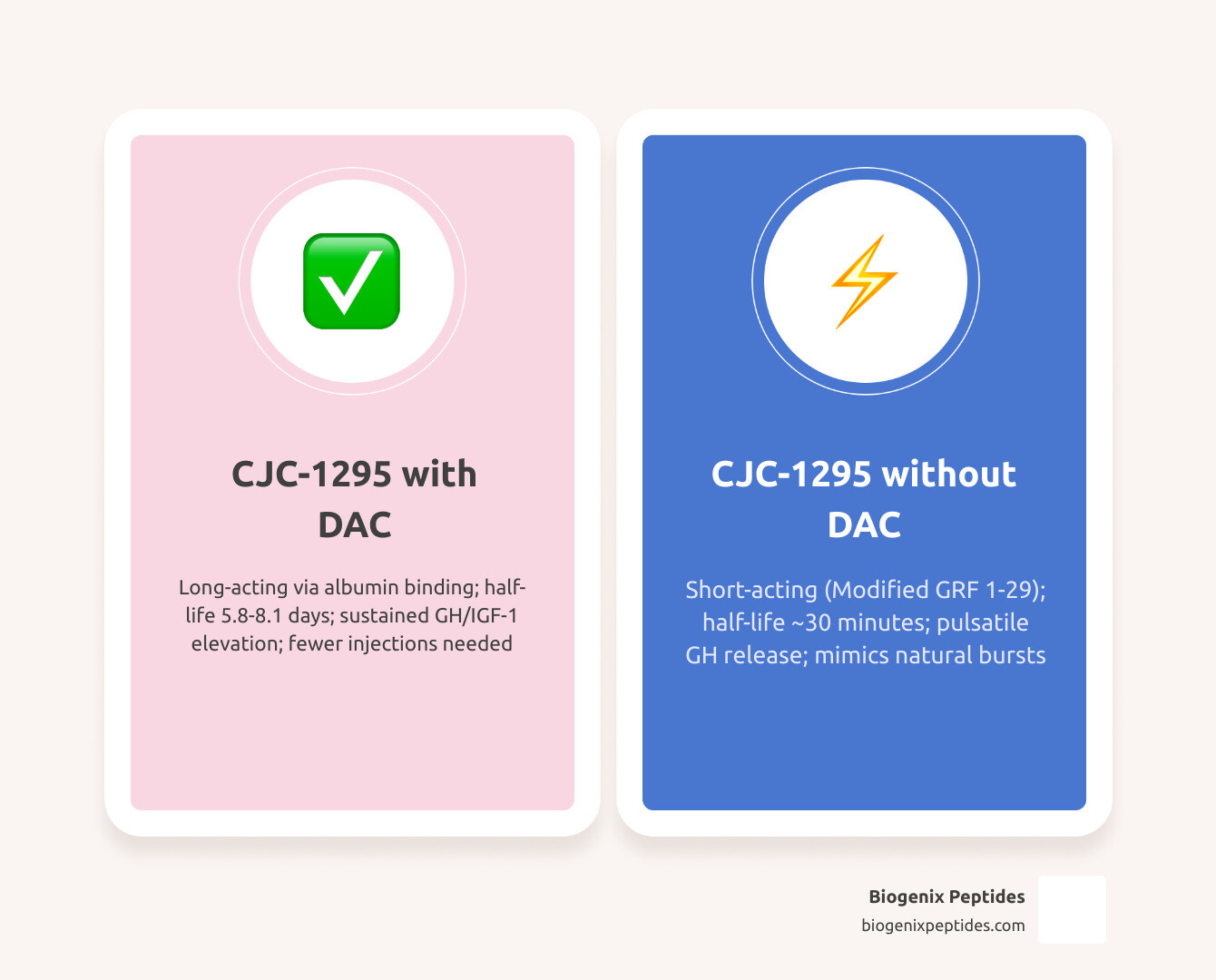
Why researchers separate “true CJC-1295” from Modified GRF 1-29
In the lab, precision matters. While many vendors use the names interchangeably, the pharmacokinetics are night and day. Researchers often prefer the “No DAC” version (Modified GRF 1-29) when they want to avoid “GH bleed”—a state of constant GH elevation that might desensitize receptors over time. Conversely, the DAC version is the go-to for investigating the effects of prolonged IGF-1 elevation.
Understanding these distinctions is crucial for setting up a valid experimental protocol. For a deeper dive into the nuances of the short-acting version, check out The Ultimate Guide to CJC 1295 Without DAC.
How CJC-1295 Peptide Works in Research Models
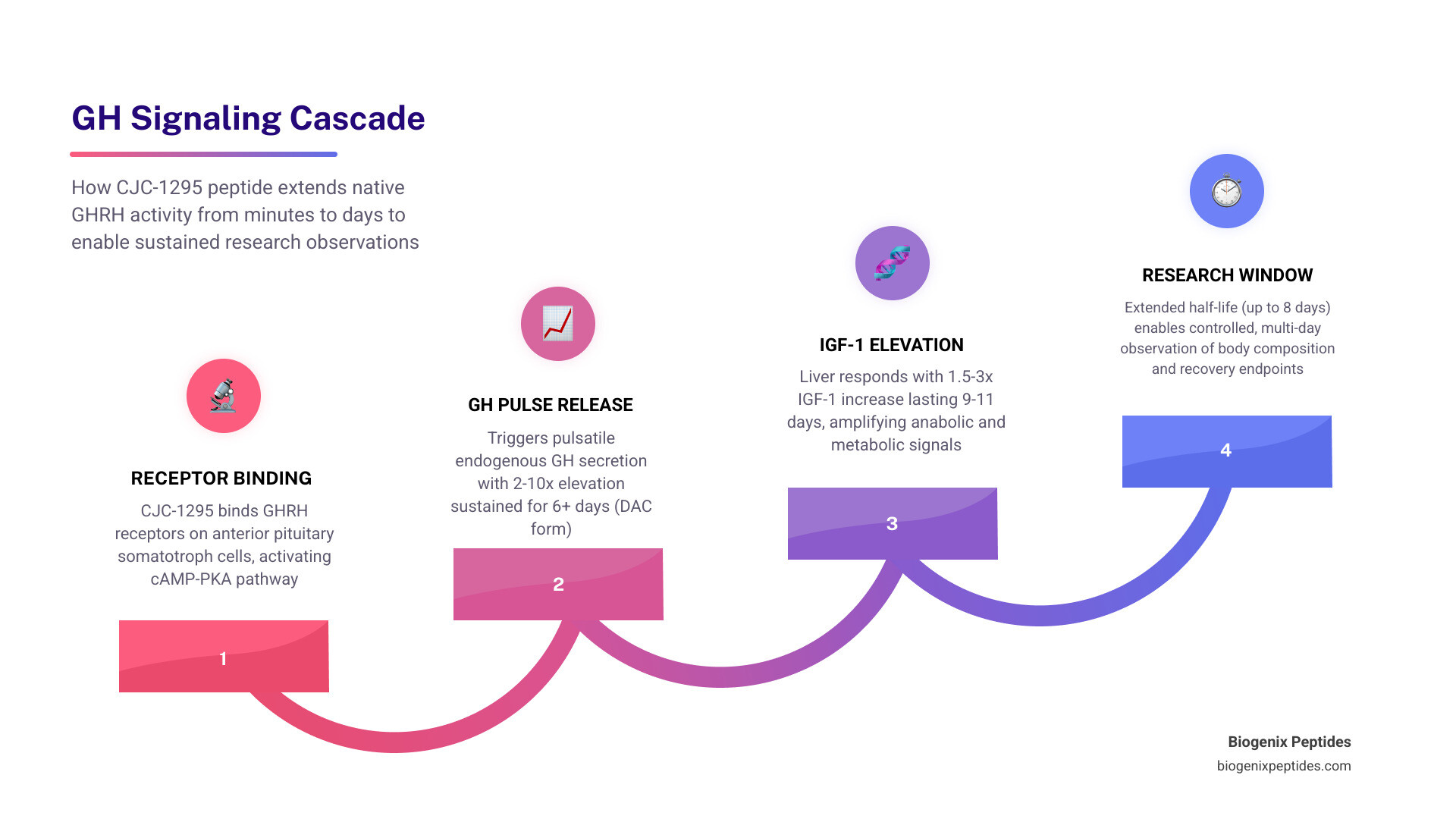
To understand why this peptide is so effective, we have to look at the GHRH receptor. Located on the somatotroph cells of the anterior pituitary, this receptor is a Class B G protein-coupled receptor. When cjc 1295 peptide binds to it, it triggers a cascade:
- cAMP Pathway Activation: The binding increases intracellular cyclic adenosine monophosphate (cAMP).
- Calcium Influx: This leads to an influx of calcium ions, which signals the cells to release stored growth hormone.
- GH Synthesis: Beyond just releasing what is already there, it stimulates the transcription of the GH gene, meaning the body actually makes more.
- Hepatic IGF-1 Release: As GH enters the bloodstream, it travels to the liver, triggering the production of Insulin-like Growth Factor 1 (IGF-1), which mediates most of the growth and repair effects.
Mechanism: from receptor binding to IGF-1 elevation
The beauty of this mechanism is that it preserves the body’s natural feedback loops. Unlike exogenous growth hormone, which can shut down natural production, CJC-1295 works within the existing endocrine framework. It amplifies the amplitude of GH pulses. This is particularly interesting in research involving sleep-linked pulses, as about 70% of daily GH secretion occurs during deep, slow-wave sleep.
Half-life and why it changes research scheduling
The half-life of a compound dictates how often it must be administered in a research setting.
- Native GHRH: < 10 minutes.
- CJC-1295 No DAC: ~30 minutes.
- CJC-1295 with DAC: 6-8 days.
The DAC version’s affinity for albumin means it isn’t cleared by the kidneys as quickly. This allows for a “set it and forget it” approach in many studies, where a single administration can keep IGF-1 levels elevated for up to 28 days.
What the human pharmacology studies actually found
Clinical data from the mid-2000s (specifically the Teichman studies) provided some of the most impressive statistics in peptide history. A single administration of CJC-1295 produced:
- GH Increase: 2- to 10-fold for 6 days or more.
- IGF-1 Increase: 1.5- to 3-fold for 9 to 11 days.
- Persistence: After multiple administrations, IGF-1 levels remained above baseline for up to 28 days.
These findings suggest that the cjc 1295 peptide is exceptionally potent at maintaining a high anabolic environment in research subjects.
Documented Findings: Body Composition, Recovery, Sleep, and Healthy-Aging Interest

The primary reason researchers flock to this peptide is its systemic impact on metabolism and tissue repair. Because it raises both GH and IGF-1, it touches almost every regenerative system in the body.
What the evidence suggests for fat loss and lean tissue
In research models, elevated growth hormone is a powerful driver of lipolysis—the breakdown of fats. Specifically, it has shown promise in reducing visceral fat (the dangerous fat around organs). Simultaneously, the increase in IGF-1 supports protein synthesis and nitrogen retention, which are the hallmarks of lean tissue preservation. Some studies have noted a potential lean muscle mass increase of approximately 2.77 lbs over a 16-week period in certain models.
cjc 1295 peptide and recovery research
Recovery is where CJC-1295 often earns its “MVP” title. By enhancing cellular reproduction and collagen synthesis, it is frequently studied for its role in repairing connective tissues like tendons and ligaments. Researchers look for multi-week trends in recovery quality, noting that the compound seems to support systemic repair rather than just localized healing.
Sleep, circadian rhythm, and age-related GH decline
After age 30, natural GH secretion declines by roughly 14% per decade. This decline is often linked to poorer sleep quality and slower recovery. Because the cjc 1295 peptide amplifies the natural pulses of GH, researchers have investigated its ability to restore more “youthful” sleep patterns. Subjects in these studies often report deeper, more restorative slow-wave sleep within the first two weeks of an experimental cycle.
Safety, Side Effects, and Who Should Avoid CJC-1295 in Research Contexts
While generally well-tolerated in clinical trials, no compound is without potential side effects. In research settings, monitoring for adverse reactions is a standard part of the protocol.
Common adverse effects reported in studies and reports
Most reported side effects are mild and transient. They include:
- Administration-site reactions: Redness, itching, or mild swelling.
- Flushing: A temporary warm sensation in the face or neck, often occurring shortly after administration.
- Headaches and Nausea: Usually mild and subsiding as the subject acclimates.
- Water Retention: Edema or joint discomfort due to increased GH levels.
- Tingling: Numbness or tingling in the extremities (paresthesia).
Higher-risk scenarios and exclusion groups
Certain conditions make a subject unsuitable for cjc 1295 peptide research. These include:
- Active Cancer: Because GH and IGF-1 promote cell growth, they could theoretically accelerate the growth of existing tumors.
- Pregnancy and Breastfeeding: The effects on fetal development are not well-studied.
- Heart Disease or Uncontrolled Diabetes: GH can affect glucose handling and insulin sensitivity.
- WADA Ban: CJC-1295 is strictly prohibited in competitive athletics.
Regulatory and evidence limitations in May 2026
As of May 2026, CJC-1295 remains a research chemical. While it reached Phase II clinical trials for lipodystrophy and GH deficiency, development was discontinued. Although a death occurred during a trial, it was deemed unrelated to the peptide itself. However, the lack of Phase III data means long-term safety surveillance is limited. In 2023, the FDA placed it on the Category 2 bulk drug substances list, further cementing its status as a compound for laboratory investigation only.
CJC-1295 Compared With Ipamorelin and Other GHRH Analogs
Researchers often compare CJC-1295 to other secretagogues to determine which is best for a specific goal.
CJC-1295 vs Ipamorelin: amplifier vs trigger
CJC-1295 is a GHRH analog—it mimics the signal that tells the pituitary to make and release GH. Ipamorelin is a GHRP (Growth Hormone Releasing Peptide) or ghrelin mimetic—it acts on a different receptor to trigger a pulse and suppress somatostatin (the “stop” signal).
- CJC-1295: Amplifies the “on” switch.
- Ipamorelin: Disables the “off” switch and triggers a clean pulse.
Because they work through different pathways, they are often used together in research to create a synergistic effect that is far more powerful than either compound alone. Ipamorelin is particularly favored because it does not significantly raise cortisol or prolactin levels.
CJC-1295 vs Other GHRH Research Compounds
Compared to Sermorelin or Tesamorelin, CJC-1295 with DAC is unique because of its massive half-life. Tesamorelin is highly effective for visceral fat but requires more frequent administration. CJC-1295 provides a more sustained elevation of the GH/IGF-1 axis, making it a better candidate for studies on overall body composition and long-term recovery trends.
Can CJC-1295 be combined with other peptides in research settings?
Yes, “stacking” is a common practice in laboratory settings.
- The GH Stack: CJC-1295 + Ipamorelin. This is the gold standard for studying maximum GH output.
- The Recovery Stack: CJC-1295 + BPC-157 or TB-500. This combination is used to investigate synergistic tissue repair.
For more information on how these combinations are structured in a lab environment, see Protocol for CJC 1295 and Ipamorelin for Maximum Gains.
Research Handling, Administration Format, and Cycle Structure
Proper handling is essential to maintain the integrity of the cjc 1295 peptide.
Typical protocol patterns reported for DAC and no-DAC versions
In research literature, the frequency depends entirely on the version:
- With DAC: Often administered 1-3 times per week due to its 6-8 day half-life.
- Without DAC: Typically administered daily (or even multiple times per day) to mimic natural pulsatile bursts.
Common research cycles last 8-12 weeks, followed by an “off-period” of 4-8 weeks to prevent receptor downregulation and allow the pituitary axis to rest.
Practical handling considerations for laboratory contexts
The peptide usually arrives as a lyophilized (freeze-dried) powder.
- Reconstitution: Use sterile bacteriostatic water. Add the water slowly, letting it run down the side of the vial. Never shake the vial; instead, gently swirl or roll it until the powder dissolves.
- Storage: Lyophilized powder is stable at room temperature for short periods but should be stored at -20°C for long-term use. Once reconstituted, it must be refrigerated (2-8°C) and used within 14-28 days.
- Protection: Keep the vial away from direct light.
Expected timeline of observed changes in reports
Research notes typically follow a predictable timeline:
- Weeks 1-2: Improved sleep quality and increased energy levels are often the first markers noted.
- Weeks 4-6: Improved recovery from physical exertion and better metabolic trends.
- Weeks 8-12: Visible changes in body composition, such as reduced fat mass and improved muscle tone, become statistically significant.
Frequently Asked Questions About CJC-1295 Peptide
Is cjc 1295 peptide the same as HGH?
No. HGH (Human Growth Hormone) is the actual hormone. CJC-1295 is a secretagogue that signals your pituitary gland to produce its own HGH. It is an “upstream” signal rather than a “downstream” replacement.
What is the half-life of cjc 1295 peptide?
It depends on the version. With DAC, the half-life is approximately 6-8 days. Without DAC (Modified GRF 1-29), the half-life is approximately 30 minutes.
Who should avoid CJC-1295?
Research subjects with active cancer, a history of heart disease, or uncontrolled glucose issues should be excluded. It is also not suitable for pregnant or breastfeeding models.
Conclusion
The cjc 1295 peptide remains a cornerstone of endocrine research because it offers something native GHRH cannot: stability and duration. Whether you are investigating the long-term effects of IGF-1 elevation with the DAC version or studying the nuances of pulsatile GH release with Modified GRF 1-29, this peptide provides a reliable, potent, and well-documented pathway for discovery.
At BioGenix Peptides, we are committed to providing the highest quality compounds for your laboratory needs. Explore our selection and continue your journey into the fascinating world of peptide science.