The Ultimate Guide to Mixing and Handling Lyophilized Powder Safely
Disclaimer: The information provided in this article is for educational and informational purposes only. It is not intended as medical advice, diagnosis, or treatment. Products and compounds referenced are for research use only and are not approved for human or veterinary consumption. Always consult a qualified professional regarding health or medical decisions.
Understanding Lyophilization and Solvent Selection
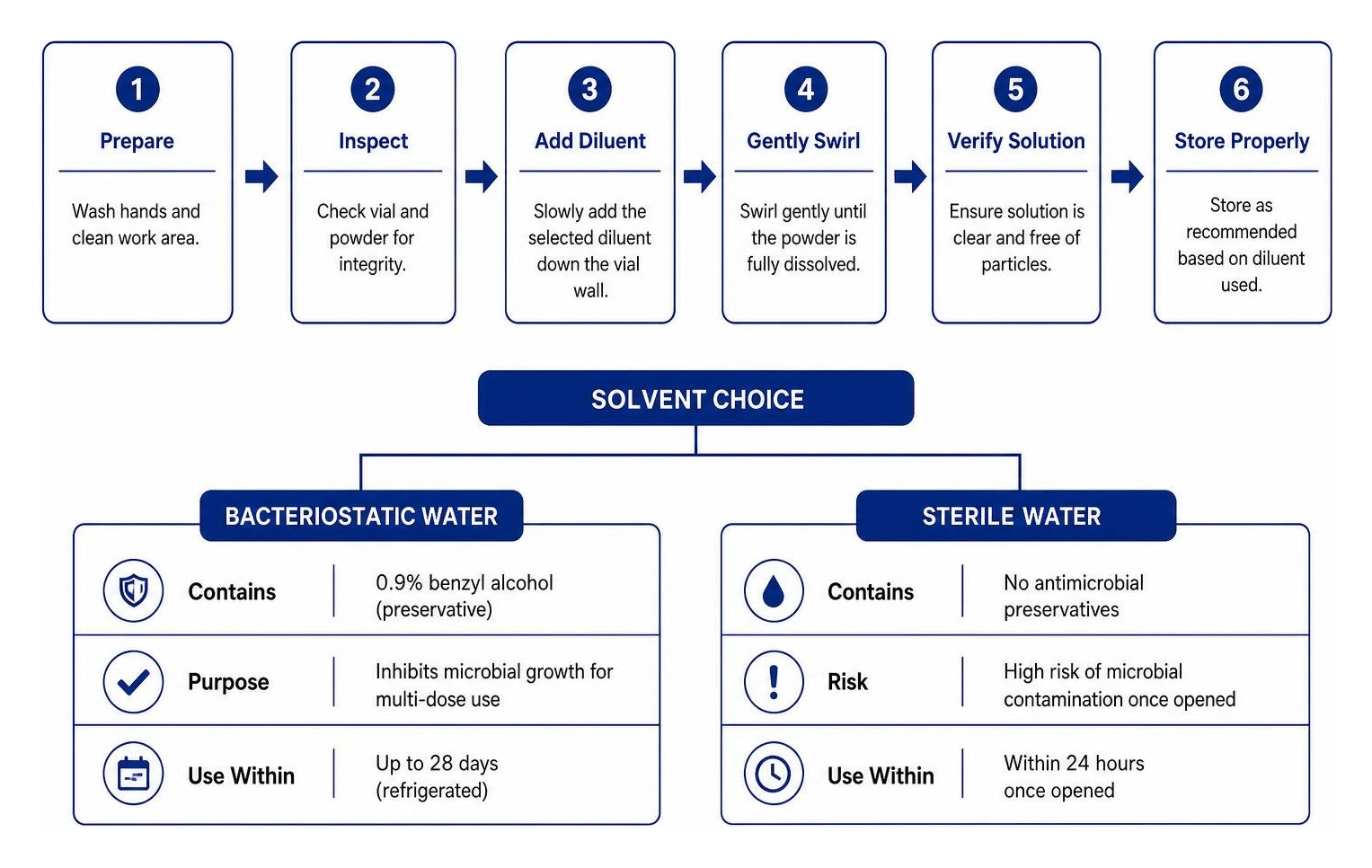
Lyophilization, or freeze-drying, is a dehydration process that removes moisture from sensitive biological compounds through sublimation under low pressure. By converting ice directly into vapor, freeze-drying creates a porous cake that maintains long-term structural stability when stored at temperatures between -20°C and -80°C for 12 to 24 months or longer. However, to utilize these compounds in laboratory research, they must be properly reconstituted into a liquid state using an appropriate diluent.
Choosing the correct solvent is the single most critical decision in the reconstitution workflow. The primary diluents used in research environments are bacteriostatic water and sterile water.
Bacteriostatic water contains 0.9% benzyl alcohol, which serves as a preservative to inhibit microbial growth. This allows for multi-use access over extended research periods, offering a refrigerated shelf life of up to 28 days for opened vials. In contrast, sterile water contains no antimicrobial preservatives. Once unsealed, sterile water carries a high risk of microbial contamination and must be utilized within 24 hours. Using sterile water for multi-day protocols is a frequent mistake that can compromise research findings.
For a deeper look into selecting the right solvent for your laboratory needs, read our guide on Sterile Water and Bacteriostatic Water Differences You Must Know.
| Feature / Metric | Bacteriostatic Water | Sterile Water |
|---|---|---|
| Preservative | 0.9% Benzyl Alcohol | None |
| Refrigerated Shelf Life (2°C to 8°C) | Up to 28 Days | Maximum 24 Hours |
| Protocol Application | Multi-use research protocols | Immediate single-use assays |
| Microbial Contamination Risk | Low (inhibits bacterial growth) | High after initial unsealing |
Secondary Solvents for Complex Peptides
While bacteriostatic water dissolves most hydrophilic compounds, certain complex, hydrophobic, or basic peptide sequences present solubility challenges. Forcing a hydrophobic peptide into pure water often results in incomplete dissolution, visible floating particulates, or complete precipitation.
In these cases, secondary organic co-solvents or acid solutions are required:
- Dilute Acetic Acid (0.1% to 1.0%): Highly effective for basic peptides rich in positively charged amino acid residues like lysine and arginine. Acetic acid lowers the pH slightly, neutralizing hydrophobic interactions and enabling rapid dissolution before further aqueous dilution.
- Dimethyl Sulfoxide (DMSO): A potent organic solvent capable of solubilizing highly hydrophobic sequences at concentrations of 20 to 50 mM, as confirmed by published protocols in STAR Protocols.
- Oxidation Warnings: DMSO is not compatible with peptides containing cysteine (Cys) or methionine (Met) residues. Organic solvents like DMSO can promote rapid oxidation of these specific amino acids, altering their chemical structure and degrading the material.
When working with hydrophobic compounds, a two-step reconstitution technique is recommended: pre-dissolve the lyophilisate in a minimal amount of organic solvent (such as DMSO or dilute acetic acid), then slowly add bacteriostatic water or phosphate-buffered saline (PBS) to reach the final working volume.
Step-by-Step Method: The Best Way Reconstitute Lyophilized Powder
Executing the best way reconstitute lyophilized powder requires strict adherence to aseptic technique, precise mechanical control, and pressure balance within the primary vial.
Before beginning, gather all core laboratory supplies:
- Lyophilized compound vial
- Appropriate solvent (e.g., bacteriostatic water)
- Sterile 23–25 gauge syringes with needles
- 70% isopropyl alcohol prep swabs
- Approved laboratory sharps container
- Reconstitution log or laboratory notebook
Preparation Protocols: The Best Way Reconstitute Lyophilized Powder without Denaturation
- Temperature Equilibration: Remove the lyophilized powder vial from cold storage (-20°C or -80°C) and allow it to sit on the lab bench at room temperature for 15 to 20 minutes before opening. Opening a cold vial immediately causes ambient humidity to condense inside the vial, introducing unwanted water droplets that degrade fragile chemical structures.
- Sanitize Surfaces: Pop off the plastic caps from both the powder and solvent vials. Thoroughly wipe the rubber stoppers with fresh 70% isopropyl alcohol swabs and allow them to air dry completely for 15 to 30 seconds.
- Draw Diluent and Balance Pressure: Draw a volume of air into the syringe equal to the amount of solvent required. Insert the needle into the bacteriostatic water vial, push the air to equalize pressure, invert the vial, and withdraw the exact volume needed.
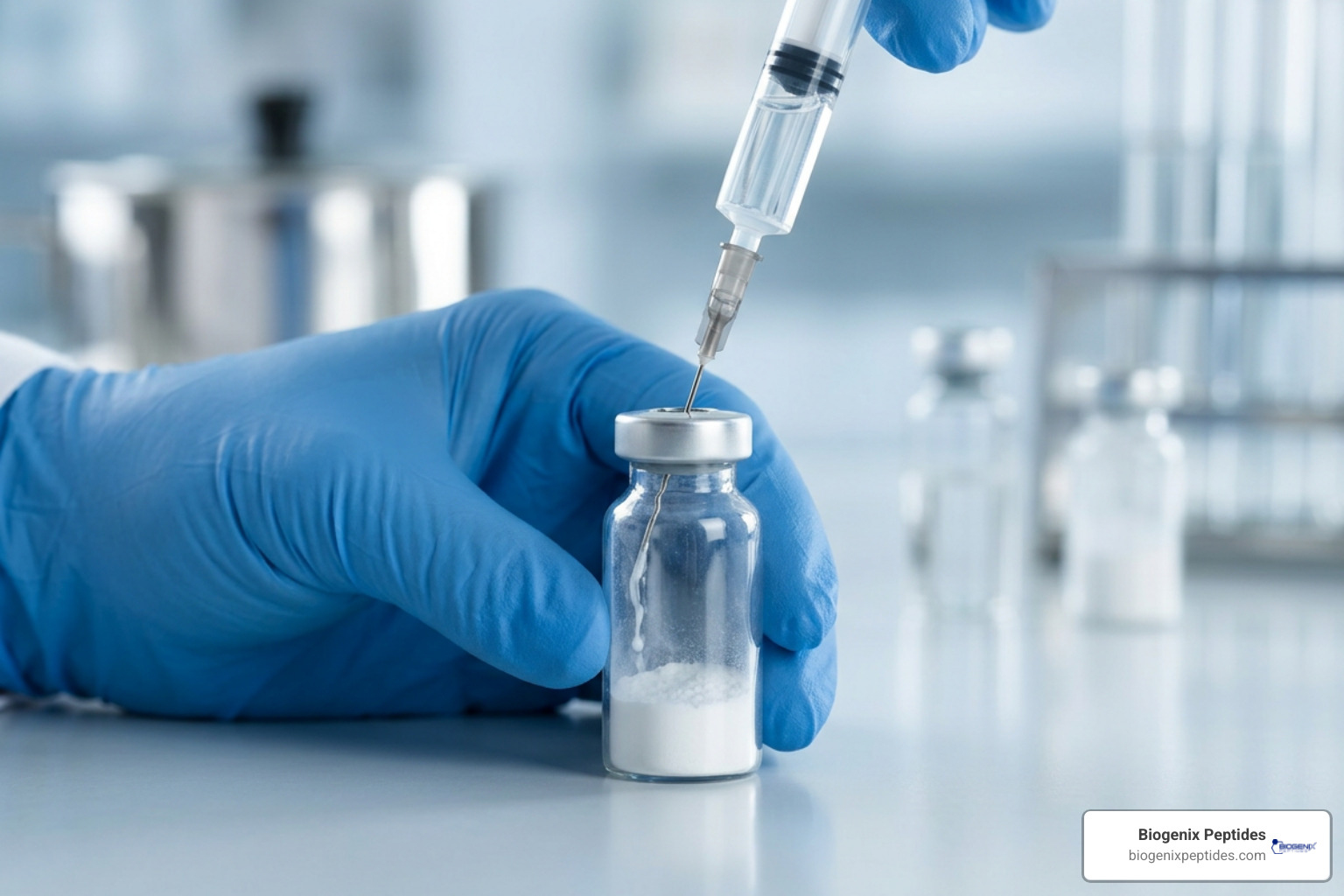
- Slow Wall-Flow Liquid Transfer: Insert the syringe needle through the rubber stopper of the lyophilized powder vial at a slight angle. Aim the needle tip against the glass inner wall of the vial. Slowly depress the plunger, allowing the liquid to trickle down the side of the glass. Never dispense diluent directly onto the delicate lyophilized cake, as direct liquid impact causes shear stress and foaming that can denature sensitive proteins.
- Equalize Vial Pressure: Before withdrawing the syringe needle from the reconstituted vial, pull back on the plunger to remove a volume of air equal to the volume of liquid introduced. This prevents positive pressure buildup that could force solution back out through the stopper perforation.
To protect delicate biological structures during liquid addition, consult A Practical Guide to Stopping Peptide Denaturation in Its Tracks.
Gentle Dissolution and Quality Inspection
Once the diluent is added, the dissolution phase begins. Gentle handling is vital to preserving structural integrity:
- Roll or Swirl Gently: Hold the vial between your palms and roll it slowly back and forth, or swirl it in smooth circular motions on the benchtop for 1 to 5 minutes.
- Never Shake: Vigorous shaking generates mechanical shear forces and persistent foam at the air-liquid interface, breaking structural bonds and causing irreversible aggregation.
- Visual Inspection: Hold the vial up to a bright light source against a dark background. Inspect the liquid for visual clarity, freedom from cloudiness, and the complete absence of undissolved flakes or floating particulates. Standard United States Pharmacopeia (USP) guidelines specify that a successfully reconstituted solution must be completely homogenous and clear.
Most standard lyophilized powders dissolve within 30 seconds to 2 minutes, though complex hydrophobic formulations may require up to 15 to 30 minutes of gentle room-temperature incubation.
Calculations, Cold Storage, and Common Mistakes
Accurate mathematical calculations are fundamental to maintaining experimental integrity. Calculating concentration relies on a basic mass-to-volume ratio:
$$\text{Concentration (mg/mL)} = \frac{\text{Mass of Powder (mg)}}{\text{Volume of Solvent Added (mL)}}$$
For example, if you add 2.0 mL of bacteriostatic water to a vial containing 5.0 mg of lyophilized powder, your final solution concentration is:
$$\frac{5.0 \text{ mg}}{2.0 \text{ mL}} = 2.5 \text{ mg/mL}$$
If your protocol requires working in micrograms ($\mu\text{g}$), convert milligrams to micrograms by multiplying by 1,000 ($2.5 \text{ mg/mL} = 2,500 \mu\text{g/mL}$). To dive deeper into volume-to-mass conversions and ratio accuracy, refer to The Science of the Bacteriostatic Water Peptide Ratio.
Avoiding Common Mistakes: The Best Way Reconstitute Lyophilized Powder Accurately
Even experienced researchers can make procedural errors when rushing. The most frequent mistakes include:
- Rushing Temperature Equilibration: Skipping the 15–20 minute room temperature warming step invites condensation, introducing moisture that accelerates chemical degradation through hydrolysis.
- Direct Liquid Jetting: Transferring solvent straight into the middle of the lyophilisate cake causes foaming and protein denaturation. Always angle the needle against the inner glass wall.
- Vigorous Shaking: Shaking a vial creates shear stress and air bubbles that destroy sensitive peptide chains.
- Mathematical Calculation Errors: Miscalculating milligram-to-microgram conversions leads to inaccurate working solutions. Implementing a two-person verification step or writing out math formulas in a physical laboratory log before drawing solvents prevents costly errors.
- Freezing Reconstituted Solutions: Freezing a liquid solution creates ice crystals that damage peptide structures during freeze-thaw cycles.
For a comprehensive breakdown of handling errors to avoid in the lab, read The 10 Most Common Mistakes People Make When They’re New to Peptide Research.
Storage Guidelines for Reconstituted Solutions
Once reconstituted, liquid solutions are far more vulnerable to thermal and chemical degradation than freeze-dried powders. The rate of chemical degradation doubles for every 10°C increase in storage temperature.
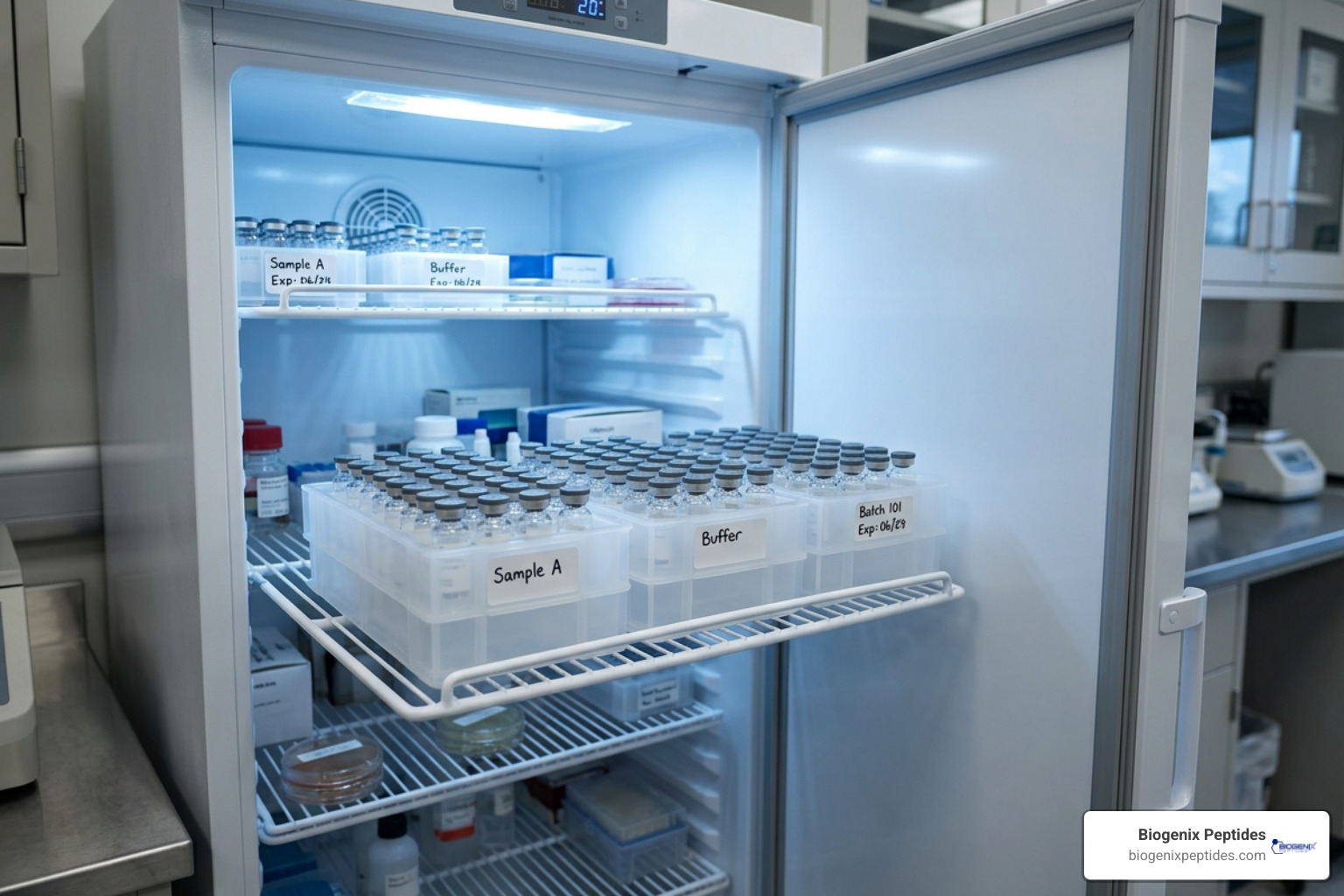
- Continuous Refrigeration: Store reconstituted vials in a dedicated laboratory refrigerator at 2°C to 8°C immediately after preparation. Avoid storing vials in refrigerator door shelves, where frequent opening causes temperature fluctuations.
- Avoid Freezing Liquid: Keep solutions in liquid form under continuous refrigeration. Do not freeze reconstituted solutions, as ice crystallization causes structural aggregation. Unused compound should remain in dry lyophilized form at -20°C until needed.
- Light Protection: Many bio-active compounds are photosensitive. Wrap vials in aluminum foil or place them in opaque storage boxes to protect them from photolytic degradation.
- Refrigerated Shelf Life: When reconstituted with bacteriostatic water and held consistently at 2°C to 8°C, solutions remain stable for research applications for 28 to 90 days, depending on sequence stability.
For best practices on maintaining thermal consistency, check out Cold Storage Secrets for Keeping Reconstituted Peptides Fresh.
Frequently Asked Questions About Lyophilized Powder Reconstitution
Why should you never shake a reconstituted peptide vial?
Shaking generates high mechanical shear forces and creates foam at the air-liquid interface. This mechanical stress alters folded molecular structures, causing protein denaturation and structural aggregation that renders the compound unusable for valid research.
How long can reconstituted solutions remain stable under refrigeration?
When reconstituted with bacteriostatic water containing 0.9% benzyl alcohol, solutions generally remain stable for 28 to 90 days under continuous refrigeration at 2°C to 8°C. Solutions prepared with preservative-free sterile water must be used within 24 hours.
What should be done if flakes or particulates persist after gentle swirling?
If particulates remain after initial rolling, let the vial sit at room temperature for 15 to 30 minutes. If flakes persist, gently mix the solution for a few hours at room temperature, then incubate the vial overnight in a refrigerator at 4°C. The extended cold incubation period resolves undissolved lyophilisate without compromising compound integrity.
Conclusion

Mastering the best way reconstitute lyophilized powder requires careful preparation, solvent selection, and gentle mechanical handling. By allowing vials to reach room temperature before opening, directing diluent slowly along the inner glass wall, avoiding shaking, balancing internal pressure, and maintaining continuous refrigeration at 2°C to 8°C, researchers ensure maximum compound stability and experimental reproducibility.
At BioGenix Peptides, we emphasize rigorous scientific methodology and proper laboratory handling to support high-level scientific research. For more detailed protocols on maintaining material purity in your lab, explore our guide on A Foolproof Way to Reconstitute Your Lyophilized Peptides.
Disclaimer: All content presented in this guide is for laboratory research purposes only, opinion only, and not intended for human or veterinary use. It does not constitute medical advice.