TB-500 5mg Reconstitution: Mixing Your Peptides Safely
What You Need to Know About TB-500 5mg Reconstitution
Disclaimer: The information provided in this article is for educational and informational purposes only. It is not intended as medical advice, diagnosis, or treatment. Products and compounds referenced are for research use only and are not approved for human or veterinary consumption. Always consult a qualified professional regarding health or medical decisions.
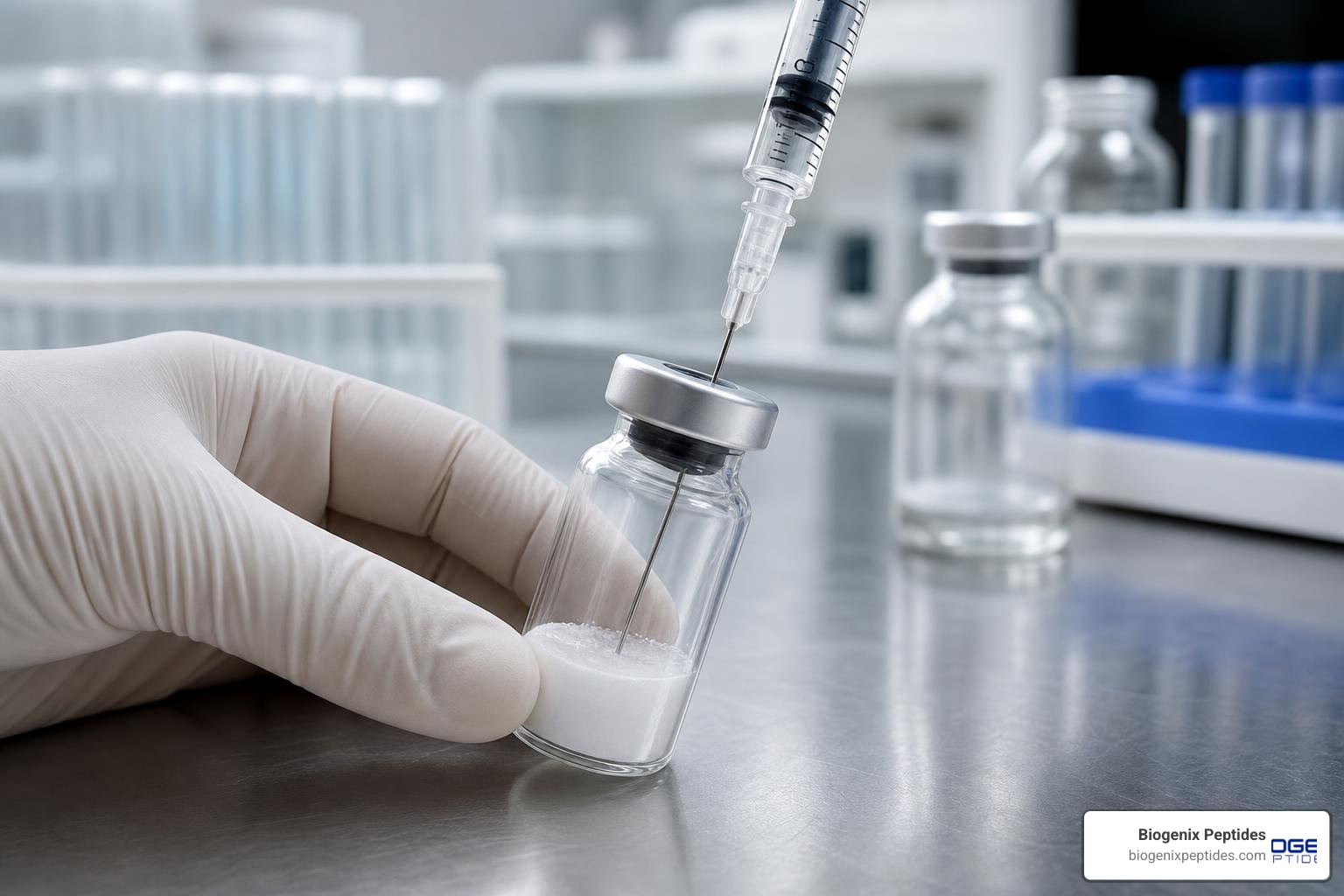
TB-500 5mg reconstitution is the process of dissolving a freeze-dried peptide vial in a sterile liquid diluent so it can be used in laboratory research. Here is a quick overview:
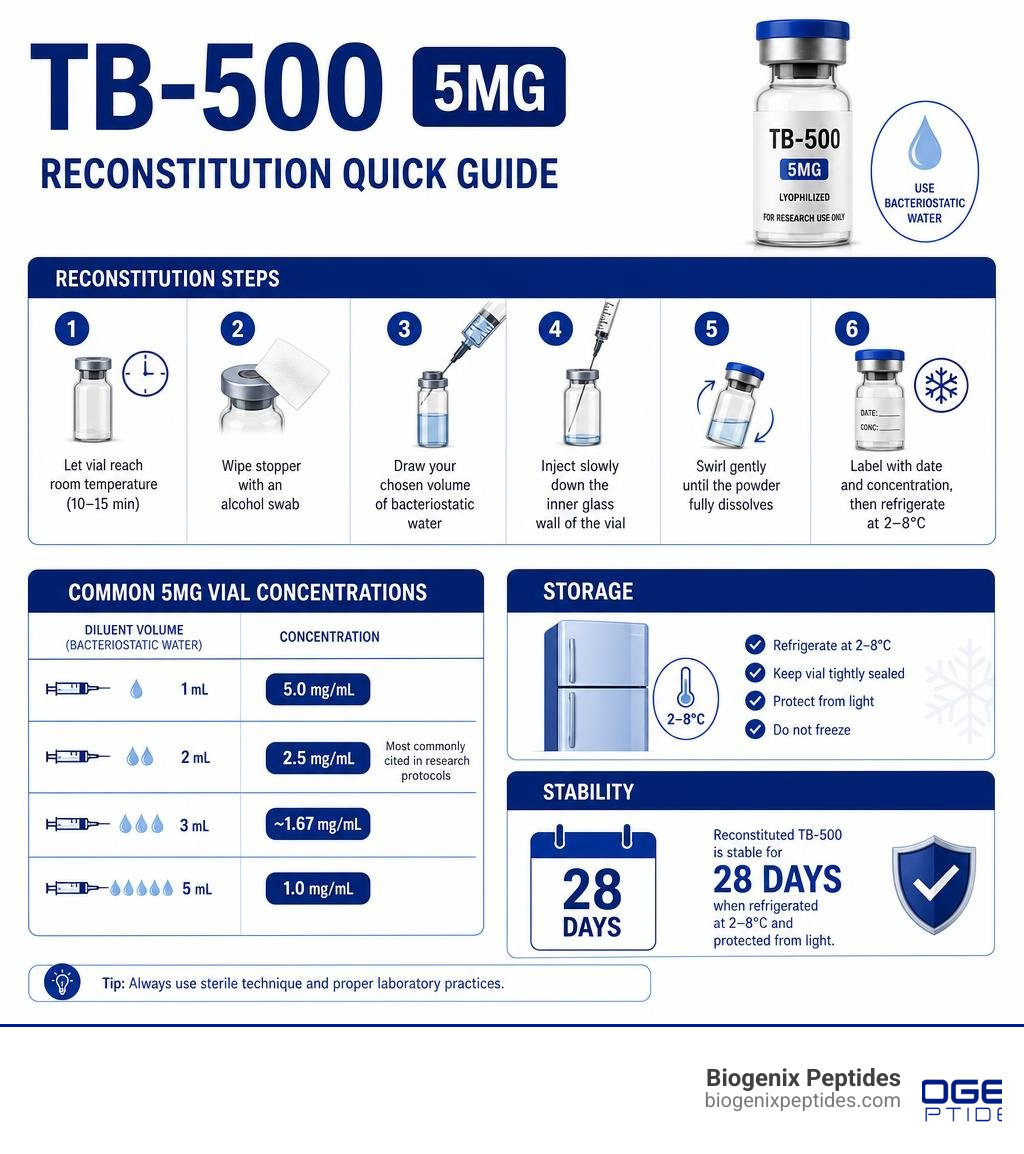
Quick Reference: TB-500 5mg Reconstitution
| Step | What to Do |
|---|---|
| 1 | Let the vial reach room temperature (10-15 min) |
| 2 | Wipe the vial stopper with an alcohol swab |
| 3 | Draw your chosen volume of bacteriostatic water |
| 4 | Dispense slowly down the inner glass wall of the vial |
| 5 | Swirl gently until the powder fully dissolves |
| 6 | Label with date and concentration, then refrigerate at 2-8°C |
Common 5mg vial concentrations:
- 1mL bacteriostatic water = 5.0 mg/mL
- 2mL bacteriostatic water = 2.5 mg/mL (most commonly cited in research protocols)
- 3mL bacteriostatic water = ~1.67 mg/mL
- 5mL bacteriostatic water = 1.0 mg/mL
Reconstituted TB-500 is stable for approximately 28 days when refrigerated at 2-8°C and protected from light.
TB-500 is a synthetic fragment of Thymosin Beta-4, a naturally occurring protein involved in cell migration, tissue repair, and angiogenesis research. Like most research peptides, it is supplied as a lyophilized (freeze-dried) powder. That powder form maximizes shelf life and stability during storage — but it cannot be used in research until it is properly dissolved in a compatible sterile diluent.
Getting the reconstitution process right matters. As one laboratory protocol guide puts it plainly: proper reconstitution is “one of the most critical — and most commonly mishandled — steps in peptide research.” An incorrectly prepared solution can lead to inconsistent experimental results, degraded compound, or inaccurate concentration calculations.
This guide walks through exactly how to do it correctly — from diluent selection to concentration math to storage.
I’m Jay Daniel, Founder and CEO of BioGenix Peptides, and I’ve spent years working hands-on with peptide reconstitution protocols, quality control, and laboratory best practices — including the precise preparation of TB-500 5mg reconstitution solutions for research applications. In the sections below, I’ll break down every step so you can prepare your peptide with confidence.
Easy tb 500 5mg reconstitution glossary:
Science of TB-500 5mg Reconstitution
To understand why we must handle this compound with care, we have to look at the chemistry of the peptide itself. TB-500 is a synthetic version of the active region of Thymosin Beta-4 (Tβ4). Specifically, it represents the N-terminal active fragment, which is a heptapeptide sequence: Ac-LKKTETQ.
With a molecular weight of approximately 4963.5 g/mol, this peptide lacks complex disulfide bonds. This structural simplicity makes it highly water-soluble compared to hydrophobic, larger proteins. However, because it is a delicate sequence of amino acids, it remains vulnerable to physical shear forces, heat, and chemical degradation.
In laboratory environments as of July 2026, research standards require maintaining a stable pH range between 5.0 and 8.0 for this peptide. It is highly compatible with standard phosphate-buffered saline (PBS) and cell culture media formulations, which is why it is widely utilized in cell-free systems and in vitro research.
Why TB-500 5mg Reconstitution is Necessary
When manufacturers synthesize peptides, they subject the liquid solution to a freeze-drying process called lyophilization. Lyophilization removes water by sublimation under a vacuum, leaving behind a delicate, porous “cake” or powder.
This dry state is essential because:
- Chemical Stability: Water acts as a solvent that facilitates hydrolytic degradation. Without water, the peptide bonds remain secure, extending the dry shelf life to several years when stored at -20°C.
- Temperature Resilience: Lyophilized powder can withstand room temperature shipping for several weeks without significant degradation, whereas liquid peptides would degrade rapidly.
- Contamination Prevention: Microorganisms require moisture to thrive. Removing water ensures the vial remains sterile until the moment of research application.
To transition the compound back into a biologically active state for laboratory assays, we must perform Reconstituting 5mg Peptides using a sterile liquid solvent.
Selecting the Right Diluent for TB-500 5mg Reconstitution
Choosing the correct solvent depends entirely on the design of your research study. Not all sterile waters are created equal:
- Bacteriostatic Water (0.9% Benzyl Alcohol): This is the gold standard for multi-session laboratory studies. The 0.9% benzyl alcohol acts as a preservative, preventing any potential bacterial growth for up to 28 days of refrigerated storage. For most standard protocols, we recommend using a high-quality Bacteriostatic Water 3ml vial to prepare your stock solutions.
- Sterile Water (Preservative-Free): This contains no preservatives. While highly pure, once the vial is punctured, it must be used immediately or discarded within 24 hours to avoid microbial contamination.
- Normal Saline (0.9% Sodium Chloride): Excellent for physiological research models, but like sterile water, it lacks preservatives and does not support multi-week storage unless aliquoted and kept under strict conditions.
- Phosphate-Buffered Saline (PBS): Preferred for in vitro cell culture studies. It is vital to note that bacteriostatic water should never be used in cell culture assays because benzyl alcohol is cytotoxic to cells.
Step-by-Step Reconstitution Protocol and Materials
Before beginning the physical process, ensure you have gathered all necessary materials on a clean, sanitized workspace.
Required Materials
- One 5mg vial of lyophilized TB-500
- One vial of sterile bacteriostatic water
- Several sterile alcohol prep pads (70% isopropyl alcohol)
- Sterile syringes (typically 1mL or 3mL syringes with 29G to 31G needles)
- A sharps disposal container

The Reconstitution Protocol
Follow these steps carefully to ensure a sterile, successful preparation:
- Temperature Equilibration: Remove the lyophilized TB-500 vial from cold storage and let it sit on your workspace for 10 to 15 minutes. Allowing the vial to reach room temperature prevents condensation from forming inside when you open it. Condensation can lead to clumping and uneven dissolution.
- Sanitize the Workspace: Wipe down your entire work surface with 70% isopropyl alcohol and wash your hands thoroughly. Pop the plastic caps off both the peptide and diluent vials, then vigorously swab the rubber stoppers with an alcohol pad. Allow them to air-dry completely for 15 to 20 seconds.
- Draw the Diluent: Attach a sterile needle to your syringe. Draw air into the syringe equal to your target diluent volume (e.g., 2.0 mL). Insert the needle into the bacteriostatic water vial, push the air to equalize pressure, flip the vial upside down, and slowly draw exactly 2.0 mL of liquid.
- Equalize Vial Pressure: Insert the needle through the center of the TB-500 vial’s rubber stopper at a 45-degree angle. Many vials are sealed under a vacuum, which can violently pull the liquid out of your syringe. Hold the plunger firmly to control the speed of the transfer.
- Slow Diluent Transfer: Slowly depress the plunger over 10 to 15 seconds. Direct the stream of bacteriostatic water against the inner glass wall of the vial rather than spraying it directly onto the delicate lyophilized powder. This prevents foaming, which can mechanically shear the peptide chains.
- Dissolve Gently: Withdraw the needle. Gently swirl the vial in a slow, circular motion or roll it slowly between your palms for 15 to 30 seconds. Never shake or vortex the vial. Shaking introduces air bubbles and can denature the peptide, rendering it useless for your research.
- Visual Inspection: Hold the vial up to a bright light. The solution should be completely clear, colorless, and free of any visible particles or cloudiness.
Reconstitution Ratios and Concentration Calculations
To ensure accuracy in your experimental applications, you must understand the relationship between the volume of diluent added and the resulting concentration of the solution.
The core formula is straightforward:
$$\text{Concentration (mg/mL)} = \frac{\text{Total Peptide Mass (mg)}}{\text{Volume of Diluent (mL)}}$$
For a standard 5mg vial, here is how different volumes of bacteriostatic water alter the concentration:
| Diluent Volume (mL) | Resulting Concentration (mg/mL) | Resulting Concentration (mcg/mL) | Syringe Unit Equivalent (per 10 Units on U-100)* |
|---|---|---|---|
| 1.0 mL | 5.0 mg/mL | 5,000 mcg/mL | 500 mcg |
| 2.0 mL | 2.5 mg/mL | 2,500 mcg/mL | 250 mcg |
| 3.0 mL | 1.67 mg/mL | 1,670 mcg/mL | 167 mcg |
| 5.0 mL | 1.0 mg/mL | 1,000 mcg/mL | 100 mcg |
*Note: On a standard U-100 syringe, 100 units equal 1.0 mL. Therefore, 10 units equal 0.1 mL.
Using 2.0 mL of bacteriostatic water is widely considered the most practical ratio for a 5mg vial. It yields a clean concentration of 2.5 mg/mL, making it easy to measure out precise quantities for laboratory assays without requiring excessively large or microscopic syringe draws.
If your protocol requires comparing different compounds, you can read our guide on BPC-157 Reconstitution Ratios to see how these calculations compare to other common regenerative research peptides.
Storage, Stability, and Common Mistakes
Once reconstituted, TB-500 is far more fragile than it was in its lyophilized state. Proper storage is paramount to preserve its structural integrity.
Temperature Control and Stability
- Refrigeration: Reconstituted TB-500 must be stored in a laboratory refrigerator at 2°C to 8°C (36°F to 46°F). Keep it protected from direct light, which can accelerate peptide bond cleavage.
- Shelf Life: When prepared with bacteriostatic water and refrigerated properly, the solution remains stable for approximately 28 to 30 days. After this window, the preservative properties of benzyl alcohol decline, and the peptide itself slowly begins to degrade.
- Unopened Powder: Unopened, lyophilized vials can be kept at room temperature for up to 12 months, in a standard refrigerator for 2 years, or frozen at -20°C for up to 3 years.
For a deeper dive into preserving your research materials, check out our comprehensive Peptide Storage Guidelines.
Common Reconstitution Mistakes to Avoid
- Vigorous Shaking: This is the most common error. Shaking creates micro-bubbles and foams the solution, which can easily shear the delicate peptide structure.
- Using Sterile Water for Multi-Session Studies: If you reconstitute with plain sterile water (without benzyl alcohol) and store it in the fridge for weeks, you risk introducing bacterial contamination. Only use plain sterile water for single-use applications.
- Freezing Reconstituted Liquids: Freezing a liquid peptide solution causes ice crystals to form. These sharp crystals physically shear the peptide bonds, destroying its chemical structure. Only the dry, lyophilized powder should be frozen.
- Reusing Needles: Always use a brand-new, sterile needle for every single draw to avoid introducing contaminants into your stock vial.
Frequently Asked Questions
Can TB-500 be combined with BPC-157 in the same vial?
In laboratory research, these two compounds are often studied together due to their complementary biological pathways. TB-500 focuses on actin sequestration and systemic cell migration, while BPC-157 supports growth factor expression and localized angiogenesis.
However, we do not recommend manually mixing separate powders into a single vial during reconstitution because it is incredibly difficult to ensure an even molecular distribution. If your research design requires both, it is highly recommended to purchase pre-formulated, verified blends or to purchase a larger TB-500 10mg vial and run separate, parallel assays to maintain complete control over your experimental variables.
What should I do if the lyophilized powder does not fully dissolve?
Because TB-500 is highly water-soluble, it should dissolve completely within 1 to 2 minutes of gentle swirling, yielding a perfectly clear, colorless solution. If you still see floating particles or clumping after 10 minutes:
- Ensure you allowed the vial to reach room temperature before adding the liquid.
- Gently roll the vial between your palms for another 30 seconds and let it sit.
- If it still refuses to dissolve or appears cloudy, the peptide may have been compromised by extreme heat during transit, or the vial may contain impurities. In such cases, discard the vial and start fresh.
Can reconstituted peptides be frozen for long-term storage?
No, you should never freeze the primary stock vial once it has been reconstituted. The expansion of water during freezing creates ice crystals that damage the peptide bonds.
If you absolutely must store a reconstituted solution long-term, the standard laboratory protocol is to immediately aliquot the solution into single-use, low-binding microcentrifuge tubes and freeze them at -80°C. This allows you to thaw a single aliquot for an experiment without subjecting the remaining stock to repeated, destructive freeze-thaw cycles.
Conclusion
Reconstituting TB-500 5mg vials successfully is a matter of precision, patience, and strict adherence to sterile laboratory techniques. By allowing the vial to reach room temperature, choosing bacteriostatic water for multi-session preservation, transferring the liquid slowly to avoid foaming, and storing the final solution under strict refrigeration, you protect your compound from degradation and ensure the integrity of your research data.
At BioGenix Peptides, we are committed to supporting scientific discovery by providing high-purity, third-party tested research materials. For premium-grade peptides, sterile diluents, and reliable laboratory supplies, visit the Biogenix Peptides Shop to equip your laboratory for success.