
Epithalon (Epitalon): The Cellular Reset Peptide Capturing Research Attention
Research Disclaimer: This article is provided for educational and informational purposes only and discusses theoretical, preclinical, and investigational research. It does not constitute medical advice. All compounds referenced are intended strictly for research, laboratory, and analytical use only and are not for human or animal consumption.
Introduction
Epithalon—also referenced in the literature as Epitalon or Epithalamin—is among the most closely examined bioregulatory peptides in modern longevity research. Originally identified in association with pineal-gland biology, Epithalon has become a focal point for scientists investigating cellular regulation, biological timing, and mechanisms linked to healthy aging—strictly within preclinical and investigational research settings.
Featured Image Placeholder (suggest: modern lab / circadian biology / cellular aging concept) Educational visual: lab research, circadian biology, or cellular aging concepts (avoid clinical/medical claims).
What makes Epithalon notable is not hype or trend cycles—it’s its repeated appearance across decades of laboratory work exploring how ultra-short peptides may influence cellular behavior at a foundational level.
What Is Epithalon?
Epithalon is a synthetic tetrapeptide composed of the amino-acid sequence:
Ala–Glu–Asp–Gly (AEDG)
Unlike larger peptide hormones or receptor-specific agonists, Epithalon belongs to a class of short regulatory peptides studied for their potential to influence cellular function through gene-expression modulation rather than direct receptor activation.
In controlled research environments, Epithalon is commonly explored for its association with:
- Cellular stress adaptation
- Circadian and biological rhythm signaling
- Gene-expression pattern normalization
- Telomere-associated cellular processes
- Coordination of normal tissue maintenance pathways
How Epithalon Is Studied to Work (Research Perspective)
Preclinical investigations suggest Epithalon interacts with pineal signaling pathways, melatonin regulation, and circadian-gene networks. Rather than producing an immediate stimulatory effect, it is examined for how it may help guide cellular systems toward balanced signaling states.
1) Circadian Rhythm & Biological Timing
Epithalon is frequently studied in models evaluating internal clock regulation—systems tied to sleep–wake cycles, metabolic timing, and long-term cellular synchronization.
2) Cellular Aging & Telomere Dynamics
One of the most cited research themes involves Epithalon’s relationship with telomerase activity and telomere maintenance. Telomeres act as protective chromosomal end caps that naturally shorten with cell division. In laboratory models, Epithalon has been associated with shifts in telomere-related mechanisms.
Important: These findings are preclinical and investigational and are not confirmed in humans.
3) Oxidative Balance & Repair Signaling
Cell and animal studies also explore Epithalon’s potential role in broader cellular resilience pathways, including:
- Supporting antioxidant signaling pathways
- Stabilizing gene-expression profiles under stress
- Coordinating normal cellular regeneration processes
Key Research Areas Exploring Epithalon
Longevity & Aging Biology
Researchers examine its influence on aging-associated biomarkers and long-term cellular resilience.
Sleep & Circadian Science
Due to its connection with pineal peptides, Epithalon is studied in models focused on melatonin signaling and biological rhythm regulation.
Cellular Stress Response
Laboratory data highlights interest in how regulatory peptides may help cells adapt to oxidative and metabolic stressors.
Tissue Maintenance & Recovery
Some studies evaluate whether short peptides like Epithalon help orchestrate normal tissue repair signaling rather than forcing accelerated growth.
Why Researchers Continue to Focus on Epithalon
Epithalon’s sustained research interest comes down to three defining characteristics:
- Ultra-short peptide architecture: Its minimal AEDG sequence is studied for efficient cellular interaction without the complexity of large proteins.
- Bioregulatory nature: Rather than activating a single receptor, Epithalon is examined for how it may influence patterns of cellular behavior.
- Longevity-relevant pathways: The combination of circadian biology and telomere research places Epithalon in a unique position among peptides explored for healthy aging mechanisms.
Peer-Reviewed & Scientific References
The following peer-reviewed publications and academic sources are provided for educational purposes only. They summarize preclinical, mechanistic, and observational research related to Epithalon (Epitalon / Epithalamin) and associated bioregulatory peptide pathways. These studies do not constitute clinical recommendations and should not be interpreted as evidence for human therapeutic use.
- Khavinson VKh, Linkova NS, Dyatlova AS, et al. Peptides restore telomerase activity in human somatic cells. Bull Exp Biol Med. 2003;135(3):275–277. https://pubmed.ncbi.nlm.nih.gov/12868201/
- Khavinson VKh, Morozov VG. Peptides of the pineal gland and regulation of aging. Neuroendocrinol Lett. 2003;24(5):371–375. https://pubmed.ncbi.nlm.nih.gov/14665703/
- Anisimov VN, Khavinson VKh. Peptide bioregulators in aging and longevity. Gerontology. 2010;56(6):541–547. https://pubmed.ncbi.nlm.nih.gov/20551615/
- Khavinson VKh, Tendler SM, Kasyanenko NA, et al. Short peptides regulate gene expression. Bull Exp Biol Med. 2012;153(4):516–520. https://pubmed.ncbi.nlm.nih.gov/23113336/
- Linkova NS, Trofimova SV, Khavinson VKh. Epigenetic mechanisms of peptide regulation of aging. Adv Gerontol. 2016;29(1):45–51. https://pubmed.ncbi.nlm.nih.gov/27239872/
- Khavinson VKh, Lin’kova NS, Trofimova SV, et al. Peptides: prospects for use in aging and age-related diseases. Biogerontology. 2012;13(3):339–350. https://pubmed.ncbi.nlm.nih.gov/22427123/
- Tendler SM, Khavinson VKh. Short peptides as regulators of gene expression and cellular differentiation. Mol Biol (Mosk). 2011;45(3):389–400. https://pubmed.ncbi.nlm.nih.gov/21696030/
Note: The majority of Epithalon research originates from molecular biology, cellular aging, and gerontology models. Findings remain investigational and are not validated for clinical application.
Final Thoughts
Epithalon sits at the crossroads of cellular regulation, biological timing, and longevity science. As interest grows in peptides that support systems-level balance rather than single-target stimulation, Epithalon continues to stand out as a reference compound in bioregulatory research.
BioGenix remains committed to supplying high-purity, research-grade Epithalon with transparent testing, rigorous documentation, and strict compliance standards—so researchers can focus on discovery with confidence.
© BioGenix Peptides™ — Educational content for research audiences. Not medical advice.

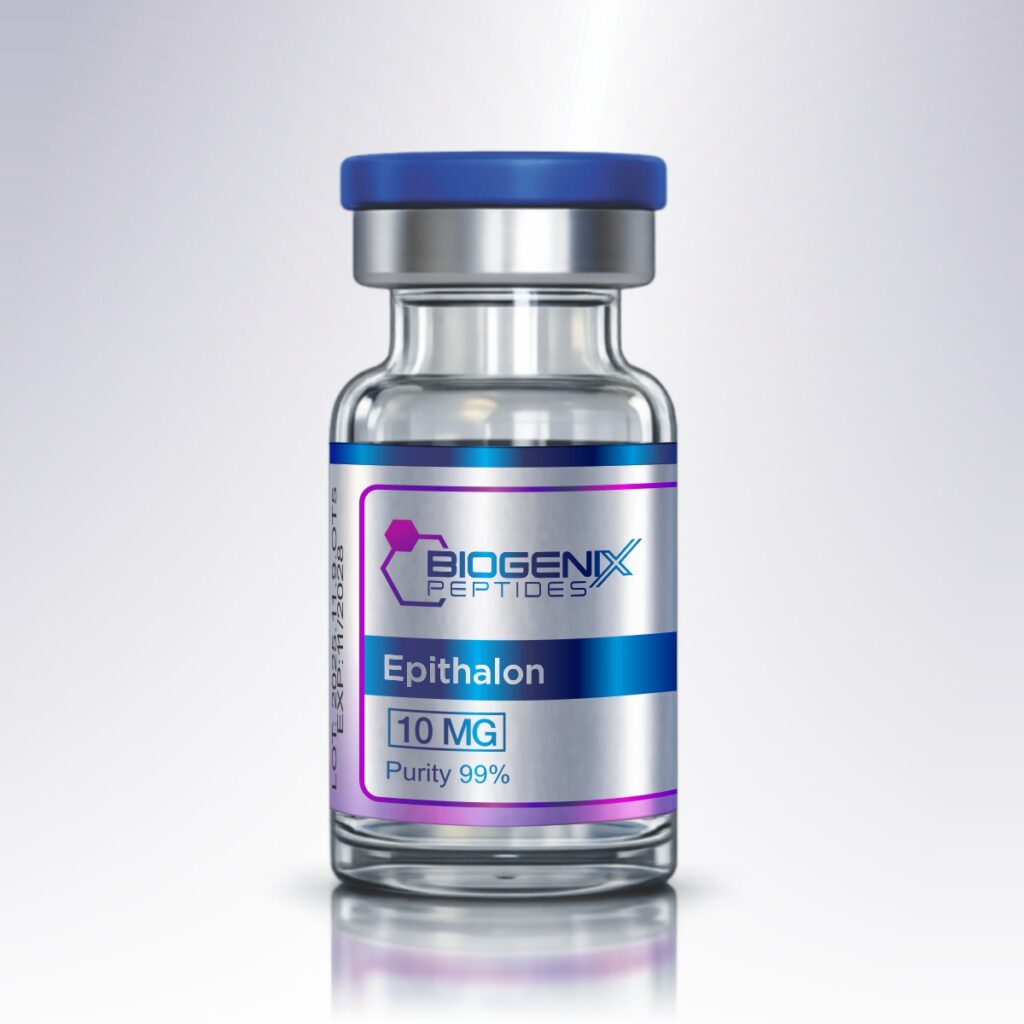
Epithalon 10mg
Epithalon, also known as AEDG peptide, Epitalon, or Epithalone, is a synthetic tetrapeptide composed of alanine, glutamic acid, aspartic acid, and glycine. It is modeled after Epithalamin, a naturally occurring pineal gland extract that has been studied for its effects on melatonin production, antioxidant activity, and cellular longevity.Research on Epithalon has suggested potential roles in pineal gland regulation, telomerase activation, oxidative stress reduction, and preservation of retinal and immune system function. Because of its connection to melatonin synthesis and circadian rhythm regulation, Epithalon has been investigated as a candidate for anti-aging, sleep, and neuroprotective studies.
In Stock
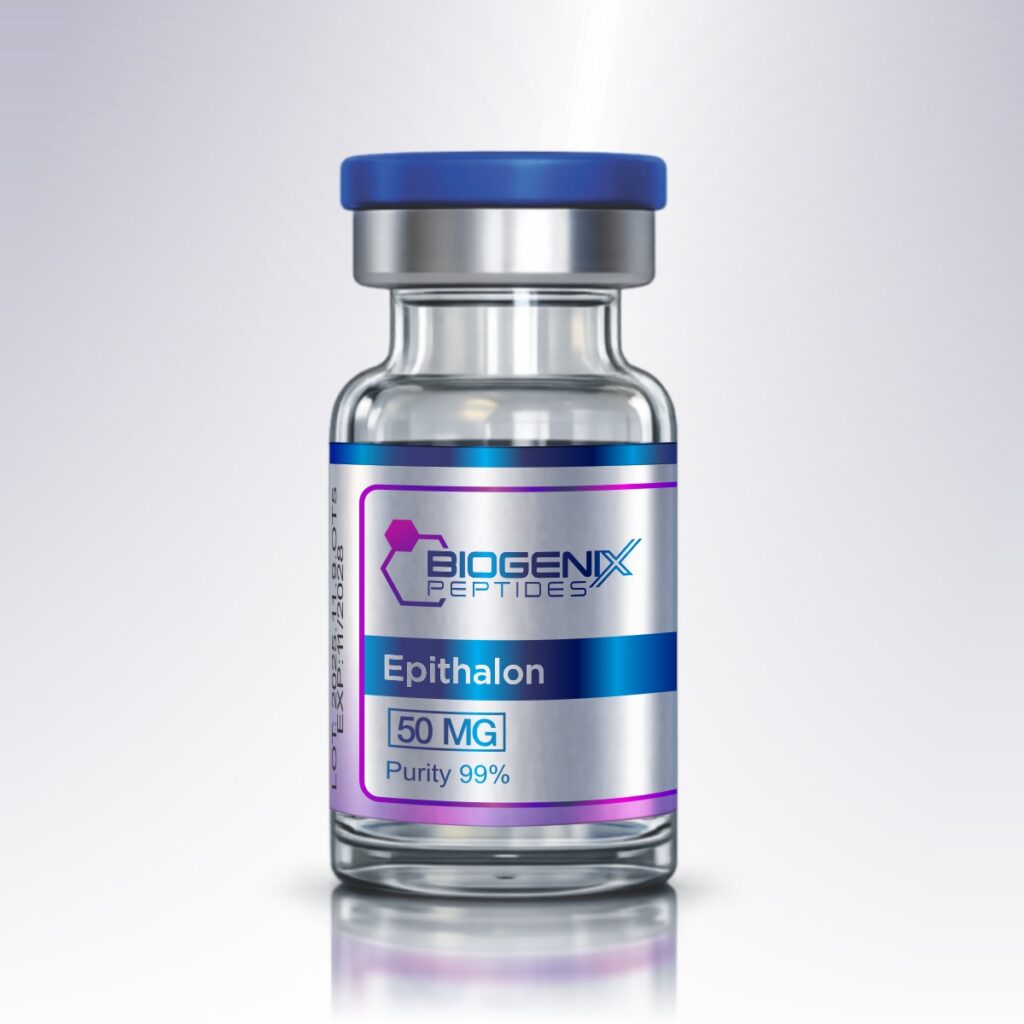
Epithalon 50mg
Epithalon, also known as AEDG peptide, Epitalon, or Epithalone, is a synthetic tetrapeptide composed of alanine, glutamic acid, aspartic acid, and glycine. It is modeled after Epithalamin, a naturally occurring pineal gland extract that has been studied for its effects on melatonin production, antioxidant activity, and cellular longevity.Research on Epithalon has suggested potential roles in pineal gland regulation, telomerase activation, oxidative stress reduction, and preservation of retinal and immune system function. Because of its connection to melatonin synthesis and circadian rhythm regulation, Epithalon has been investigated as a candidate for anti-aging, sleep, and neuroprotective studies.
In Stock