A Quick Start Guide to Peptide Blend Benefits
Disclaimer: The information provided in this article is for educational and informational purposes only. It is not intended as medical advice, diagnosis, or treatment. Products and compounds referenced are for research use only and are not approved for human or veterinary consumption. Always consult a qualified professional regarding health or medical decisions.
What Research Suggests About Peptide Blends Benefits
Any opinions in this article are research-oriented interpretations only and should not be understood as guidance for human use.
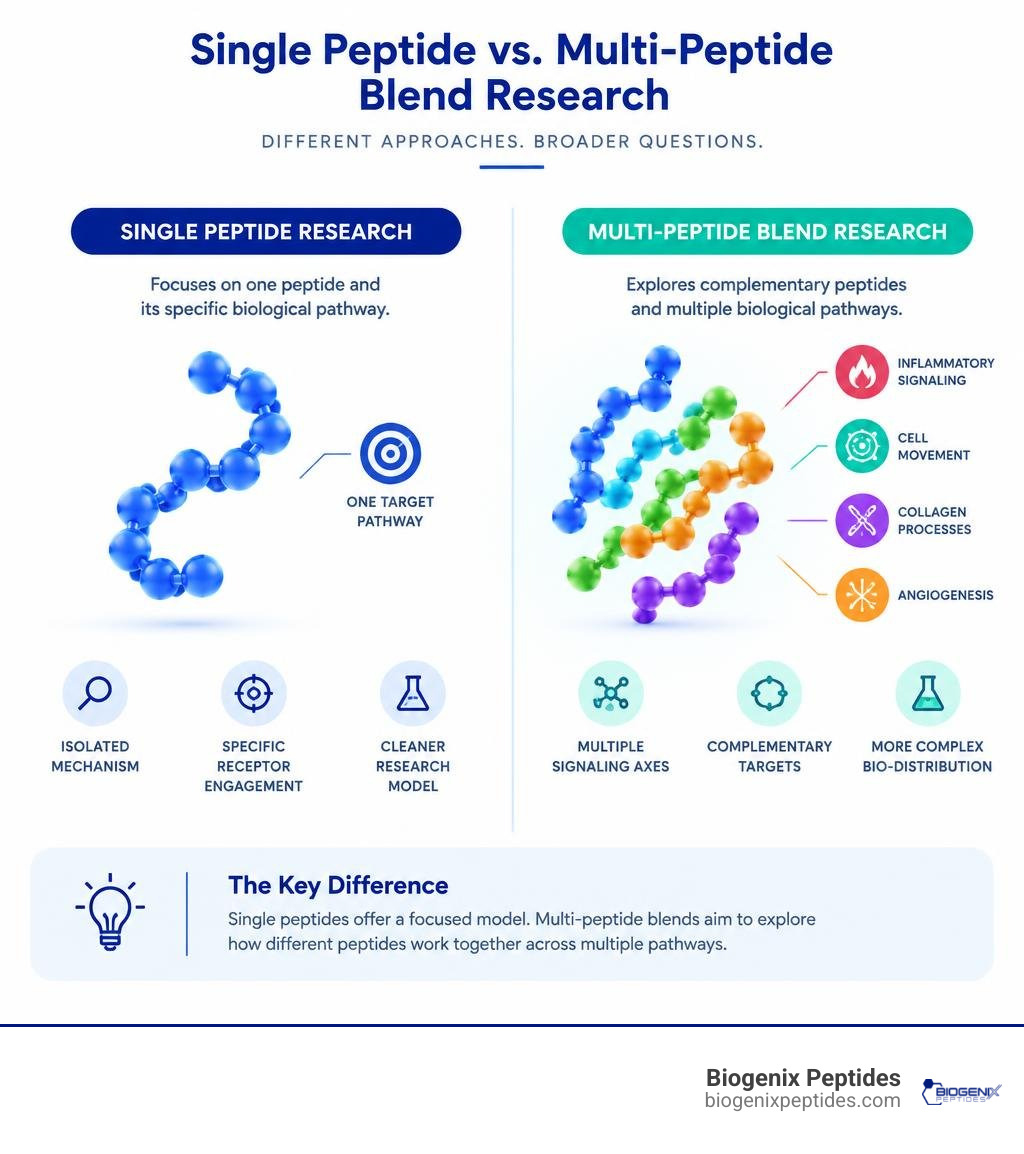
Peptide blends combine two or more peptides in one research formulation. Their proposed advantage is that each component may act on a different research pathway, such as inflammatory signaling, cell movement, collagen-related processes, or blood-vessel formation. However, most peptide blends benefits are theoretical or drawn from studies of individual ingredients, not well-controlled human studies of the finished blend.
For example, blends containing GHK-Cu, BPC-157, TB-500, and KPV are often researched for multi-step tissue-repair processes. Animal and cell research suggests possible effects on tendon strength, angiogenesis, and inflammatory pathways, but it does not establish that a blend is safe, effective, or superior to a single peptide in people.
I’m Jay Daniel, founder and CEO of BioGenix Peptides, with experience in peptide sourcing, purity validation, quality control, and research education. In this guide, I’ll help separate the proposed peptide blends benefits from the evidence gaps, formulation differences, and key research considerations.
Understanding Peptide Blends: How Multi-Peptide Formulas Differ from Single Compounds
In cellular and biochemical research, single peptides are short chains of amino acids designed to interact with specific cellular receptors or biological pathways. While isolated compounds offer a clean model for testing single-target mechanisms, biological processes like tissue remodeling, inflammatory cascades, and metabolic regulation rarely rely on a single signaling event. This reality has driven interest in multi-peptide formulations, where complementary sequences are investigated together to examine broader molecular networks.
The complete guide to peptide blends explains how researchers observe that multi-compound formulas differ fundamentally in bio-distribution, target receptor engagement, and combined cellular signaling. Rather than testing a single molecule in isolation, blended research chemicals aim to explore parallel biochemical axes simultaneously. For example, recent scientific analysis on peptide roles in metabolic nutrition highlights how amino acid sequences coordinate signaling across metabolic, gastrointestinal, and endocrine pathways in cellular models.
Synergistic Mechanisms and Practical Peptide Blends Benefits
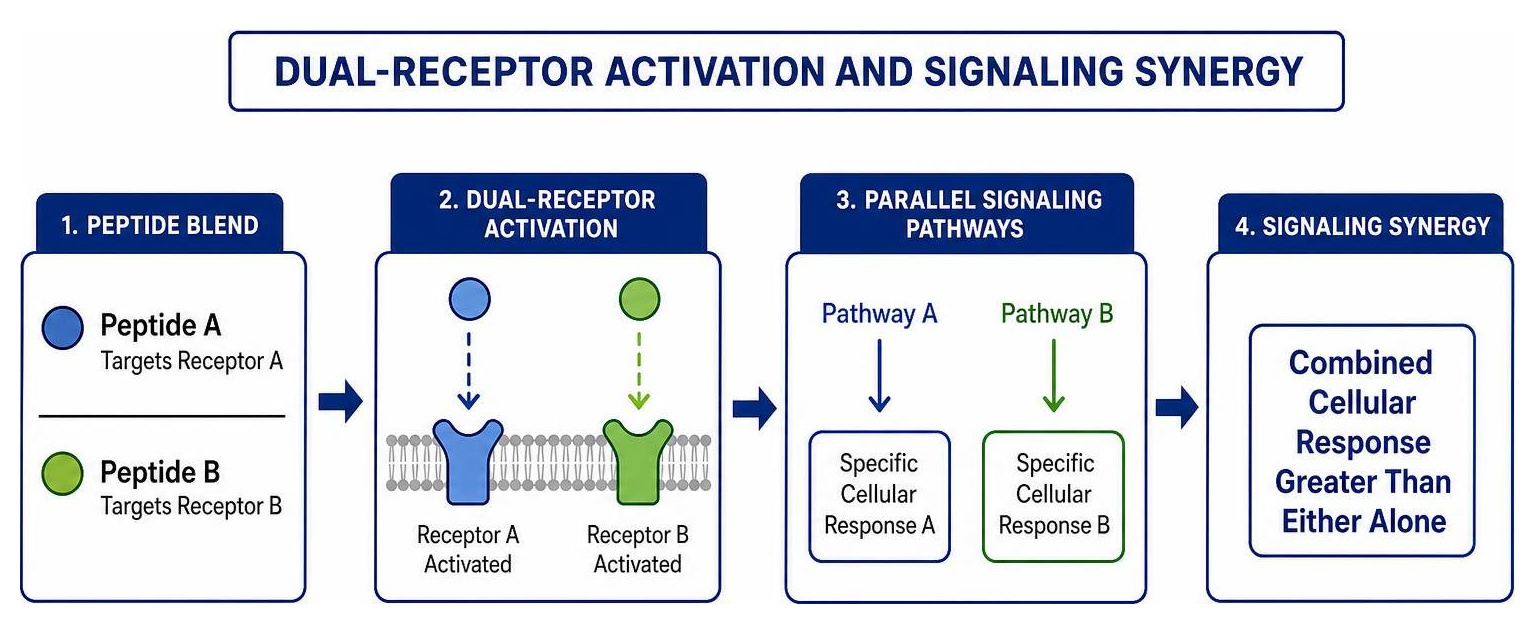
The core theoretical appeal of multi-compound formulations lies in biochemical synergy—the concept that two compounds acting on distinct receptor sites produce a combined biological response greater than either alone. A classic laboratory example is the pairing of a growth hormone releasing hormone (GHRH) analog with a growth hormone secretagogue (GHS).
Investigating a combination like CJC-1295 No DAC Ipamorelin allows researchers to observe complementary pharmacokinetic profiles: one compound widens the baseline hormone release window while the other triggers a selective pulse via the ghrelin receptor. As detailed in our review of the CJC No DAC stack, studying dual-pathway activation provides a more dynamic model of endocrine signaling than examining an isolated secretagogue.
Convenience and Measurement Accuracy in Multi-Compound Research Regimens
Beyond theoretical pathway synergy, multi-compound research formulas offer practical advantages in laboratory workflow. Handling individual lyophilized vials requires separate reconstitution procedures, multiple solution transfers, and complex calculations to maintain specific ratios across experimental trials.
Pre-formulated combinations feature predetermined molecular ratios established in published research protocols. This standardization minimizes pipetting variability, reduces vial-handling stress, and prevents common calculation errors during laboratory preparation. However, blending is not an automatic solution for every investigation; as outlined in our analysis of why stacking peptides can work against you, combining too many active sequences without clear rationale can lead to unintended receptor saturation, competitive binding, or unpredictable cross-reactivity in vitro.
Top Research Categories and Proposed Peptide Blends Benefits for Recovery and Repair

Multi-peptide formulations are categorized by their primary biological focus in experimental models. While these categories reflect mechanistic targets identified in cell cultures and animal models, they represent active frontiers in regenerative biology, metabolic signaling, and structural tissue repair.
Tissue Healing, Angiogenesis, and Cellular Migration
Connective tissue recovery requires coordinated biological events: inflammatory clearance, cellular migration, extracellular matrix deposition, and neovascularization. In animal models, combining the pentadecapeptide BPC-157 with the actin-regulating fragment TB-500 has demonstrated synergistic effects on structural recovery.
In rodent studies evaluating transected or surgically injured Achilles tendons, repaired tissue treated with BPC-157 withstood significantly more biomechanical force before failing compared to controls. This structural resilience is accompanied by pronounced angiogenesis—the formation of new microvascular networks—in damaged muscle and tendon tissue. When paired with TB-500 (a synthetic fraction of thymosin beta-4 that accelerates actin filament assembly and fibroblast migration), researchers can study the complete continuum of structural repair in formulations like the BPC-157 TB-500 10mg Blend and the higher-concentration BPC-157 TB-500 20mg Blend.
Anti-Inflammatory Cascades and Skin Regeneration Peptide Blends Benefits
Chronic inflammation impairs tissue repair by sustaining elevated levels of pro-inflammatory cytokines and degrading the cellular matrix. Research investigating multi-pathway recovery frequently examines peptides that modulate inflammatory signaling cascades alongside matrix synthesis, as explored in research on the right peptide blends.
A key component in these models is KPV, a tripeptide derived from alpha-melanocyte-stimulating hormone (α-MSH). In cell culture experiments with intestinal and immune cell lines, KPV has been shown to downregulate both nuclear factor kappa B (NF-κB) and mitogen-activated protein kinase (MAPK) pathways. By suppressing these fundamental inflammatory highways, the peptide reduces the downstream release of inflammatory cytokines like TNF-α and IL-6. When paired with copper-binding tripeptides like GHK-Cu—known in laboratory models to stimulate procollagen synthesis, glycosaminoglycan production, and fibroblast proliferation—the combination allows researchers to assess both inflammatory mitigation and dermal matrix remodeling within a single model.
Metabolic Optimization and Growth Hormone Secretagogues
Metabolic research has increasingly turned to multi-receptor secretagogue and incretin combinations. Formulations like the Tesamorelin Ipamorelin 10mg Blend are investigated in endocrine models to study targeted lipolysis, visceral fat reduction, and the modulation of somatopause-related cellular aging.
Similarly, dual-incretin models such as the Cagrilintide Semaglutide 10mg Blend pair long-acting GLP-1 receptor agonists with amylin analogs. In laboratory metabolic experiments, this dual approach allows researchers to study synergistic appetite regulation pathways, gastric emptying dynamics, and glucose homeostasis across distinct neuroendocrine receptor populations.
Comparing Popular Formulations: KLOW vs. GLOW and Other Combinations

Among recovery and aesthetic research models, two multi-peptide combinations have gained significant prominence: the classic GLOW formulation and the expanded 4-in-1 KLOW complex. While both share foundational regenerative peptides, their molecular profiles address distinct experimental questions.
| Feature / Metric | GLOW Formulation | KLOW Formulation |
|---|---|---|
| Active Peptides | GHK-Cu, BPC-157, TB-500 | GHK-Cu, BPC-157, TB-500, KPV |
| Primary Research Focus | Dermal remodeling, collagen synthesis, microvascular repair | Systemic recovery, dense tissue repair, cytokine pathway suppression |
| Inflammatory Modulation | Localized tissue remodeling signaling | Dual NF-κB and MAPK pathway down-regulation via KPV |
| Angiogenesis Support | High (BPC-157 + TB-500 pathway activation) | High (BPC-157 + TB-500 pathway activation) |
| Clinical Trial Status | Laboratory and animal models; limited human data | Laboratory and animal models; limited human data |
The 4-in-1 Healing Stack: GHK-Cu, BPC-157, TB-500, and KPV
The Klow Blend 80mg represents an extensive multi-step repair model. By uniting four distinct amino acid sequences, it offers researchers a framework to explore four continuous biological phases:
- Collagen and Matrix Assembly (GHK-Cu): Provides copper-assisted signaling for extracellular matrix remodeling and fibroblast activation.
- Neovascularization (BPC-157): Promotes endothelial cell organization and vascular endothelial growth factor (VEGF) signaling for localized blood vessel formation.
- Cellular Migration (TB-500): Upregulates actin dynamics to facilitate rapid cellular migration toward damaged tissue boundaries.
- Cytokine Down-Regulation (KPV): Blunts excessive inflammatory signaling via NF-κB and MAPK pathway inhibition.
While these individual mechanisms are well-documented in cellular assays and animal studies, there is currently no established human clinical evidence demonstrating that KLOW outperforms GLOW or single peptides in living subjects.
Aesthetic and Tissue Repair Focus: The Classic GLOW Formulation
The traditional Glow Blend omits the KPV tripeptide, concentrating exclusively on the triad of GHK-Cu, BPC-157, and TB-500. This formulation is primarily utilized in aesthetic and dermal research to examine skin elasticity, fibroblast proliferation, and microvascular repair without introducing the potent immunomodulatory dynamics of KPV.
Scientific Evidence, Safety Profiles, and Regulatory Considerations
While laboratory findings on peptide synergy are scientifically intriguing, evaluating these compounds requires an objective look at current evidentiary limits and safety considerations. According to institutional reviews on guidelines on peptide benefits and safety concerns, the vast majority of non-pharmaceutical peptide research remains limited to cell cultures, rodent models, and anecdotal reports, with human clinical trial evidence remaining sparse.
Researchers must also account for regulatory frameworks, quality disparities, and legal classifications, as detailed in our guide to U.S. peptide blend regulations.
FDA Category 2 Status and “Research Use Only” Classifications
In the United States, the regulatory landscape for experimental peptides is stringent. The U.S. Food and Drug Administration (FDA) has placed many non-approved synthetic peptides on the Category 2 Bulk Drug Substances list. This classification indicates that the compounds present significant safety concerns, lack validated clinical efficacy, and cannot be legally compounded by retail pharmacies for human administration. Additional background on these safety boundaries is discussed in broad peptides overview and natural alternatives resources.
Key safety concerns identified in pharmacology literature include:
- Off-Target Cellular Effects: Because synthetic signaling peptides can interact with tissues beyond their intended target sites, they carry theoretical risks such as the unintended activation of dormant cancer cells via pro-angiogenic or growth-factor signaling pathways.
- Documented Side Effects in Literature: Observed reactions across animal and preliminary human data include localized site irritation, headaches, systemic fatigue, and gastrointestinal distress or nausea.
- Purity and Contamination Risks: Reagents obtained from unverified gray-market suppliers often suffer from inconsistent lyophilization, chemical impurities, incorrect peptide sequences, and heavy metal contamination.
Consequently, these compounds are legally distributed strictly as “Research Chemicals Only” and are not approved for human or veterinary administration.
Anti-Doping Regulations and Athletic Bans
Because growth hormone secretagogues, incretins, and healing peptides influence hormonal signaling and physiological recovery mechanisms, they are strictly prohibited in competitive athletics. The World Anti-Doping Agency (WADA) places almost all synthetic peptides on its Prohibited List under categories S0 (Non-approved substances) and S2 (Peptide hormones, growth factors, and related substances).
Major professional sporting organizations—including the NFL, NHL, NBA, and Olympic governing bodies—enforce zero-tolerance policies and comprehensive screening for non-approved synthetic peptides.
Frequently Asked Questions About Peptide Blends
How do peptide blends differ from stacking individual peptide compounds?
In laboratory protocols, pre-mixed blends combine multiple synthetic sequences into a single standardized vial at fixed molecular ratios. This eliminates the need for multiple reconstitution procedures, simplifies laboratory solution preparation, and ensures uniform ratio consistency across experimental trials compared to handling multiple separate compounds.
What is the primary difference between KLOW and GLOW peptide blends?
The primary distinction is the inclusion of the KPV tripeptide in KLOW. While GLOW focuses on GHK-Cu, BPC-157, and TB-500 for matrix remodeling and vascular signaling, KLOW incorporates KPV to study targeted anti-inflammatory signaling via NF-κB and MAPK pathway down-regulation.
Are peptide blends approved by the FDA for clinical application?
No. Synthetic peptide blends such as BPC-157/TB-500, GLOW, and KLOW are unapproved substances classified under FDA Category 2 guidelines. They are sold strictly as non-clinical research chemicals for laboratory evaluation and are not approved for human therapy, diagnosis, or consumption.
Conclusion
Multi-peptide formulations offer an intriguing look into complex cellular signaling, multi-target synergy, and structural recovery mechanisms. By combining complementary sequences into unified formulations, researchers can study interconnected physiological cascades—from angiogenesis and matrix synthesis to inflammatory regulation—within a single controlled system.
However, scientific enthusiasm must be balanced with research rigor. Because the overwhelming majority of current evidence stems from cellular assays and animal models, finished blends lack established human clinical trial validation. At BioGenix Peptides, we remain committed to providing high-purity, laboratory-tested research compounds alongside objective scientific education. For a deeper dive into multi-compound research frameworks, explore the complete guide to peptide blends.