
Why MOTS-c is Your New Fat Burning Bestie
MOTS-c Peptide Fat Burning: What the Science Actually Says
MOTS-c peptide fat burning is one of the most compelling areas of metabolic research right now — and for good reason.
Here’s the quick answer if you’re evaluating whether MOTS-c can help with fat loss:
| What You Want to Know | The Short Answer |
|---|---|
| What is MOTS-c? | A 16-amino acid peptide encoded by mitochondrial DNA |
| How does it burn fat? | Activates AMPK → enhances fatty acid oxidation and glucose utilization |
| Is there evidence? | Yes — strong animal data; early human correlations are promising |
| Does it prevent obesity? | In mice on high-fat diets, it prevented weight gain without reducing food intake |
| Who has lower levels? | Obese individuals and older adults show measurably lower circulating MOTS-c |
| Is it approved for humans? | No — currently classified as a research peptide only |
Most fat loss approaches chase symptoms. Cut calories. Add cardio. Take a stimulant. But what if the real bottleneck is happening inside your cells — specifically, inside your mitochondria?
That’s exactly what MOTS-c research suggests. This peptide doesn’t just nudge your metabolism. It signals directly from the mitochondria to regulate how your body uses glucose, oxidizes fat, and responds to insulin. In animal studies, it prevented high-fat-diet-induced obesity even when caloric intake was identical between treated and untreated groups. That’s a meaningful distinction.
And it’s not just about weight. In obese male children and adolescents, circulating MOTS-c levels were found to be 20.3% lower than in non-obese controls — suggesting the peptide plays a real role in human metabolic health, not just lab models.
I’m Jay Daniel, Founder and CEO of BioGenix Peptides, and I’ve spent years researching mitochondrial peptides — including the evolving science behind MOTS-c peptide fat burning, from AMPK pathway activation to practical research applications. In this guide, I’ll walk you through exactly what the evidence shows, what it doesn’t, and what you need to know before evaluating MOTS-c for your research.
What is MOTS-c and How Does it Torch Fat?
To understand how mots c peptide fat burning works, we have to look at where it comes from. Most of the DNA in your body lives in the nucleus of your cells, but your mitochondria—those famous “powerhouses of the cell”—actually carry their own unique set of genetic instructions.
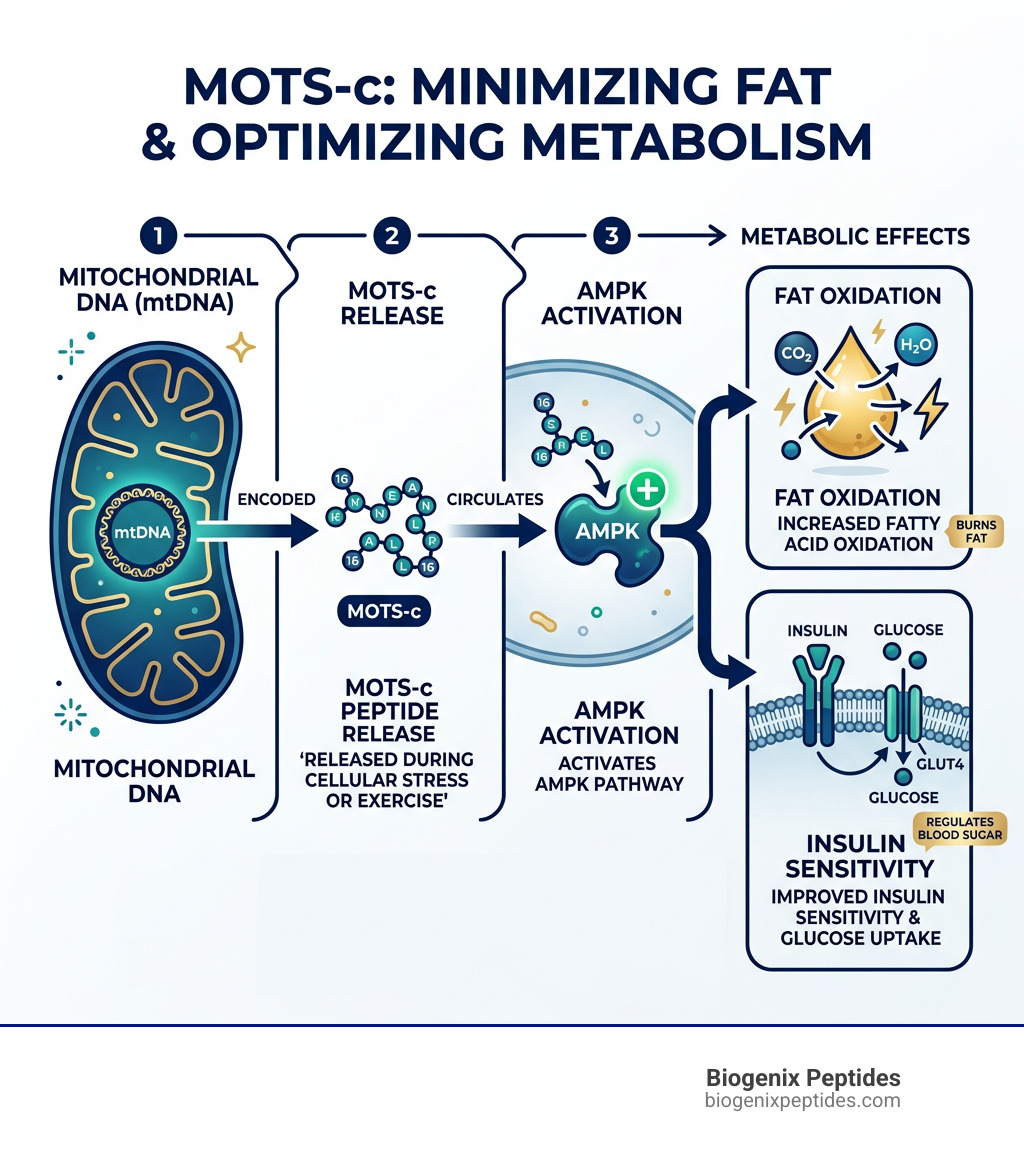
MOTS-c (Mitochondrial Open Reading Frame of the 12S rRNA-c) is a 16-amino acid peptide encoded within the mitochondrial genome. Specifically, it is derived from the 12S ribosomal RNA region. For a long time, scientists thought this part of the Mitochondrial DNA didn’t do much. However, research has revealed that it contains a short open reading frame that produces this bioactive peptide.
What makes MOTS-c is its role in “retrograde signaling.” Instead of the nucleus just telling the mitochondria what to do, the mitochondria use MOTS-c to talk back to the nucleus. This communication allows the mitochondria to act as hubs for regulating cellular biochemistry, signaling the rest of the cell to shift into “fat-burning mode” when energy demands are high or metabolic stress is present.
When researchers first identified this peptide in 2015, they realized it wasn’t just a local signal; it travels through the blood like a hormone. Because it targets skeletal muscle and fat tissue, researchers began investigating MOTS-c 10mg vials as a potential tool for restoring metabolic balance in aging and obesity.
The Science of MOTS-c peptide fat burning
The primary way mots c peptide fat burning occurs is through the activation of the AMPK (AMP-activated protein kinase) pathway. Think of AMPK as your body’s “master energy switch.” When this switch is flipped on, the body stops storing energy and starts burning it.
The mechanism is fascinatingly complex. MOTS-c works by inhibiting the folate cycle, which leads to the accumulation of a compound called AICAR. High levels of AICAR are what trigger the activation of AMPK. Once AMPK is active, several things happen simultaneously:
- Enhanced Fatty Acid Oxidation: The body becomes more efficient at breaking down stored fat to use as fuel.
- Improved Glucose Disposal: Skeletal muscles pull sugar out of the bloodstream more effectively.
- Mitochondrial Biogenesis: The cell is prompted to create new, healthy mitochondria, effectively upgrading your cellular “engine.”
Recent studies on mitochondria-to-nucleus regulation suggest that MOTS-c even translocates to the nucleus during metabolic stress to change how our genes are expressed. This means it doesn’t just burn fat in the moment; it may help reprogram the cell to be more metabolically flexible over the long term.
Proven Benefits: From Mouse Models to Human Metabolism
The data supporting mots c peptide fat burning is largely rooted in rigorous animal models that show staggering results. In studies where mice were fed a high-fat diet (HFD) designed to cause rapid weight gain, those treated with MOTS-c (typically 0.5 mg/kg/day) looked drastically different from the control group.
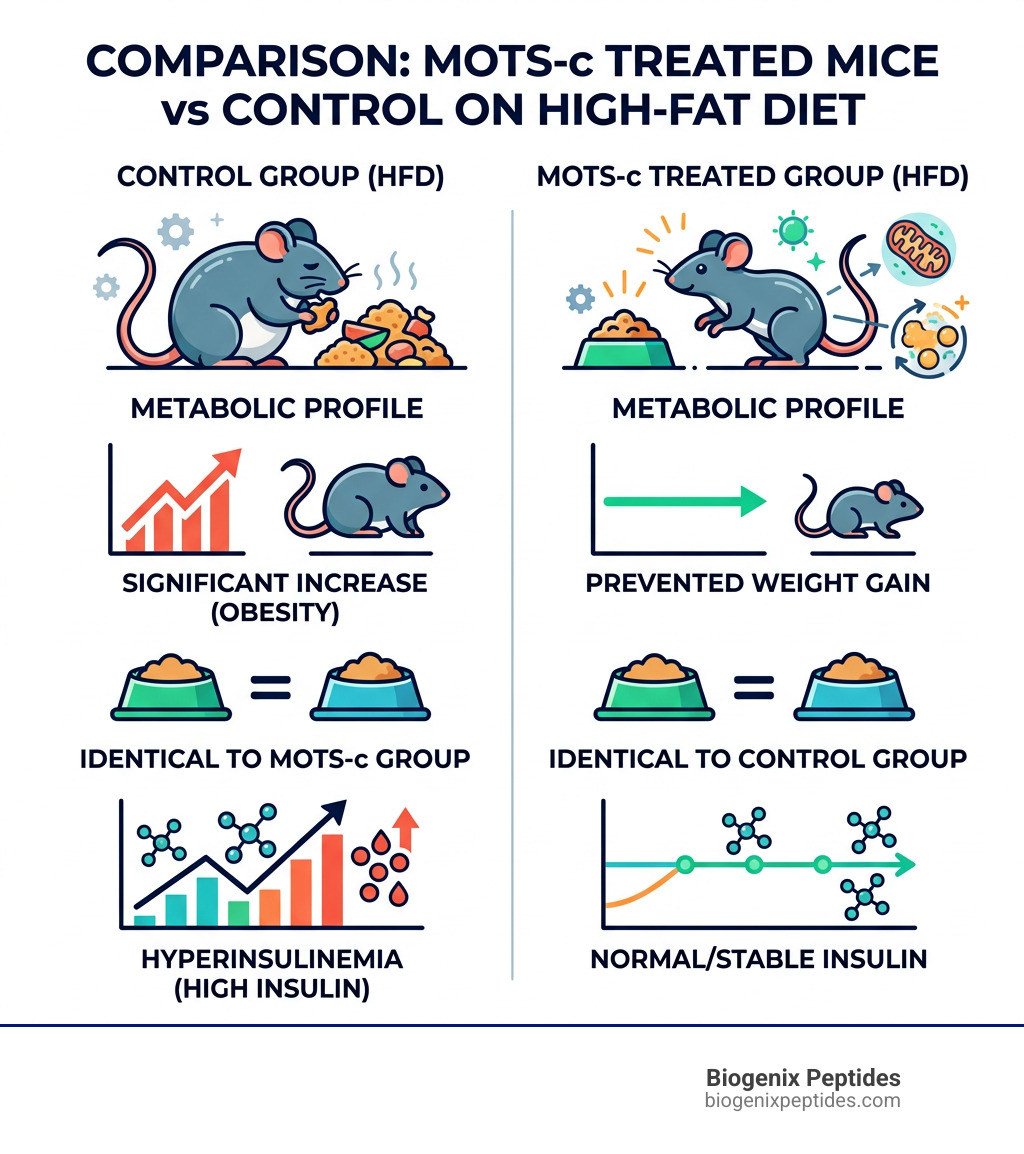
| Research Metric | Control Group (HFD) | MOTS-c Treated Group (HFD) |
|---|---|---|
| Body Weight Gain | Significant Increase (Obesity) | Prevented Weight Gain |
| Caloric Intake | Identical to MOTS-c group | Identical to Control group |
| Insulin Levels | Hyperinsulinemia (High Insulin) | Normal/Stable Insulin |
| Liver Health | Hepatic Lipid Accumulation | Reduced Fat in Liver |
| Energy Expenditure | Standard | Increased Heat & Oxygen Use |
The most shocking takeaway from The mitochondrial-derived peptide MOTS-c promotes metabolic homeostasis is that the treated mice stayed lean despite eating the same amount of high-calorie food as the obese mice. This suggests that MOTS-c doesn’t work by suppressing appetite, but by increasing the metabolic rate and the efficiency of fat oxidation. This has led many to label it as a “motion simulator” or exercise mimetic, as it provides many of the cellular benefits of a workout even in a sedentary state. You can read more about these findings in our guide on MOTS-c: The mitochondrial peptide turning heads in metabolic research.
Reversing Insulin Resistance with MOTS-c peptide fat burning
Insulin resistance is the arch-nemesis of fat loss. When your cells stop responding to insulin, your body pumps out more of the hormone to compensate. Since insulin is a “storage” hormone, high levels make it nearly impossible to burn body fat.
Mots c peptide fat burning addresses this by improving skeletal muscle insulin sensitivity. Research shows that MOTS-c increases the translocation of GLUT4, a glucose transporter, to the cell surface. This allows muscle cells to soak up glucose without needing massive amounts of insulin.
In hyperinsulinemic-euglycemic clamp studies—the gold standard for measuring insulin sensitivity—MOTS-c treatment improved whole-body insulin sensitivity by approximately 30%. By reducing the “insulin load” on the body, MOTS-c helps shift the environment from fat storage to fat utilization. If you are exploring options for weight management, checking out our Metabolic / Weight Loss category can provide more context on how these pathways interact. Understanding AMP-activated protein kinase signaling is key to grasping why this peptide is such a heavy hitter for metabolic flexibility.
Maximizing MOTS-c peptide fat burning Results
If you are conducting research on mots c peptide fat burning, the method of administration and timing can significantly influence the results. MOTS-c is a peptide, meaning it cannot be taken as a pill because the digestive system would simply break it down into basic amino acids.
Dosing Protocols and Administration
In research settings, MOTS-c is typically administered via subcutaneous injection. Because it mimics the effects of exercise, many researchers prefer a morning “fasted” dose to capitalize on the body’s natural fat-burning state.
- Standard Research Dosage: Common protocols often involve 5mg to 10mg per dose.
- Frequency: Usually administered 2 to 3 times per week.
- Advanced Protocols: Some advanced research models utilize “loading phases” with daily injections for 5-10 days followed by a maintenance schedule.
- Cycling: To prevent receptor downregulation, a cycle of 6-12 weeks “on” followed by a 4-week “off” period is frequently recommended.
For those interested in the “exercise mimicry” aspect, we have a detailed breakdown in The lazy athlete’s guide to MOTS-c.
Synergistic Stacks for Weight Management
In metabolic research, MOTS-c is rarely studied in a vacuum. It is often combined with other compounds that target different fat-loss pathways for a synergistic effect.
- GLP-1 Agonists: While MOTS-c handles cellular metabolism and insulin sensitivity, GLP-1 agonists (like Semaglutide) focus on appetite suppression and delayed gastric emptying.
- AOD-9604: This is a fragment of the human growth hormone molecule that specifically targets fat reduction without affecting blood sugar. Using AOD-9604 5mg alongside MOTS-c can provide a “two-pronged” attack on stubborn adipose tissue.
- 5-Amino-1MQ: This compound targets the NNMT enzyme in fat cells. Combining it with MOTS-c can further enhance metabolic research outcomes.
- Growth Hormone Secretagogues: Peptides like CJC-1295 and Ipamorelin can help maintain lean muscle mass while MOTS-c focuses on fat oxidation.
For more information on how these compounds interact, see our article on Peptides that talk to fat cells.
Safety, Legality, and Sourcing Considerations
When looking for MOTS-c, the quality of the peptide is paramount. There is a significant difference between “research-grade” and “pharmaceutical-grade” substances. Unregulated online vendors often sell products with purities as low as 60%, which can contain harmful byproducts or cause immunogenicity issues. Always ensure you are sourcing from reputable laboratories that provide third-party testing for purity and potency.
Legal Status and WADA Regulations
It is crucial to understand the legal landscape. In the United States, MOTS-c is currently classified as a “research chemical.” This means it is not FDA-approved for human consumption and is intended for laboratory research purposes only.
For competitive athletes, the rules are even stricter. The World Anti-Doping Agency (WADA) has placed MOTS-c on its Prohibited List under Section 4 (Metabolic Modulators). Because it can enhance endurance and physical performance, its use is banned in professional sports.
Potential Side Effects
While MOTS-c is generally well-tolerated in animal studies, some researchers report mild side effects, including:
- Injection Site Irritation: Redness or itching at the site of administration (rotating sites is recommended).
- Nausea: Occasionally reported if taken on an empty stomach without proper hydration.
- Energy Fluctuations: Some users report feeling “over-energized” if dosed too late in the day, which can interfere with sleep.
Frequently Asked Questions about MOTS-c
How long does it take to see fat loss results?
Results with mots c peptide fat burning are not overnight. Most research models show a distinct timeline:
- Weeks 1-2: Changes in energy levels and stamina are usually the first things noticed.
- Weeks 4-6: Improvements in exercise recovery and metabolic markers (like blood sugar stability) become evident.
- Weeks 8-12: Significant changes in body composition and fat reduction are typically measured at this stage, provided that diet and lifestyle factors are supportive.
Does MOTS-c require exercise to work?
While MOTS-c is an exercise mimetic, it works best when paired with actual physical activity. Think of MOTS-c as a force multiplier. In mice, it doubled running capacity and restored physical function in older subjects. If you are sedentary, MOTS-c can help protect against the metabolic damage of a high-fat diet, but if you combine it with resistance training or Zone 2 cardio, the fat-burning effects are significantly amplified through synergistic AMPK activation.
Is MOTS-c legal for competitive athletes?
No. As mentioned, MOTS-c is on the WADA Prohibited List. If you are a professional or collegiate athlete subject to drug testing, using MOTS-c could lead to a disqualification. Its status as a research peptide means it is meant for scientists and researchers investigating its properties, not for use in sanctioned athletic competitions.
Conclusion
At Biogenix Peptides, we believe that the future of wellness lies in understanding the language of our cells. Mots c peptide fat burning represents a shift away from traditional weight loss methods toward a more sophisticated, mitochondrial-focused approach. By restoring the signaling pathways that naturally decline with age and obesity, MOTS-c offers a promising look at how we might one day treat metabolic dysfunction at its root.
While we are still in the early stages of human research, the existing data on insulin sensitivity, fatty acid oxidation, and obesity prevention is nothing short of revolutionary. For those looking to dive deeper into mitochondrial research, we offer MOTS-c 40mg options for extensive laboratory studies. As we continue to unlock the secrets of the mitochondrial genome, MOTS-c stands out as a true “bestie” for anyone serious about metabolic restoration.