
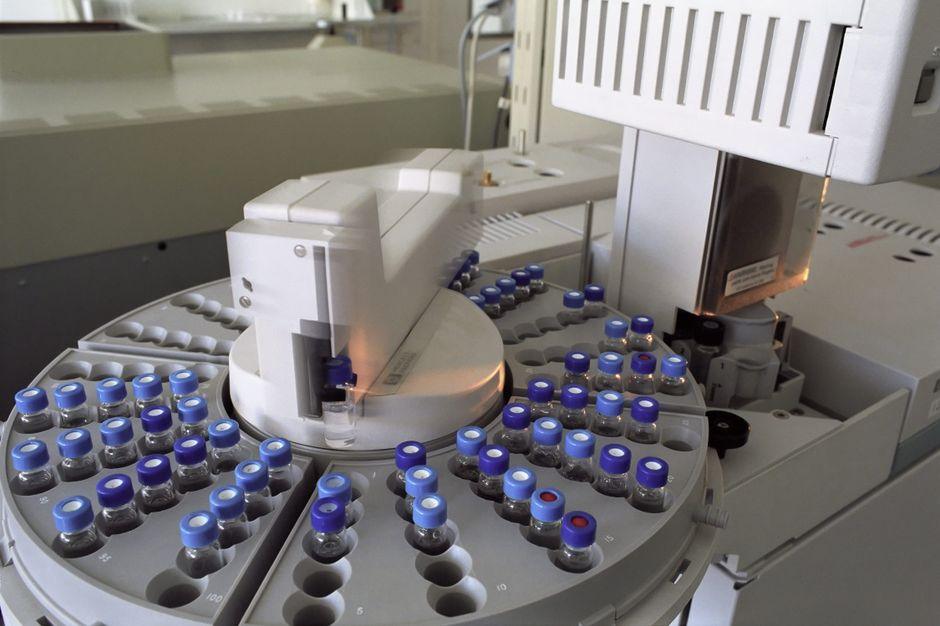
Lyophilized Powder Injection Explained
Disclaimer: The information provided in this article is for educational and informational purposes only. It is not intended as medical advice, diagnosis, or treatment. Products and compounds referenced are for research use only and are not approved for human or veterinary consumption. Always consult a qualified professional regarding health or medical decisions.
What “Lyophilized” Actually Means — and Why It Matters for Research

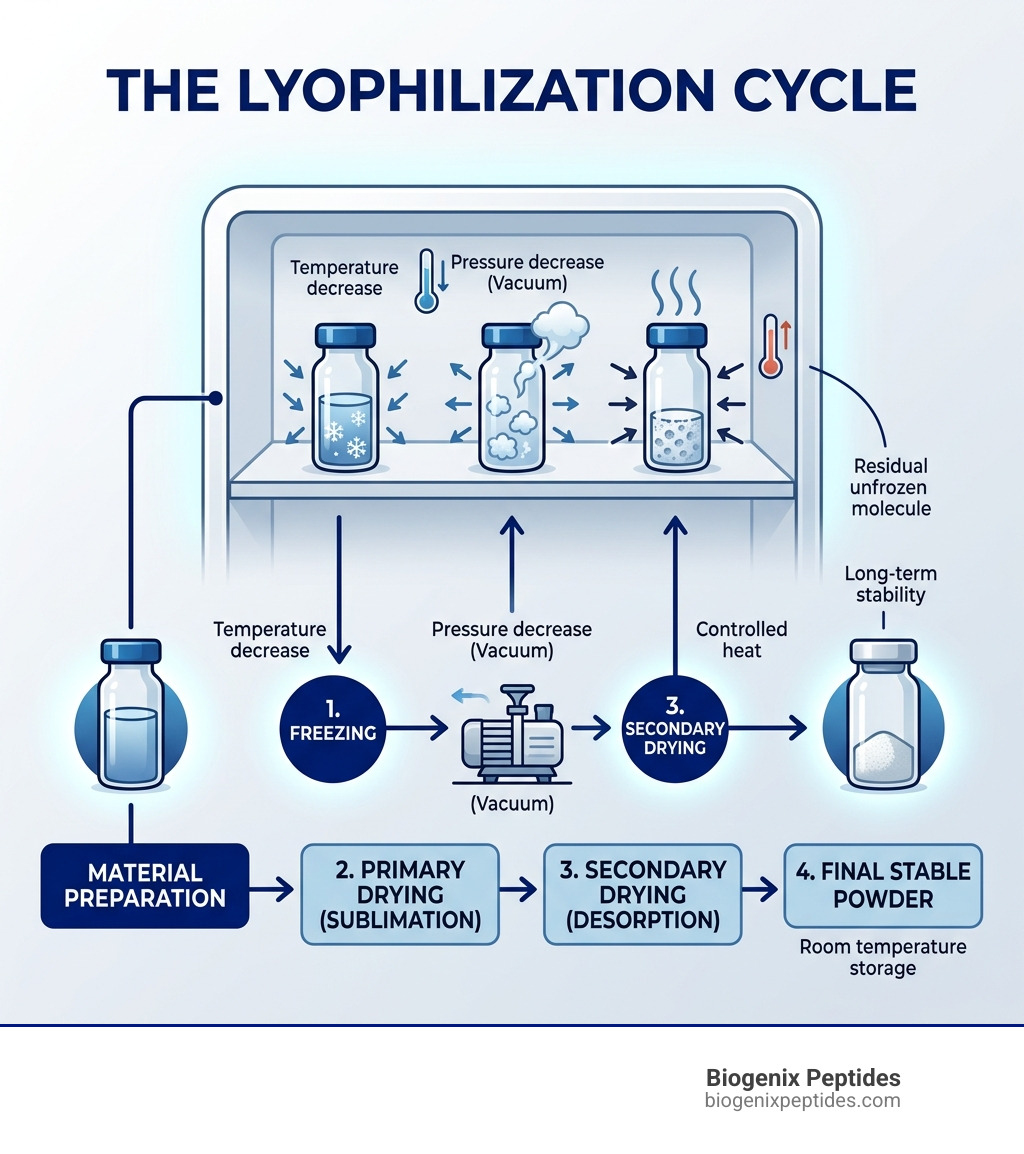
What is lyophilized refers to any material that has had its water removed through a controlled freeze-drying process — transforming a liquid or semi-solid substance into a dry, stable powder without using heat.
In simple terms:
- A liquid compound is frozen solid
- The surrounding pressure is lowered to a near-vacuum
- The ice converts directly to vapor — skipping the liquid phase entirely (this is called sublimation)
- What remains is a lightweight, porous powder that can last years without degrading
This process is called lyophilization — and it’s the gold standard for preserving sensitive biological compounds, including research peptides, vaccines, and biologics.
Here’s why researchers care:
| Property | Liquid Form | Lyophilized Form |
|---|---|---|
| Shelf life | Weeks | 2-3 years |
| Storage requirements | Often refrigerated | Often room temperature |
| Degradation risk | High | Low |
| Transport stability | Fragile | Robust |
Over 60% of biologics on the market today depend on lyophilization to remain viable — making it one of the most critical preservation technologies in modern science.
I’m Jay Daniel, Founder and CEO of BioGenix Peptides, and through years of hands-on experience in peptide sourcing, manufacturing, and quality control, I’ve worked extensively with lyophilized compounds and understand what is lyophilized material and why it matters for research integrity. In this guide, I’ll walk you through every key aspect of the process — from the science behind it to how it affects your research workflow.
What is Lyophilized Material in a Research Context?
When we look at the technical LYOPHILIZATION Definition & Meaning – Merriam-Webster, we see it described as the process of freeze-drying. However, in the laboratory, it is often referred to as cryodesiccation. This is a low-temperature dehydration process that is far more sophisticated than simply “drying something out.”
To understand what is lyophilized at a molecular level, we have to look at the physics of the “triple point.” In thermodynamics, the triple point is the specific temperature and pressure at which the solid, liquid, and gaseous phases of a substance coexist in equilibrium. By manipulating these variables, we can force water to transition from a solid (ice) directly into a gas (vapor) without ever becoming a liquid again. This is called vacuum sublimation.
In a research context, this matters because liquid water is the primary playground for chemical degradation. Hydrolysis (the chemical breakdown of a compound due to reaction with water) and oxidation are the enemies of peptide stability. By removing the water while the substance is frozen, we lock the molecular structure of the research compound in place.
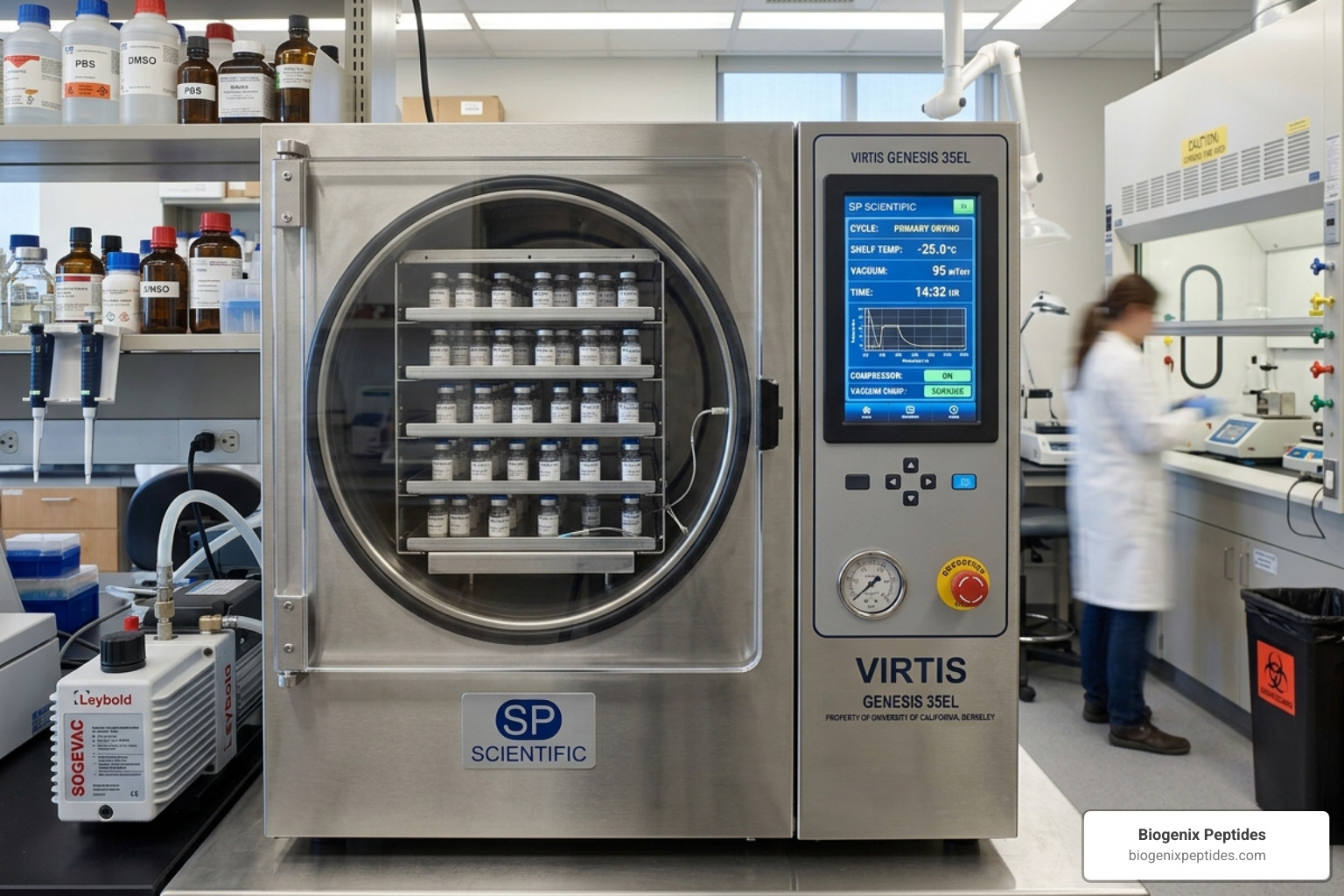
As of April 2026, the demand for high-purity research materials has made the use of a laboratory lyophilizer standard practice. These machines are designed to provide the extreme vacuum and temperature control necessary to ensure the final product—often called a “cake”—is chemically identical to the original liquid formulation, just without the volatile solvent. This results in research-grade stability that allows for precise experimentation without the fear of the compound degrading before the study is complete.
The Three Stages of the Lyophilization Process
Lyophilization is not a “quick fix” process. It is a slow, methodical journey that typically takes between 48 to 96 hours to complete. If we rush it, we risk destroying the delicate structure of the biologics. We generally categorize the process into three distinct phases: freezing, primary drying, and secondary drying.
Understanding what is lyophilized during the freezing phase
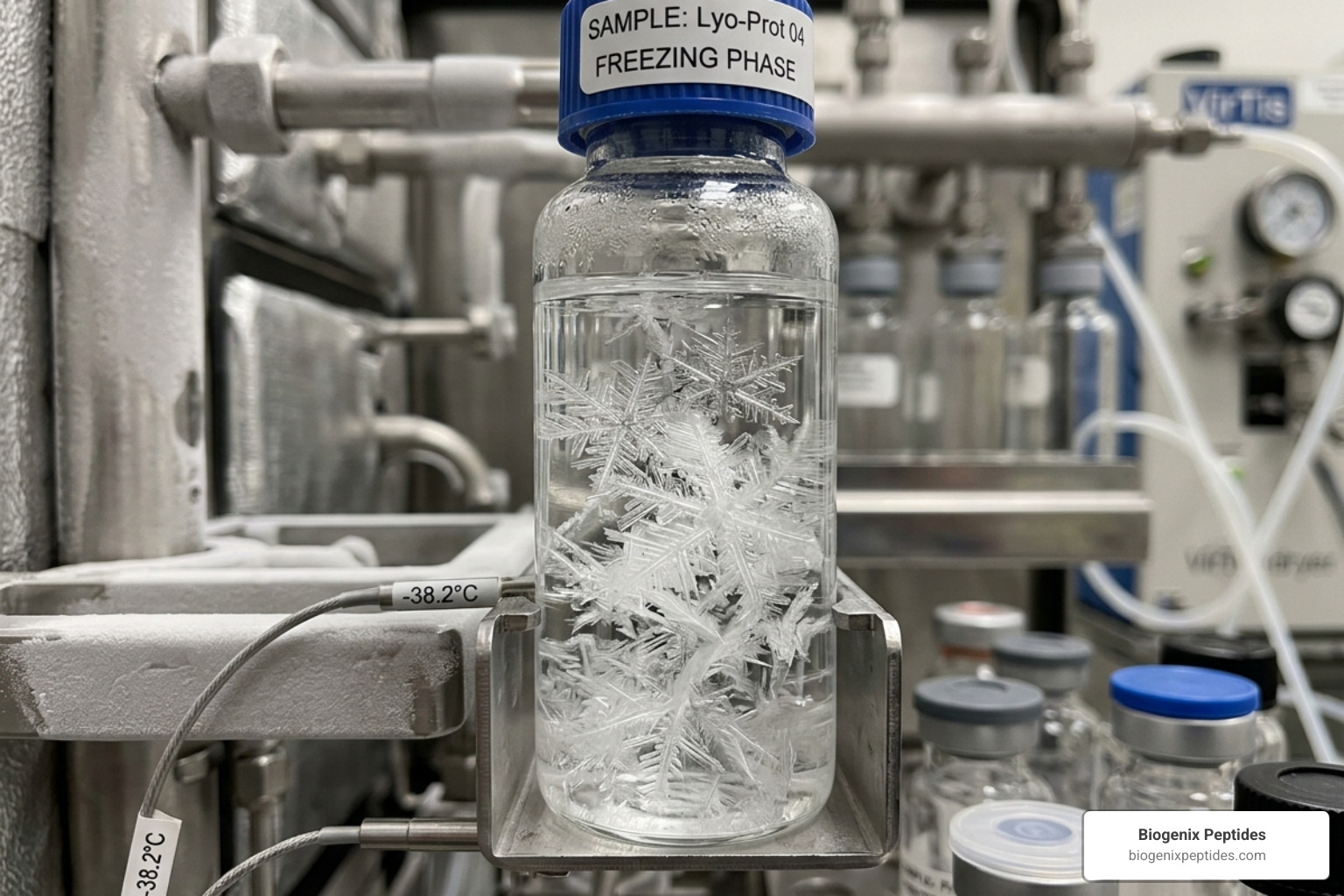
The freezing phase is arguably the most critical step. It’s not just about making the material cold; it’s about how the ice crystals form. We must cool the material below its “eutectic point”—the lowest temperature at which the solution can exist in a liquid phase.
- Annealing: Sometimes, we use a process called annealing, where we rapidly freeze the material and then slightly raise the temperature. This allows smaller ice crystals to combine into larger ones, creating “highways” or pores that make the later drying stages much faster and more efficient.
- Crystalline vs. Amorphous: Depending on the excipients (the “filler” ingredients), the frozen material might form a tidy crystalline structure or a glass-like amorphous solid. Amorphous solids don’t have a specific eutectic point; instead, they have a “glass transition temperature.” If we exceed this temperature during drying, the whole structure can collapse into a sticky mess.
- Thermal Stability: The goal of this phase is to ensure the research compound is completely immobilized. Rapid cooling is often used for biological materials to prevent large ice crystals from puncturing cell walls or damaging delicate protein folds.
Primary and Secondary Drying: What is Lyophilized Residual Moisture?
Once the material is frozen solid, the vacuum pump kicks in, and the drying begins.
- Primary Drying (Sublimation): This is where the heavy lifting happens. We lower the pressure in the chamber and add a tiny amount of heat (just enough to drive sublimation but not enough to melt the ice). About 95% of the water is removed during this phase. This is the stage where the ice turns into vapor and is caught by a “cold trap” or condenser, which is usually kept at a bone-chilling -60°C to -80°C.
- Secondary Drying (Desorption): Even after the visible ice is gone, there are still water molecules “stuck” (adsorbed) to the research compound. In this phase, we raise the temperature slightly higher—sometimes up to room temperature or slightly above—while maintaining a deep vacuum. This breaks the ionic bonds holding those last water molecules.
According to research on What is Lyophilization?, the goal is to reach a state of 1-5% residual moisture. Some high-end processes can even push this as low as 1-4%. This ultra-low moisture level is what prevents the compound from reacting with its environment, ensuring it remains “active” for whenever the researcher is ready to use it.
Why Research Peptides and Biologics are Lyophilized
You might wonder why we go through all this trouble. Why not just ship research peptides in a pre-mixed liquid? The answer lies in the inherent fragility of these molecules.
Why Research Peptides Are Typically Lyophilized And How This Benefits Research highlights that peptides are essentially chains of amino acids. In a liquid environment, these chains are subject to “wiggling” and unfolding. Once they unfold or break, they lose their biological “key” and can no longer interact with receptors in a research model.
Stability and Shelf-Life
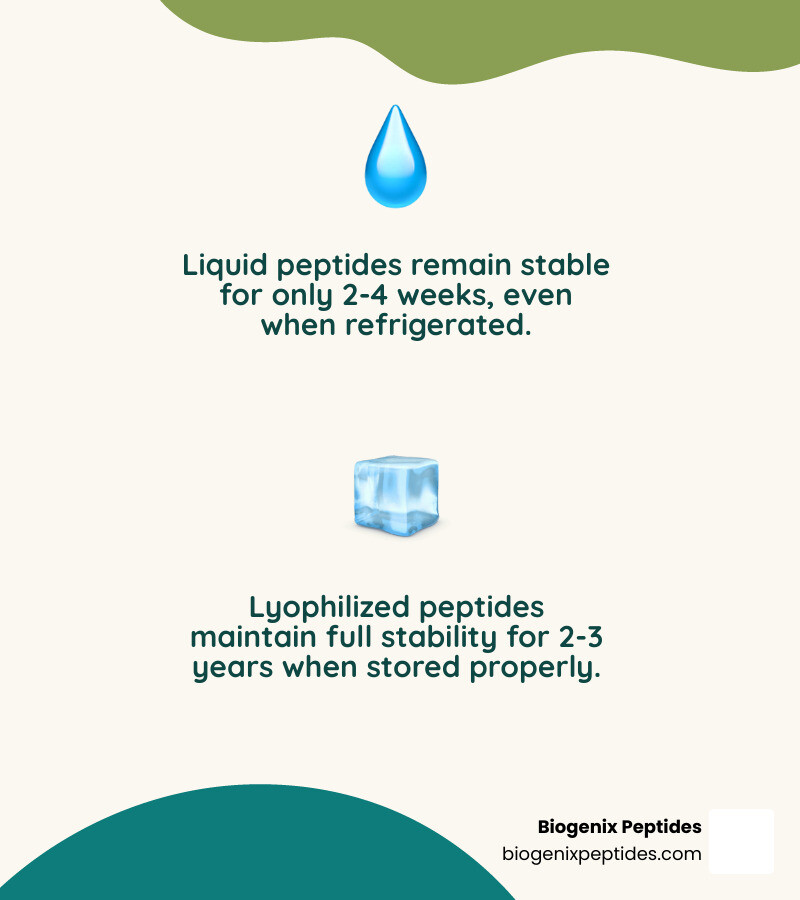
The stability benefits are staggering. A liquid peptide might last only a few weeks, even if refrigerated. However, a lyophilized peptide can remain stable for 2 to 3 years when stored correctly. This is why over 60% of biologics on the market today—including heavy hitters like Herceptin and Keytruda—rely on this technology. In 2018, sales for the top 10 lyophilized drugs exceeded $40 billion, and that number has only grown as we move through 2026.
Thermal Sensitivity
Most biologics are “labile,” meaning they are easily broken down by heat. Traditional heat-drying would cook the proteins, rendering them useless. Lyophilization is a “cold” process, which preserves the delicate three-dimensional shape of the molecule. This allows for global distribution without the need for a strict, expensive “cold chain” (refrigerated shipping) at every single step, although many researchers still choose to ship on dry ice for maximum security.
Reconstitution and Handling of Lyophilized Research Compounds
Once a researcher receives a vial of what is lyophilized powder, they cannot use it in its dry state. It must be turned back into a liquid through a process called reconstitution.
We have developed A Foolproof Way To Reconstitute Your Lyophilized Peptides to ensure researchers don’t damage the compound during this sensitive transition.
The Diluent
The most common diluent used in a laboratory setting is bacteriostatic water. This is sterile water containing 0.9% benzyl alcohol, which acts as a preservative to prevent the growth of bacteria. Other options include sterile saline or specialized buffers, depending on the specific requirements of the study.
Aseptic Technique
Because these compounds are used in sensitive research environments, maintaining sterility is paramount. This involves:
- Cleaning the top of the vial with an alcohol swab.
- Using a sterile syringe to draw up the diluent.
- Gently “dribbling” the liquid down the side of the glass vial rather than spraying it directly onto the powder.
If you want a detailed walkthrough, we recommend checking out Reconstituting Lyophilized Peptides Step By Step or the updated Reconstituting Lyophilized Peptides Step By Step 2. For those working with specific amounts, such as a 5mg vial, there are nuances to the math and volume that are covered in The Secret To Reconstituting Peptides 5Mg Correctly.
Challenges and Quality Control in Lyophilization
While lyophilization is the “gold standard,” it is not without its risks. The Lyophilization of Parenteral (7/93) – FDA guide outlines many of the pitfalls that can occur during manufacturing.
Common Physical Defects
- Cake Collapse: If the temperature rises above the “collapse temperature” during primary drying, the porous structure of the powder fails. It turns into a shrunken, sticky mass that is very difficult to reconstitute.
- Melt-back: This happens when the ice melts into a liquid before it can sublimate. It usually results from a loss of vacuum or a “hot spot” on the lyophilizer shelf.
- Vapor Choking: If the water evaporates too fast, it can create a “traffic jam” of vapor that the vacuum pump can’t handle, leading to a spike in pressure and potential product ruin.
Environmental Controls
To prevent contamination, lyophilization must occur in an ISO 5 (Class 100) environment. This is a cleanroom where the air is filtered to remove almost all dust and microbes. Manufacturers also use “Clean-In-Place” (CIP) and “Steam-In-Place” (SIP) systems to sterilize the equipment between batches.
One interesting risk mentioned in industry literature is silicone oil leakage. Lyophilizer shelves are often heated and cooled by circulating silicone oil. If a shelf develops a microscopic leak, that oil can contaminate the research vials. Modern facilities now use mass spectrometers to “sniff” for any traces of oil during the cycle to ensure the purity of the final product.
Frequently Asked Questions about Lyophilized Products
How long do lyophilized research chemicals last?
In their dry, powder form, most lyophilized research chemicals are remarkably hardy. When stored in a cool, dark place (like a freezer at -20°C), they can remain viable for 2 to 3 years. Even at room temperature, many are stable for several weeks or months, which is why they are so convenient for shipping. However, once they are reconstituted into a liquid, the clock starts ticking—usually, they should be used within 2 to 4 weeks if kept refrigerated.
Can lyophilized powder be stored at room temperature?
Yes, one of the biggest “wins” for what is lyophilized material is its ability to withstand room-temperature storage during transit. For long-term storage (months or years), we still recommend a freezer to minimize any tiny amount of residual degradation, but for the short term, the “cake” structure is very stable. This is a massive advantage over liquid biologics, which can be ruined by just a few hours of heat exposure.
What is the difference between freeze-drying and spray-drying?
While both remove water, they do it differently. Spray-drying involves spraying a liquid into a hot chamber to evaporate the water instantly. It’s faster and cheaper, but the high heat can damage proteins and peptides. Lyophilization uses cold and vacuum, which is much “gentler” on the molecular structure. Freeze-drying costs about five times as much as conventional drying, but for high-value research compounds, it is the only way to ensure the integrity of the results.
Conclusion
As we look toward the remainder of 2026, the field of biotechnology is expanding at a breakneck pace. The pharmaceutical lyophilization market has been growing at a rate of approximately 13.5% per year, driven by the surge in complex biologics and personalized research.
At Biogenix Peptides, we recognize that the quality of your research depends entirely on the stability of your compounds. Understanding what is lyophilized is the first step in mastering the handling of these sophisticated materials. By utilizing the science of sublimation, we can provide researchers with tools that are not only potent but also incredibly durable.
Whether you are just beginning a new study or are looking to optimize your existing laboratory protocols, the “cake” in the vial is the result of nearly a century of scientific innovation—from the battlefields of WWII to the reaches of deep space.
For more information on handling your materials, please refer to our comprehensive guide on Reconstituting Lyophilized Peptides Step-By-Step.