How to Reconstitute and Use Lyophilized Powder for Injection Safely
Disclaimer: The information provided in this article is for educational and informational purposes only. It is not intended as medical advice, diagnosis, or treatment. Products and compounds referenced are for research use only and are not approved for human or veterinary consumption. Always consult a qualified professional regarding health or medical decisions.
Lyophilized Powder: Safe Research Reconstitution Basics
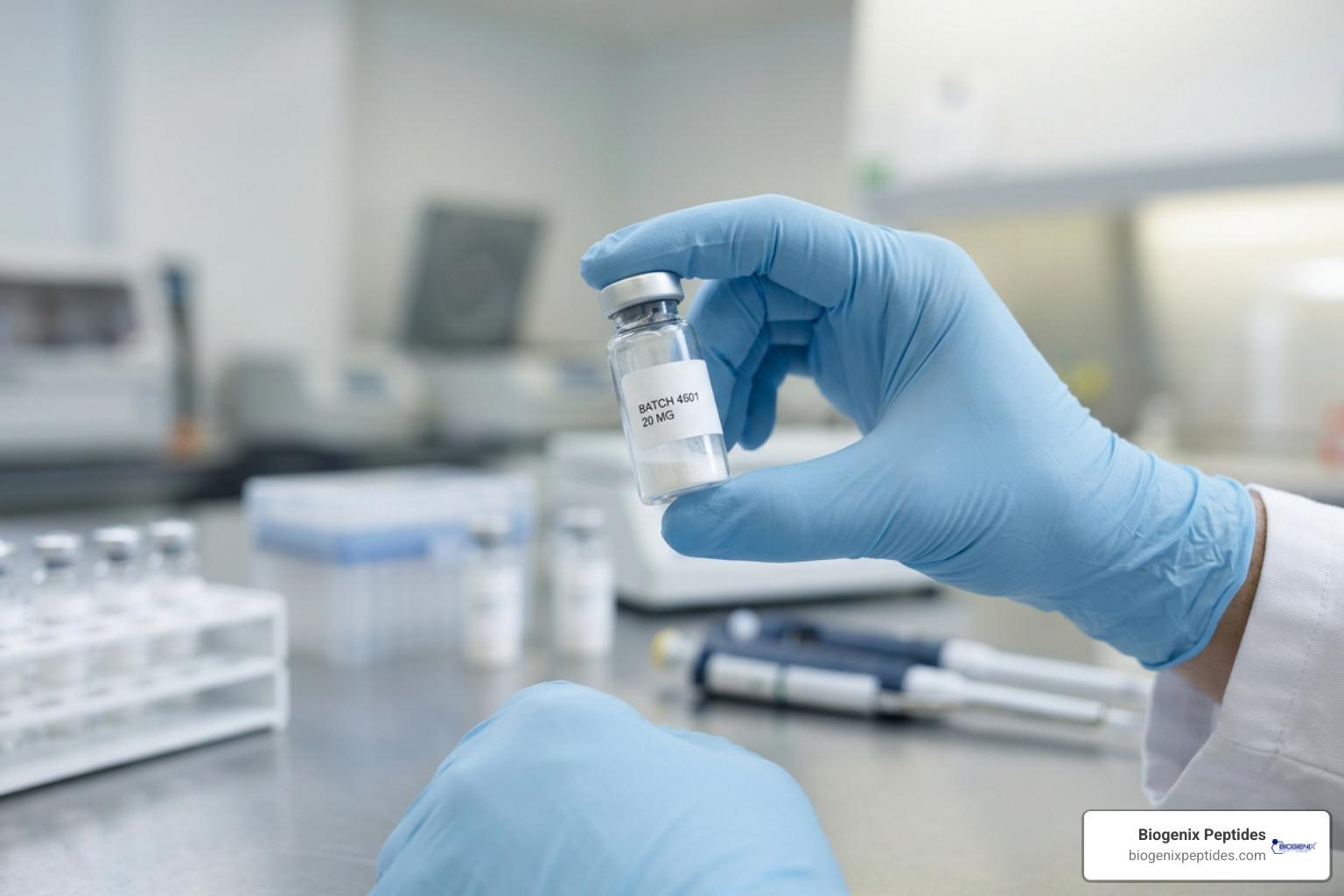
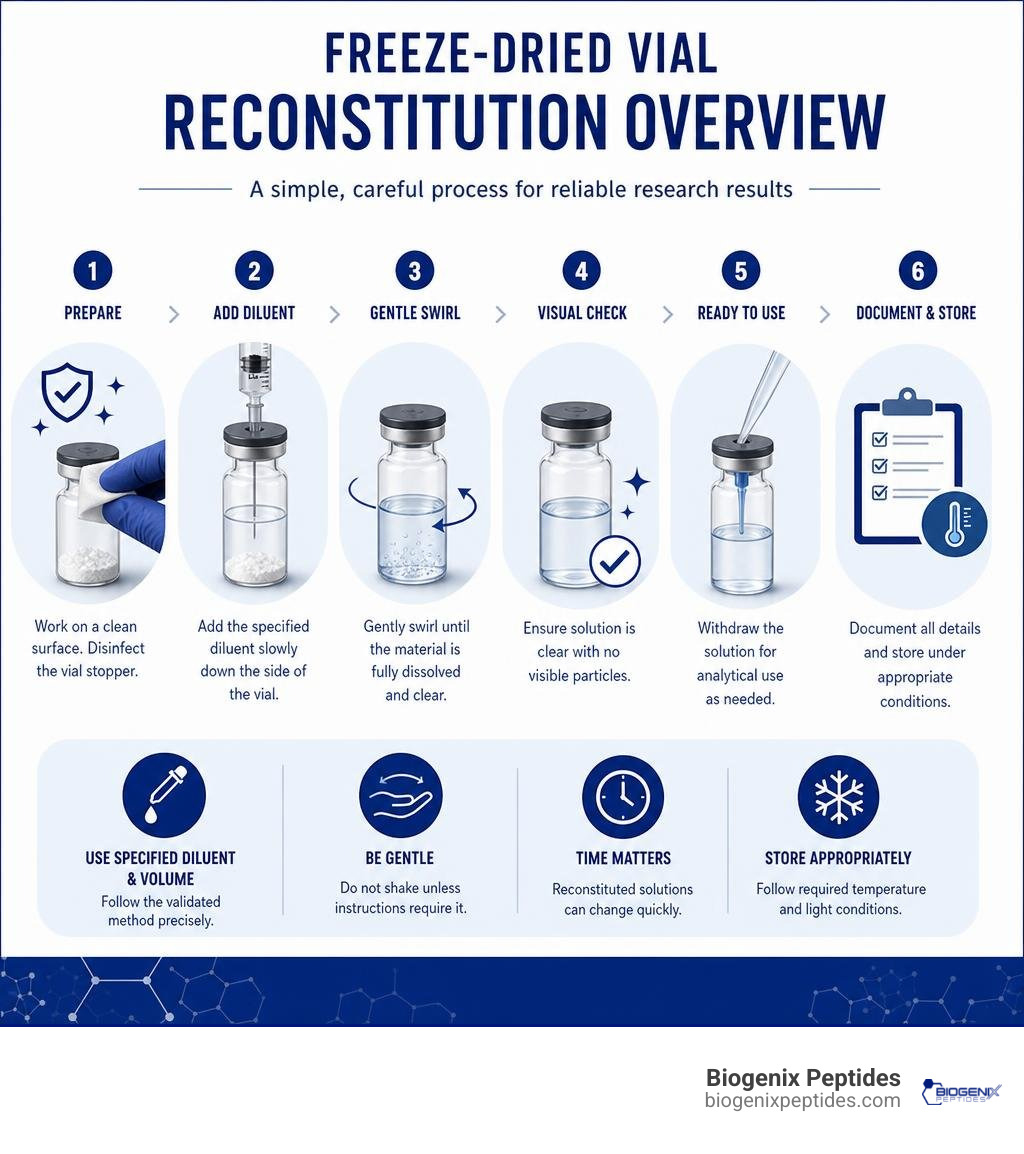
A lyophilized powder is a freeze-dried compound supplied in a vial. For research handling, use only the diluent and volume specified by the validated method, work on a clean surface, disinfect vial stoppers, add diluent slowly, and gently swirl until the material is fully dissolved and clear. Do not shake unless the product instructions specifically require it.
The term lyophilized powder is addressed strictly as a non-clinical descriptor for freeze-dried research materials, not as guidance for human or veterinary administration.
Freeze-drying removes water while protecting many moisture-sensitive compounds during storage. Once reconstituted, stability can change quickly, so researchers should document the diluent, concentration, preparation time, storage conditions, and any visible changes before analytical work.
I’m Jay Daniel, Founder and CEO of BioGenix Peptides, with years of hands-on experience in peptide sourcing, quality control, and research-focused laboratory practices. My work with lyophilized powder emphasizes careful preparation, purity awareness, and responsible research handling before we examine the science behind freeze-drying.
Understanding Lyophilized Powder in Laboratory Research
In analytical and laboratory research, preserving the structural integrity of sensitive biomolecules is a major priority. When liquid solutions contain peptides, proteins, or small-molecule compounds, water molecules actively promote hydrolytic degradation, deamidation, and oxidation over time. As lyophilized powder explained demonstrates, removing that water transforms a fragile liquid solution into a stable, porous solid structure commonly called a “cake.”
The adoption of freeze-drying technology across scientific workflows has grown by approximately 13.5% annually over recent years. In fact, industry assessments show that over 60% of modern biologics require lyophilization to maintain physical and chemical integrity throughout their distribution life cycle. Without this stabilization technique, blockbuster therapeutic proteins like trastuzumab ($7.2B in 2018 sales) and pembrolizumab ($7.2B in 2018 sales) could suffer rapid loss of potency.
Adhering to regulatory standards such as the FDA guidance on lyophilization of parenterals ensures that research materials maintain strict sterility, low moisture content, and uniform cake structure across production batches.
The Science of the Freeze-Drying Process
Lyophilization is an intricate physical process that safely removes solvent from a frozen product without exposing delicate molecular chains to high thermal stress. Rather than applying direct heat to evaporate moisture—which would quickly denature sensitive peptide bonds—freeze-drying relies on three sequential stages:

- Freezing Phase: The liquid formulation is cooled below its eutectic point or glass transition temperature ($T_g’$), converting water into distinct ice crystals while concentrating the active solute into an amorphous or crystalline matrix.
- Primary Drying (Sublimation): Chamber pressure is reduced drastically under a vacuum while controlled thermal energy is applied to the shelves. This causes the frozen ice to sublimate directly from a solid into water vapor, which migrates to a cold condenser.
- Secondary Drying (Desorption): The chamber temperature is gradually increased under low pressure to desorb chemically bound water molecules from the solute matrix, leaving behind a dry cake with residual moisture levels typically below 1–3%.
Formulation Classifications and Quality Validation
Research scientists encounter various freeze-dried forms in laboratory workflows. Depending on product characteristics, materials may dissolve into clear aqueous solutions or create uniform suspensions. In analytical monographs and comparative literature, reference materials classified as a lyophilized powder formulation provide established baselines for evaluating cake morphology, dissolution rates, and reconstitution dynamics. Reference registries like the DailyMed reference on lyophilized solutions define specific criteria for validating freeze-dried parenteral preparations.
Assessing the purity, content uniformity, and degradation profile of a freeze-dried cake requires rigorous quality control methods that conform to International Council for Harmonisation (ICH) guidelines. For instance, analytical scientists evaluate active component recovery using clean UV spectrophotometric assays at designated wavelengths (such as 241 nm for ceftriaxone matrices) to ensure accurate baseline quantification before starting laboratory testing.
Essential Equipment and Sterile Environment Preparation
Precision starts with maintaining a clean workspace. When preparing freeze-dried materials, airborne particulates and microbial contaminants can degrade sample quality or compromise assay outcomes.
Maintaining proper sterile technique and creating a sterile research environment allows investigators to prevent cross-contamination while working with sensitive biomolecules under standard laboratory conditions.

Essential Supplies for Reconstituting Lyophilized Powder
Before beginning the reconstitution protocol, gather the following laboratory materials on a sanitized workbench:
- Sealed vial containing the lyophilized target compound
- Validated reconstitution diluent, such as bacteriostatic water or sterile 0.9% sodium chloride
- Dedicated sterile mixing syringe with an appropriately sized needle, such as 20-22 gauge
- Sterile fluid extraction syringe for precise aliquot handling
- 70% isopropyl alcohol prep pads
- Dedicated, puncture-resistant laboratory sharps container
Selecting the right diluent is critical for experimental success. As detailed in our breakdown of sterile water and bacteriostatic water differences, bacteriostatic water contains 0.9% benzyl alcohol to inhibit microbial growth in multi-entry vials, whereas plain sterile water contains no antimicrobial preservatives and must be handled in single-use workflows.
Safe Handling and Pressure Equalization Protocol
Because freeze-drying vials are routinely sealed under a partial vacuum or inert nitrogen overlay, sudden needle entry can draw liquid in rapidly, causing mechanical shear against fragile peptide bonds.
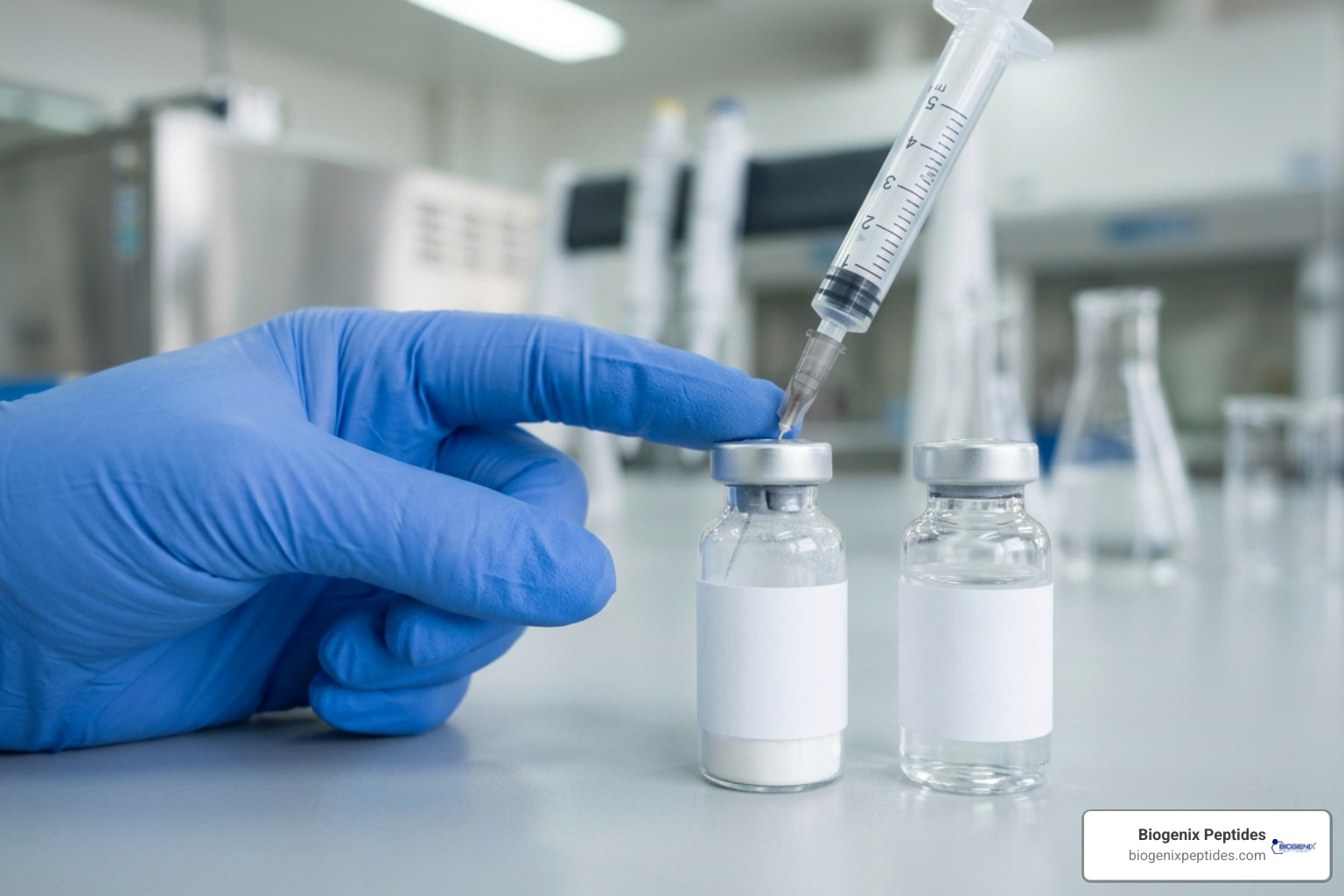
To equalize vial pressure smoothly, pull the mixing syringe plunger back to match the exact volume of diluent you plan to introduce. After introducing the diluent down the inner glass wall, draw out an equivalent volume of headspace air into the syringe barrel before withdrawing the needle. This equalizes pressure, prevents splashing, and stops aerosolized droplets from escaping through the stopper.
Step-by-Step Protocol for Reconstitution and Research Handling
Proper fluid addition ensures uniform solubilization while preserving three-dimensional molecular structures.
| Diluent Type | Antimicrobial Preservative | Common Laboratory Applications | Post-Reconstitution Shelf Life |
|---|---|---|---|
| Bacteriostatic Water | 0.9% Benzyl Alcohol | Multi-aliquot research, extended testing protocols | Up to 28 days under controlled refrigeration (2°C–8°C) |
| Sterile Water | None (Preservative-free) | Single-aliquot analytical assays, cell assays | Immediate handling; discard unused portions within 4–24 hours |
| 0.9% Sodium Chloride | None (Isotonic saline) | Specific ionic-strength-dependent binding studies | Immediate handling or short-term cold storage per monograph |
Step-by-Step Guide to Preparing Lyophilized Powder
Follow this standard research workflow to reconstitute freeze-dried materials:
- Sanitize Workspace and Hands: Clean the lab bench with 70% isopropyl alcohol and put on clean laboratory gloves.
- Disinfect Stoppers: Remove flip-off caps from both the diluent and lyophilized compound vials. Wipe each rubber septum thoroughly with an alcohol swab and allow them to dry naturally for 30 seconds.
- Draw Diluent: Attach a sterile needle to your mixing syringe, draw ambient air equal to your intended fluid volume, introduce the air into the diluent vial, and draw the designated volume of fluid.
- Slow Liquid Transfer: Insert the needle at a 45-degree angle through the compound vial stopper, aiming the bevel toward the interior glass wall. Slowly depress the plunger so the liquid runs down the glass rather than directly spraying the cake.
- Equalize Headspace Pressure: Draw an equivalent volume of air back into the syringe before removing the needle from the vial.
- Gently Dissolve: Do not shake the vial vigorously. Slowly swirl the solution in circular motions until all powder particles fully dissolve into a clear, uniform liquid.
Cold Storage and In-Use Stability Guidelines
Once reconstituted into an aqueous state, compounds become vulnerable to ambient degradation pathways. Reviewing cold storage secrets for keeping reconstituted peptides fresh highlights the importance of maintaining strict refrigeration parameters (2°C to 8°C / 36°F to 46°F) to slow hydrolytic breakdown.
Store reconstituted research solutions away from light and avoid repeated freeze-thaw cycles, which introduce ice-crystal shear forces that can fragment peptide backbones and reduce experimental repeatability.
Laboratory Sharps Disposal and Biohazard Safety Protocols
Proper containment of sharps and biohazard consumables is a mandatory laboratory safety practice. Discard every needle, syringe, and glass ampoule immediately after use into a rigid, puncture-resistant biohazard container.
Never recap, bend, or shear needles by hand. When containment units reach their indicated fill lines (typically three-quarters full), seal and process them through approved institutional hazardous waste disposal pathways in compliance with local environmental health and safety regulations.
Frequently Asked Questions About Lyophilized Research Compounds
What is lyophilized powder used for in laboratory research?
In laboratory and analytical research settings, freeze-dried powders provide a stable matrix for moisture-sensitive compounds, including synthetic peptides, monoclonal antibodies, and active pharmaceutical reference standards. Removing water prevents early hydrolytic degradation, ensures long-term room-temperature or refrigerated stability, and delivers consistent molar concentrations when reconstituted for in vitro assays.
Why should you swirl instead of shaking reconstituted solutions?
Vigorous shaking creates high fluid shear forces and introduces air bubbles into the liquid matrix. For complex peptides and proteins, this agitation disrupts secondary and tertiary folding structures, causing molecular aggregation, denaturation, and reduced binding affinity during analytical testing. Gentle swirling dissolves the cake while preserving structural conformation.
How should used reconstitution needles be discarded safely?
All used needles, transfer syringes, and glass vials should be discarded immediately into an OSHA-compliant, puncture-resistant sharps container located directly within the research workspace. Never leave unshielded needles on the lab bench or place loose sharps in regular laboratory trash bins.
Conclusion
Handling freeze-dried research compounds with precision protects sample integrity and supports consistent, reproducible experimental outcomes. By maintaining sterile technique, selecting compatible diluents, equalizing vial pressure, and avoiding harsh mechanical agitation, research teams preserve delicate molecular structures for demanding analytical protocols.
To explore validated mixing calculations, volumetric ratios, and step-by-step reconstitution handling guidelines for lyophilized peptides and other laboratory materials, reference our detailed walkthrough on reconstituting lyophilized peptides step by step to refine your laboratory workflows.