
Why Your Face and Waistline Might Prefer Natural Peptides Over Injections
Why Researchers Are Rethinking Peptide Delivery in 2026
Disclaimer: The information provided in this article is for educational and informational purposes only. It is not intended as medical advice, diagnosis, or treatment. Products and compounds referenced are for research use only and are not approved for human or veterinary consumption. Always consult a qualified professional regarding health or medical decisions.
Disclaimer: The information provided in this article is for educational and informational purposes only. It is not intended as medical advice, diagnosis, or treatment. Products and compounds referenced are for research use only and are not approved for human or veterinary consumption. Always consult a qualified professional regarding health or medical decisions.

Natural peptide injection alternatives are a growing area of preclinical research — and the options being studied include compounds that may target appetite, fat metabolism, skin integrity, and cellular repair through the body’s own signaling pathways.
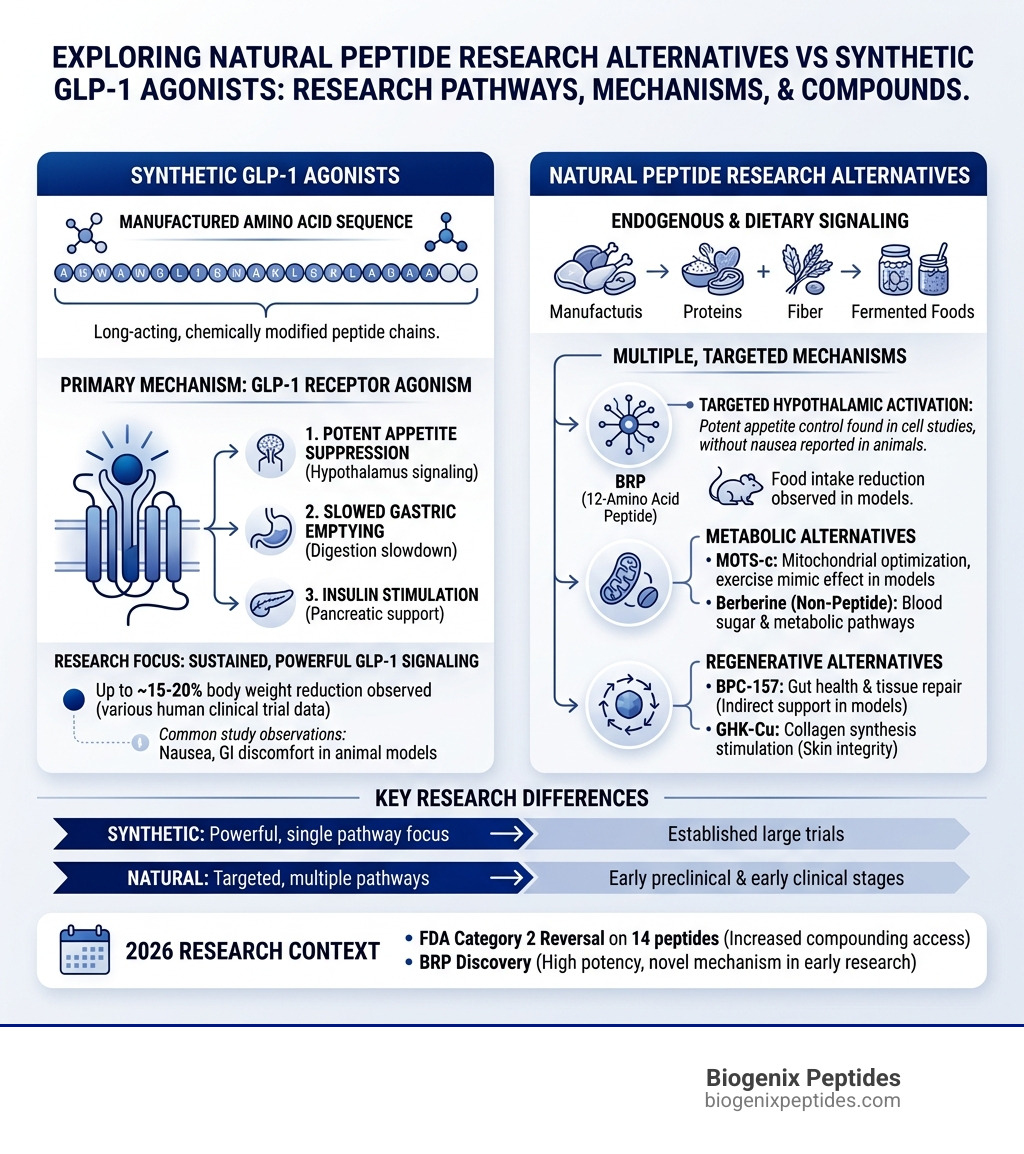
Here is a quick overview of the most-studied natural peptide research alternatives, based on current preclinical and early clinical data:
| Compound | Research Focus | Key Model Finding |
|---|---|---|
| BRP | Appetite suppression, fat loss | Up to 50% food intake reduction in mice and minipigs |
| MOTS-c | Metabolic flexibility, insulin regulation | Mimics exercise effects at mitochondrial level |
| BPC-157 | Gut health, tissue repair, inflammation | Indirect metabolic support in animal models |
| GHK-Cu | Skin collagen, cellular repair | Collagen synthesis stimulation in preclinical models |
| Berberine | Blood sugar, weight management | ~4 lbs weight loss in human supplement trials |
| GLP-1 pathway foods | Natural GLP-1 stimulation | Transient effects via fiber, protein, fermented foods |
The research landscape shifted notably in February 2026, when the FDA reversed its Category 2 restrictions on 14 of 19 previously restricted peptides — restoring compounding access under physician prescription. At the same time, Stanford researchers published findings on BRP, a naturally occurring 12-amino-acid peptide that activated hypothalamic neurons ten times more potently than GLP-1 in lab-grown cells, without triggering nausea or food aversion in animal models.
That combination — regulatory change plus novel discovery — has put natural peptide research firmly in the spotlight.
But the picture is more nuanced than the headlines suggest. Most evidence still comes from animal models. Human trial data remains limited. And the line between “natural” and “synthetic” in peptide science is often blurry.
This article breaks down what the research actually shows, across peptides, non-peptide compounds, and lifestyle-based GLP-1 strategies — all framed strictly as research observation, not medical guidance.
I’m Jay Daniel, Founder and CEO of BioGenix Peptides, with years of hands-on experience in peptide sourcing, quality control, and the science of natural peptide injection alternatives across preclinical research contexts. My work sits at the intersection of laboratory integrity and emerging peptide science — which makes this one of the most interesting topics I’ve tracked in recent years.
Exploring Natural Peptide Research Alternatives in Preclinical Models
As we move through April 2026, the scientific community is increasingly focused on how endogenous (naturally occurring) molecules can be utilized in research to achieve metabolic and regenerative outcomes. While synthetic GLP-1 agonists have dominated the news, researchers are looking toward natural peptide injection alternatives that may offer more targeted pathways.
Peptides are essentially short chains of amino acids that act as the body’s primary signaling molecules. In a laboratory setting, researchers use these compounds to study how specific cellular “instructions” are carried out. Understanding Peptide Basics is essential for anyone tracking these trends, as it explains how these molecules differ from larger proteins and hormones.

One of the most exciting developments in this space is the discovery of BRP (Brain-Related Peptide). According to research from Stanford Medicine, a naturally occurring molecule rivals synthetic GLP-1s in weight loss research, specifically identifying BRP as a potent regulator of appetite. Unlike synthetic drugs that circulate throughout the body, BRP appears to act with high specificity on the brain’s hunger centers.
BRP as a Natural Peptide Research Alternative for Appetite Suppression
BRP is a 12-amino-acid peptide derived from the BRINP2 prohormone. In preclinical models, its primary mechanism involves targeting the hypothalamus—the “control center” for hunger and satiety. Stanford’s research utilized an AI algorithm called “Peptide Predictor” to screen thousands of human genes, eventually identifying BRP as a standout candidate.
In animal trials, BRP demonstrated a remarkable ability to reduce food intake by up to 50% in the hour following administration in both lean mice and minipigs. This is significant because minipigs share a metabolic profile very similar to humans. For a deeper dive into how these molecules are categorized, you can explore The Complete Guide to Peptides in Scientific Research.
GHK-Cu: A Natural Peptide Research Alternative for Skin and Collagen
While BRP and MOTS-c focus on the waistline, GHK-Cu (Copper Peptide) remains the gold standard for researching skin integrity and “face” health. GHK is a naturally occurring tripeptide in human plasma that declines significantly with age.
In research models, GHK-Cu is studied for its ability to:
- Stimulate collagen and elastin synthesis.
- Promote the production of glycosaminoglycans (like hyaluronic acid).
- Modulate the expression of genes involved in DNA repair.
Because GHK-Cu works with the body’s existing copper stores to signal tissue remodeling, it is often viewed as a “biomimetic” alternative to more aggressive synthetic skin treatments. You can learn more about these signaling mechanisms in our Peptide Research Fundamentals guide.
Mechanisms of Action: How Natural Peptides Target the Waistline
How exactly do these research peptides influence body composition? The magic happens at the cellular level, particularly through mitochondrial flexibility and prohormone convertase pathways.
For instance, MOTS-c is unique because it is encoded within the mitochondrial DNA itself. It is often called an “exercise mimetic” in research because it helps the body switch between burning glucose and burning fat more efficiently—a process known as metabolic flexibility.
BRP, on the other hand, works through the prohormone convertase 1/3 pathway. This is the same biological “machinery” that produces natural GLP-1 in the gut, but BRP targets the hypothalamus 10 times more potently than GLP-1 in laboratory cell cultures. This targeted approach is thought to be the reason why animal models do not show the typical “food aversion” or nausea associated with synthetic agonists that affect the entire digestive tract.
To understand the broader implications of these signals, see our article on What Are Peptides? The Complete Science-Backed Guide to Cell Signaling, Metabolism, Hormones & Longevity.
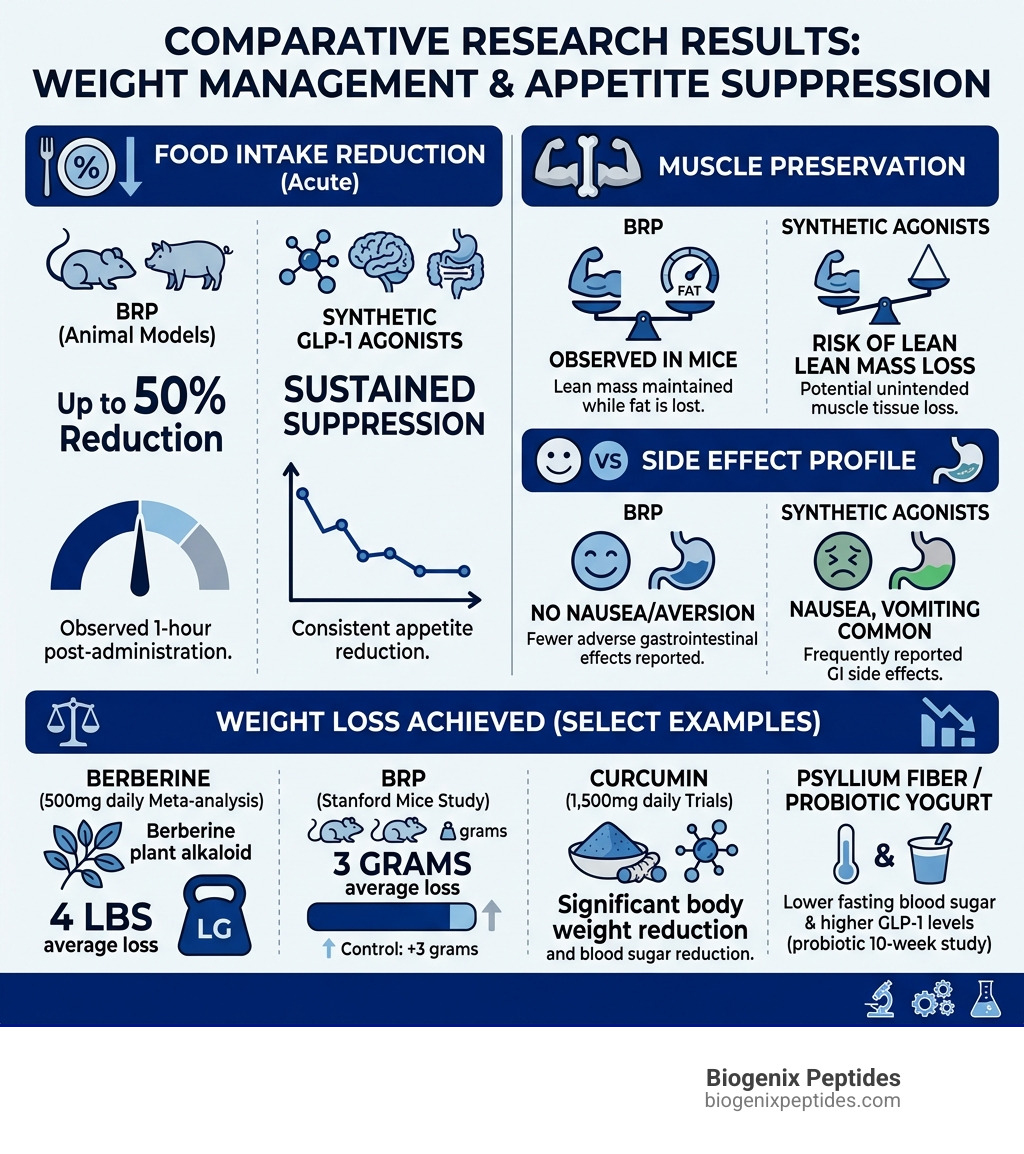
Comparative Research Results: BRP vs. Synthetic Agonists
| Metric | BRP (Animal Models) | Synthetic GLP-1 Agonists |
|---|---|---|
| Target Area | Hypothalamus (Specific) | Brain, Gut, Pancreas (Widespread) |
| Food Intake Reduction | Up to 50% (Acute) | Sustained suppression |
| Side Effect Profile | No nausea/aversion observed | Nausea, vomiting common |
| Muscle Preservation | Observed in mice | Risk of lean mass loss |
Non-Peptide Research Compounds for Metabolic Health
When looking for natural peptide injection alternatives, many researchers also examine non-peptide compounds that mimic some of the metabolic effects of GLP-1. These are often easier to source and have a longer history of human data, though their effects are generally more modest.
- Berberine: Often dubbed “nature’s Ozempic” on social media, berberine is a plant alkaloid. Research indicates it may activate AMPK, an enzyme that regulates metabolism.
- Curcumin: Found in turmeric, this compound is studied for its ability to reduce inflammation and improve insulin sensitivity in subjects with metabolic syndrome.
- Psyllium Fiber: Soluble fiber is perhaps the most “natural” way to stimulate the body’s own GLP-1 production. When fiber ferments in the gut, it triggers the release of endogenous GLP-1.
For more information on how these fit into the broader landscape, visit our Category: Peptide Basics or read our specific analysis on A Look at Natural Peptide Research for Metabolic Health.
Comparative Statistics in Weight Management Research
The data from various trials provides a clear picture of the efficacy gap between lifestyle supplements and research peptides:
- Berberine: A meta-analysis showed that subjects taking 500mg daily lost an average of 4 lbs over the study period.
- BRP (Stanford Mice Study): Obese mice treated with daily BRP for 14 days lost an average of 3 grams (almost entirely fat), while the control group gained 3 grams.
- BRP (Minipig Study): Showed a 50% reduction in food intake in the hour following administration.
- Curcumin: Trials using 1,500mg daily showed significant reductions in blood sugar and body weight in diabetic subjects.
- Probiotic Yogurt: A 10-week study in obese adults showed higher natural GLP-1 levels and lower fasting blood sugar.
Safety Profiles and Regulatory Status in April 2026
The regulatory environment for peptides is constantly evolving. As of April 2026, the most significant update remains the February 2026 FDA reclassification. This move restored “Category 1” status to 14 key peptides, including BPC-157 and GHK-Cu, allowing licensed compounding pharmacies to prepare them under specific conditions.

However, it is vital to distinguish between compounded medications and “research-use-only” (RUO) peptides. RUO peptides are intended for laboratory research and are not approved for human consumption. Quality control is paramount in this space, which is Why Research Peptides Are Typically Lyophilized—a process of freeze-drying that preserves the molecular structure and extends shelf life for research purposes.
Protocol Considerations for Research Subjects
In a laboratory setting, the integrity of the research depends on precise preparation. Most research peptides arrive in a lyophilized (powder) state and require careful handling.
- Reconstitution: This is the process of adding a liquid medium to the powder to create a solution. Researchers must use sterile techniques to avoid contamination.
- Bacteriostatic Water: This is the standard medium used because it contains a small amount of benzyl alcohol to inhibit bacterial growth.
- Ratios: The concentration of the solution must be calculated accurately to ensure consistency across research trials.
For detailed technical guidance, researchers refer to Reconstituting Lyophilized Peptides Step-by-Step and The Science of the Bacteriostatic Water Peptide Ratio.
Frequently Asked Questions about Peptide Research
Do natural peptides cause the same nausea as synthetic GLP-1 agonists?
In preclinical research models, naturally occurring peptides like BRP have not demonstrated the nausea or “food aversion” typical of synthetic GLP-1 drugs. This is likely because BRP targets receptors specifically in the hypothalamus, whereas synthetic agonists interact with receptors in the gut and brainstem, which can trigger the “queasy” feeling.
What is the difference between BPC-157 and BRP in fat loss models?
BPC-157 is primarily studied for its “Body Protection” properties—healing the gut, reducing systemic inflammation, and repairing tendons. While it may support metabolic health indirectly by improving gut function, it is not a direct appetite suppressant. BRP, however, is being researched specifically for its potent ability to signal the brain to stop eating.
Are natural peptides like GHK-Cu effective for skin integrity in research models?
Yes, GHK-Cu is one of the most well-documented peptides for skin research. Studies consistently show that it can increase collagen production by up to 70% in certain cell cultures. It is considered a “natural” alternative because the GHK sequence is native to human blood, though the versions used in research are synthesized to match that natural sequence exactly.
Conclusion
As we look toward the future of regenerative medicine, the shift toward natural peptide injection alternatives represents a move toward biological harmony. Whether it’s the hypothalamus-specific action of BRP or the mitochondrial support of MOTS-c, these compounds offer a glimpse into a world where we can support the body’s own pathways rather than overriding them.
At Biogenix Peptides, we are committed to providing the highest-purity compounds to support the next generation of metabolic and longevity research. By focusing on quality, transparency, and the latest scientific data, we help researchers unlock the potential of these remarkable signaling molecules.
Ready to advance your preclinical studies? Explore the latest research compounds and join us at the forefront of peptide science.