
Ultimate Guide to Reputable Peptide Stores Online
Disclaimer: The information provided in this article is for educational and informational purposes only. It is not intended as medical advice, diagnosis, or treatment. Products and compounds referenced are for research use only and are not approved for human or veterinary consumption. Always consult a qualified professional regarding health or medical decisions.
Why Is Finding a Reputable Peptide Store Online So Critical?
In the rapidly expanding landscape of peptide research as of June 2026, the online marketplace has grown exponentially. While this offers unprecedented access to diverse amino acid sequences, it also introduces substantial risks. Sourcing high-purity compounds is not merely a matter of financial prudence; it is an absolute necessity for scientific reproducibility. When we conduct laboratory experiments, the chemical integrity of our starting materials dictates the validity of our entire project.
If a research compound contains even minor impurities, those contaminants can introduce uncontrolled variables into the experimental system. For instance, residual trifluoroacetic acid (TFA) salts, heavy metals, or incomplete peptide sequences can bind to target receptors, alter cell culture viability, or skew spectrophotometric readings. This makes it impossible to determine whether the observed biological effect was caused by the target peptide or by an underlying contaminant. Consequently, months of laboratory work and thousands of dollars in research funding can be instantly invalidated.
Furthermore, the rise of unregulated online storefronts has flooded the market with sub-standard materials. Many of these websites operate without physical addresses, verifiable laboratory testing, or secure payment processing. By serving as an educational and sourcing benchmark for researchers, we at Biogenix Peptides aim to elevate the standards of the entire industry. We believe that transparency, rigorous quality control, and scientific literacy are the cornerstones of successful laboratory research. For those who are new to sourcing these compounds, our comprehensive Beginners Guide to Buy Peptides Online provides an invaluable starting point to navigate this complex marketplace safely.
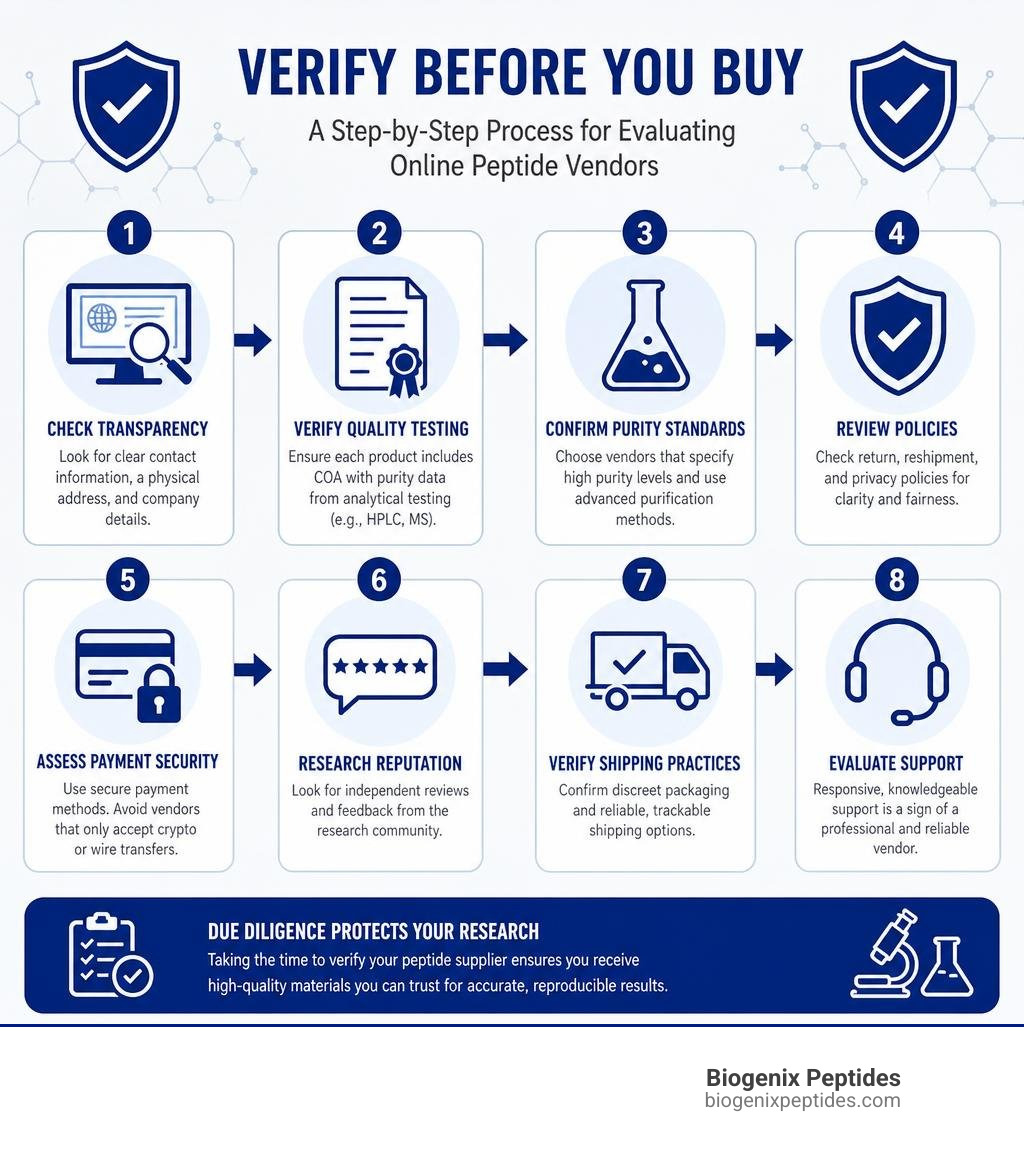
What Are the Most Reputable Online Stores for High-Quality Peptides?
When searching for high-quality peptides online, researchers must distinguish between bulk chemical manufacturers and specialized, research-grade retail suppliers. Bulk manufacturers typically serve large pharmaceutical companies and institutional laboratories, requiring high minimum order quantities and formal procurement accounts. Specialized retail suppliers, on the other hand, cater to independent laboratories, academic researchers, and smaller biotech firms by offering smaller quantities of highly purified, ready-to-reconstitute compounds.
To help you navigate these options, we have compiled a comparison table outlining the key differences between these supplier types:
| Supplier Type | Target Audience | Quality Verification | Key Advantage | Minimum Order Requirements |
|---|---|---|---|---|
| Global Biotech Manufacturers | Institutional Labs, Pharma | In-house HPLC & Mass Spec, GMP-certified facilities | Extreme volume capacity, custom synthesis | High (often thousands of dollars) |
| Specialized Research Suppliers | Independent Labs, Academics | Third-party independent testing (e.g., Janoshik) | Rapid shipping, accessible quantities, retail support | None (single-vial options available) |
Choosing the right partner is essential to protect your research budget and ensure the continuity of your projects. For a broader perspective on domestic sourcing options, you can review A Massive List of Peptide Suppliers USA to see how different entities compare in terms of regional availability and service offerings.
Global Scientific and Biotech Manufacturers
Global biotechnology and chemical manufacturers represent the backbone of the global peptide supply chain. These massive corporations operate state-of-the-art facilities that comply with Current Good Manufacturing Practices (cGMP) and ISO standards. They primarily produce high-volume catalog peptides, custom amino acid derivatives, and bulk reagents for clinical trials and industrial applications.
Among the most prominent global entities are established multinational corporations with over 50 years of experience in peptide and oligonucleotide development and manufacture. These manufacturers offer thousands of different biologically active peptides, amino acid derivatives, and reagents, making them a primary source for major pharmaceutical companies. Similarly, leading global synthesis providers have established themselves as industry leaders, having provided high-quality peptides to more than 10,000 customers worldwide over decades of operation. Researchers looking for ready-to-ship catalog compounds for specific therapeutic areas—such as diabetes, neuroscience, or oncology—frequently utilize comprehensive global databases to locate highly purified reference standards.
While these global giants offer unmatched manufacturing capacity and institutional credibility, their procurement processes can be highly bureaucratic. Sourcing from them typically requires establishing corporate accounts, navigating complex regulatory paperwork, and waiting weeks or months for custom synthesis queues. For independent researchers, these hurdles can slow down the pace of discovery.
Specialized Research-Grade Peptide Suppliers
To bridge the gap between industrial manufacturers and independent laboratories, specialized online stores have emerged as the preferred sourcing channel for many researchers. These platforms offer the agility, customer support, and accessible quantities that large corporations cannot provide, while maintaining the same rigorous purity standards.
A prime example of an established, specialized domestic supplier is a manufacturer servicing the bio-research field for over 30 years, producing its research peptides, antibodies, and assay kits directly in the United States. Operating out of advanced facilities in major scientific hubs, such companies are highly regarded for their scientific precision. Researchers can explore extensive inventories of specialized neuropeptides and endocrine markers through dedicated domestic research portals.
At Biogenix Peptides, we position ourselves alongside these elite domestic suppliers by offering a highly curated catalog of ultra-pure compounds. We understand that independent researchers need more than just a product; they need verifiable proof of quality, responsive customer service, and secure, rapid shipping. By focusing on batch-specific third-party testing and transparent reporting, we ensure that your laboratory projects are supported by compounds of the highest caliber. To understand how to balance cost and quality without compromising your experimental standards, read our guide on Where to Buy Peptides Without Losing Your Gains or Your Shirt.
Evaluating Domestic vs. International Research Suppliers
When sourcing research materials, the geographic location of the supplier plays a critical role in both quality control and legal compliance. Sourcing from domestic (U.S.-based) suppliers offers distinct advantages over purchasing from international entities.
First, domestic suppliers are subject to U.S. federal and state laws, which provides a layer of accountability that foreign entities lack. If a domestic supplier claims a purity level of 99% but delivers a contaminated batch, researchers have legal recourse and consumer protection. Second, international shipping introduces severe logistical risks. Peptides are delicate molecular structures that can easily degrade when subjected to the extreme temperatures, prolonged transit times, and physical agitation common in international customs facilities. A package held in a warm customs warehouse for two weeks can arrive completely inactive, even if it left the manufacturing facility at 99% purity. By sourcing domestically, you ensure rapid transit times, temperature-controlled shipping options, and consistent compound integrity.
How Can Researchers Verify the Purity and Quality of Peptides Online?
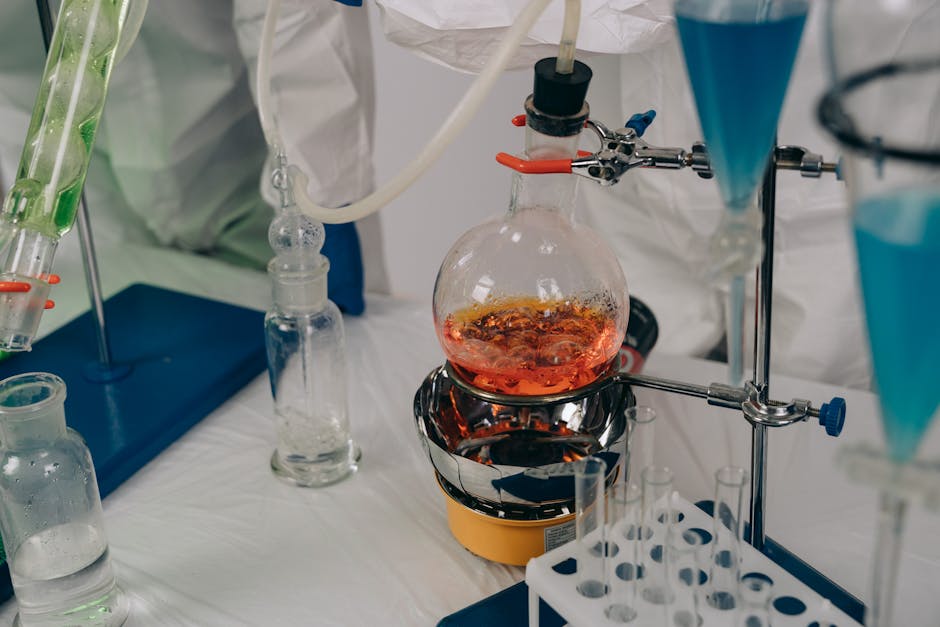
In an industry where visual inspection cannot distinguish between a high-purity peptide and a vial of plain mannitol powder, verification is everything. Independent, third-party testing is the absolute gold standard for quality assurance. Researchers should never rely on a supplier’s in-house claims or self-issued certificates, as these documents can easily be fabricated or outdated.
To see a practical demonstration of how different online sources compare under real-world scrutiny, you can watch this video analysis: I Tested 10 Research Grade Peptide Sites! #peptides – YouTube . This resource highlights the stark differences in quality and transparency across various online retailers, reinforcing the need for rigorous independent verification.
Understanding Certificates of Analysis (CoA)
A Certificate of Analysis (CoA) is the birth certificate of a peptide batch. A legitimate, trustworthy CoA must be issued by an independent, ISO/IEC 17025 accredited analytical laboratory (such as Janoshik Analytical) and must include several key components:
- Batch-Specific Identification: The batch number on the CoA must match the batch number printed on the vial you receive.
- High-Performance Liquid Chromatography (HPLC) Chromatogram: This test measures the purity of the peptide. The chromatogram should show a single, sharp peak representing the target compound, with minimal secondary peaks (which represent impurities).
- Mass Spectrometry (MS) Identity Profile: While HPLC measures purity, MS confirms identity. It measures the molecular weight of the compound to ensure that the synthesized amino acid sequence matches the target peptide’s theoretical mass.
- Verifiable Laboratory Credentials: The CoA should feature a unique verification code or QR code that allows you to verify the report directly on the testing laboratory’s independent website. This prevents dishonest vendors from altering old reports or copying CoAs from other suppliers.
Purity Standards for Scientific Research
For scientific research, the baseline acceptable purity level for peptides is 98%, though reputable vendors should ideally guarantee 99% or higher to set a high standard for laboratory-grade materials.
Why is this 1% or 2% difference so critical? During the chemical synthesis process (typically Fmoc solid-phase peptide synthesis), incomplete couplings or side reactions can occur. If these truncated sequences or protective group residues are not meticulously purified out via preparative HPLC, they remain in the final lyophilized powder. In cellular assays or receptor-binding studies, these structurally similar impurities can act as competitive antagonists or agonists, completely skewing your data. Furthermore, high-purity peptides are typically lyophilized under sterile conditions and vacuum-sealed in glass vials. This prevents moisture ingress and bacterial contamination, both of which accelerate chemical degradation pathways like hydrolysis and oxidation.
What Are the Key Differences Between FDA-Approved, Compounded, and Research-Grade Peptides?

Navigating the peptide market requires a clear understanding of how these compounds are classified legally and regulatory-wise. The intended application of the peptide dictates the legal channel through which it must be sourced. Sourcing a compound through the wrong channel can lead to legal issues, financial loss, or compromised research. To help you navigate these classifications, our comprehensive Buying Guide provides a detailed breakdown of the purchasing process.
FDA-Approved Peptides
FDA-approved peptides are commercial pharmaceutical products that have undergone extensive, multi-phase clinical trials to prove their safety and efficacy in humans. These compounds are manufactured in highly regulated, federally inspected facilities and are approved for specific therapeutic indications. Examples include insulin for diabetes management, specific GLP-1 receptor agonists for metabolic research, Tesamorelin for lipodystrophy, and PT-141 for sexual dysfunction.
Because these are approved medical treatments, they can only be legally sourced through licensed commercial pharmacies and require a valid prescription from a licensed healthcare provider. They are subject to strict quality control standards enforced by the FDA, ensuring absolute consistency in concentration and sterile formulation.
Compounded Peptides
Compounded peptides are custom-formulated medications prepared by state-licensed compounding pharmacies. Under Section 503A of the Federal Food, Drug, and Cosmetic (FD&C) Act, compounding pharmacies are permitted to combine, mix, or alter ingredients to create customized medications for individual patients based on a specific prescription. This is highly valuable when a patient requires a specific strength, a preservative-free formulation, or an alternative delivery method that is not commercially available.
Compounding pharmacies source their active pharmaceutical ingredients (APIs) from FDA-registered chemical manufacturers. However, because compounded peptides are prepared for individual patients, they do not undergo the formal FDA approval process for safety and efficacy that commercial pharmaceuticals do. Their quality and sterility are governed by state boards of pharmacy and United States Pharmacopeia (USP) standards, such as USP <797> for sterile compounding.
Research-Grade Peptides (RUO)
Research-grade peptides are designated strictly for “Research Use Only” (RUO). These compounds are synthesized specifically for laboratory experimentation, in vitro assays, and animal studies. They are strictly prohibited from human or veterinary consumption, and their packaging must clearly reflect this restriction.
Because RUO peptides are not intended for human use, they do not require FDA approval, nor do they require a prescription to purchase. However, they must still be manufactured to incredibly high chemical purity standards to ensure scientific validity. Reputable online stores sell these compounds exclusively to researchers and scientific institutions, enforcing strict terms of service to prevent unauthorized human utilization.
What Legal and Regulatory Considerations Apply to Buying Peptides Online in 2026?
The legal landscape surrounding peptide acquisition is highly dynamic and has undergone significant shifts over the last several years. Researchers must stay informed of these changes to ensure their procurement practices remain fully compliant with federal and state regulations. For ongoing updates on legal developments and compliance strategies, check our dedicated Category: Buying Guide section.
The 2024–2026 FDA Regulatory Timeline
If you have followed peptide regulatory policies over the last few years, you have witnessed rapid adjustments. By late 2024, the FDA enacted a major crackdown, moving 19 popular peptides to the restricted Category 2 list. This restriction effectively prohibited compounding pharmacies from preparing these compounds, severely limiting access for clinical research and therapeutic applications.
However, the regulatory pendulum swung again in early 2026. In April 2026, 14 of those restricted peptides were moved out of Category 2 restriction, pending a formal FDA advisory review scheduled for late July 2026. This reclassification has created a transitional period where researchers and compounding pharmacies are preparing for a potential reopening of access to these compounds.
As of mid-2026, only 6 peptides remain fully legal to compound or prescribe without pending regulatory hurdles:
- Sermorelin
- Tesamorelin
- PT-141
- Gonadorelin
- NAD+
- Glutathione
Understanding this timeline is critical when evaluating online vendors. Any retail store claiming to sell restricted peptides for human consumption in 2026 is operating outside the law and should be avoided immediately.
Sourcing Peptides Legally and Safely
To ensure your procurement practices are fully compliant, you must strictly adhere to the “Research Use Only” framework. Reputable online peptide stores will always require buyers to agree to terms of service stating that the compounds will be utilized solely for laboratory research and will not be administered to humans or animals outside of approved scientific protocols.
Furthermore, importing research chemicals from unregulated international suppliers carries severe legal and financial risks. U.S. Customs and Border Protection (CBP) regularly seizes shipments of unlabeled or mislabeled chemical substances. If a shipment is seized, the buyer can face federal investigation for importing unapproved new drugs. Sourcing from compliant, domestic suppliers like Biogenix Peptides eliminates these risks, ensuring that your research materials are legally acquired and safely delivered.
What Red Flags Should Buyers Watch For to Avoid Counterfeit Peptides?
The popularity of peptide research has unfortunately attracted bad actors to the online marketplace. Counterfeit, sub-strength, or contaminated products are common among low-quality vendors. Protecting your research budget and laboratory safety requires a keen eye for common red flags.
Common Red Flags in Online Peptide Stores
When evaluating an online peptide supplier, watch out for the following warning signs:
- Unusually Low Prices: High-quality peptide synthesis, purification, and independent third-party testing are expensive processes. If a vendor offers bulk discounts or prices that are significantly lower than the market average, the products are likely sub-strength, contaminated, or entirely counterfeit.
- Marketing for Human Consumption: Legitimate research suppliers will never market their products for human application, provide administration guidelines, or discuss clinical outcomes. If a website uses prohibited medical terms or explains how to administer the compounds, they are violating federal regulations and likely selling sub-standard materials.
- Missing or Altered CoAs: A reputable vendor must provide batch-specific, verifiable third-party CoAs. If the lab reports on the website are blurred, outdated, missing batch numbers, or lack a verification QR code, treat the vendor with extreme suspicion.
- Unprofessional Storefronts: Avoid websites that lack secure payment processing (such as SSL encryption), do not provide a clear physical address or contact information, or only accept payment via untraceable methods like cryptocurrency or peer-to-peer transfer apps without alternative options.
For researchers looking to secure high-quality materials while maximizing their budget through legitimate promotional channels, we recommend reviewing our guide on The Best Peptide Coupon Codes for Beginners to find verified discounts from reputable suppliers.
Shipping, Storage, and Handling Red Flags
Peptides are delicate chains of amino acids held together by peptide bonds. They are highly susceptible to environmental degradation. Exposure to extreme heat, UV light, or violent physical agitation can cause the secondary and tertiary structures of the protein to unfold (denature), rendering the compound biologically inactive.
A major red flag for any peptide vendor is improper shipping and storage practices. If a supplier ships lyophilized peptides in plain, uninsulated bubble mailers during the height of summer without temperature-protected inserts or cold packs, the compounds are highly likely to arrive degraded. Reputable vendors invest in robust packaging, fast shipping options, and proper handling protocols to ensure the molecular stability of the compounds during transit.
What Are the Most Common Questions About Buying Peptides Online?
To help researchers navigate the procurement process with confidence, we have compiled answers to the most frequently asked questions regarding online peptide acquisition.
Do I need a prescription to purchase research-grade peptides online?
No, a prescription is not required to purchase genuine “Research Use Only” (RUO) peptides. Because these compounds are sold strictly for in vitro laboratory experimentation and animal research under approved scientific protocols, they do not fall under the jurisdiction of medical prescribing laws. However, buyers must represent a legitimate research entity or academic institution and agree to terms of service prohibiting any human consumption.
How should research peptides be stored to prevent degradation?
Lyophilized (freeze-dried) peptide vials should be stored in a cool, dark environment to prevent degradation pathways such as oxidation, hydrolysis, and deamidation. For short-term storage (up to a few months), keeping the vials refrigerated at 2°C to 8°C is typically sufficient. For long-term preservation (up to several years), the vials should be stored in a medical-grade freezer at -20°C or lower. Once a peptide is reconstituted into a liquid solution, it becomes far more unstable and must be kept refrigerated and utilized within a short timeframe, typically 14 to 30 days, depending on the specific sequence.
What is the significance of a 99% purity guarantee?
A 99%+ purity guarantee, verified by independent HPLC and mass spectrometry, indicates that the vial contains virtually no synthesis byproducts, residual solvents, or heavy metals. In scientific research, this level of purity is critical to prevent experimental interference. Even a 1% impurity can introduce active chemical contaminants that bind to non-target receptors, alter cellular signaling, or cause cell death in culture, producing false-positive or false-negative results and ruining the reproducibility of your study.
How Can You Secure High-Quality Peptides for Your Next Research Project?
Sourcing high-quality peptides online in June 2026 requires a disciplined approach centered on scientific integrity, regulatory compliance, and rigorous quality verification. By prioritizing suppliers that provide batch-specific, third-party Certificates of Analysis from accredited laboratories, you protect both your research data and your budget. Avoid vendors that exhibit red flags such as marketing for human consumption, unusually low pricing, or lack of transparent contact information.
Whether you are conducting metabolic studies, tissue repair research, or cellular assays, the quality of your starting materials is non-negotiable. At Biogenix Peptides, we are committed to supporting the scientific community by providing ultra-pure, independently verified research compounds that you can trust.
Ready to elevate the standard of your laboratory experiments? Explore our fully transparent, independently tested catalog of research-grade compounds at the Biogenix Peptides Shop today.