The Ultimate Guide to Sourcing Wholesale Peptides Domestically
Disclaimer: The information provided in this article is for educational and informational purposes only. It is not intended as medical advice, diagnosis, or treatment. Products and compounds referenced are for research use only and are not approved for human or veterinary consumption. Always consult a qualified professional regarding health or medical decisions.
Sourcing from Wholesale Peptide Suppliers USA
Sourcing research compounds from domestic wholesale peptide suppliers USA offers significant advantages over international channels. When dealing with overseas manufacturing, researchers often face unpredictable customs delays, potential seizures, and a lack of recourse if a batch fails to meet quality standards. By contrast, domestic sourcing ensures that products are synthesized, tested, and distributed under strict United States regulatory and quality frameworks.
The domestic supply chain is built on rapid turnaround times and high accountability. Sourcing domestically allows research institutions to secure bulk procurement contracts with predictable lead times, insulated from the geopolitical and logistic disruptions common in international shipping. Furthermore, domestic suppliers are subject to strict local oversight, which guarantees that the chemical integrity of the compounds is maintained from synthesis to delivery. This level of reliability is crucial for longitudinal laboratory studies where consistency across batches is paramount. For a comprehensive look at domestic options, you can review A Massive List of Peptide Suppliers USA to map out potential partners.
Quality Control and Analytical Verification Standards

In peptide synthesis, purity is the single most critical metric. Reputable domestic suppliers operate under strict analytical testing protocols to guarantee that their compounds reach a purity threshold of $\geq99\%$. This verification relies on two primary analytical techniques: High-Performance Liquid Chromatography (HPLC) and Mass Spectrometry (MS).
Every bulk batch must be accompanied by a third-party Certificate of Analysis (COA). While many suppliers claim high purity, top-tier domestic manufacturers provide accessible, verifiable COAs for every single batch before purchase. This transparency allows researchers to verify the exact chemical composition of their orders, ensuring that no unexpected contaminants or synthesis byproducts interfere with experimental models.
| Analytical Method | Primary Function | Why It Matters for Peptide Quality |
|---|---|---|
| High-Performance Liquid Chromatography (HPLC) | Separates, identifies, and quantifies each component in a mixture. | Confirms the exact purity percentage of the target peptide (ensuring it is $\geq99\%$). |
| Mass Spectrometry (MS) | Measures the mass-to-charge ratio of ions to determine molecular weight. | Verifies the identity of the compound, ensuring no structural anomalies or incorrect sequences. |
However, analytical chemistry is only part of the equation. Advanced suppliers recognize that standard HPLC and MS testing do not detect biological or inorganic contaminants. To ensure true research integrity, premium batches undergo additional screening:
- Endotoxin Testing: Endotoxins are biologically active bacterial remnants that can survive sterilization and corrupt research data. Leading suppliers enforce a strict endotoxin threshold of $\leq 0.05 \text{ EU/mL}$.
- Heavy Metals Analysis: Inductively Coupled Plasma Mass Spectrometry (ICP-MS) is utilized to screen for lead, arsenic, mercury, and cadmium introduced during chemical synthesis.
- Sterility Testing: Ensures the complete absence of living microbial contamination, which is vital for maintaining sterile laboratory environments.
By insisting on these rigorous standards, laboratories can prevent experimental anomalies and ensure that their research findings are reproducible and scientifically valid. To understand how to navigate these quality metrics without overpaying, consult our guide on Where to Buy Peptides Without Losing Your Gains or Your Shirt.
Product Categories, Custom Synthesis, and Pricing

Domestic wholesale suppliers maintain diverse catalogs to support varied scientific inquiries, alongside custom manufacturing options for novel sequences.
Popular Research Compounds from Wholesale Peptide Suppliers USA
Reputable USA suppliers offer a wide selection of in-stock research peptides. These compounds are categorized by their primary research applications:
- Tissue Repair & Recovery: Compounds like BPC-157 and TB-500 are highly sought after for studying cellular regeneration, angiogenesis, and wound healing pathways in laboratory models.
- Metabolic & Weight Management Research: GLP-1 and GIP receptor agonists, such as Semaglutide and Tirzepatide, are widely distributed for metabolic studies, insulin sensitivity research, and appetite regulation pathways.
- Growth Hormone Secretagogues: Peptides such as Sermorelin, Ipamorelin, and CJC-1295 (with or without DAC) are utilized to study growth hormone pathways, pituitary function, and cellular signaling.
- Other Specialized Compounds: Melanotan 2, IGF-1 LR3, Epitalon, and DSIP are frequently supplied for research into dermal biology, cellular longevity, and sleep regulation.
For those new to acquiring these compounds, our Beginners Guide to Buy Peptides Online provides an excellent starting point.
Custom Synthesis and White-Label Solutions
For unique research needs, top-tier suppliers offer custom peptide synthesis using advanced Solid-Phase Peptide Synthesis (SPPS) methods. This allows researchers to specify custom sequences, purity levels, and modifications (such as biotinylation, phosphorylation, or cyclization) tailored to their specific experimental designs. Beyond raw synthesis, wholesale providers offer versatile business-to-business services for qualified research organizations:
- Bulk Supply (API): Raw active pharmaceutical ingredients provided in bulk quantities for large-scale laboratory studies and high-throughput screening.
- White-Label & Private Label Manufacturing: Lyophilized vials produced, packaged, and prepared for custom branding with flexible labeling options (including non-branded or fully customized solutions) for research-only distribution.
- Dropshipping and Fulfillment: Direct-to-lab or direct-to-qualified-research-site fulfillment options for licensed research networks, streamlining the supply chain while maintaining RUO handling requirements.
To assist buyers in navigating these options, suppliers structure their pricing on tiered volume discounts. For example, wholesale discount tiers are typically structured at 20, 50, 100, 250, 500, and 1,000 unit thresholds, allowing laboratories to lower their cost-per-vial significantly. For a structured breakdown of purchasing steps, check our comprehensive Buying Guide.
Regulatory Compliance and Logistics
Navigating the regulatory landscape is essential when purchasing wholesale peptides. Within the United States, these compounds are strictly classified as Research Use Only (RUO). They are not approved by the FDA for human or veterinary consumption, diagnostic procedures, or therapeutic applications. Reliable suppliers emphasize this distinction with clear labeling, disclaimers, and strict buyer verification processes to ensure that these materials are only handled by qualified laboratory personnel.
Furthermore, premium domestic suppliers operate within Current Good Manufacturing Practice (CGMP) compliant facilities. This ensures that every step of the synthesis, purification, and vial-filling process is documented, validated, and controlled under rigorous laboratory standards, minimizing the risk of cross-contamination. For general background on these standards, researchers can review the FDA’s overview of Current Good Manufacturing Practice regulations.
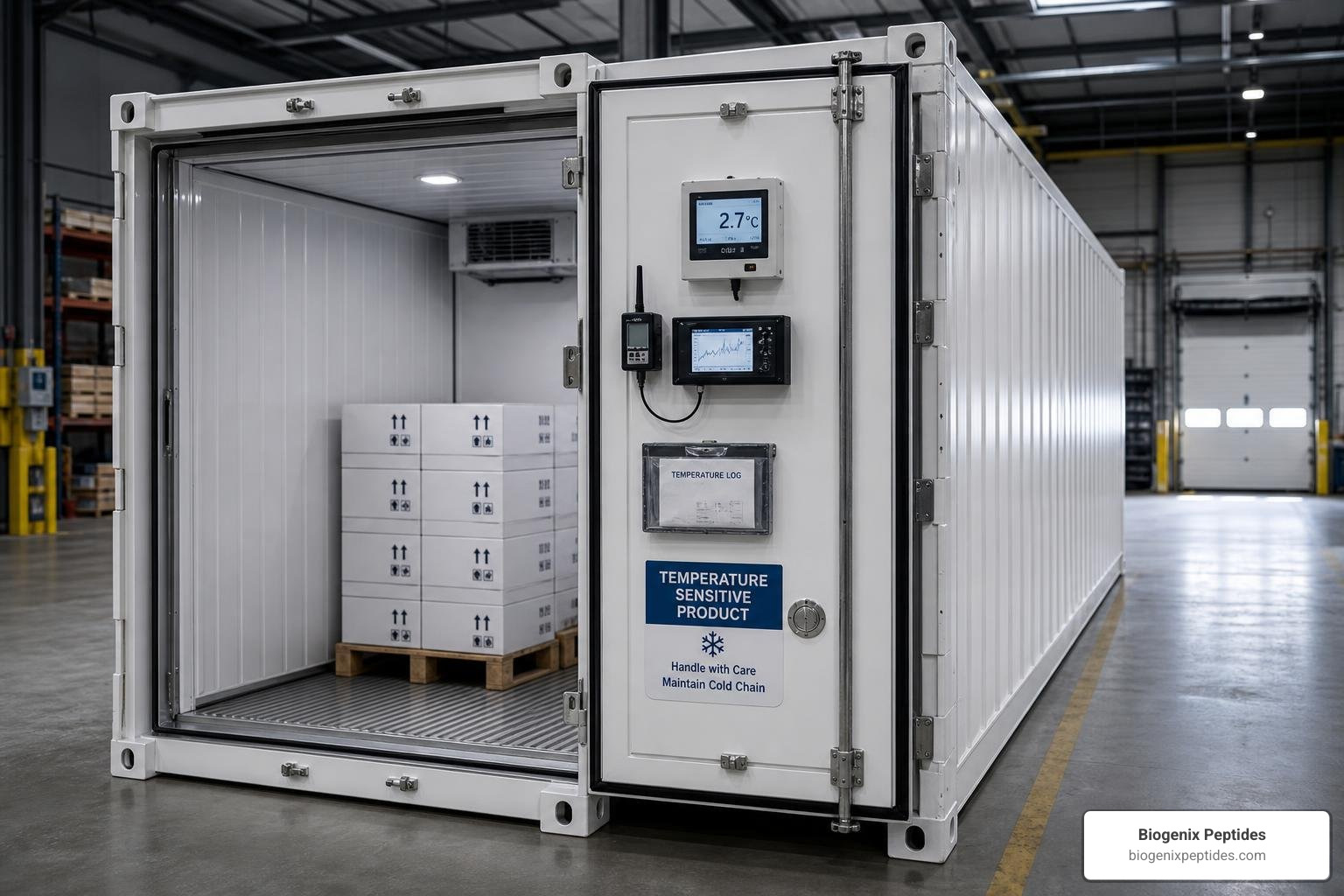
Logistics play an equally vital role in preserving peptide integrity. Peptides are highly sensitive to temperature, light, and moisture.
- Lyophilized Powder: To maximize stability, peptides are supplied as vacuum-sealed lyophilized (freeze-dried) powders. In this state, they can remain stable for 2 to 3 years at room temperature, though long-term storage is recommended at $-20^\circ\text{C}$.
- Cold-Chain Shipping: To prevent thermal degradation during transit, suppliers utilize temperature-controlled packaging and rapid shipping methods. Most domestic orders ship via express carriers (such as FedEx or UPS) with same-day dispatch on weekday orders, ensuring delivery within 2 to 3 business days across the USA.
For more details on shipping standards and purchasing regulations, explore our dedicated Category: Buying Guide.
Vetting Wholesale Peptide Suppliers USA Safely
When selecting a wholesale partner, researchers must perform due diligence. Do not rely solely on a supplier’s marketing claims. Verify that they:
- Provide batch-specific HPLC-MS analytical data and independent third-party COAs prior to purchase.
- Conduct comprehensive contaminant screening, including endotoxin and heavy metal testing.
- Offer clear quality guarantees (such as a 30-day guarantee on unopened products).
- Maintain transparent customer service channels with technical support for solubility and handling inquiries.
At Biogenix Peptides, we emphasize these vetting standards to ensure research integrity across the scientific community.
Frequently Asked Questions
What is the standard purity level for wholesale research peptides?
Reputable domestic suppliers maintain a minimum purity threshold of $\geq99\%$. This level of purity is verified via analytical HPLC and Mass Spectrometry to ensure that no synthesis byproducts or truncated sequences compromise research data. High-purity peptides are essential for ensuring that experimental results are not skewed by impurities or structural anomalies.
How should lyophilized peptides be stored for long-term stability?
Lyophilized peptides should be stored at $-20^\circ\text{C}$ for long-term preservation. For short-term storage (under 1–3 months), a standard refrigerator temperature of $2^\circ\text{C}$ to $8^\circ\text{C}$ is acceptable, provided the vials are kept away from light and moisture. Once reconstituted with a sterile solvent, the peptides should be stored at $2^\circ\text{C}$ to $8^\circ\text{C}$ and typically utilized in laboratory assays within 14 to 21 days to avoid gradual degradation. It is critical to avoid repeated freeze-thaw cycles, as this can damage the peptide’s delicate structure.
Why is domestic sourcing preferred over international suppliers?
Domestic sourcing ensures faster shipping times (often 2–3 days), eliminates the risk of customs seizures, and guarantees that the products are synthesized under US quality and regulatory standards. Additionally, domestic suppliers offer easier communication, technical support, and reliable recourse under US business laws if a batch fails to meet specifications. This level of security is invaluable for maintaining strict research timelines.
Conclusion
Securing a reliable domestic partner among the available wholesale peptide suppliers USA is foundational to the success of your laboratory or clinical research. By prioritizing suppliers that offer verified $\geq99\%$ purity, transparent third-party COAs, and robust cold-chain logistics, you protect your research from contamination and inconsistent variables. Investing in high-quality, domestically sourced compounds ensures that your experimental data remains robust, reproducible, and scientifically sound.
When you are ready to source high-purity, domestically distributed compounds backed by rigorous testing, visit the Biogenix Peptides Shop to explore our catalog of research-grade peptides.