
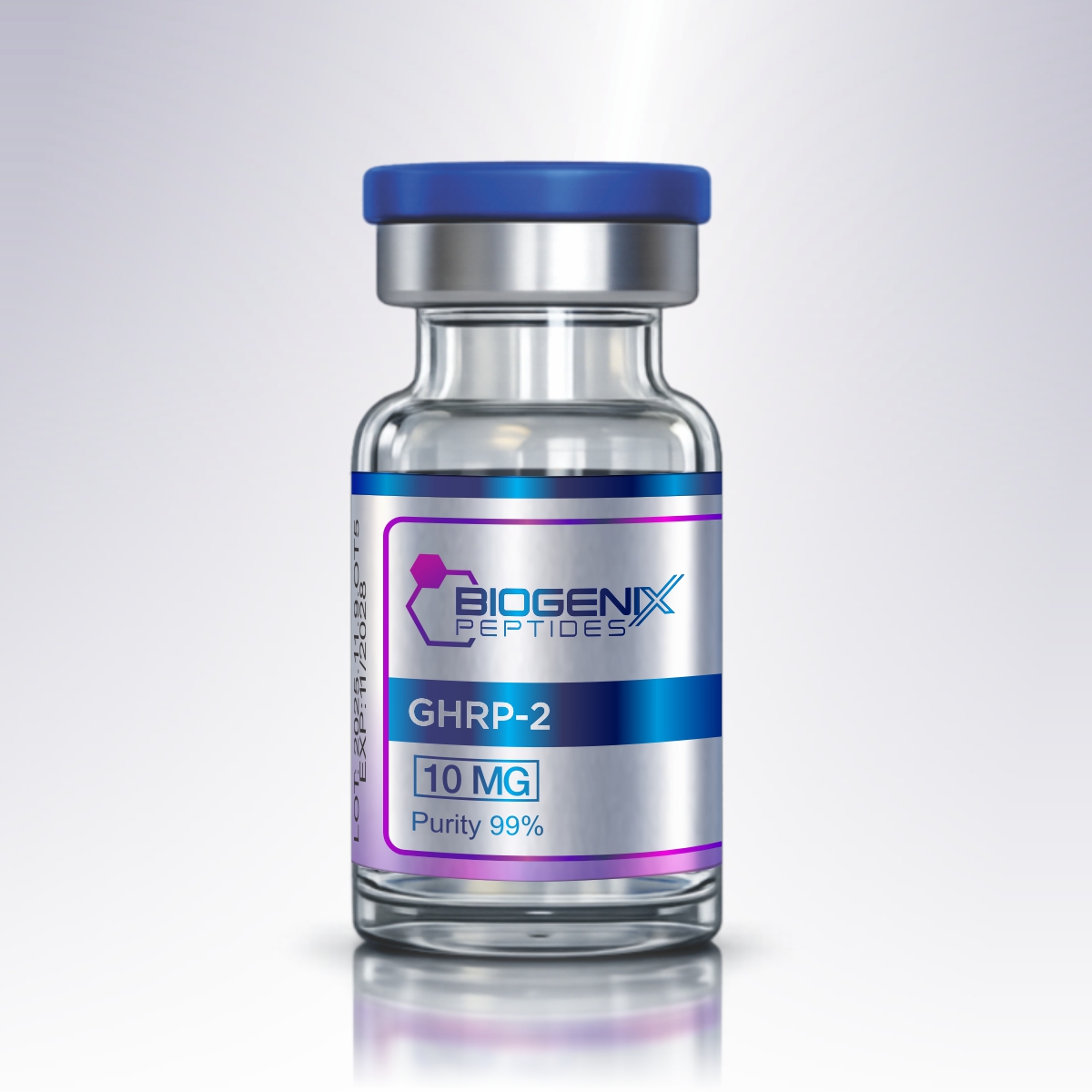
GHRP-2 10mg
$48.00
GHRP-2 (pralmorelin) is a synthetic pentapeptide and growth hormone-releasing peptide (GHRP) that acts as an agonist of the ghrelin (growth hormone secretagogue) receptor, GHS-R1a. Although structurally related to met-enkephalin, GHRP-2 lacks neurotransmitter-like effects and instead engages endocrine pathways to stimulate growth hormone (GH) secretion. Beyond the pituitary, GHS-Rs are distributed in the hypothalamus and peripheral tissues, linking GHRP-2 to research on appetite, metabolism, inflammation, and tissue protection.
In Stock
GHRP-2 (Growth Hormone Releasing Peptide 2) — Research Overview
Introduction
GHRP-2 (pralmorelin) is a synthetic pentapeptide and growth hormone-releasing peptide (GHRP) that acts as an agonist of the ghrelin (growth hormone secretagogue) receptor, GHS-R1a. Although structurally related to met-enkephalin, GHRP-2 lacks neurotransmitter-like effects and instead engages endocrine pathways to stimulate growth hormone (GH) secretion. Beyond the pituitary, GHS-Rs are distributed in the hypothalamus and peripheral tissues, linking GHRP-2 to research on appetite, metabolism, inflammation, and tissue protection.
Mechanisms of Action
GHRP-2 binds GHS-R1a, a G protein–coupled receptor, initiating intracellular cascades that can include activation of Gαq/11, phospholipase C (PLC), and hydrolysis of PIP2 into IP3 and DAG. IP3 mobilizes intracellular Ca2+, while DAG activates protein kinase C (PKC); together these signals promote GH exocytosis from pituitary somatotrophs. In some models, cAMP generation further amplifies GH synthesis. Receptor desensitization has been observed shortly after exposure, with sensitivity recovering within several hours.
Centrally, GHRP-2 may influence appetite-regulating neurons by enhancing orexigenic neuropeptides (NPY/AgRP), inhibiting anorexigenic α-MSH signaling, and engaging mesolimbic reward circuitry—mechanisms consistent with ghrelin-like increases in food intake.
Chemical Characteristics
| Compound | Type | Molecular Formula | Molecular Weight |
| GHRP-2 | Synthetic growth hormone secretagogue (hexapeptide) | C₄₅H₅₅N₉O₆ | 818.0 g/mol |
Other Titles: Pralmorelin
Research Applications
1. Growth Hormone / IGF-1 Secretion
– Comparative studies reported that GHRP-2 elicits greater GH peaks than native GHRH and can co-elevate prolactin, ACTH, and cortisol in some settings.- Reported findings include: up to ~181-fold higher acute GH spikes versus baseline in cell/organ models; ~47-fold increases in mean 2.5‑hour pulsatile GH output versus placebo; and sustained regimens yielding ~3–5× GH elevations with IGF‑1 rising from ~100 μg/L to ~180 μg/L.
2. Appetite and Energy Intake
– In controlled buffet-style paradigms, GHRP-2 exposure increased caloric intake by ~36% versus saline, with energy intake per kg rising to approximately 136 kJ/kg compared with ~101 kJ/kg in controls. GH area‑under‑curve also increased markedly in parallel.
3. Muscle Catabolism and Tissue Protection (Preclinical)
– Thermal‑injury murine models suggest reductions in inflammatory markers (e.g., IL‑6) and muscle atrophy mediators (MuRF‑1, MAFbx), with indications of lowered muscle protein breakdown. Case observations have described associated weight and lean mass gains.
4. Oxidative Stress, Atherogenic Signaling, and Inflammation
– In ApoE−/− mice, prolonged GHRP-2 exposure was linked to higher circulating IGF‑I, reduced aortic superoxide production, and lower expression of pro‑oxidant/pro‑inflammatory genes (e.g., 12/15‑lipoxygenase, interferon‑γ, MIF). Cell studies indicate protection against OxLDL‑induced peroxide production, IGF‑I receptor suppression, and apoptosis, as well as reduced macrophage lipid loading.- In acute lung‑injury models, GHRP‑2 reduced edema, neutrophil infiltration, and pro‑inflammatory cytokines, with evidence of dampened NF‑κB activation.
5. Diagnostic Applications in GH Deficiency (Research Use)
– As an alternative to insulin tolerance testing, GHRP‑2 has been evaluated as a provocative agent: post‑fasting administration produced reproducible GH peaks within ~1 hour across cohorts previously characterized by ITT. In pediatric or developing models of GH deficiency, GHRP‑2 alone and in combination with GHRH elicited robust GH responses.
6. Combination Studies (TRH, GnRH)
– In prolonged hypo‑somatotropism/hypogonadism/hypothyroid research models, combined GHRP‑2 + TRH + GnRH regimens produced the greatest activation across GH, TSH, and LH axes relative to GHRP‑2 alone or GHRP‑2 + TRH.
Practical Considerations in Models
– Rapid receptor desensitization suggests spacing between exposures may influence outcomes.- Off‑axis endocrine effects (ACTH/cortisol, prolactin) have been observed and may be model‑dependent.
Conclusion
GHRP‑2 is a ghrelin‑receptor agonist investigated for robust GH/IGF‑1 stimulation, orexigenic effects, and potential tissue‑protective, anti‑inflammatory, and antioxidative properties across preclinical and clinical paradigms. Its use as a GH‑provocative agent has also been explored. Outcomes vary with dose, timing, model, and combination protocols.
GHRP-2 (Growth Hormone Releasing Peptide-2) — References
- Bowers, C. Y., Reynolds, G. A., Durham, D., Barrera, C. M., Pezzoli, S. S., Thorner, M. O. Growth hormone–releasing peptide stimulates GH release in normal men and acts synergistically with GHRH. Journal of Clinical Endocrinology & Metabolism. 1990;70(4):975–982. https://doi.org/10.1210/jcem-70-4-975
- Bowers, C. Y. GH‐releasing peptides – structure and kinetics. Journal of Pediatric Endocrinology & Metabolism. 1998;11(2):199–205. https://doi.org/10.1515/jpem.1998.11.2.199
- Bowers, C. Y., Momany, F. A., Reynolds, G. A., Hong, A. On the in vitro and in vivo activity of a new synthetic hexapeptide that acts on the pituitary to specifically release growth hormone. Endocrinology. 1984;114(5):1537–1545. https://doi.org/10.1210/endo-114-5-1537
- Thorner, M. O., Chapman, I. M., Cella, S. G., Davis, J., Vance, M. L., Bowers, C. Y. The growth hormone-releasing peptides: clinical studies. Endocrine Reviews. 1997;18(5): 648–672. https://doi.org/10.1210/edrv.18.5.0313
- Ghigo, E., Arvat, E., Gianotti, L., Imbimbo, B. P., Lenaerts, V., Deghenghi, R., Camanni, F. Growth hormone-releasing hormone combined with GHRP-2 strongly stimulates GH release in normal and obese subjects, elderly individuals, and patients with GH deficiency. Journal of Clinical Endocrinology & Metabolism. 1994;79(5): 1264–1268. https://doi.org/10.1210/jcem.79.5.7962326
- Arvat, E., Di Vito, L., Maccario, M., Broglio, F., Benso, A., Gottero, C., Papotti, M., Muccioli, G., Dieguez, C., Casanueva, F. F., Deghenghi, R., Camanni, F., Ghigo, E. Endocrine activities of ghrelin, a natural growth hormone secretagogue (GHS), in humans: comparison and interactions with GHRP-2 and GHRH. Journal of Clinical Endocrinology & Metabolism. 2001;86(2): 1169–1174. https://doi.org/10.1210/jcem.86.2.7207
- Camanni, F., Ghigo, E., Arvat, E. Growth hormone-releasing peptides and their analogues. Baillière’s Clinical Endocrinology and Metabolism. 1998;12(3): 383–398. https://doi.org/10.1016/S0950-351X(98)80009-0
- Jacks, T., Hickey, G. J., Judith, F., Schneider, H., Bowers, C. Y., Thorner, M. O. Effects of intravenous GHRP-2 on GH secretion in elderly and young adults. Journal of Clinical Endocrinology & Metabolism. 1995;80(11): 3209–3215. https://doi.org/10.1210/jcem.80.11.7593437
- Poehlman, E. T., Copeland, K. C., Bowers, C. Y. Influence of growth hormone-releasing peptide on metabolic function in older individuals. Metabolism. 1994;43(10): 1336–1341. https://doi.org/10.1016/0026-0495(94)90056-6
- Svensson, J., Lönn, L., Jansson, J. O., Murphy, G., Bengtsson, B. A. Two-week treatment with GHRP-2 in GH-deficient adults increases 24-hour GH secretion. Clinical Endocrinology. 1997;46(4): 425–430. https://doi.org/10.1046/j.1365-2265.1997.1600942.x
NOTICE OF COMPLIANCE
The mission of BioGenix Peptides™ is to provide researchers with the highest-quality, Ultra-Pure Series™ compounds to help unlock the full potential of this evolving field. With precision, purity, and scientific integrity at the core of our operations, BioGenix Peptides™ is dedicated to supporting responsible exploration and discovery
Products from BioGenix Peptides™ are not intended for human consumption. They are supplied exclusively for in-vitro and pre-clinical research purposes.
By purchasing or using these products, the Customer accepts full responsibility for their handling and use, and agrees to indemnify and hold BioGenix Peptides™ harmless from any claims resulting from misuse.
Having trouble viewing? Use the buttons below to download or open the certificate.
Related products

In Stock