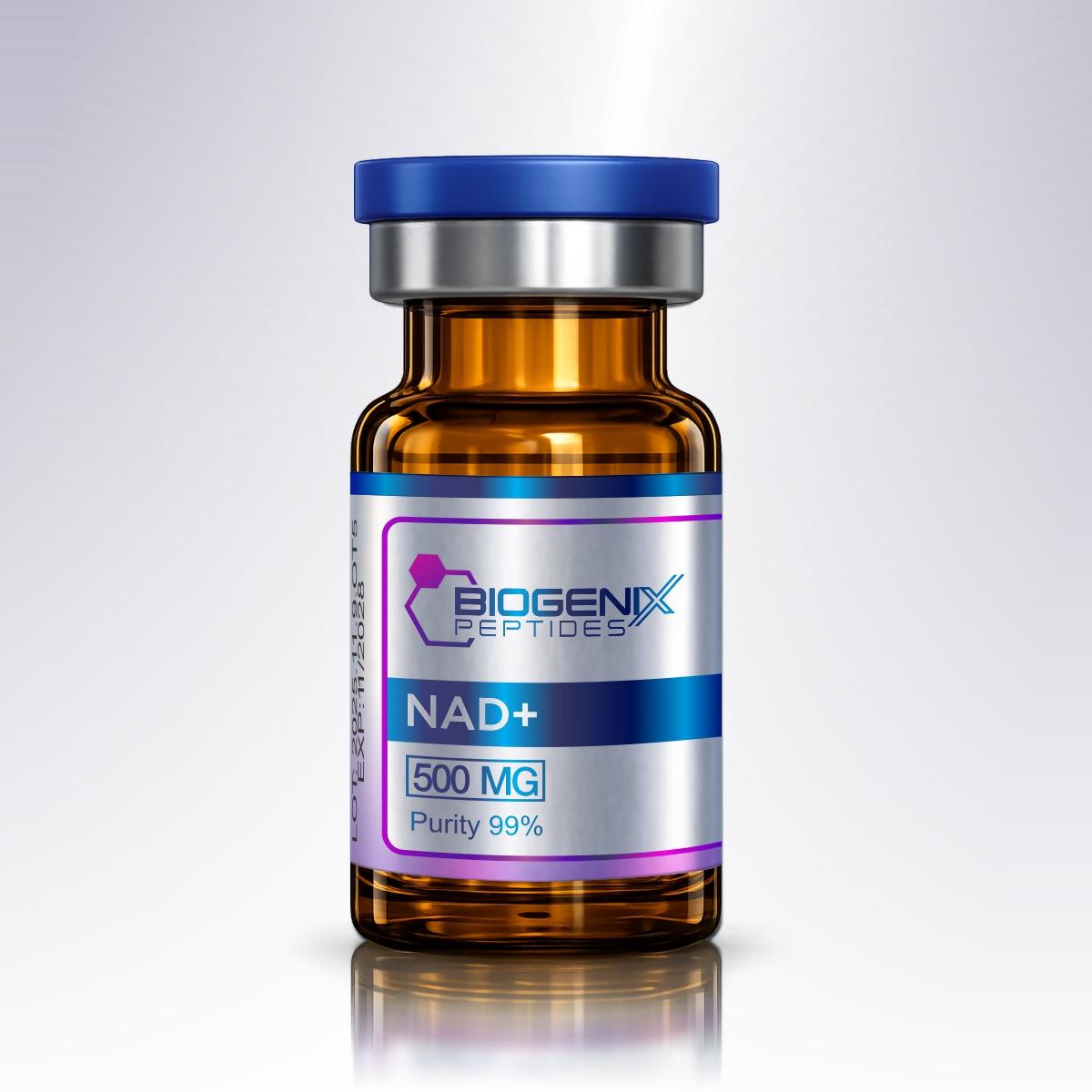
NAD+ 500mg
$72.00
NAD⁺ (Nicotinamide Adenine Dinucleotide) is a molecule found in every cell of the body and is essential for creating energy. Researchers study NAD⁺ because it helps power the mitochondria—the parts of the cell responsible for energy production—and supports processes related to metabolism, cellular repair, and overall longevity.
In research settings, NAD⁺ has been explored for its role in maintaining healthy energy levels, supporting DNA repair, and helping cells function more efficiently as they age. Many studies also focus on how NAD⁺ levels naturally decline over time, making it an important molecule for understanding aging, vitality, and long-term cellular health.
In Stock
NAD⁺ (Nicotinamide Adenine Dinucleotide)
Nicotinamide Adenine Dinucleotide (NAD⁺) is an essential coenzyme found in all living cells, serving as a critical electron carrier in redox reactions that fuel cellular metabolism. It participates in over 500 enzymatic reactions and is integral to mitochondrial energy production, DNA repair, and cellular signaling. NAD⁺ functions as a cofactor for several enzyme families, including sirtuins, poly(ADP-ribose) polymerases (PARPs), and CD38, which regulate metabolism, genomic stability, and cell longevity.
Overview
NAD⁺ exists in two forms: the oxidized (NAD⁺) and reduced (NADH) states, cycling between these forms to maintain cellular redox balance. Through its role in glycolysis, the tricarboxylic acid (TCA) cycle, and oxidative phosphorylation, NAD⁺ is pivotal for ATP production. In addition, NAD⁺ serves as a substrate for sirtuin enzymes (SIRT1–SIRT7) that regulate gene expression, mitochondrial biogenesis, and stress responses. Declines in NAD⁺ levels have been linked to aging, metabolic dysfunction, and neurodegenerative disease. Research has demonstrated that restoring NAD⁺ concentrations in aged models may rejuvenate mitochondrial function and improve systemic metabolic health.
Chemical Characteristics
| Compound | Type | Molecular Formula | Molecular Weight |
| NAD⁺ | Endogenous coenzyme (redox cofactor) | C₂₁H₂₇N₇O₁₄P₂ | 663.43 g/mol |
Other Known Titles: β-Nicotinamide adenine dinucleotide; Coenzyme I; DPN; Diphosphopyridine nucleotide
Research and Clinical Studies
NAD⁺ and Metabolic FunctionResearch suggests that NAD⁺ is a central regulator of energy metabolism, acting as an electron acceptor in catabolic reactions. In mitochondria, NAD⁺ accepts electrons during glycolysis and the TCA cycle to form NADH, which subsequently donates electrons to the electron transport chain for ATP synthesis. Reduced NAD⁺ levels have been associated with insulin resistance, hepatic steatosis, and decreased oxidative capacity. Studies on NAD⁺ precursors such as nicotinamide riboside (NR) and nicotinamide mononucleotide (NMN) suggest that replenishing cellular NAD⁺ may improve metabolic flexibility and mitochondrial respiration in experimental models.
NAD⁺ in DNA Repair and LongevityNAD⁺ serves as a required substrate for PARP enzymes that repair DNA strand breaks. During genotoxic stress, excessive activation of PARP can deplete NAD⁺ pools, leading to cellular energy crisis. Sirtuins, another NAD⁺-dependent enzyme class, promote genome stability and longevity by regulating histone deacetylation and transcriptional control of stress resistance genes. In rodent models, NAD⁺ repletion via NMN or NR supplementation has been shown to restore mitochondrial function, reduce inflammation, and enhance life span indicators.
NAD⁺ and NeuroprotectionResearch has indicated that neuronal NAD⁺ depletion contributes to axonal degeneration and neurodegenerative processes. Increasing NAD⁺ levels has been shown to upregulate SIRT1 and SIRT3 activity, protecting neurons from oxidative stress and mitochondrial dysfunction. Experimental models suggest NAD⁺ replenishment may delay cognitive decline and reduce neuroinflammation in Alzheimer’s and Parkinson’s disease models.
NAD⁺ and Immune RegulationNAD⁺ also influences immune cell metabolism and inflammatory signaling. CD38 and CD157 enzymes consume NAD⁺ during immune activation, affecting macrophage polarization and cytokine release. By maintaining NAD⁺ homeostasis, cellular redox balance and inflammatory tone may be better regulated. These findings underscore NAD⁺’s role as a nexus between metabolism, immunity, and aging biology.
Lyophilized Form
NAD⁺ is provided as a lyophilized, filler-free research cofactor to preserve chemical integrity and stability during storage. Reconstitute with sterile solvent immediately prior to experimental use and store at ≤ –20 °C to avoid repeated freeze–thaw cycles.
NAD⁺ — References
- Verdin, E. NAD⁺ in aging, metabolism, and neurodegeneration. Science. 2015;350(6265):1208–1213.https://doi.org/10.1126/science.aac4854
- Cantó, C., Menzies, K. J., Auwerx, J. NAD⁺ metabolism and the control of energy homeostasis: a balancing act between mitochondria and the nucleus. Cell Metabolism. 2015;22(1):31–53.https://doi.org/10.1016/j.cmet.2015.05.023
- Yoshino, J., Baur, J. A., Imai, S. I. NAD⁺ intermediates: the biology and therapeutic potential of NMN and NR. Cell Metabolism. 2018;27(3):513–528.https://doi.org/10.1016/j.cmet.2017.11.002
- Rajman, L., Chwalek, K., Sinclair, D. A. Therapeutic potential of NAD⁺-boosting molecules: the in vivo evidence. Cell Metabolism. 2018;27(3):529–547.https://doi.org/10.1016/j.cmet.2018.02.011
- Zhang, H., Ryu, D., Wu, Y., Gariani, K., Wang, X., Luan, P., D’Amico, D., Ropelle, E. R., Lutolf, M. P., Aebersold, R., Schoonjans, K., Menzies, K. J., Auwerx, J. NAD⁺ repletion improves mitochondrial and stem cell function and enhances life span in mice. Science. 2016;352(6292):1436–1443.https://doi.org/10.1126/science.aaf2693
- Mills, K. F., Yoshida, S., Stein, L. R., Grozio, A., Kubota, S., Sasaki, Y., Redpath, P., Migaud, M. E., Apte, R. S., Uchida, K., Yoshino, J., Imai, S. I. Long-term administration of nicotinamide mononucleotide mitigates age-associated physiological decline in mice. Cell Metabolism. 2016;24(6):795–806.https://doi.org/10.1016/j.cmet.2016.09.013
- Trammell, S. A., Schmidt, M. S., Weidemann, B. J., Redpath, P., Jaksch, F., Dellinger, R. W., Li, Z., Abel, E. D., Migaud, M. E., Brenner, C. Nicotinamide riboside is uniquely and orally bioavailable in mice and humans. Nature Communications. 2016;7:12948.https://doi.org/10.1038/ncomms12948
- Martens, C. R., Denman, B. A., Mazzo, M. R., Armstrong, M. L., Reisdorph, N., McQueen, M. B., Chonchol, M., Seals, D. R. Chronic nicotinamide riboside supplementation is well-tolerated and elevates NAD⁺ in healthy middle-aged and older adults. Nature Communications. 2018;9:1286.https://doi.org/10.1038/s41467-018-03421-7
- Chini, C. C. S., Tarragó, M. G., Chini, E. N. NAD⁺ and the aging process: role in life, death and everything in between. Molecular and Cellular Endocrinology. 2017;455:62–74.https://doi.org/10.1016/j.mce.2016.11.003
- Bogan, K. L., Brenner, C. Nicotinic acid, nicotinamide, and nicotinamide riboside: a molecular evaluation of NAD⁺ precursor vitamins in human nutrition. Annual Review of Nutrition. 2008;28:115–130.https://doi.org/10.1146/annurev.nutr.28.061807.155443
NOTICE OF COMPLIANCE
The mission of BioGenix Peptides™ is to provide researchers with the highest-quality, Ultra-Pure Series™ compounds to help unlock the full potential of this evolving field. With precision, purity, and scientific integrity at the core of our operations, BioGenix Peptides™ is dedicated to supporting responsible exploration and discovery
Products from BioGenix Peptides™ are not intended for human consumption. They are supplied exclusively for in-vitro and pre-clinical research purposes.
By purchasing or using these products, the Customer accepts full responsibility for their handling and use, and agrees to indemnify and hold BioGenix Peptides™ harmless from any claims resulting from misuse.
Having trouble viewing? Use the buttons below to download or open the certificate.
Related products

In Stock