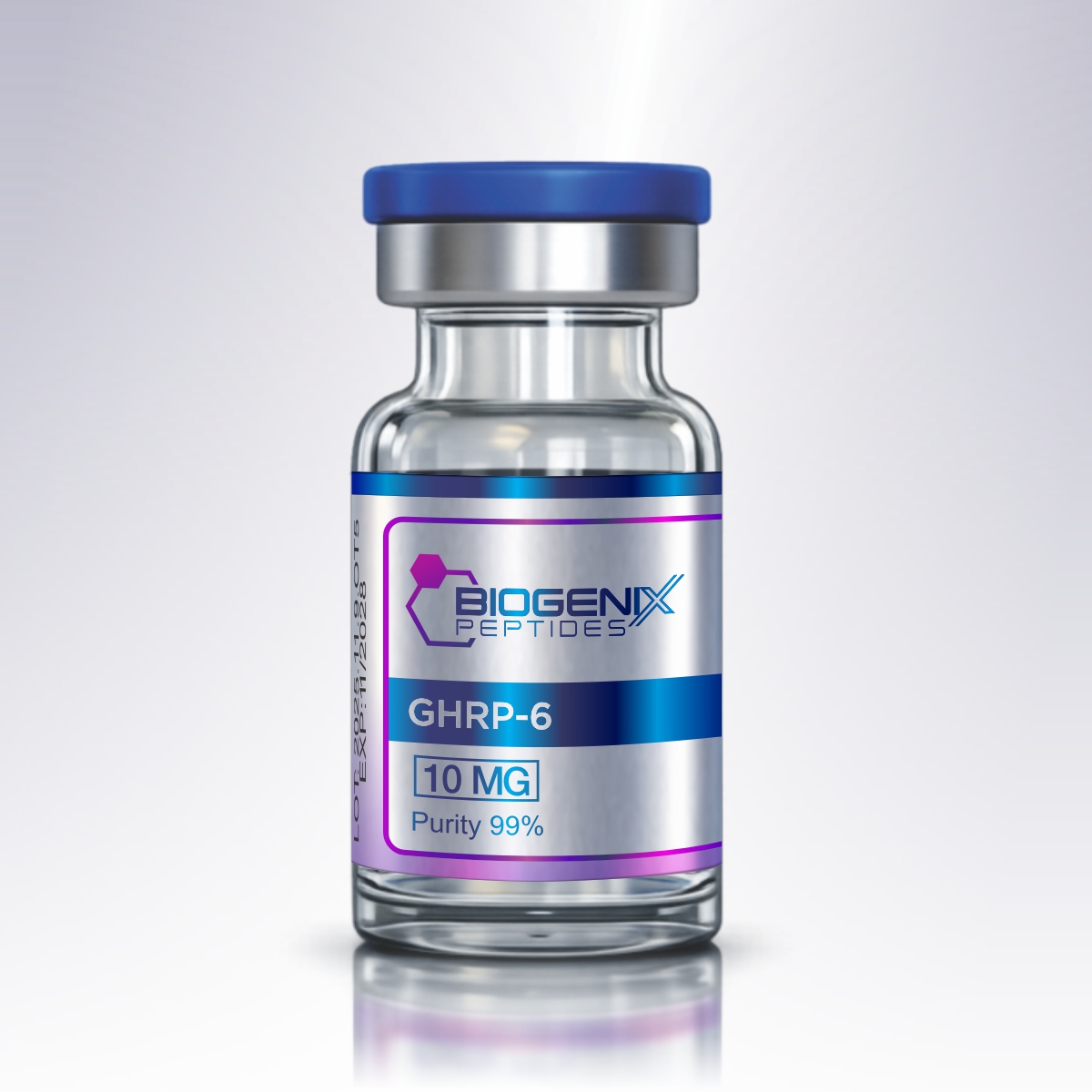
GHRP-6 10mg
$48.00
GHRP-6 (Growth Hormone Releasing Hexapeptide) is a synthetic low molecular weight hexapeptide, developed as part of the GHRP family to stimulate growth hormone (GH) secretion. Structurally related to met-enkephalin, GHRP-6 lacks opioid activity and instead activates growth hormone secretagogue receptors (GHS-Rs), which later proved to be ghrelin receptors. By doing so, it has been studied for potential roles in growth hormone regulation, metabolism, appetite, muscle tissue, neuroprotection, and tissue repair.
In Stock
GHRP-6 (Growth Hormone Releasing Peptide 6) — Research Overview
Introduction
GHRP-6 (Growth Hormone Releasing Hexapeptide) is a synthetic low molecular weight hexapeptide, developed as part of the GHRP family to stimulate growth hormone (GH) secretion. Structurally related to met-enkephalin, GHRP-6 lacks opioid activity and instead activates growth hormone secretagogue receptors (GHS-Rs), which later proved to be ghrelin receptors. By doing so, it has been studied for potential roles in growth hormone regulation, metabolism, appetite, muscle tissue, neuroprotection, and tissue repair.
Mechanisms of Action
Research suggests that GHRP-6 may act through two pathways: direct stimulation of the pituitary gland and indirect influence via hypothalamic pathways. It appears to require endogenous GHRH to exert its full potential and may also interact with CD36 receptors, which are involved in lipid metabolism, angiogenesis, phagocytosis, and inflammation control. CD36 binding is thought to mediate prosurvival and anti-inflammatory pathways.
Chemical Characteristics
| Compound | Type | Molecular Formula | Molecular Weight |
| GHRP-6 | Synthetic growth hormone secretagogue (hexapeptide) | C₄₆H₅₆N₁₂O₆ | 873.01 g/mol |
Other Titles: Growth Hormone Releasing Peptide-6
Research Applications
1. Hypothyroidism Models
– In hypothyroid research models, GHRP-6 induced significantly higher GH levels compared to GHRH, possibly due to functional antagonism of somatostatin at the pituitary level.
2. Cortisol Hormone Release and Sleep
– In clinical sleep EEG research, GHRP-6 increased secretion of GH and ACTH/cortisol. Notably, cortisol release and stage 2 sleep were elevated, while other EEG variables remained unchanged.
3. Organ Function and Multiple Organ Failure Models
– GHRP-6 improved gut epithelial cell migration in injury models without increasing proliferation. In multiple organ failure models, it reduced hepatic and intestinal damage and lipid peroxidation by 50–85%. Combining GHRP-6 with EGF further enhanced these protective effects.
4. Gastrointestinal Transit
– In diabetic mouse models with delayed GI transit, GHRP-6 improved gastric emptying (GE) and intestinal transit (IT), though colonic transit (CT) remained unchanged.
5. Neuroprotection
– In murine brain models, GHRP-6 elevated IGF-1 mRNA in the hypothalamus, hippocampus, and cerebellum. This was associated with activation of survival pathways (Akt phosphorylation, Bcl-2 upregulation), suggesting neuroprotective potential and enhanced neuronal survival.
6. Muscle Tissue and Anabolic Potential
– In cultured myoblasts, GHRP-6 increased myogenic marker proteins, IGF-1, and collagen type I production.- Human studies reported GH peaks ~15.4–15.7 μg/L with GHRP-6 stimulation, compared with ~5.5 μg/L for physiological GH release.
7. Tissue Recovery and Anti-Fibrotic Action
– GHRP-6 accelerated wound healing, reduced hypertrophic scarring, and lessened fibrotic cytokine expression.- In burn and radiation injury models, ghrelin receptor activation via GHRP-6 reduced TNF-α and improved recovery.- In liver fibrosis models, prolonged GHRP-6 exposure reduced fibrotic areas by up to 75% and decreased nodularity by 60%.
Conclusion
GHRP-6 is a synthetic hexapeptide that stimulates GH secretion via ghrelin receptors, while also interacting with CD36 to mediate additional protective effects. Research suggests potential applications in hypothyroidism, cortisol regulation, neuroprotection, muscle growth, wound healing, and anti-fibrotic actions. Outcomes vary with dosage, timing, and model context.
GHRP-6 (Growth Hormone Releasing Peptide-6) — References
- Bowers, C. Y., Momany, F. A., Reynolds, G. A., Hong, A. On the in vitro and in vivo activity of a new synthetic hexapeptide that acts on the pituitary to specifically release growth hormone. Endocrinology. 1984;114(5):1537–1545. https://doi.org/10.1210/endo-114-5-1537
- Bowers, C. Y., Reynolds, G. A., Durham, D., Barrera, C. M., Pezzoli, S. S., Thorner, M. O. Growth hormone–releasing peptide stimulates GH release in normal men and acts synergistically with GHRH. Journal of Clinical Endocrinology & Metabolism. 1990;70(4):975–982. https://doi.org/10.1210/jcem-70-4-975
- Thorner, M. O., Chapman, I. M., Cella, S. G., Davis, J., Vance, M. L., Bowers, C. Y. The growth hormone-releasing peptides: clinical studies. Endocrine Reviews. 1997;18(5):648–672. https://doi.org/10.1210/edrv.18.5.0313
- Ghigo, E., Arvat, E., Gianotti, L., Imbimbo, B. P., Lenaerts, V., Deghenghi, R., Camanni, F. Growth hormone-releasing hormone combined with GHRP-6 strongly stimulates GH release in normal and obese subjects, elderly individuals, and patients with GH deficiency. Journal of Clinical Endocrinology & Metabolism. 1994;79(5):1264–1268. https://doi.org/10.1210/jcem.79.5.7962326
- Camanni, F., Ghigo, E., Arvat, E. Growth hormone-releasing peptides and their analogues. Baillière’s Clinical Endocrinology and Metabolism. 1998;12(3):383–398. https://doi.org/10.1016/S0950-351X(98)80009-0
- Arvat, E., Broglio, F., Benso, A., Gottero, C., Muccioli, G., Papotti, M., Deghenghi, R., Ghigo, E. Ghrelin and synthetic GH secretagogues: interactions and endocrine activities in humans. Journal of Clinical Endocrinology & Metabolism. 2001;86(3):1169–1174. https://doi.org/10.1210/jcem.86.3.7207
- Popovic, V., Leal, A., Micic, D., Dieguez, C., Casanueva, F. F. Ghrelin and synthetic GH secretagogues in normal and pathological states. Endocrine. 2003;22(1):21–27. https://doi.org/10.1385/ENDO:22:1:21
- Jacks, T., Hickey, G. J., Judith, F., Schneider, H., Bowers, C. Y., Thorner, M. O. Effects of intravenous GHRP-6 on GH secretion in elderly and young adults. Journal of Clinical Endocrinology & Metabolism. 1995;80(11):3209–3215. https://doi.org/10.1210/jcem.80.11.7593437
- Poehlman, E. T., Copeland, K. C., Bowers, C. Y. Influence of growth hormone-releasing peptide on metabolic function in older individuals. Metabolism. 1994;43(10):1336–1341. https://doi.org/10.1016/0026-0495(94)90056-6
- Muccioli, G., Tschöp, M., Papotti, M., Deghenghi, R., Heiman, M., Ghigo, E. Neuroendocrine and peripheral activities of ghrelin: implications in metabolism and obesity. European Journal of Pharmacology. 2002;440(3):235–254. https://doi.org/10.1016/S0014-2999(02)01432-X
NOTICE OF COMPLIANCE
The mission of BioGenix Peptides™ is to provide researchers with the highest-quality, Ultra-Pure Series™ compounds to help unlock the full potential of this evolving field. With precision, purity, and scientific integrity at the core of our operations, BioGenix Peptides™ is dedicated to supporting responsible exploration and discovery
Products from BioGenix Peptides™ are not intended for human consumption. They are supplied exclusively for in-vitro and pre-clinical research purposes.
By purchasing or using these products, the Customer accepts full responsibility for their handling and use, and agrees to indemnify and hold BioGenix Peptides™ harmless from any claims resulting from misuse.
Having trouble viewing? Use the buttons below to download or open the certificate.
Related products

In Stock