Get Your Gray Matter Grooving with Cerebrolysin Peptide
Disclaimer: The information provided in this article is for educational and informational purposes only. It is not intended as medical advice, diagnosis, or treatment. Products and compounds referenced are for research use only and are not approved for human or veterinary consumption. Always consult a qualified professional regarding health or medical decisions.
What Researchers Need to Know About Cerebrolysin Peptide
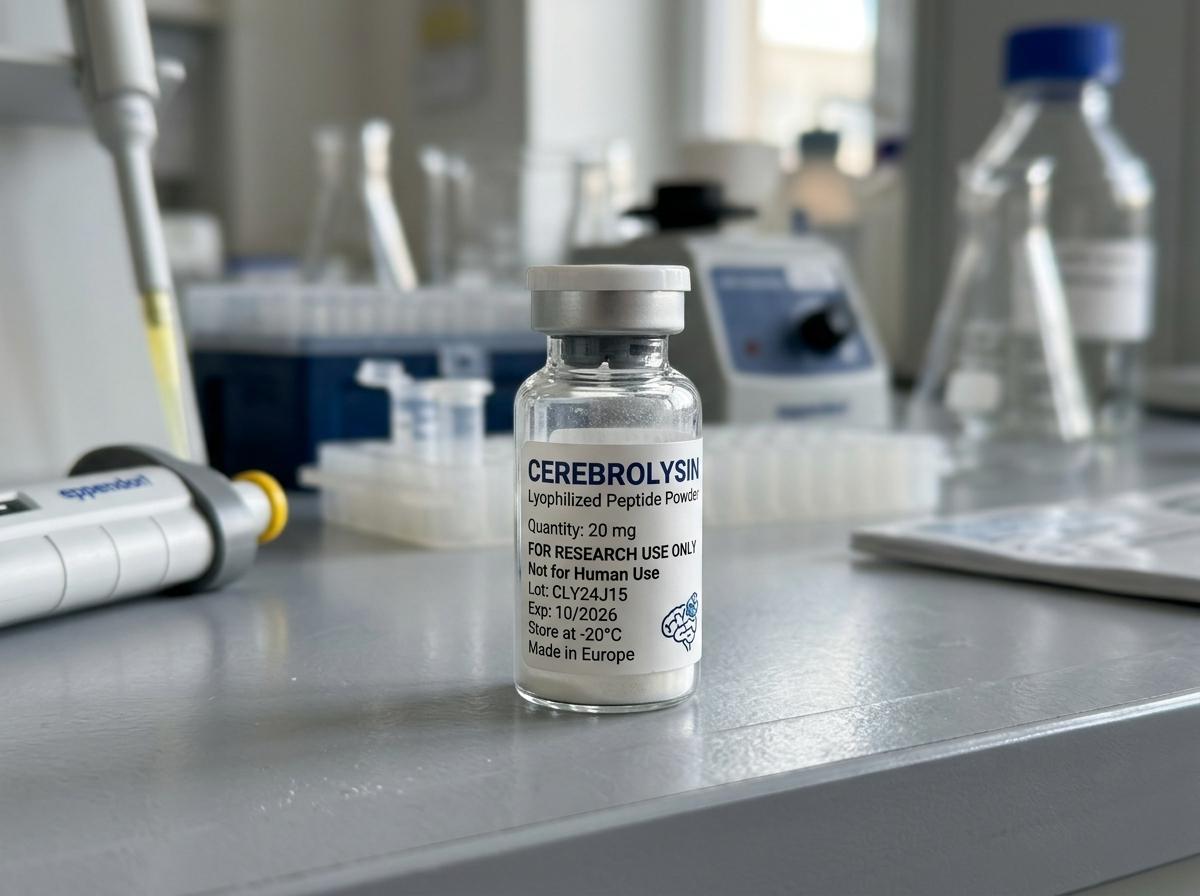
Cerebrolysin peptide for sale is available from research-grade suppliers as a lyophilized compound intended strictly for laboratory and preclinical study — not for human or veterinary use.
Here is a quick overview for researchers:
| What You Want to Know | Quick Answer |
|---|---|
| What is it? | A low-molecular-weight neuropeptide mixture derived from porcine brain proteins |
| Who sells it? | Research peptide suppliers (e.g., Biogenix Peptides) |
| Legal status in the USA? | Not FDA-approved; sold for research purposes only |
| Purity standard? | Typically ≥98–99%, verified by HPLC and COA |
| Storage? | Lyophilized vials at –20°C; reconstituted solution at 2–8°C |
| Research focus areas? | Neuroprotection, stroke recovery, neurodegeneration, synaptic plasticity |
Cerebrolysin has a long history in neuroscience. First developed in 1949 and approved for medical use in 1954, it has since been studied in over 200 human trials across the past 15 years and is clinically used in more than 50 countries. That track record makes it one of the most researched neurotrophic compounds available today — and a compelling subject for preclinical investigation.
This guide breaks down what the science says, how researchers handle and store it, and how it compares to similar compounds.
I’m Jay Daniel, Founder and CEO of Biogenix Peptides, with years of hands-on experience in peptide sourcing, quality control, and research applications — including compounds like cerebrolysin peptide for sale in preclinical settings. My goal here is to give you clear, research-backed information so you can make informed decisions for your lab work.

Scientific Research on Cerebrolysin Peptide for Sale
Cerebrolysin is not your average single-chain peptide. It is a complex biotechnologically prepared peptide mixture derived from purified porcine brain proteins. This mixture contains low-molecular-weight neuropeptides (generally no larger than 10,000 Daltons) and free amino acids. What makes it a “rockstar” in the lab is its multi-modal mechanism of action. Unlike many synthetic peptides that target one specific receptor, Cerebrolysin mimics the action of endogenous neurotrophic factors.
Scientific literature suggests that Cerebrolysin contains elements that act similarly to Brain-Derived Neurotrophic Factor (BDNF), Glial Cell Line-Derived Neurotrophic Factor (GDNF), Ciliary Neurotrophic Factor (CNTF), and Nerve Growth Factor (NGF). In research settings, these factors are the “construction crew” of the brain, responsible for maintaining, repairing, and growing neurons.

The primary pillars of Cerebrolysin research include:
- Neuroprotection: Studies indicate it may protect neurons from metabolic compromise, such as oxidative stress and excitotoxicity caused by excess glutamate.
- Synaptic Plasticity: It has been observed to enhance the formation of new synaptic connections, which is vital for learning and memory.
- Neurogenesis: Research in animal models shows that Cerebrolysin can stimulate the bridge between stem cells and functional neurons.
For those just starting their journey into these compounds, our Peptide Basics guide offers a great foundation on how these molecular chains function.
Investigating Cerebrolysin Peptide for Sale in Recovery Models
One of the most significant areas of study for Cerebrolysin involves acute neurological “events.” Because traumatic brain injury (TBI) affects approximately 15 million individuals annually worldwide, researchers are constantly looking for ways to improve functional recovery.
In the landmark CREGS study, researchers looked at the impact of Cerebrolysin on stroke recovery. The data showed that subjects treated with the peptide mixture demonstrated significant improvements in functional recovery compared to control groups. These improvements were measured using standardized tools like the modified Rankin Scale (mRS) and the National Institutes of Health Stroke Scale (NIHSS).
Furthermore, in rodent models of Middle Cerebral Artery Occlusion (MCAO)—a common way to simulate a stroke—Cerebrolysin was shown to reduce the size of the “infarct” (the area of dead tissue) and accelerate the restoration of neurological function. If your research focuses on the “hardware” of the brain, you might want to explore our Product Category Cognitive for related tools.
Cognitive Enhancement and Neurodegeneration Research
Beyond acute injury, Cerebrolysin is a staple in research regarding long-term cognitive decline, such as Alzheimer’s disease and vascular dementia. The “gray matter grooving” happens when the peptide’s neurotrophic factors help preserve dendritic connections that usually wither away in neurodegenerative models.
Some studies suggest that Cerebrolysin can slow down the progression of symptoms in severe dementia models, with effects persisting for months after the research period concludes. It is also being investigated for its role in Peptides That Influence Memory Reconsolidation, looking at how the brain “updates” or stabilizes memories after they are retrieved.
Protocols for Handling and Storage
When you find a reputable source for cerebrolysin peptide for sale, it usually arrives as a lyophilized (freeze-dried) powder in a sterile vial. This state is designed to keep the delicate peptide chains stable during transit. However, once it reaches your lab, the real work begins.
Reconstitution and Handling
To prepare the peptide for in vitro or animal studies, it must be reconstituted. This involves adding a liquid—typically Bacteriostatic Water Reconstitution Solution 3ml or sterile saline—to the vial.
The rule of thumb here is “gentle does it.” You should never shake the vial, as the mechanical stress can break the peptide bonds, rendering the research material useless. Instead, let the water run slowly down the side of the glass and gently swirl the vial until the powder is fully dissolved. For a more detailed walkthrough, see our guide on Reconstituting Lyophilized Peptides Step-by-Step.
Best Practices for Research with Cerebrolysin Peptide for Sale
Precision is the name of the game in scientific research. To ensure your results aren’t skewed by degraded material, follow these storage guidelines:
- Temperature Stability: Keep lyophilized vials in a freezer at –20°C for long-term storage. If you plan to use them within a few weeks, a standard refrigerator (2–8°C) is usually sufficient.
- Post-Reconstitution: Once the peptide is liquid, its “shelf life” drops significantly. It should be kept at 2–8°C and used within a short window—often cited as 5 to 10 days in many research protocols—to maintain maximum activity.
- Light Sensitivity: Store your vials in a dark place. Light can catalyze the breakdown of organic molecules.
- Verification: Always ensure your supplier provides a Certificate of Analysis (COA). This document confirms the purity (ideally ≥98%) and the identity of the substance via HPLC and Mass Spectrometry. If you aren’t sure what you’re looking at, check out How to Read a Peptide COA.
For more comprehensive data on keeping your samples fresh, refer to our Peptide Storage Stability Guidelines.
Comparative Analysis and Alternatives
Cerebrolysin is often compared to other “heavy hitters” in the cognitive research space, such as Semax and Selank. While they all aim to support the central nervous system, their origins and specific functions differ.
| Feature | Cerebrolysin | Semax | Selank |
|---|---|---|---|
| Origin | Porcine-derived mixture | Synthetic (ACTH fragment) | Synthetic (Tuftsin analog) |
| Main Action | Multi-modal (BDNF/NGF mimic) | Melanocortin system modulation | Anxiolytic/Immune modulation |
| Primary Research Use | Neuroregeneration & Stroke | Focus & Neuroprotection | Emotional Stability |
| Composition | Peptide/Amino acid blend | Single peptide chain | Single peptide chain |
Cerebrolysin is unique because it isn’t just one peptide; it’s a “cocktail” provided by nature. This makes it more “multi-modal” than synthetic options. However, for researchers looking for more targeted synthetic options, compounds like Semax vs Selank offer a different experimental path.
Another interesting alternative in the neuro-regulatory space is Cortagen ALA-GLU-ASP-PRO, a tetrapeptide studied for its effects on brain signaling resilience and gene expression.
Frequently Asked Questions about Cerebrolysin
Is Cerebrolysin approved for human use in the USA?
No. In the United States, Cerebrolysin is not registered with the FDA and is not approved for human or veterinary use. It is strictly designated as a research chemical. While it is used as a prescription medication in over 50 other countries (primarily in Europe and Asia), it must only be purchased in the U.S. for laboratory research purposes. For a deeper dive into the legal landscape, read The Complete Guide to Peptides in Scientific Research.
What are the primary side effects observed in research?
In human clinical trials conducted outside the U.S., Cerebrolysin is generally noted for its high safety profile. However, some adverse reactions have been documented, including:
- Rare instances of dizziness or headaches.
- Mild gastrointestinal issues (nausea).
- Occasional agitation or sweating if administered too quickly in a clinical setting.
- In very rare cases, hypersensitivity or allergic reactions.
Because the European Medicines Agency (EMA) has set the frequency for Periodic Safety Update Reports to every 13 years, the medical community considers its safety profile well-established for its approved uses abroad.
How does it differ from single-peptide nootropics?
Most nootropic peptides, like Semax 5mg or Selank 5mg, are single synthetic sequences designed to hit a specific target. Cerebrolysin is a “synergistic blend.” Because it is derived from porcine brain proteins, it contains a variety of peptides and amino acids that work together to mimic natural brain growth factors. This makes it more complex to study but potentially more comprehensive in its effects on Cognitive Neurological Research Peptides.
Conclusion
Cerebrolysin remains one of the most intriguing compounds in neurology. Its 70-year history and the sheer volume of supporting research—from the CREGS stroke study to Alzheimer’s models—make it an essential tool for any lab focused on neuroprotection and brain repair.
At Biogenix Peptides, we are committed to providing high-purity cerebrolysin peptide for sale for your research needs. Our products are manufactured to the highest standards, ensuring that your data is based on consistent, quality material. Whether you are investigating stroke recovery or the frontiers of synaptic plasticity, we are here to support your scientific journey.
Ready to advance your research? Browse our Buying Guide or head straight to our Shop to find the tools you need for your next breakthrough.
Disclaimer: All products mentioned are for laboratory research use only. This article represents the opinion of the authors based on available scientific literature and does not constitute medical advice.