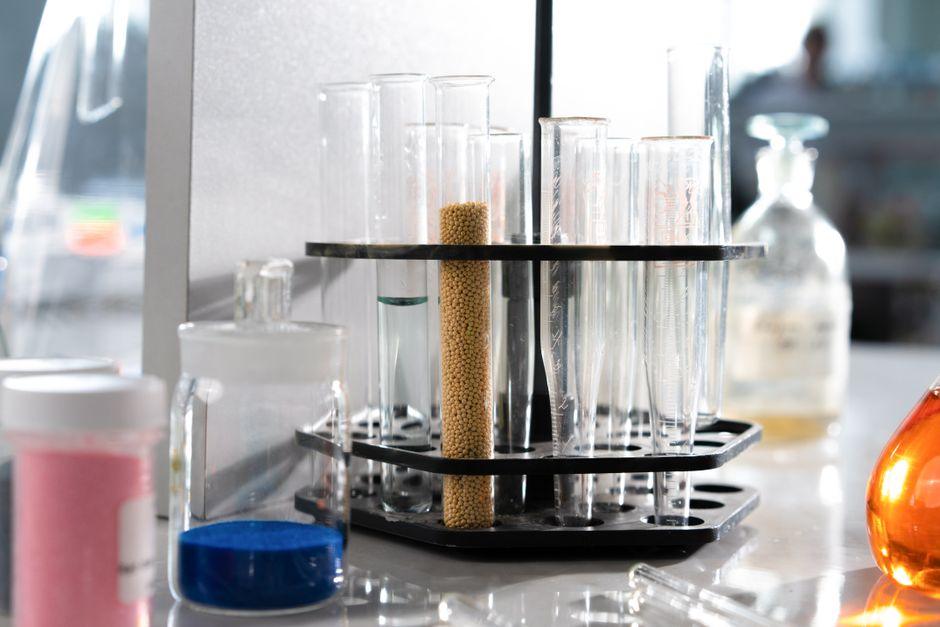
Fmoc Solid Phase Peptide Synthesis Basics and Starter Essentials
Disclaimer: The information provided in this article is for educational and informational purposes only. It is not intended as medical advice, diagnosis, or treatment. Products and compounds referenced are for research use only and are not approved for human or veterinary consumption. Always consult a qualified professional regarding health or medical decisions.
A practical Fmoc chemistry peptide starter setup includes a fritted reaction vessel or SPE column, low-shear agitation, dry DMF/DCM handling, Fmoc amino acids, a suitable resin such as Rink amide, Wang, or 2-chlorotrityl chloride, piperidine for Fmoc removal, DIC/Oxyma or HBTU/HATU coupling chemistry, wash solvents, cleavage scavengers, and basic monitoring by Kaiser test or UV Fmoc quantification. The workflow is simple: load or select the C-terminal resin, deprotect, wash, couple, verify completion, repeat the cycle, then cleave, precipitate, and analyze the crude research peptide.
Core Principles of Fmoc Solid-Phase Peptide Synthesis
Solid-phase peptide synthesis (SPPS) transformed synthetic chemistry by immobilizing the growing peptide chain onto an insoluble polymeric solid support. In modern chemical biology, the Fmoc/tBu strategy represents the gold standard orthogonal method. Unlike older Boc/Bzl protocols that rely on hazardous liquid hydrofluoric acid for final cleavage, Fmoc chemistry operates through a mild two-dimensional orthogonal protection scheme. The temporary N-alpha-amino protecting group, 9-fluorenylmethoxycarbonyl (Fmoc), is labile to secondary bases such as piperidine, while side-chain functional groups and resin linkers are permanently shielded by acid-labile protecting groups (such as tert-butyl ethers, esters, and trityl derivatives).
Chain elongation proceeds directionally from the C-terminus toward the N-terminus. The C-terminal amino acid is covalently anchored through its carboxyl group to a functionalized solid support, leaving its N-alpha-amino group accessible for iterative deprotection and acylation cycles. Understanding the distinction between peptide synthesis explained solid phase vs solution phase methods highlights why solid-phase assembly dominates laboratory workflows: it eliminates the need for tedious intermediate liquid-liquid extractions and chromatographic isolations after every single amide bond formation. Instead, excess soluble reagents and reaction byproducts are rapidly separated from the immobilized peptide-resin matrix via simple filtration and solvent wash steps, as outlined in the Fundamentals of modern SPPS methodologies.
Step-by-Step Chain Elongation Cycle
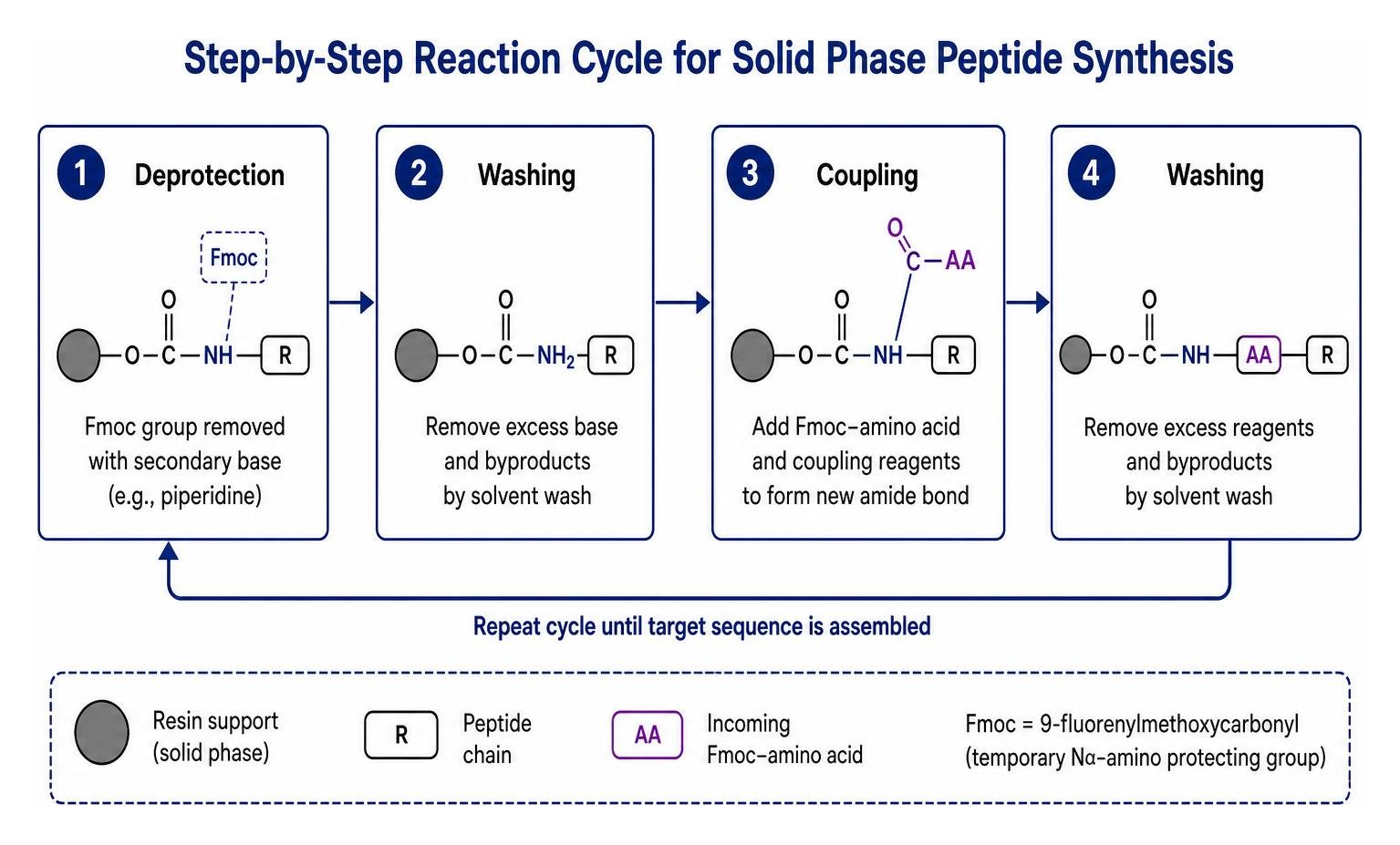
The Fmoc SPPS chemical cycle consists of four distinct operational stages executed iteratively until the target sequence is fully assembled:
- N-alpha-Fmoc Deprotection: The resin-bound peptide is treated with 20% piperidine in N,N-dimethylformamide (DMF). Piperidine abstracts the acidic fluorenyl ring proton (pKa around 25), triggering beta-elimination to release the free N-alpha-amine, carbon dioxide, and dibenzofulvene. The released dibenzofulvene is rapidly scavenged by excess piperidine to form a stable piperidine-dibenzofulvene adduct.
- Resin Washing: The solid support is rigorously washed with DMF (typically 5 to 6 bed volumes) to remove all traces of secondary amine base and fulvene adducts. Incomplete washing allows residual piperidine to prematurely deprotect incoming activated amino acids, causing rampant double-insertion deletions.
- Carboxyl Activation and Coupling: The incoming Fmoc-protected amino acid (3 to 5 molar equivalents relative to resin loading) is activated using carbodiimide or uronium/aminium reagents. Modern protocols heavily favor N,N’-diisopropylcarbodiimide (DIC) combined with ethyl 2-cyano-2-(hydroxyimino)acetate (Oxyma Pure) or uronium salts like HBTU/HATU in the presence of N,N-diisopropylethylamine (DIEA). The activated ester acylates the free resin-bound amine over 30 to 60 minutes. A detailed breakdown of coupling mechanics is available in our peptide synthesis complete guide.
- Iterative Washing and Verification: The resin is rinsed thoroughly with DMF and dichloromethane (DCM) to remove unreacted amino acids and spent coupling additives before commencing the subsequent deprotection cycle.
In-Process Monitoring and Reaction Control
Because solid-phase synthesis involves compounding step-wise yields, maintaining high per-step conversion is essential. Achieving a 99.5% coupling efficiency across a 20-mer yields approximately 91% crude target, whereas dropping to 95.0% per step slashes the final full-length yield to just 36%.
To prevent deletion sequences, researchers rely on qualitative and quantitative reaction checks:
- Qualitative Ninhydrin (Kaiser) Test: Detects primary amines on resin beads. A few washed beads are treated with solutions of ninhydrin, potassium cyanide in pyridine, and phenol, then heated to 100 °C for one minute. An intense dark blue or purple coloration indicates unreacted primary amines (coupling failure), while a clear yellow solution confirms complete acylation.
- Spectrophotometric UV Quantification: Fmoc deprotection efficiency can be tracked quantitatively by measuring the absorbance of the piperidine-dibenzofulvene adduct in the deprotection effluent at 301 nm (extinction coefficient at 301 nm = 7,800 M⁻¹cm⁻¹). This provides immediate diagnostic data on coupling completeness and steric aggregation without destructive cleavages.
- Acetic Anhydride Capping: When difficult couplings fail to reach 100% completion after a secondary re-coupling attempt, the remaining unreacted amines are permanently capped using a mixture of 25% acetic anhydride (Ac2O) and DIEA in DCM or DMF. Capping terminates truncated fragments, converting hard-to-separate deletion peptides into short acetylated species that are easily separated during downstream preparative reverse-phase chromatography, as detailed in this Technical guide to SPPS mechanisms and troubleshooting.
Essential Lab Equipment and Reagents for an Fmoc Chemistry Peptide Starter Kit
Setting up a reliable manual or semi-automated benchtop peptide synthesis station does not require expensive automated synthesizers. A well-designed starter bench setup leverages manual fritted glass reaction vessels (or disposable polypropylene SPE filter columns) equipped with solvent-resistant PTFE stopcocks and porous polyethylene frits (20–50 µm porosity).
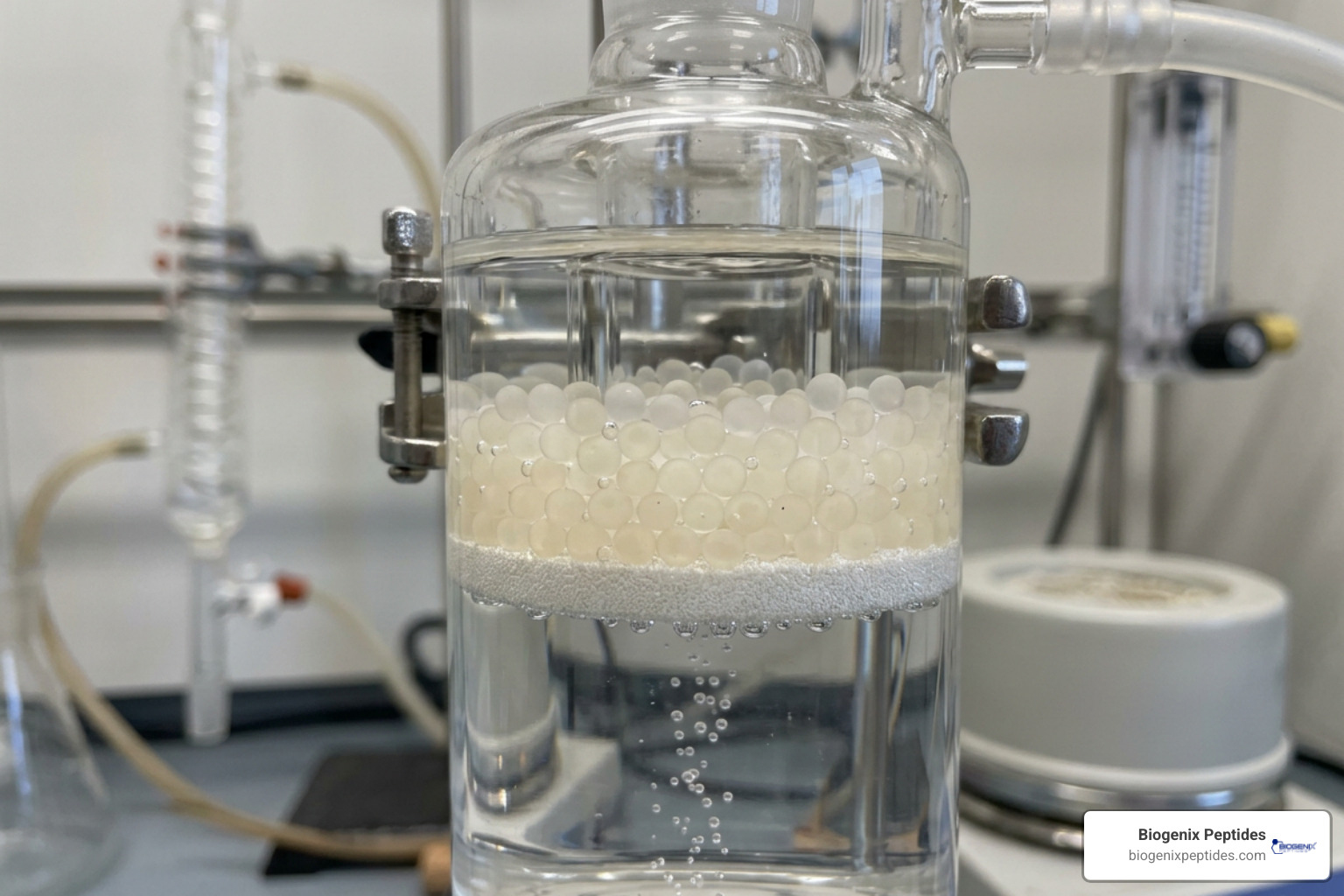
Agitation must never be conducted using magnetic stir bars; spinning stir bars physically crush polymeric resin beads into fine particulates that clog filter frits and impede solvent drainage. Instead, low-shear agitation is achieved using orbital shakers, nutating 3D rocking mixers, or gentle vertical wrist-action shakers. Alternatively, nitrogen bubbling through the bottom frit creates an efficient inert-atmosphere fluidization bed.
Core Reagents and Resins for Your Fmoc Chemistry Peptide Starter Setup
Choosing the correct solid support resin determines the C-terminal functionality and dictates overall synthesis strategy. Resins consist of crosslinked polystyrene (PS, typically 1% divinylbenzene) or poly(ethylene glycol)-grafted polystyrene (PEG-PS) beads functionalized with chemical linkers.
| Solid Support Resin | Linker Type | Target C-Terminal Functional Group | Cleavage Conditions | Primary Recommended Research Application |
|---|---|---|---|---|
| Rink Amide AM / MBHA | 4-[(2,4-Dimethoxyphenyl)-(Fmoc-amino)methyl]phenoxy | C-terminal primary carboxamide (-CONH2) | 90–95% TFA, scavengers (2 h) | Synthesis of amidated signaling peptides and hormones |
| Wang Resin | 4-Alkoxybenzyl alcohol | C-terminal carboxylic acid (-COOH) | 90–95% TFA, scavengers (2 h) | Routine peptide acids lacking C-terminal cysteine or proline |
| 2-Chlorotrityl Chloride (CTC) | 2-Chlorotrityl chloride | C-terminal carboxylic acid (-COOH) or protected fragments | 1% TFA in DCM (mild) or 95% TFA (global) | C-terminal Cys/Pro peptides; suppresses DKP and enantiomerization |
| Sieber Amide Resin | 9-Fmoc-amino-xanthen-3-yloxy | C-terminal carboxamide (protected fragments) | 1% TFA in DCM | Protected peptide amide segments for convergent fragment condensation |
Setting Up a Cost-Effective Fmoc Chemistry Peptide Starter Workflow
To maintain maximum chemical reactivity and prevent side reactions, establish a dry solvent handling protocol. Commercial peptide-synthesis grade DMF should be stored over activated 4 Å molecular sieves to minimize free dimethylamine, which can induce slow baseline deprotection of stored Fmoc-amino acid solutions. Coupling reagents—such as DIC, Oxyma Pure, HBTU, HATU, and PyBOP—should be stored desiccated at 4 °C and partitioned into single-use aliquots to prevent moisture condensation upon repeated warming.
Maintaining sterile, clean workspace parameters is equally critical when isolating and lyophilizing finished compounds, a principle highlighted in our guide on creating a sterile research environment. Researchers beginning manual synthesis will benefit from reviewing this Practical primer on beginner peptide synthesis before handling volatile cleavage acids and thiol scavengers.
Advanced Protocols: Cysteine Handling and Disulfide Bond Engineering
Cysteine residues introduce significant synthetic complexity into Fmoc SPPS. Due to the electron-withdrawing nature of the protected thiol and the acidity of the alpha-proton, cysteine is exceptionally vulnerable to base-catalyzed racemization (enantiomerization to D-cysteine) and beta-elimination during base deprotection and standard carboxyl activation.
Racemization occurs primarily through two pathways:
- Direct alpha-Proton Abstraction: Base-catalyzed ionization of the alpha-carbon forming a planar enolate intermediate.
- Oxazolone/Thiazolone Intermediate Formation: Intramolecular attack of the activated carbonyl oxygen on the preceding amide carbonyl, generating a cyclic intermediate that rapidly epimerizes.
To suppress cysteine racemization, carboxyl activation must be carried out under neutral or slightly acidic conditions. Standard uronium activation (HBTU/DIEA or HATU/DIEA) involves excess tertiary amine bases that drastically accelerate epimerization. Instead, carbodiimide/oxime systems such as DIC/Oxyma Pure should be used without tertiary bases. Racemization rates during DIC/Oxyma Pure coupling demonstrate stark differences among protecting groups: Fmoc-Cys(Thp)-OH exhibits only 0.74% racemization, compared to 3.3% for Fmoc-Cys(Trt)-OH and 6.8% for Fmoc-Cys(Dpm)-OH.
Furthermore, when synthesizing peptide acids containing a C-terminal cysteine, anchoring onto standard Wang resin causes extensive base-catalyzed beta-elimination during iterative piperidine cycles. This produces dehydroalanine, which subsequently reacts with piperidine to form unwanted beta-piperidinylalanine adducts (+49 Da). Anchoring C-terminal cysteine to bulky trityl-type supports, such as 2-chlorotrityl chloride resin, sterically shields the alpha-proton and eliminates beta-elimination entirely.
Orthogonal Protecting Groups for Multi-Cysteine Peptides
Synthesizing peptides with multiple native disulfide bridges requires orthogonal thiol protecting groups that can be selectively unmasked under distinct chemical conditions.
- Fmoc-Cys(Trt)-OH (Triphenylmethyl): Standard acid-labile protection. Cleaved simultaneously with global side chains using 90–95% TFA in the presence of silane/thiol scavengers. Complete deprotection of Cys(Trt) is typically achieved using 30 mL of cleavage cocktail per 0.5 mmol of peptidyl-resin.
- Fmoc-Cys(Thp)-OH (Tetrahydropyranyl): Provides superior suppression of coupling racemization (0.74%). Fully removed by treatment with TFA/water/TIS (95:2.5:2.5 v/v/v) within 2 hours.
- Fmoc-Cys(Acm)-OH (Acetamidomethyl): Acid-stable protection resistant to TFA global cleavage. Removed oxidatively using iodine (I2) or thallium(III) trifluoroacetate [Tl(TFA)3], driving concurrent disulfide bond formation.
- Fmoc-Cys(STmp)-OH (5-Sulfenyl-(2-thiomethylpyridine)): Highly base- and acid-stable, but selectively cleaved on-resin under mild reducing conditions. Albericio demonstrated that four STmp groups can be removed cleanly on the solid phase with just three 5-minute treatments of 0.1 M N-methylmorpholine (NMM) in DMF containing 5% beta-mercaptoethanol.
- Fmoc-Cys(Mmt)-OH (4-Methoxytrityl): Super-acid-labile group selectively removed using 1% TFA in DCM in the presence of 5% TIS, releasing a bright yellow-orange 4-methoxytrityl carbocation monitored spectrophotometrically at 460 nm.
On-Resin and Solution Disulfide Oxidation Methods
Forming intramolecular disulfide bridges can be achieved through directed on-resin cyclization or post-cleavage solution-phase folding.
- On-Resin Kinetic Oxidation: Selectively deprotecting orthogonal cysteine pairs (such as Cys(Mmt) or Cys(STmp)) on the solid support allows intramolecular cyclization via chemical oxidants while preventing intermolecular dimerization. N-Chlorosuccinimide (NCS) in DMF affects rapid, quantitative on-resin disulfide oxidation using as little as 2 equivalents within 15 minutes. Alternatively, iodine (I2, 10 equivalents in DMF/DCM) oxidizes bis-Acm protected peptides directly on resin.
- Thermodynamic Solution Oxidation (Air Folding): Linear peptides containing free sulfhydryls are dissolved at high dilution (0.1 mg/mL or less, peptide concentration 5 mM or less) in aqueous ammonium bicarbonate buffer (pH 8.0–8.5) and stirred openly under atmospheric air. Air oxidation allows the peptide to reach its most thermodynamically stable native conformation. Folding progression is tracked in real time using analytical RP-HPLC or the colorimetric Ellman test (monitoring 2-nitro-5-thiobenzoate dianion generation at 412 nm).
- Storage Best Practices: Lyophilized free sulfhydryl peptides undergo rapid atmospheric oxidation and dimerization if left exposed. Crude or purified thiol-containing peptides must be immediately sealed under an inert argon or nitrogen headspace and stored at -20 °C or -80 °C. Reconstitution buffers must be thoroughly degassed via helium sparging or vacuum sonication and maintained at slightly acidic pH (e.g., 0.1% aqueous TFA) to prevent premature thiolate anion formation.
Specialized Peptide Modifications: Chemical and Enzymatic N-alpha-Methylation
Site-specific N-alpha-methylation is a powerful modification used in peptide drug design to enhance proteolytic stability, enforce specific backbone conformations, and improve membrane permeability.
Synthesizing N-alpha-methylated residues site-specifically on solid support requires distinct chemical strategies:
- Site-Specific Monomethylation (Fukuyama-Mitsunobu / o-NBS Strategy): The resin-bound free N-alpha-amine is first protected and activated using 2-nitrobenzenesulfonyl chloride (o-NBS-Cl) and 2,4,6-collidine in NMP. The resulting sulfonamide nitrogen is deprotonated with 1,8-diazabicyclo[5.4.0]undec-7-ene (DBU) and selectively alkylated using dimethyl sulfate (Me2SO4). Finally, the o-NBS activating group is removed using 2-mercaptoethanol and DBU, yielding a secondary N-alpha-methylamine ready for subsequent acylation.
- Reductive Dimethylation: Introducing symmetrical N-alpha-dimethylation on solid support is carried out directly using formaldehyde (HCHO, 37% aqueous solution) in the presence of sodium cyanoborohydride (NaBH3CN) and 1% acetic acid in DMF.
Chemical Alkylation vs. Recombinant NTMT1 Enzymatic Methylation
Achieving clean N-alpha-trimethylation on linear peptides via chemical alkylation (using methyl iodide and silver oxide or excess alkylating agents) is notoriously difficult; it suffers from incomplete quaternization, side-chain over-alkylation, and significant elimination byproducts. Recombinant enzymatic biocatalysis offers an ultra-selective alternative, a trend detailed in our review of enzymatic ligation in peptide synthesis why it may be the next major leap in complex peptide manufacturing.
Mammalian N-terminal methyltransferase 1 (NTMT1) catalyzes the transfer of methyl groups from S-adenosylmethionine (SAM) onto free peptide N-termini displaying the canonical consensus sequence X-P-[K/R] (where X represents small uncharged residues such as Ala, Ser, or Gly).
Recombinant His-tagged NTMT1 is readily expressed in Escherichia coli BL21(DE3) and purified via immobilized metal affinity chromatography (Ni-NTA agarose) followed by TEV protease tag removal. In enzymatic biocatalysis reactions, purified NTMT1 is utilized at a final concentration of 10 µM with a peptide-to-enzyme ratio of 50:1 in 50 mM potassium phosphate buffer (pH 7.5) containing 1.5 equivalents of SAM per methyl transfer at 37 °C. Enzymatic trimethylation delivers superior product purity with zero over-alkylation of internal lysine or histidine side chains.
Cleavage, Workup, and Analytical Characterization
Global cleavage unmasks all acid-labile side-chain protecting groups and severs the anchoring benzyl or benzhydryl linker, releasing the crude peptide into solution. Cleavage is carried out using concentrated trifluoroacetic acid (TFA) supplemented with nucleophilic scavenger cocktails designed to intercept transient, highly reactive carbocations (tert-butyl, trityl, Pbf cations):
- Standard Sequences: TFA / H2O / TIS (95 : 2.5 : 2.5 v/v/v) for 2 hours at room temperature.
- Cysteine / Methionine Sequences: TFA / H2O / TIS / EDT (94 : 2.5 : 1.0 : 2.5 v/v/v).
Following cleavage, the resin is filtered off using a disposable polypropylene column. The cleavage filtrate is concentrated under a stream of nitrogen to approximately one-third its original volume and dripped into a 10-fold volume of ice-cold diethyl ether or methyl tert-butyl ether (MTBE) pre-chilled to -20 °C. The precipitated crude peptide pellet is isolated by centrifugation (3,500 × g at 4 °C for 5 minutes), washed three times with cold ether to extract residual TFA and scavengers, and dried under vacuum prior to reconstitution and analysis via hplc and mass spectrometry in peptide analysis.
Diagnostic Mass Shifts and Troubleshooting Common Impurities
Interpreting crude liquid chromatography-mass spectrometry (LC-MS) spectra requires identifying key diagnostic mass shifts to pinpoint chemical side reactions:
- Aspartimide Formation (-18.01 Da): Base-catalyzed cyclization of Asp-Gly or Asp-Ser sequences during piperidine deprotection, releasing H2O. Subsequent ring opening by piperidine generates +67.11 Da alpha- and beta-piperidides.
- tert-Butyl Re-Alkylation (+56.06 Da): Inadequate carbocation scavenging during TFA cleavage leads to alkylation of electron-rich tryptophan, tyrosine, or methionine residues by free tert-butyl cations.
- Trityl Retention (+242.11 Da): Incomplete deprotection of bulky Cys(Trt) or Asn/Gln(Trt) groups resulting from insufficient cleavage time or depleted silane scavenger.
- Tryptophan CO2 Adduct (+44.00 Da): Acid-catalyzed decarboxylation of Trp(Boc) generates a transient carbamic acid intermediate that remains observable on MS; the adduct spontaneously decarboxylates into the parent peptide upon standing in aqueous solution for 24 hours.
- Methionine / Cysteine Oxidation (+15.99 Da): Generation of methionine sulfoxide or cysteic acid derivatives from dissolved atmospheric oxygen or unquenched peroxides in aged ether.
Evaluating these diagnostic mass shifts against analytical certificates of analysis is detailed in our overview on how to read a peptide coa understanding hplc mass spectrometry ms.
Frequently Asked Questions about Fmoc Chemistry Peptide Synthesis
Why is Wang resin problematic for peptides with a C-terminal cysteine?
Wang resin anchors amino acids through a standard benzylic ester linkage. When cysteine is esterified to this linker, the electron-withdrawing ester and beta-sulfur acidify the alpha-proton. During repeated exposure to 20% piperidine deprotection cycles, the base abstracts the alpha-proton, triggering beta-elimination of the resin carboxylate to yield an immobilized dehydroalanine intermediate.
Piperidine then undergoes conjugate nucleophilic addition into dehydroalanine, generating unwanted beta-piperidinylalanine (+49 Da) impurities and causing severe racemization. Substituting Wang resin with 2-chlorotrityl chloride resin introduces severe steric hindrance that protects the alpha-proton, completely preventing beta-elimination.
How can cysteine racemization be minimized during Fmoc coupling?
Cysteine racemization during peptide chain assembly is minimized by avoiding base-mediated uronium activation methods (such as HBTU/DIEA or HATU/DIEA) and eliminating pre-activation incubation times.
Chemists should use carbodiimide/oxime mixtures—specifically DIC paired with Oxyma Pure—in DMF under neutral conditions. Furthermore, utilizing low-racemization derivatives such as Fmoc-Cys(Thp)-OH cuts racemization rates down to 0.74% (compared to 3.3% for standard trityl protection), while keeping coupling temperatures at or below 50 °C during microwave-assisted assembly.
What is the recommended cleavage cocktail for cysteine-containing sequences?
For sequences containing unprotected free thiols (from cleaved Cys(Trt) or Cys(Thp) groups), use a high-scavenger cocktail composed of:
TFA / H2O / TIS / EDT (94 : 2.5 : 1.0 : 2.5 v/v/v)
Use approximately 30 mL of cleavage cocktail per 0.5 mmol of peptidyl-resin and agitate for 2 to 2.5 hours at room temperature. The ethanedithiol (EDT) and triisopropylsilane (TIS) act synergistically: EDT acts as an efficient nucleophile that irreversibly traps released trityl and tBu cations, preventing them from re-alkylating the free cysteine sulfhydryl groups.
(Note: If intramolecular disulfide bonds were already formed on-resin prior to cleavage, EDT must be completely excluded from the cocktail, as thiols reduce disulfide bridges back to linear dithiols).
Conclusion
Mastering Fmoc solid-phase peptide synthesis requires a firm grasp of orthogonal protecting group mechanics, disciplined reaction monitoring, and specialized handling for sensitive residues like cysteine. From selecting the optimal solid support resin to executing low-racemization coupling protocols and precise global cleavage workups, strict process control ensures consistent synthesis outcomes in non-clinical laboratory research.
At Biogenix Peptides, our mission is to support the scientific community with rigorous, research-grade synthesis protocols and analytical insights across both academic and industrial chemistry laboratories. Equipping your bench space with the proper tools is the first step; explore our comprehensive review of essential laboratory equipment for professional peptide research to ensure your experimental setup meets the highest standards of chemical integrity. All protocols and compounds discussed herein are intended strictly for laboratory research and non-clinical development purposes.