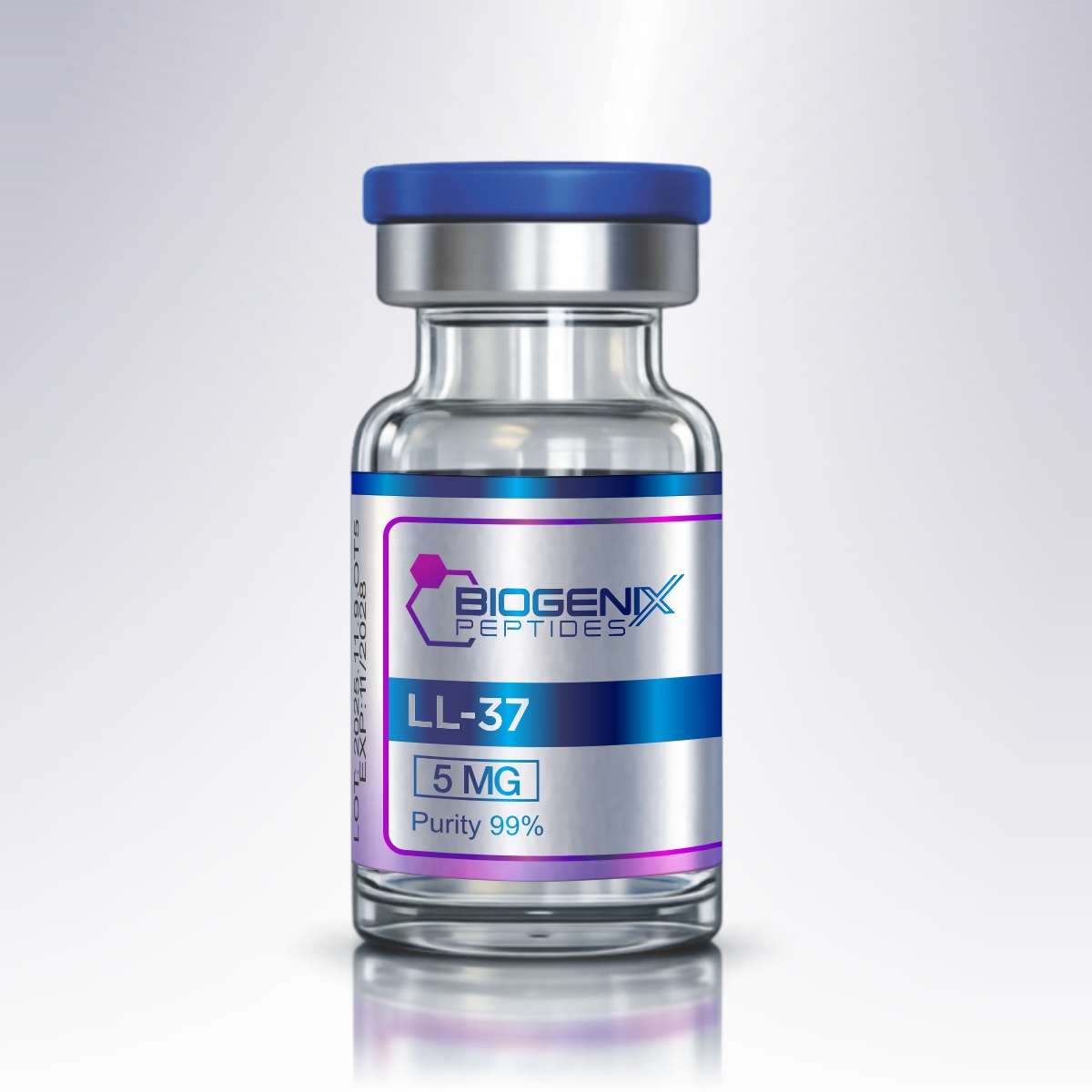
LL-37 5mg
$48.00
LL-37 is a naturally occurring peptide that plays an important role in the body’s first line of defense. It is part of the innate immune system and is studied for its ability to help protect the body from bacteria, support healthy inflammation balance, and assist in tissue repair.
In research settings, LL-37 has been shown to interact with harmful microbes, help maintain the strength of the skin and gut barriers, and support the body’s natural healing processes. Studies also explore its potential role in calming irritation, promoting wound recovery, and helping the immune system respond more effectively during stress or injury.
Because LL-37 can influence both immune activity and tissue repair, it is often used as a research tool to better understand how the body protects itself and restores damaged or irritated tissues.
In Stock
LL-37 — Overview & Chemical Characteristics
LL-37 is a 37–amino-acid cationic antimicrobial peptide (AMP) belonging to the human cathelicidin family and encoded by the CAMP gene. It is produced as part of the innate immune system and plays a central role in host defense, immune signaling, tissue repair, and the regulation of inflammation. LL-37 is the only known cathelicidin in humans, making it a uniquely important molecule in epithelial and immune protection.
LL-37 is generated from its precursor hCAP18, a pro-peptide stored in neutrophil granules and produced by various epithelial and immune cells. During infection or tissue injury, hCAP18 is cleaved to release the active LL-37 fragment, which rapidly interacts with pathogens, host cell membranes, and immune receptors, exhibiting a wide spectrum of biological activities.
Chemical Identity
- CAS Number: 154947-66-7
- Peptide Length: 37 amino acids
- Molecular Formula: C205H340N60O53
- Molecular Weight: 4493.342 g/mol
- Peptide Class: Antimicrobial peptide (AMP) / human cathelicidin
Structural & Mechanistic Characteristics
Amphipathic α-Helix
LL-37 adopts a long, flexible amphipathic α-helical structure in membrane-like environments. This arrangement presents hydrophobic residues on one face and positively charged residues on the other, allowing the peptide to:
- Insert into microbial lipid bilayers.
- Disrupt membrane organization and integrity.
- Form transient pores or destabilizing curvature in microbial membranes.
These properties underpin LL-37’s broad-spectrum antimicrobial capabilities.
Cationic Charge & Selective Targeting
LL-37 carries a strong net positive charge, which promotes electrostatic attraction to negatively charged components of microbial surfaces such as lipopolysaccharide (LPS) in Gram-negative bacteria and teichoic acids
in Gram-positive organisms. Mammalian cell membranes are comparatively less anionic, which contributes to LL-37’s preferential binding to microbial targets.
Immune Receptor Interactions
In addition to its direct antimicrobial actions, LL-37 functions as an immunomodulatory peptide through interactions with multiple host receptors, including:
- FPR2 (formyl peptide receptor 2): mediates chemotaxis and leukocyte activation.
- P2X7 receptor: contributes to inflammasome and cytokine regulation.
- EGFR transactivation: supports epithelial proliferation and wound repair.
- Toll-like receptors (e.g., TLR4, TLR9): modulates responses to microbial nucleic acids and LPS.
Through these pathways, LL-37 acts as a bridge between innate immunity, inflammation control, and tissue healing.
Primary Biological Functions (Research Context)
Broad-Spectrum Antimicrobial Activity
LL-37 has been shown to exhibit activity against a wide array of microorganisms, including:
- Gram-negative bacteria (e.g., Escherichia coli, Pseudomonas aeruginosa).
- Gram-positive bacteria (e.g., Staphylococcus aureus).
- Fungi such as Candida species.
- Certain enveloped viruses.
Mechanisms include membrane disruption, interference with intracellular targets, and binding/neutralization of bacterial endotoxins such as LPS, which can blunt excessive inflammatory responses.
Immune Modulation & Inflammation Control
LL-37 is also recognized as a powerful immunomodulator. In experimental systems it can:
- Regulate production of pro- and anti-inflammatory cytokines.
- Promote chemotaxis of neutrophils, monocytes, T cells, and other leukocytes.
- Influence dendritic cell maturation and antigen presentation.
- Attenuate LPS-driven inflammatory signaling by directly binding endotoxin.
These activities help maintain a balanced immune response, supporting pathogen clearance while limiting collateral tissue damage.
Wound Healing & Tissue Regeneration
LL-37 contributes to tissue repair processes across skin and mucosal surfaces. Research indicates that it:
- Stimulates epithelial cell migration and proliferation via EGFR-linked signaling.
- Promotes angiogenesis, partly through up-regulation of VEGF.
- Enhances fibroblast activity and extracellular matrix remodeling.
- Accelerates re-epithelialization and wound closure in cutaneous injury models.
Taken together, these effects position LL-37 as a key peptide in models of wound healing and regenerative biology.
Gut Barrier & Mucosal Protection
LL-37 is expressed at various mucosal surfaces, including the gastrointestinal tract, where it:
- Supports the integrity of epithelial tight junctions.
- Helps regulate interactions between the host and the gut microbiota.
- Modulates inflammatory responses during bacterial challenge or barrier disruption.
These properties make LL-37 an important tool in research on inflammatory bowel conditions, epithelial permeability, and mucosal immunity.
Representative Research Applications
In controlled experimental settings, LL-37 is commonly used to explore:
- Host–pathogen interactions – mechanisms of innate defense against bacteria, fungi, and viruses.
- Chronic inflammation and immune dysregulation – including models of colitis, dermatitis, chronic wounds, and airway inflammation.
- Skin health and dermatology – roles in acne, rosacea, psoriasis, and cutaneous barrier function.
- Tissue regeneration and repair – epithelial migration, angiogenesis, and matrix remodeling.
- Gut barrier and microbiome research – epithelial defense, permeability, and host–microbe balance.
- Biofilm formation and disruption – LL-37’s effects on microbial biofilms and surface colonization.
Selected Supporting Studies
- Studies describing LL-37 as a multifunctional host-defense peptide with antimicrobial and immunomodulatory roles.
- Work demonstrating LL-37’s involvement in skin immunity, wound healing, and epithelial repair mechanisms.
- Investigations of LL-37’s impact on gut barrier integrity and inflammatory responses in intestinal models.
- Research examining LL-37’s role in airway and lung defense against respiratory pathogens.
- Biofilm-focused studies exploring LL-37’s ability to prevent or disrupt microbial biofilm formation.
NOTICE OF COMPLIANCE
The mission of BioGenix Peptides™ is to provide researchers with the highest-quality, Ultra-Pure Series™ compounds to help unlock the full potential of this evolving field. With precision, purity, and scientific integrity at the core of our operations, BioGenix Peptides™ is dedicated to supporting responsible exploration and discovery.
Products from BioGenix Peptides™ are not intended for human consumption. They are supplied exclusively for in-vitro and pre-clinical research purposes.
By purchasing or using these products, the Customer accepts full responsibility for their handling and use, and agrees to indemnify and hold BioGenix Peptides™ harmless from any claims resulting from misuse.
CONTINUE RESEARCH
Having trouble viewing? Use the buttons below to download or open the certificate.

In Stock