
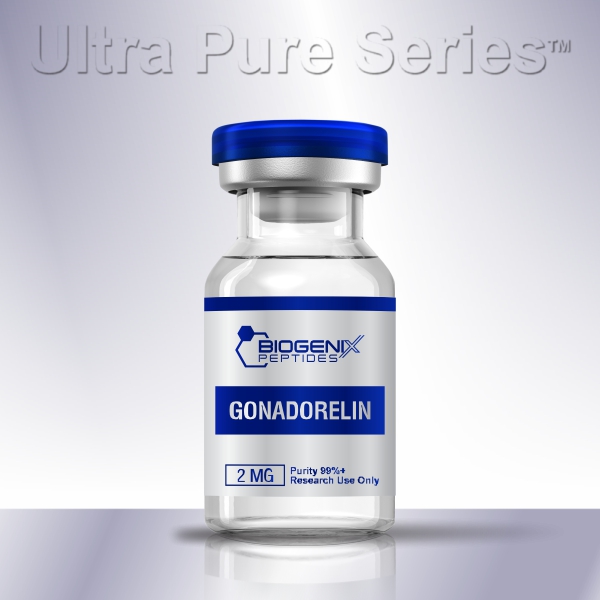
GONADORELIN 2mg
$23.00
Gonadorelin is a synthetic decapeptide that mimics the natural gonadotropin-releasing hormone (GnRH) secreted by the hypothalamus. This peptide is composed of ten amino acids and has been widely studied for its potential role in regulating reproductive hormone secretion. Specifically, Gonadorelin acts on the pituitary gland to stimulate the release of luteinizing hormone (LH) and follicle-stimulating hormone (FSH).
Out of stock
Gonadorelin Peptide
Gonadorelin is a synthetic decapeptide that mimics the natural gonadotropin-releasing hormone (GnRH) secreted by the hypothalamus. This peptide is composed of ten amino acids and has been widely studied for its potential role in regulating reproductive hormone secretion. Specifically, Gonadorelin acts on the pituitary gland to stimulate the release of luteinizing hormone (LH) and follicle-stimulating hormone (FSH).
Overview
Gonadorelin is considered the simplest active form of natural GnRH, designed to bind with GnRH receptors on the anterior pituitary cells. By activating these receptors, Gonadorelin may stimulate the synthesis and release of LH and FSH, which are crucial for reproductive function. Research has suggested potential uses in exploring fertility regulation, ovarian and testicular function, and endocrine system modulation.
Chemical Characteristics
| Compound | Type | Molecular Formula | Molecular Weight |
| Gonadorelin | Synthetic gonadotropin-releasing hormone (GnRH) analogue (decapeptide) | C₅₅H₇₅N₁₇O₁₃ | 1182.311 g/mol |
Other Known Titles: Luteinizing Hormone-Releasing Hormone (LHRH), GnRH, Decapeptide Gonadorelin
Research and Clinical Studies
Gonadorelin and LH/FSH Secretion
Research suggests that Gonadorelin may induce a rapid release of LH and FSH in experimental models. These two gonadotropins are critical for stimulating gonadal steroidogenesis and gametogenesis. Short-term studies suggest an immediate increase in LH and FSH levels following Gonadorelin exposure.
Gonadorelin and Reproductive Function
Animal studies have examined Gonadorelin’s effects on reproductive tissues, showing potential roles in triggering ovulation, supporting spermatogenesis, and regulating reproductive hormone balance. It has also been investigated for its role in diagnosing hypothalamic-pituitary-gonadal axis function.
Gonadorelin and Endocrine Research
Beyond fertility studies, Gonadorelin has been explored for its role in endocrine-related conditions. Its controlled release of gonadotropins makes it valuable for evaluating pituitary responsiveness and understanding hormone feedback loops in the hypothalamic-pituitary-gonadal axis.
Lyophilized Peptide Form
Gonadorelin is typically supplied as a lyophilized powder to preserve stability and purity. It should be reconstituted with bacteriostatic water or sterile diluent before laboratory use. Storage at -20 °C is recommended to maintain peptide integrity.
Gonadorelin (GnRH) — References
- Matsuo, H., Baba, Y., Nair, R. M. G., Arimura, A., Schally, A. V. Structure of the porcine LH- and FSH-releasing hormone. I. The proposed amino acid sequence. Biochemical and Biophysical Research Communications. 1971;43(6):1334–1339. https://doi.org/10.1016/S0006-291X(71)80019-0
- Baba, Y., Matsuo, H., Schally, A. V. Structure of the porcine LH- and FSH-releasing hormone. II. Confirmation of the proposed structure by conventional sequential analyses. Biochemical and Biophysical Research Communications. 1971;44(2):459–463. https://doi.org/10.1016/S0006-291X(71)80067-0
- Schally, A. V., Arimura, A., Kastin, A. J., Matsuo, H., Baba, Y., Redding, T. W., Nair, R. M. G., Debeljuk, L., White, W. F. Gonadotropin-releasing hormone: one polypeptide regulates secretion of luteinizing and follicle-stimulating hormones. Science. 1971;173(4001):1036–1038. https://doi.org/10.1126/science.173.4001.1036
- Guillemin, R., Jutisz, M., Sakiz, E., Schally, A. V. Secretion of LH and FSH by anterior pituitary tissue in response to purified hypothalamic LH-releasing factor. Endocrinology. 1962;70(6):948–963. https://doi.org/10.1210/endo-70-6-948
- Wildt, L., Häusler, A., Marshall, G., Hutchison, J. S., Plant, T. M., Belchetz, P. E., Knobil, E. Frequency and amplitude of gonadotropin-releasing hormone stimulation and gonadotropin secretion in the rhesus monkey. Endocrinology. 1981;109(2):376–385. https://doi.org/10.1210/endo-109-2-376
- Crowley, W. F., Filicori, M., Spratt, D. I., Santoro, N. F. The physiology of gonadotropin-releasing hormone (GnRH) secretion in men and women. Recent Progress in Hormone Research. 1985;41:473–531. https://doi.org/10.1016/b978-0-12-571141-8.50018-8
- Filicori, M., Butler, J. P., Crowley, W. F. Neuroendocrine regulation of the corpus luteum in the human. Evidence for pulsatile progesterone secretion. Journal of Clinical Investigation. 1984;73(6):1638–1647. https://doi.org/10.1172/JCI111374
- Marshall, J. C., Kelch, R. P. Gonadotropin-releasing hormone: role of pulsatile secretion in the regulation of reproduction. New England Journal of Medicine. 1986;315(23):1459–1468. https://doi.org/10.1056/NEJM198612043152307
- Barkan, A. L., Reame, N. E., Kelch, R. P., Marshall, J. C. Pulsatile secretion of luteinizing hormone in men: evidence for dual regulation by gonadotropin-releasing hormone and gonadal steroids. Journal of Clinical Investigation. 1985;75(3):763–770. https://doi.org/10.1172/JCI111767
- Layman, L. C. Clinical applications of gonadotropin-releasing hormone and its analogues. Endocrinology and Metabolism Clinics of North America. 1992;21(4):857–883. https://doi.org/10.1016/S0889-8529(18)30222-7
- Conn, P. M., Crowley, W. F. Gonadotropin-releasing hormone and its analogues. New England Journal of Medicine. 1991;324(2):93–103. https://doi.org/10.1056/NEJM199101103240205
- Hall, J. E., Whitcomb, R. W., Rivier, J., Vale, W., Crowley, W. F. Differential regulation of luteinizing hormone, follicle-stimulating hormone, and free alpha-subunit secretion from the gonadotrope by gonadotropin-releasing hormone frequency in humans. Journal of Clinical Endocrinology & Metabolism. 1990;71(4):948–955. https://doi.org/10.1210/jcem-71-4-948
NOTICE OF COMPLIANCE
The mission of BioGenix Peptides™ is to provide researchers with the highest-quality, Ultra-Pure Series™ compounds to help unlock the full potential of this evolving field. With precision, purity, and scientific integrity at the core of our operations, BioGenix Peptides™ is dedicated to supporting responsible exploration and discovery
Products from BioGenix Peptides™ are not intended for human consumption. They are supplied exclusively for in-vitro and pre-clinical research purposes.
By purchasing or using these products, the Customer accepts full responsibility for their handling and use, and agrees to indemnify and hold BioGenix Peptides™ harmless from any claims resulting from misuse.
No certificate available for this product.
Related products

Out of stock