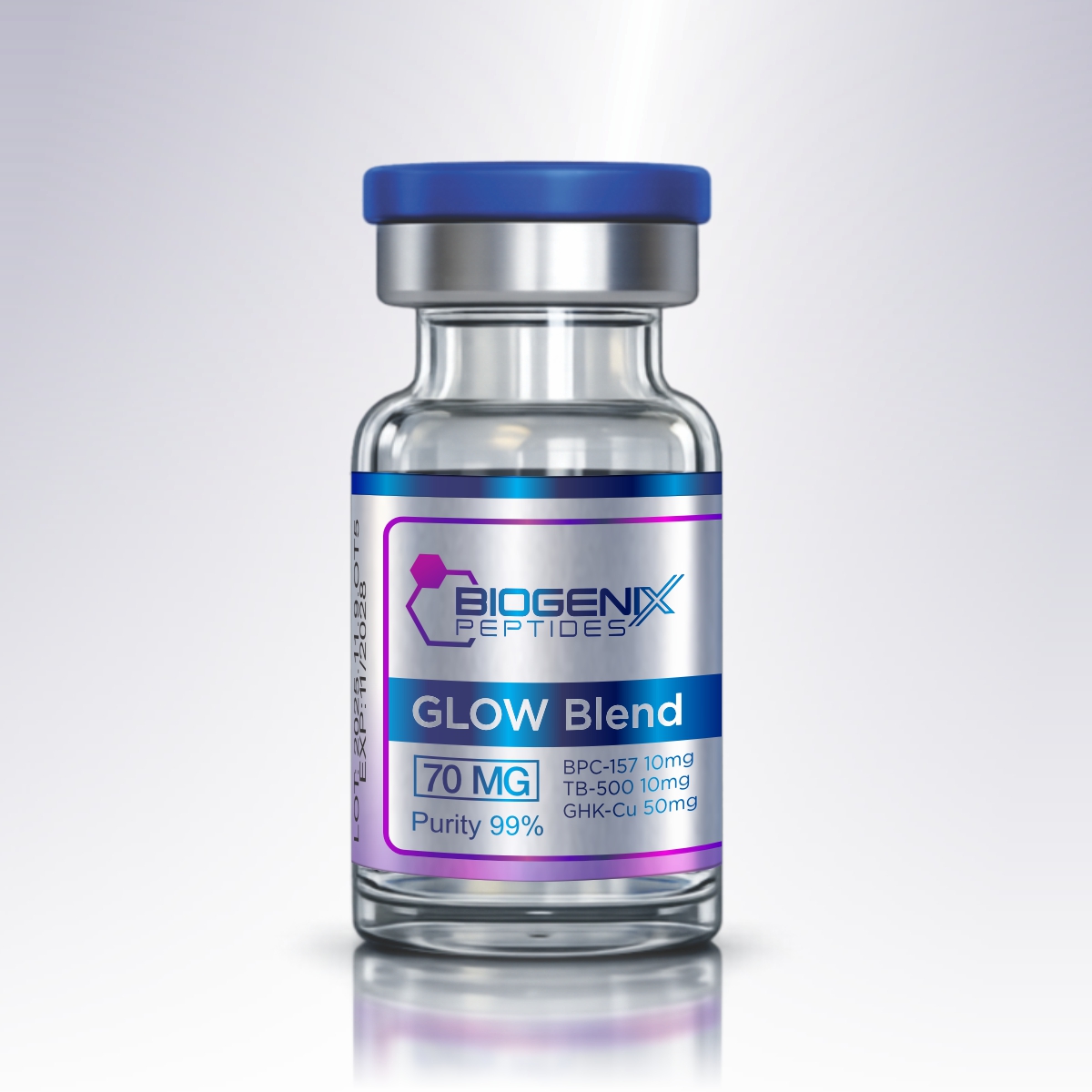
GLOW 70mg Blend
$160.00
This multi-peptide preparation unites three widely researched regenerative peptides into a single vial for investigations that probe complementary pathways of tissue repair and remodeling.- GHK-Cu is best known for up-regulating wound-healing genes and driving collagen, elastin, and angiogenic growth-factor expression.- BPC-157 exhibits gastro-protective, tendon-/ligament-healing, and anti-inflammatory actions through modulation of nitric-oxide signaling, growth-factor receptors, and cytokine balance.- TB-500 enhances cell migration and angiogenesis primarily via actin‐sequestering and integrin-linked pathways.When combined, researchers can examine potential synergy across copper-mediated extracellular-matrix activation (GHK-Cu), cytoprotective/anti-inflammatory signaling (BPC-157), and actin-dependent cell-motility mechanisms (TB-500).This preparation is provided as a 70 mg lyophilized blend containing 50 mg GHK-Cu, 10 mg BPC-157, and 10 mg TB-500 per vial.
In Stock
BPC-157 + TB-500 + GHK-Cu Peptide Blend
Description
This multi-peptide preparation unites three widely researched regenerative peptides into a single vial for investigations that probe complementary pathways of tissue repair and remodeling.- GHK-Cu is best known for up-regulating wound-healing genes and driving collagen, elastin, and angiogenic growth-factor expression.- BPC-157 exhibits gastro-protective, tendon-/ligament-healing, and anti-inflammatory actions through modulation of nitric-oxide signaling, growth-factor receptors, and cytokine balance.- TB-500 enhances cell migration and angiogenesis primarily via actin‐sequestering and integrin-linked pathways.When combined, researchers can examine potential synergy across copper-mediated extracellular-matrix activation (GHK-Cu), cytoprotective/anti-inflammatory signaling (BPC-157), and actin-dependent cell-motility mechanisms (TB-500).This preparation is provided as a 70 mg lyophilized blend containing 50 mg GHK-Cu, 10 mg BPC-157, and 10 mg TB-500 per vial.
Overview of Mechanisms
– GHK-Cu: May promote wound healing by activating genes related to tissue remodeling, angiogenesis, and ECM (extracellular matrix) support.- BPC-157: Suggested to modulate NO pathways and inflammatory cytokines, supporting tendon, ligament, and gastric tissue repair.- TB-500: Believed to regulate actin-binding proteins, stimulating cellular motility and angiogenesis, potentially accelerating recovery from soft-tissue damage.- Combination Potential: By merging ECM activation, anti-inflammatory protection, and cell migration mechanisms, this blend may provide overlapping regenerative effects in experimental models.
Chemical Characteristics
| Compound | Type | Molecular Formula | Molecular Weight |
| BPC-157 / TB-500 / GHK-Cu Blend | Synthetic peptide + copper peptide blend (BPC-157 + Thymosin β4 fragment + GHK-Cu) | C₆₂H₉₈N₁₆O₂₂ + C₂₁₂H₃₅₀N₅₆O₇₈S + C₁₄H₂₄CuN₆O₄ | ~6000 g/mol (combined) |
Lyophilized Peptides
All three peptides are supplied in a freeze-dried, filler-free state to maximize stability and preserve chemical integrity during refrigerated or frozen storage. Reconstitute with sterile solvent immediately prior to experimental use and store aliquots at ≤ –20 °C to prevent repeated freeze–thaw cycles.
Research and Clinical Studies
Although there are limited published studies on the triple blend, each peptide has been independently researched for tissue repair:- GHK-Cu: Reported to upregulate collagen synthesis, angiogenesis, and wound-healing gene expression.- BPC-157: Shown in experimental models to protect gastric mucosa, accelerate tendon-to-bone healing, and mitigate inflammatory markers.- TB-500: Suggested to stimulate actin-dependent cell migration, angiogenesis, and recovery in tissue injury models. Collectively, the combination offers a research platform for examining overlapping regenerative pathways such as collagen deposition, vascularization, and recovery timelines post-injury.
Having trouble viewing? Use the buttons below to download or open the certificate.
Related products

In Stock