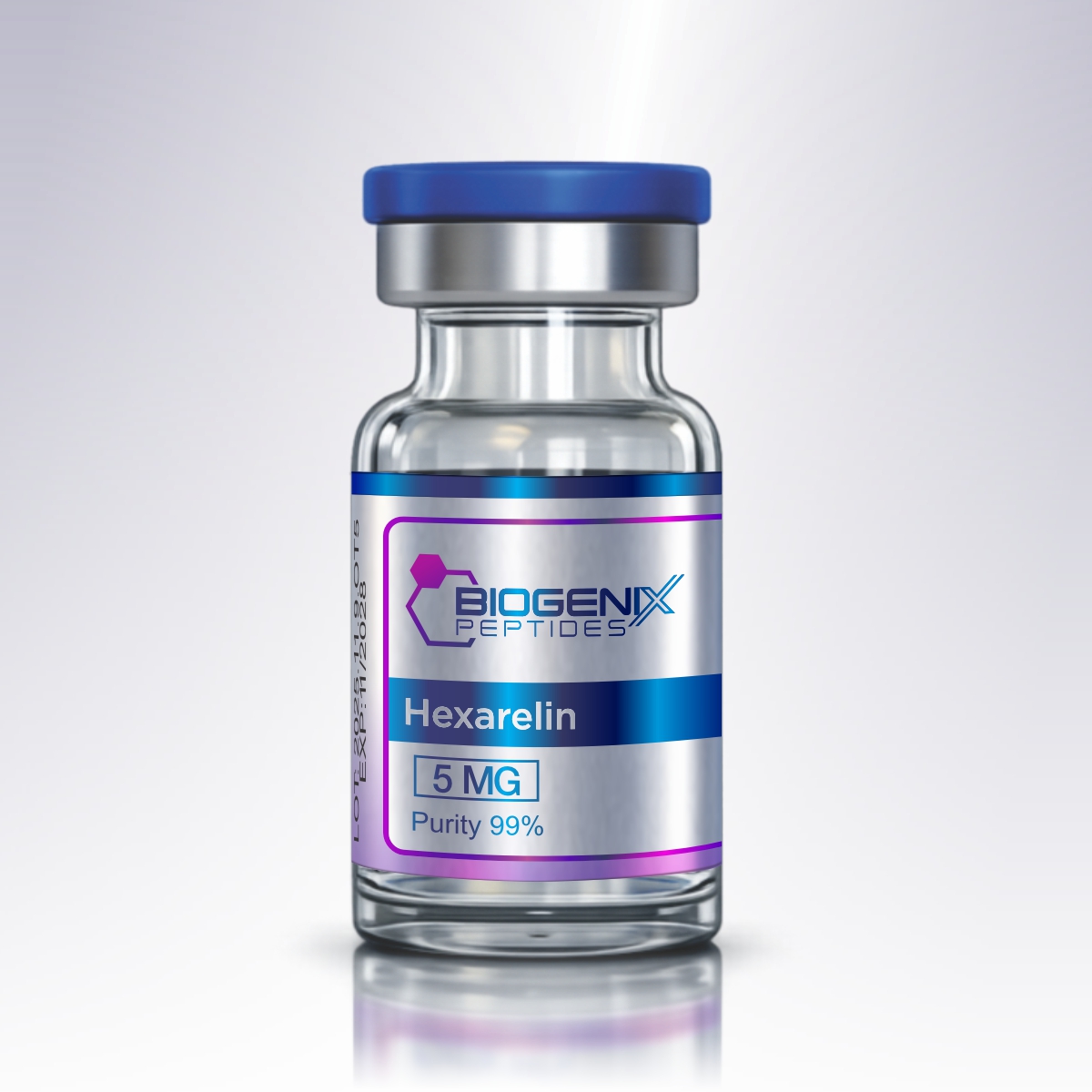
Hexarelin 5mg
$42.00
Hexarelin is a small synthetic peptide in the growth hormone–releasing peptide (GHRP) family. It is commonly studied for its ability to help the body release more growth hormone, which plays an important role in muscle repair, recovery, and overall metabolic function.
Researchers often use Hexarelin to explore how growth hormone affects muscle tissue, strength, and regeneration. It is also studied for its potential protective effects on the heart, especially in models involving stress or reduced blood flow. Some studies suggest that Hexarelin may support healthy heart function by interacting with specific receptors involved in energy use.
Hexarelin is also of interest in research on bone health and metabolic balance. Because it acts on the same receptor as the natural hormone ghrelin, it may influence appetite, energy use, and the way the body processes fats and carbohydrates.
Overall, Hexarelin is explored as a tool for understanding growth hormone activity, tissue repair, cardiovascular support, and metabolic wellness in controlled research settings.
In Stock
Hexarelin — Overview & Chemical Characteristics
Hexarelin (also known as Examorelin) is a synthetic hexapeptide belonging to the growth hormone–releasing peptide (GHRP) family. It is designed to bind and activate the growth hormone secretagogue receptor (GHS-R1a), the same receptor that responds to the endogenous hormone ghrelin. In research settings, Hexarelin has been widely studied for its ability to stimulate growth hormone (GH) release, support anabolic pathways, and influence metabolic and endocrine functions under controlled experimental conditions.
Hexarelin is notable for its high GH-releasing potency and enhanced resistance to enzymatic degradation, giving it greater stability than many earlier GHRPs. These characteristics make it a useful tool for investigating growth hormone dynamics, tissue repair mechanisms, and cardiometabolic pathways.
Chemical Identity
- CAS Number: 140703-51-1
- Molecular Formula: C47H58N12O6
- Molecular Weight: 887.059 g/mol
- Peptide Length: 6 amino acids (hexapeptide)
- Peptide Class: Growth Hormone Secretagogue (GHS) / GHRP family
Structural Characteristics
Hexarelin incorporates several synthetic and D-amino-acid residues that enhance its binding affinity and metabolic stability compared with earlier GHRPs such as GHRP-6 or GHRP-2. These modifications help protect the peptide from rapid enzymatic breakdown and support a more sustained pharmacodynamic profile in experimental models.
- Contains non-natural amino acids that improve receptor specificity and potency.
- Displays high affinity for the GHS-R1a receptor, enhancing GH pulse amplitude and frequency.
- Shows greater resistance to proteolytic degradation than many first-generation secretagogues.
- Frequently reported as more potent than GHRP-6 or GHRP-2 in head-to-head GH release studies.
Mechanism of Action (Research Context)
Hexarelin primarily acts via the growth hormone secretagogue receptor type 1a (GHS-R1a), a G protein–coupled receptor distributed in the pituitary, hypothalamus, and peripheral tissues.
- GHS-R1a activation: Binding of Hexarelin to GHS-R1a stimulates Gq/G11
and Gs-linked signaling, leading to increased intracellular calcium and cAMP, and ultimately
promoting GH release from pituitary somatotrophs. - Synergy with GHRH: Hexarelin can show additive or synergistic effects with growth
hormone–releasing hormone (GHRH) in some experimental paradigms, augmenting GH pulse amplitude. - Peripheral ghrelin-pathway actions: Through ghrelin-receptor engagement, Hexarelin
may influence appetite regulation, energy balance, and lipid metabolism in research models. - Cardiac receptor interactions: Studies suggest that Hexarelin may interact with
CD36 and related receptors in cardiac tissue, contributing to cardioprotective signaling.
Potential Research Applications
Researchers study Hexarelin across several experimental domains related to growth hormone biology, tissue repair, cardiovascular function, and metabolism.
Growth Hormone Stimulation
Hexarelin is one of the most potent synthetic GH secretagogues in the GHRP class. Research has shown that it:
- Produces robust, pulsatile increases in growth hormone via pituitary GHS-R1a activation.
- Can lead to downstream increases in insulin-like growth factor-1 (IGF-1) in experimental systems.
- Often elicits greater GH release than GHRP-6 or GHRP-2 at comparable doses.
Because of this strong GH-releasing profile, Hexarelin is commonly used to investigate pituitary responsiveness, GH secretory patterns, and endocrine feedback mechanisms in controlled studies.
Muscle and Tissue Repair Models
Growth hormone and IGF-1 are key regulators of protein synthesis and tissue remodeling. In this context, Hexarelin has been used in models examining:
- Skeletal muscle recovery following mechanical overload, immobilization, or metabolic stress.
- Collagen turnover and connective-tissue repair.
- Regeneration kinetics after experimental muscle or tendon injury.
Its combination of high GH-stimulating potency and stability makes Hexarelin a useful tool for probing anabolic and reparative signaling pathways in vitro and in vivo.
Cardiac Protective Pathways (Ischemia–Reperfusion Models)
One of the most distinctive research areas for Hexarelin is cardioprotection. Preclinical data suggest that it:
- May reduce apoptosis and cell death in cardiac tissue subjected to ischemia–reperfusion injury.
- Can improve left ventricular function and contractility in certain heart-damage models.
- Interacts with CD36 and related receptors, which are involved in myocardial lipid handling and
cardioprotective responses. - May enhance recovery and limit structural damage following reperfusion stress.
These findings have positioned Hexarelin as a valuable research compound in experimental cardiology and myocardial-protection studies.
Bone Density and Skeletal Research
Due to its GH and IGF-1–linked activity, Hexarelin has been explored in studies of skeletal health, including:
- Osteoblast function and bone-formation pathways.
- Bone mineral density changes in models of age-related or hormone-related bone loss.
- Bone remodeling dynamics and fracture-healing kinetics.
These investigations use Hexarelin as a tool to better understand how GH secretagogues may influence skeletal integrity and remodeling under controlled conditions.
Metabolic Health and Energy Regulation
Because Hexarelin targets the ghrelin receptor system, researchers also examine its roles in:
- Glucose metabolism and insulin sensitivity.
- Lipid utilization and fat-oxidation pathways.
- Appetite-regulating and energy-balance circuits.
Its dual influence on GH release and ghrelin pathways makes Hexarelin a useful experimental compound for dissecting endocrine–metabolic interactions.
Endocrine Axis Interactions (Exploratory)
Some exploratory work has investigated whether Hexarelin can influence cross-talk among multiple hormonal axes, including:
- Hypothalamic–pituitary–adrenal (HPA) signaling.
- Thyroid-related metabolic pathways.
- Gonadal hormone regulation through broader hypothalamic–pituitary–gonadal (HPG) axis effects.
While these are not primary indications, they highlight the broader interest in Hexarelin as a probe for complex endocrine networks.
Representative Studies (Selected)
- Bowers CY et al. – Foundational characterization of growth hormone–releasing peptides and their
receptor interactions. - Broglio F et al. – Clinical and preclinical analyses of GH release and endocrine actions of Hexarelin.
- Sun Q et al. – Investigations into cardioprotective effects of Hexarelin in ischemia–reperfusion models.
- Deghenghi R et al. – Comparative potency data for Hexarelin vs. GHRP-6 and other secretagogues.
For research use only. Not for human consumption.
Having trouble viewing? Use the buttons below to download or open the certificate.
Related products

In Stock